Best Criminal Justice Schools in Kansas
Compare 16 accredited Criminal Justice programs in Kansas, with net price after aid, graduation rates, earnings and debt from IPEDS and the U.S. College Scorecard.

What does a bachelor's degree in criminal justice add in a state where officers can be certified without one? In Kansas, the Kansas Commission on Peace Officers' Standards and Training sets certification minimums that do not require a degree, so the credential matters most for competitive agencies, federal and probation roles, and promotion.
The standard credential is the Bachelor of Science (B.S.) in Criminal Justice, though some schools here award a Bachelor of Arts or a concentration-based major instead. The programs ranked here run at Kansas schools, on campus and online, and are ordered by Scorecard outcomes, cost and completions.
The real tension is price against payoff: a private college with higher sticker tuition can undercut a public university after aid, while pay varies widely by agency and county.
Key Points
- Emporia State University ranks first with its Applied Criminology major.
- The University of Kansas leads with a 68.8% school-wide graduation rate.
- Kansas officers need CPOST certification; a bachelor's degree isn't required.
Best Criminal Justice Schools in Kansas: Our Top 10 Ranked
Emporia State University takes the top spot on this list, built around an Applied Criminology major that lets students shape a concentration toward corrections, forensic science, victimology or graduate study. Every school below awards a bachelor's degree in criminal justice or a closely named equivalent, and together they cover public flagships, regional universities and private colleges, including several that can be finished partly or entirely online. Tuition, net price and graduation rate figures shown with each entry are school-wide and approximate, not results for the criminal justice program alone.
Emporia State University
#1Emporia, KS · ~$16,000/yr (est.)
Best for: Concentration-seekers in applied criminology
Emporia State University is a public regional university in Emporia where criminal justice is taught as an Applied Criminology major rather than a standard criminal justice track. Students choose a concentration such as correctional services, forensic science, victimology or preparation for law school and graduate study, and the coursework centers on ethics, system structures and advocacy. Every new student is enrolled in the Stinger Success Program, and scholarships are open to all students through the university's scholarship portal.
- Concentration options span corrections, forensic science and victimology
- Coursework in ethics, systemic structures and advocacy
- Emphasis on critical thinking and community change
- Prepares students for law school and forensic science study
- Graduates work as officers, victim advocates, lawyers and investigators
- New students automatically join the Stinger Success Program
- Scholarships available to all students through the Scholarship Portal
- Based at the Emporia, Kansas campus
Washburn University
#2Topeka, KS · ~$15,000/yr (est.)
Best for: Topeka students blending policing and forensics
Washburn University in Topeka awards a stand-alone Bachelor of Criminal Justice through its Criminal Justice and Legal Studies department, so students assemble the degree from any mix of criminal justice coursework rather than a fixed sequence. Four emphases are offered, and the forensic emphasis splits into investigative and investigative-science pathways. Undergraduates can intern, join the Criminal Justice Association, add a legal studies certificate or criminal justice minor to any major, and learn from faculty and staff who have worked in the field.
- Four emphases: corrections, law enforcement, security, forensics
- General BCJ lets students mix law enforcement and forensic courses
- Forensic emphasis splits into investigation and investigative sciences
- Undergraduate internship opportunities available
- Faculty and staff have worked in the field
- Legal studies certificate can be added to any major
- Criminal Justice Association student group on campus
- Fast-track pathway into the department's graduate program
University of Kansas
#3Lawrence, KS · $12,000 – $30,000/yr (est.)
Best for: Working adults seeking a fully online flagship
The University of Kansas is the state's flagship research university in Lawrence, and its Bachelor of Science in Criminal Justice is housed in the School of Professional Studies. The 120-credit degree pairs a broad KU Core with seven core courses on policing, courts, sentencing and research methods, a 12-credit concentration and a capstone. Students can study in person at Lawrence or complete the entire degree online, and graduates leave with a curriculum that reaches into victim advocacy, restorative justice and federal agency work.
- 120 total credit hours, including a 34-35 credit KU Core
- Seven core courses cover policing, courts, sentencing and research methods
- Seven concentrations, from crime scene investigation to global crime
- 12-credit concentration plus 9 upper-division elective credits
- CRIM 499 capstone required for graduation
- Available in person at Lawrence or fully online
- Graduation requires a 2.0 KU GPA and 45 junior/senior hours
- C or better required in all core, concentration and capstone courses
Pittsburg State University
#4Pittsburg, KS · $16,000/yr (est. net price)
Pittsburg State University is a public regional university in southeast Kansas offering a criminal justice major that blends sociology, criminal law, forensic science and psychology. Students take part in simulated exercises and fieldwork, and the program partners with local law enforcement agencies, nonprofits and legal organizations. Professors have worked in criminal justice themselves, and graduates move into policing, probation and parole, prosecution and defense, intelligence analysis, victim advocacy and crime scene work.
- Coursework in sociology, criminal law, forensic science and psychology
- Simulated activities and fieldwork built into the major
- Partners with local law enforcement agencies, nonprofits and legal organizations
- Professors who have worked in criminal justice careers
- Prepares students for police, detective and probation officer roles
- Also maps to homeland security and intelligence analyst work
- Career paths include prosecution, defense and victim advocacy
- Scholarships and financial assistance available
Wichita State University
#5Wichita, KS · ~$13,000/yr (est.)
Wichita State University's School of Criminal Justice awards a Bachelor of Science in Criminal Justice with separate on-campus and online tracks, and describes itself as one of the oldest criminal justice programs in the country. Two concentrations, Courts and Law and Criminal Intelligence, sit alongside the general degree, and an undergraduate certificate in crime scene investigation is also offered. The Criminal Justice Student Association runs guest speaker, tour and career-focused events throughout the year.
- On-campus track and a fully online track
- Two concentrations: Courts and Law, Criminal Intelligence
- Courts and Law covers criminal law, court systems, evidence and victims
- Criminal Intelligence covers digital investigations and crime analytics
- Coursework in law enforcement, courts, corrections, ethics and policy
- Undergraduate certificate in crime scene investigation available
- Student association runs guest speaker and career events
- Describes itself as one of the oldest criminal justice programs
Fort Hays State University
#6Hays, KS · ~$13,000/yr (est.)
Fort Hays State University in western Kansas offers both a Bachelor of Arts and a Bachelor of Science in Criminal Justice across 120 credit hours, on campus or fully online. Core coursework runs through criminology, criminal law, procedure, law enforcement, corrections, juvenile justice and forensic science, with electives in cybercrime, terrorism and criminal justice administration. Students complete internships, field courses and research projects, and the campus hosts the National De-escalation Training Center.
- 120 total credit hours, on campus or fully online
- BA requires 10 foreign language credits; the BS does not
- Core covers criminology, criminal law, procedure, enforcement and corrections
- Electives include cybercrime, terrorism and criminal justice administration
- Internships, field courses and research projects required
- Criminal Justice Club meets weekly on campus
- Delta Tau Omega chapter of the American Criminal Justice Association
- Campus hosts the National De-escalation Training Center
MidAmerica Nazarene University
#7Olathe, KS · ~$32,000/yr (est.)
MidAmerica Nazarene University is a private Christian university in Olathe offering a Bachelor of Arts in Criminal Justice that integrates faith into the study of crime and justice. The 126-credit degree pairs a broad general education with focused major requirements, and seniors sit the ETS Major Field Test, on which the institutional mean has reached the 90th percentile. Faculty include law enforcement officers, crime scene investigators, district attorneys, legal scholars and community corrections officers.
- 126 total credit hours, including 30 to 33 in major requirements
- General education takes 42 to 50 credits
- Seniors take the ETS Major Field Test before graduating
- Institutional mean score has reached the 90th percentile
- Faculty include officers, crime scene investigators and district attorneys
- Faith integrated into the classroom
- Meets on-site at the Olathe campus
- Early action considered for juniors with a 3.75 cumulative GPA
Kansas Wesleyan University
#8Salina, KS · $20,000 – $25,000/yr (est.)
Kansas Wesleyan University is a private university in Salina offering a Bachelor of Arts in Criminal Justice that can be completed fully online, on campus or in a hybrid mix of the two. The curriculum emphasizes critical thinking, ethical decision-making, communication and technology skills, and is built around internships, fieldwork and partnerships with justice organizations. Graduates have gone on to become judges, city prosecutors, attorneys, investigators and police officers.
- Bachelor of Arts degree with fully online and hybrid options
- Curriculum reflects Academy of Criminal Justice Sciences standards
- Internships, fieldwork and partnerships with justice organizations
- Emphasis on ethics, communication and technology skills
- Prepares students for law school and graduate study
- Graduates have become judges, city prosecutors and attorneys
- Institution accredited by the Higher Learning Commission
Newman University
#9Wichita, KS · ~$20,000/yr (est.)
Newman University in Wichita runs a research and practice criminal justice program founded in 2005 that draws on science, social science, theology and allied health. Field trips, guest speakers and active learning are built into coursework covering law enforcement, courts and corrections, and the program is led by a licensed attorney and former prosecutor. Newman also maintains a statewide transfer pathway with Kansas community and technical colleges for students arriving with an associate degree.
- Research and practice program founded in 2005 by Dr. Jill Fort
- Coursework combines science, social science, theology and allied health
- Field trips, guest speakers and active learning built in
- Covers law enforcement, courts and corrections
- Led by a licensed attorney and former prosecutor
- Alumni work in local, state and federal agencies and courts
- Statewide transfer pathway with Kansas community colleges
- Up to 60 credits from an associate degree, plus prior learning credit
Sterling College
#10Sterling, KS · ~$22,000/yr (est.)
Sterling College is a small private Christian college in Sterling, Kansas, offering criminal justice as a major with Law Enforcement and Pre-Law concentrations. The stated objective is to prepare students to enter the law enforcement profession directly after graduation or to continue into law school or graduate study. The college also runs a separate Wildlife Law Enforcement program that pairs environmental science with the criminal justice system's role in protecting natural resources.
- Two concentrations: Law Enforcement and Pre-Law
- Prepares students to enter law enforcement directly after graduation
- Also designed as a path to law school or graduate study
- Separate Wildlife Law Enforcement program pairs environmental science
- Wildlife track covers the justice system's role in protecting natural resources
Cost & outcomes by school
Federal data for the highest-earning Criminal Justice programs, independent of the ranking above. Earnings are this field's bachelor's graduates four years after completing where the Scorecard reports them, else the school's undergraduate median.
| School | Net price / yr | Grad rate | Earnings | Debt | Grads/yr | Format |
|---|---|---|---|---|---|---|
| Central Christian College of Kansas KS | $11,404 | 27% | $74,997 | $31,250 | 15 | Online or campus |
| Southwestern College KS | $29,824 | 36% | $63,138 | $25,000 | 15 | Online |
| MidAmerica Nazarene University KS | $32,165 | 54% | $62,972 | $15,000 | 3 | Campus |
| University of Kansas KS | $18,059 | 69% | $61,945 | $21,000 | 3 | Online or campus |
| Rasmussen University-Kansas KS | $23,980 | 46% | $60,483 | $29,236 | — | Online |
| Friends University KS | $27,715 | 43% | $59,387 | $25,000 | 9 | Online or campus |
| Fort Hays State University KS | $12,569 | 48% | $55,790 | $23,362 | 51 | Online or campus |
| Newman University KS | $19,971 | 53% | $55,041 | $20,801 | 8 | Campus |
| Washburn University KS | $15,280 | 53% | $53,587 | $18,375 | 16 | Online or campus |
| Wichita State University KS | $13,194 | 51% | $51,305 | $22,382 | 71 | Online or campus |
| Kansas Wesleyan University KS | $22,671 | 49% | $51,152 | $19,938 | 15 | Online or campus |
| Pittsburg State University KS | $15,784 | 57% | $50,579 | $23,968 | 17 | Campus |
Sources: U.S. Department of Education. Net price, graduation rate, earnings and debt: College Scorecard (earnings and debt for this field's bachelor's graduates where reported, else school-wide); graduates: IPEDS. A dash means no figure is reported.
Cost, debt & payoff
Median earnings of this field's bachelor's graduates (4 yrs after completing, else the school's undergraduate median) vs. their median federal loan debt · U.S. College Scorecard
Across these programs the median graduate earns about $54,314 and finishes with roughly $23,306 in debt — a ratio that clears a common rule of thumb (keep debt below first-year salary). Net price and debt vary widely school to school, so check the per-school figures in the table above before you shortlist.
How We Ranked Kansas Criminal Justice Schools
The rankings rest on federal data rather than school marketing: College Scorecard outcomes, cost figures, and the number of criminal justice degrees each school awards. No school pays for placement, and no marketing claim affects the order.
What the Numbers Can and Can't Tell You
Graduation and net-price figures cover the whole institution. They describe the whole university, not the criminal justice major alone, so treat them as a read on the school's overall track record. Earnings windows also differ by school, because Scorecard measures graduates at different points after completion. Compare pay figures as rough signals, not exact side-by-side numbers.
Accreditation: What It Covers
Kansas public and private universities are regionally accredited by the Higher Learning Commission (HLC). Current HLC records show the University of Kansas as accredited1, and Kansas Wesleyan University has been continuously accredited since March 28, 1958.2 Central Christian College of Kansas is also listed as accredited.3
HLC accredits the institution, not the individual major. Criminal justice has no widely recognized programmatic accreditor for bachelor's degrees. The Academy of Criminal Justice Sciences (ACJS) publishes academic standards, but that is a professional framework, not accreditation equivalent to HLC. HLC's 2026 actions authorizing new Kansas Wesleyan criminal justice bachelor's offerings are program approvals, not specialized accreditation.4
How to Verify a School Yourself
- HLC directory: Search the school's name on the Higher Learning Commission website and confirm the status reads accredited and bachelor's degrees are listed.
- Federal database: Check the U.S. Department of Education's accreditation database for the same institution.
- Admissions office: Ask whether the criminal justice program holds any outside recognition, and what exactly it covers.
Most Affordable Bachelor's Programs in Criminal Justice in Kansas
Sticker tuition and what students actually pay are two different numbers. Average net price subtracts grants and scholarships from the full cost of attendance, so a private college with higher tuition can cost less than a public university. Sorted by average net price from 2024 IPEDS and College Scorecard data, these are the lowest-cost Kansas options for a bachelor's degree in criminal justice. Central Christian College of Kansas, from our directory, has the lowest net price at $11,404 despite $21,000 in tuition. Among the ranked schools, Fort Hays State University pairs the lowest in-state tuition, $5,923, with a $12,569 net price.
| School | City | Type | In-State Tuition and Fees | Out-of-State Tuition and Fees | Average Net Price After Aid | Program Format |
|---|---|---|---|---|---|---|
| Central Christian College of Kansas | McPherson | Private nonprofit | $21,000 | $21,000 | $11,404 | Campus and online |
| Fort Hays State University | Hays | Public | $5,923 | $17,741 | $12,569 | Campus and online |
| Wichita State University | Wichita | Public | $9,684 | $19,869 | $13,194 | Campus and online |
| Washburn University | Topeka | Public | $9,945 | $20,949 | $15,280 | Campus and online |
| Pittsburg State University | Pittsburg | Public | $8,400 | $19,744 | $15,784 | Campus |
Online and Hybrid Bachelor's Degrees in Criminal Justice at Kansas Schools
Kansas schools deliver their online criminal justice bachelor's degrees through universities that also teach on campus, so format is a scheduling decision, not a lesser credential.
Which Kansas schools teach online
The University of Kansas, Wichita State University, Fort Hays State University and Kansas Wesleyan University all publish a fully online option for the degree. Washburn University and Sterling College are listed with both formats, pairing their campus programs with online coursework; Kansas Wesleyan also advertises hybrid course schedules that mix the two. Emporia State University, Pittsburg State University, MidAmerica Nazarene University and Newman University describe their criminal justice degrees as campus-based programs, with MidAmerica Nazarene's cohort meeting on-site in Olathe.
Asynchronous or scheduled: match the format to your week
Online coursework generally runs in one of two modes. Asynchronous sections let you work through lectures and assignments on your own schedule inside weekly deadlines, which is what shift workers, patrol officers on rotating rosters, deployed military members and working parents usually need. Scheduled sections hold live sessions at set times, often in the evening, and suit students who want a cohort, steady pacing and a fixed weekly commitment.
Concentrations are worth checking before you commit. The University of Kansas lists seven concentration options and Wichita State lists two, while Sterling College lists two. Where a school publishes concentrations, confirm the track you want runs in the format you will actually use.
Accreditation and tuition before you enroll
Kansas Wesleyan University names its Higher Learning Commission accreditation on the program page. For any online program, verify the school's regional accreditor yourself before you apply, since federal aid and later graduate admission both depend on it. Online students are sometimes charged a different per-credit rate than campus students, so check the per-credit rate before you apply.
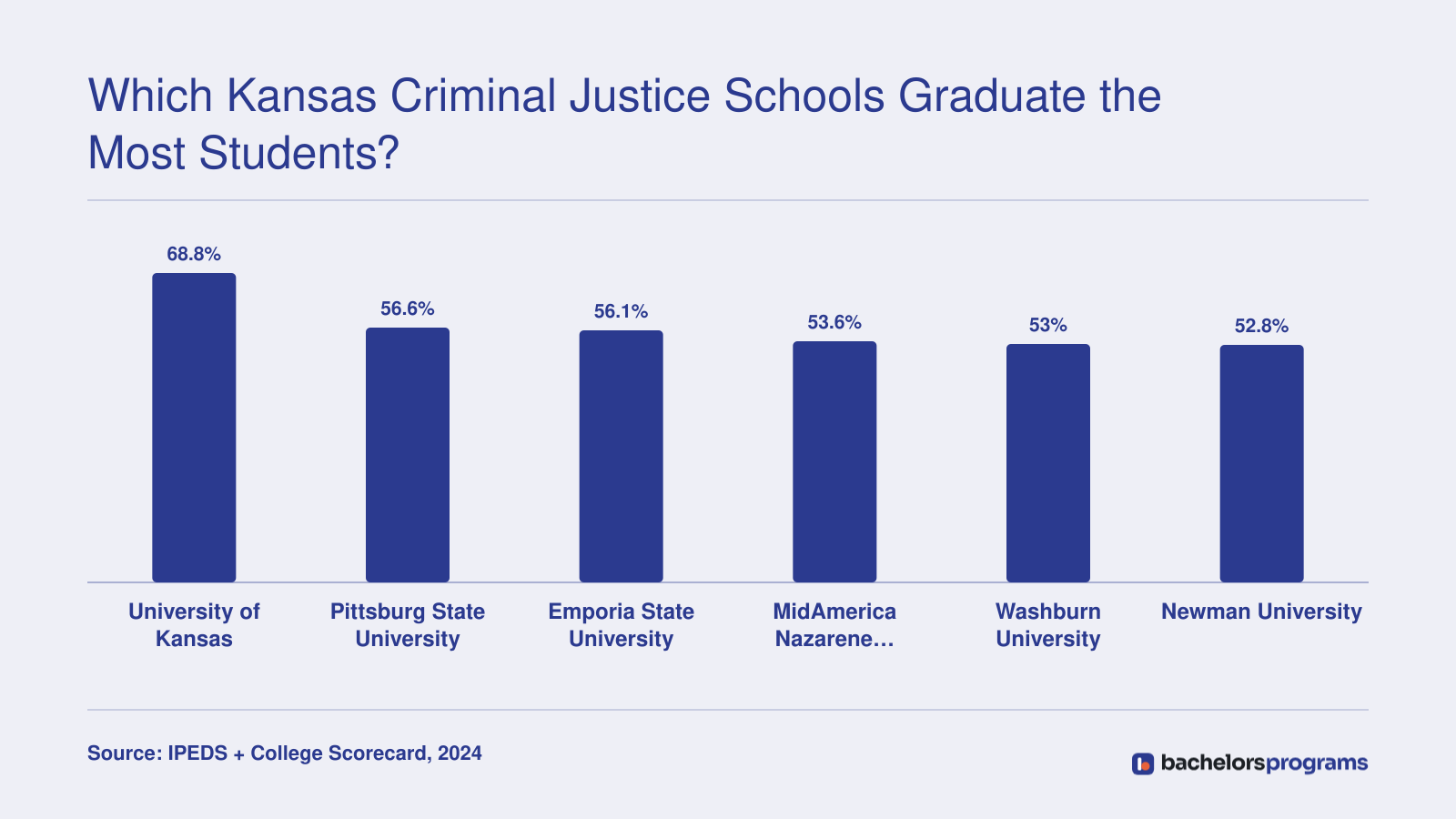
Which Kansas Criminal Justice Schools Graduate the Most Students?
These are school-wide graduation rates, the share of first-time, full-time students who finish a bachelor's degree within six years. They are not rates for the criminal justice program itself. The University of Kansas leads at 68.8%, while Newman University sits at 52.8%, a 16-point gap. The other schools shown cluster between 53% and 57%.
Related Articles
Kansas Law Enforcement Certification: What a Degree Does and Doesn't Replace
Criminal Justice Job Pay in Kansas and the Kansas City Area
Pay in criminal justice varies by agency, county and year, so a fixed wage table goes stale quickly. A better approach is to pull current numbers yourself. Here is how.
Start with BLS Occupational Employment and Wage Statistics
The Bureau of Labor Statistics publishes Occupational Employment and Wage Statistics (OEWS) at BLS.gov. The May 2025 estimates, released May 15, 20261, cover states and metropolitan areas, including Kansas and the Kansas City metro. Search by occupation code and geography, and match these listings:
- Police and sheriff's patrol officers: SOC 33-3051
- Correctional officers and jailers: SOC 33-3012
- Detectives and criminal investigators: SOC 33-3021
- Probation officers and correctional treatment specialists: SOC 21-1092
The metro estimates use OMB Bulletin 23-01 area definitions2, and each release blends six semiannual survey panels collected from November 2022 through May 2025. Treat the figures as a recent benchmark rather than what an agency pays today.
Add Local Sources
State and metro averages hide big gaps between a small rural department and a large urban one. Fill in the picture with:
- Kansas Department of Labor wage data
- City and county HR salary schedules across the Kansas City area
- Recruitment pages for police, sheriff, and corrections departments
- Criminal justice program pages at the schools ranked here, which sometimes publish local salary context
Check Associations and Live Postings
Professional groups such as the Kansas Association of Chiefs of Police, the Kansas Sheriffs' Association, the American Probation and Parole Association, and corrections associations can point you to agencies and pay norms. Current job postings are often the most reliable source, since they list starting ranges and benefits. If a posting leaves pay vague, contact the recruiter and ask for the verified starting salary and the raise schedule. That beats relying on an outdated or incomplete number.
Questions to Ask Yourself
Do you want a sworn officer role, or a corrections, forensic, or legal-support job?
Can you attend scheduled campus or hybrid sessions, or do you need fully asynchronous online classes?
Does the net price after Kansas aid fit your budget, and will your community college credits transfer?
Compare Criminal Justice programs on the data that matters
Explore more Criminal Justice & Law majors or browse every field of study.
All Criminal Justice & Law programs Browse every field of study