Best Criminology Schools in Kansas
Compare 5 accredited Criminology programs in Kansas, with net price after aid, graduation rates, earnings and debt from IPEDS and the U.S. College Scorecard.
Kansas does not require a criminology degree to become a police officer, so the real question is whether the degree returns what it costs. Kansas programs offer it as either a Bachelor of Science (B.S.) or a Bachelor of Arts (B.A.).
The programs ranked here, campus and online, are compared using Scorecard cost and outcome data, with admissions, accreditation, and careers covered along the way.
Earning the degree adds tuition but does not change what certification requires. Its value rests on the investigative, analyst, and supervisory roles it prepares you for, and on keeping debt in proportion to starting pay.
Key Points
- Kansas State University ranks first; Saint Mary offers its criminology B.A. online.
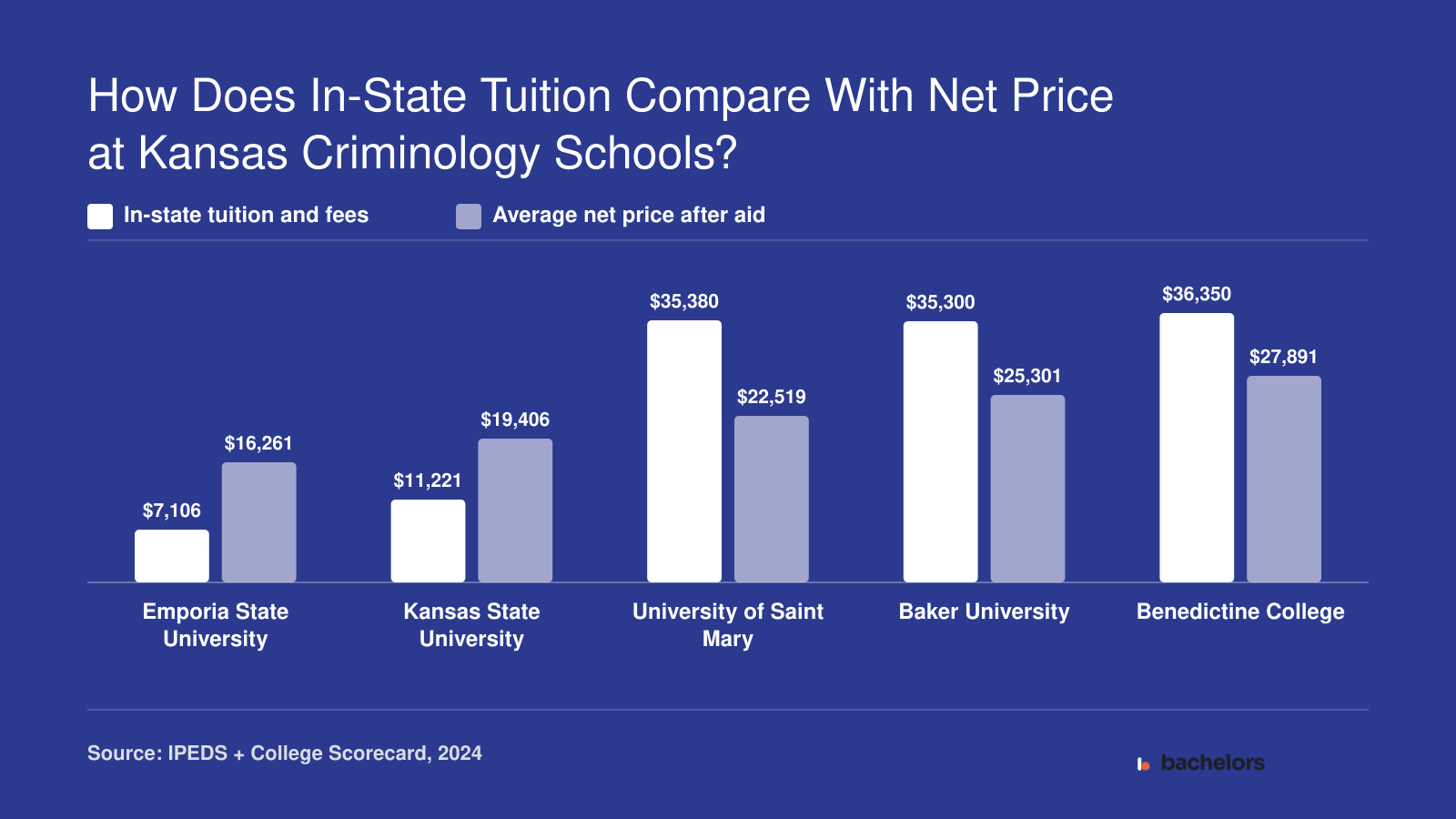
- At Saint Mary, Baker and Benedictine, aid drops net price below tuition.
- Kansas police certification through CPOST requires age 21, not a degree.
Best Bachelor's Degree in Criminology Programs in Kansas, Ranked
Kansas State University takes the top spot for its B.A. or B.S. in criminology, a research-leaning program that pairs a supervised internship with options such as a senior thesis, a forensic studies certificate, and an early start on graduate coursework. The five programs below run from a large public research university to two private colleges, a fully online option, and a regional public university with an unusually low in-state price. Each card lists concentrations and delivery format, plus school-wide in-state tuition, average net price after aid, and graduation rate so cost and completion can be compared side by side.
Kansas State University
#1Manhattan, KS · $11,000 – $29,000/yr (est.)
Best for: Research-minded students seeking thesis options
Kansas State University in Manhattan is the state's largest public research university, and its criminology program is the most research-oriented option in Kansas. Students can swap the internship track for advanced coursework and a senior thesis, add a forensic studies certificate, or begin graduate coursework early through a concurrent pathway toward a master's. The major draws on more than 90 research centers and an undergraduate criminology club whose speakers have included FBI agents. School-wide figures put in-state tuition at $11,221, average net price after aid at $19,406, and the graduation rate at 71 percent.
- B.A. or B.S. in criminology
- Professional supervised internship available
- Option to take lower-level graduate courses
- Undergraduate Criminology Club with FBI agent speakers
- Clear pathways to graduate school and law school
- Access to 90-plus campus research centers
- Senior thesis can replace the internship track
- Forensic studies certificate offered with anthropology
Benedictine College
#2Atchison, KS · $28,000/yr (est. net price)
Best for: Students wanting a small Catholic liberal arts setting
Benedictine College in Atchison is a small Catholic liberal arts college where the B.S. in criminology sits in the sociology and criminology department and treats crime as a social science. Students take required work in classical and contemporary theory, data analysis, and crime policy, then apply it through internship placements with criminal justice agencies. Classes stay small, with a 16-to-1 student-faculty ratio, and the department also offers a criminology minor. School-wide, in-state tuition is $36,350, average net price after aid is $27,891, and the graduation rate is 62 percent.
- Bachelor of Science in Criminology
- Covers classical and contemporary theories of crime
- Includes theory testing and data analysis
- Examines crime prevention, control, and punishment
- Internships with criminal justice agencies
- Prepares for graduate and professional school
- Criminology minor available
- Interdisciplinary social science coursework
Emporia State University
#3Emporia, KS · ~$16,000/yr (est.)
Best for: Students wanting victimology and law enforcement tracks
Emporia State University in Emporia offers applied criminology as both a B.A. and a B.S., with four concentrations that make it the most customizable of the Kansas programs: graduate school preparation, law enforcement and corrections, systemic structures, and victimology. Internships run through the Kansas Bureau of Investigation, the Emporia Police Department, and campus safety, while coursework covers ethics, advocacy, criminal psychology, and trauma. School-wide figures show the lowest in-state price in this group at $7,106, an average net price after aid of $16,261, and a 56 percent graduation rate.
- B.A. and B.S. tracks in applied criminology
- Four concentration options, including victimology
- Graduate school preparation track in research and statistics
- Internships with the Kansas Bureau of Investigation
- Coursework in ethics, advocacy and criminal psychology
- Victimology track covers trauma, abuse and neglect
- Small class sizes and expert instructors
University of Saint Mary
#4Leavenworth, KS · ~$23,000/yr (est.)
The University of Saint Mary in Leavenworth is the only Kansas school in this group offering the criminology bachelor's degree fully online, and it is built with transfer students in mind. Students who arrive with an associate degree typically finish in about 18 months, with multiple start dates, accelerated terms, and dedicated support staff for online learners. The curriculum, which blends psychology and sociology, is reviewed by a criminology advisory board of law enforcement professionals. School-wide, tuition is $35,380, average net price after aid is $22,519, and the graduation rate is 48 percent.
- Fully online bachelor's in criminology
- Associate-degree entrants average about 18 months
- Curriculum guided by law enforcement experts
- Criminology advisory board reviews the coursework
- Coursework spans psychology and sociology
- Multiple start dates with accelerated terms
- Dedicated support staff for online learners
Baker University
#5Baldwin City, KS · ~$25,000/yr (est.)
Baker University in Baldwin City is a private liberal arts university where criminology is studied through a B.A. in sociology with a crime and criminology concentration. The concentration takes 9 credit hours from courses on cyber deviance, victimology, violence, deviant behavior, and law and society, and every major finishes with a capstone seminar. At least one internship is part of the experience, with placements arranged through agencies in Topeka, Lawrence, and Kansas City. School-wide, in-state tuition is $35,300, average net price after aid is $25,301, and the graduation rate is 58 percent.
- B.A. in sociology with a crime and criminology concentration
- 124 credit hours, about four years of study
- 9 credit hours of concentration coursework
- Internships with Topeka, Lawrence and Kansas City agencies
- Capstone senior seminar with a formal oral presentation
- Department scholarships for sociology majors
- Concentration courses include cyber deviance and victimology
Cost & outcomes by school
Federal data for the highest-earning Criminology programs, independent of the ranking above. Earnings are this field's bachelor's graduates four years after completing where the Scorecard reports them, else the school's undergraduate median.
| School | Net price / yr | Grad rate | Earnings | Debt | Grads/yr | Format |
|---|---|---|---|---|---|---|
| Baker University KS | $25,301 | 58% | $63,855 | $25,000 | 2 | Campus |
| University of Saint Mary KS | $22,519 | 48% | $59,483 | $25,474 | 17 | Online |
| Kansas State University KS | $19,406 | 71% | $57,262 | $21,250 | 13 | Campus |
| Benedictine College KS | $27,891 | 62% | $53,175 | $24,599 | 13 | Campus |
| Emporia State University KS | $16,261 | 56% | $47,601 | $19,500 | — | Campus |
Sources: U.S. Department of Education. Net price, graduation rate, earnings and debt: College Scorecard (earnings and debt for this field's bachelor's graduates where reported, else school-wide); graduates: IPEDS. A dash means no figure is reported.
Cost, debt & payoff
Median earnings of this field's bachelor's graduates (4 yrs after completing, else the school's undergraduate median) vs. their median federal loan debt · U.S. College Scorecard
Across these programs the median graduate earns about $57,262 and finishes with roughly $24,599 in debt — a ratio that clears a common rule of thumb (keep debt below first-year salary). Net price and debt vary widely school to school, so check the per-school figures in the table above before you shortlist.
How We Ranked Kansas Criminology Bachelor's Programs
Ranking a criminology program comes down to a practical question: what does the degree cost you, and what does it return? Our order weighs the numbers a prospective student can actually check, not name recognition or campus prestige.
What We Compare
- Net price: the average yearly cost after federal, state and institutional aid, published school-wide for first-time undergraduates.
- Outcomes: graduation rate for the school as a whole, plus median earnings and typical federal loan debt for graduates of the program where the school reports them.
- Completions: how many students actually finish the criminology award, which tells you whether the program has real momentum behind it.
- Selectivity: admission rate and the academic profile of enrolled students.
- Format flexibility: whether the degree runs on campus, fully online, or in some combination, a factor if you work or commute.
Program Numbers vs. School Numbers
Earnings, debt and completions are program-level figures: they describe people who finished this particular major. The graduation rate covers the whole institution, and so does net price; read both as context rather than as a verdict on the criminology department. Net price in particular is a sector-average estimate for the whole undergraduate population, not a personal quote. Your own aid package will differ once the financial aid office reviews your FAFSA.
A Deliberately Narrow List
We rank Kansas-based schools only, and every option here is a bachelor's degree in criminology or a closely related major such as applied criminology or sociology. Criminology is a small field in Kansas higher education, so the list reflects what Kansas schools actually report rather than a padded roster. Kansas State University, Benedictine College, Emporia State University, University of Saint Mary and Baker University appear because each publishes a program a student can enroll in now.
Online and Hybrid Criminology Bachelor's Options at Kansas Schools
Which Kansas schools let you earn a criminology bachelor's degree without relocating? Kansas State University and University of Saint Mary do.1 The rest are campus-based; none of the program pages we reviewed describes a hybrid format.
How the Schools Sort Out
- Online: K-State's 100% online B.A. or B.S. in criminology (120 credits, listed under Manhattan Online) and Saint Mary's online B.A. in criminology.
- Campus-only: Benedictine's B.S. in Criminology, Baker's sociology program with a crime and criminology concentration, and Emporia State's Applied Criminology B.A. and B.S., which is not offered online in 2026.1
- Hybrid: None of these schools' pages describe one. If you want a mix of online and in-person work, ask admissions directly.
How Saint Mary's Online Format Works
Saint Mary describes an 18-month program that can be completed fully online, with multiple start dates and dedicated online learner support staff. Coursework draws on psychology and sociology, and the curriculum is shaped by law enforcement experts and a criminology advisory board.
Internships and Career Services Online
K-State's online degree ends with a 6-credit capstone. You choose an internship track, field experience in a criminal justice or related agency, typically over a summer, or a scholarship track built on lower-level graduate courses that prepare you for graduate study. None of the pages we reviewed explains how online students find and supervise placements, or whether career services work differently for them.
Saint Mary's page points to its Leavenworth-Lansing and Kansas City locations for practicum resources, with placements in law enforcement, corrections, juvenile corrections, victim services and social-service agencies. It does not say whether online students are handled differently. Because those connections are regional, ask how a placement would work from outside the area.
Emporia State (Kansas Bureau of Investigation, Emporia Police Department, ESU Police and Safety), Benedictine and Baker all describe internships, but those are campus arrangements. None of them publishes internship or career-services details for online students, since no online option is described.
Before you apply, ask each online program how remote students find placements and whether career advisors work with them.
Questions to Ask Yourself
Do you need an internship placed with a local police department or court?
Will you be working full time or relocating to a Kansas campus?
Do you want a built-in network of Kansas agencies or maximum scheduling flexibility?
Related Articles
How Does In-State Tuition Compare With Net Price at Kansas Criminology Schools?
At Emporia State and Kansas State, average net price runs higher than sticker tuition because it adds housing, food and books before subtracting grants, while at Saint Mary, Baker and Benedictine, aid brings the yearly cost well below published tuition. Net price is an institution-wide average for all undergraduates, not a criminology-specific figure, and it reflects how public and private schools report aid differently, so treat it as an estimate of what you might pay.
Kansas Law Enforcement Certification at a Glance
Compare Criminology programs on the data that matters
Explore more Criminal Justice & Law majors or browse every field of study.
All Criminal Justice & Law programs Browse every field of study