Best Early Childhood Education Schools in Kansas
Compare 9 accredited Early Childhood Education programs in Kansas at 8 colleges, with net price after aid, graduation rates, earnings and debt from IPEDS and the U.S. College Scorecard.

A bachelor's degree in early childhood education is the standard route to a Kansas license covering Birth through Grade 3, though the credential's exact title varies by school. The real tension is between price and fit: net costs differ sharply from school to school, and some programs are dedicated education degrees while others are general studies or psychology tracks that need extra steps to reach a teaching license.
The programs below span campus and online bachelor's options at Kansas schools, from large public universities to small private colleges.
Preschool and child care pay trails public-school teaching, so the license a degree leads to often matters more than the diploma's title.
Key Points
- Fort Hays State has the lowest net price here, at $12,569.
- Ottawa University-Online graduates report $50,010 median earnings four years out.
- Transfer students: Kansas State accepts up to 75 community college credits.
Best Early Childhood Education Schools in Kansas: Our Ranked List
Pittsburg State University
#1Pittsburg, KS · $16,000/yr (est. net price)
Best for: Future birth-to-kindergarten teachers
Pittsburg State ranks first here and offers the clearest licensure route under $7,000 in annual tuition: an Early Childhood Unified major covering birth through kindergarten in the Department of Teaching and Leadership, plus a Family and Consumer Sciences child development concentration and a child development minor. In-state tuition is about $6,342 and the university's graduation rate is 57 percent. Graduates earned a median of about $43,500 four years after finishing.
- Bachelor's major in Teaching and Leadership
- Early Childhood Unified Birth through Kindergarten major
- Child Development minor also available
- 4 concentration options, including Child Development
- CDA training hours and CDA coursework in child development
- Internships and service-learning projects
- Prepares students for roles as teacher, coordinator or advocate
- Leads to FCS teacher, extension agent or trainer careers
Fort Hays State University
#2Hays, KS · ~$13,000/yr (est.)
Best for: Working child care providers needing online classes
Fort Hays State University is the least expensive and most flexible entry point: a Bachelor of General Studies with a 21-hour child development concentration built for online students, day care providers and working early childhood staff. In-state tuition is about $4,704 a year and the graduation rate is 48 percent. This is not a licensure route, and the university directs teaching-license seekers to its Teacher Education Department. Graduates earned a median of about $45,200 four years after finishing.
- 21-hour Child Development concentration
- Designed for online degree seekers
- Courses offered in fall, spring and summer terms
- Covers human growth and development and children's literature
- Includes classroom discipline and instructional technology
- Contact the Teacher Education Department for a licensure path
Kansas State University
#3Manhattan, KS · $11,000 – $29,000/yr (est.)
Best for: Students focused on licensure exam readiness
Kansas State University awards a 120-credit Bachelor of Science in early childhood education and backs it with the strongest reported outcomes on this list: a 100 percent pass rate on the two national early childhood licensure exams and 99 percent job placement. Graduates are eligible for Kansas unified licensure, birth through kindergarten, including children with disabilities. In-state tuition is about $10,243, the graduation rate is 71 percent, and graduates earned a median of about $46,600 four years after finishing.
- 120 total credit hours
- Birth through kindergarten teaching focus
- Coursework in exceptional development and serving children with disabilities
- Meets Kansas teacher unified licensure requirements
- Course in home, school and community partnerships
- University and departmental scholarships available
University of Kansas
#4Lawrence, KS · $12,000 – $30,000/yr (est.)
The University of Kansas offers a Bachelor of Science in Education in Unified Early Childhood that prepares students for Kansas licensure in both general and special education, birth through third grade, and includes a yearlong student teaching internship. Admission is rolling. In-state tuition is about $10,968 and the graduation rate is 69 percent. Graduates earned a median of about $50,400 four years after finishing, the highest figure among the programs on this list.
- Kansas licensure in general and special education, birth through third grade
- Yearlong student teaching internship
- Coursework in literacy, family engagement, assessment and classroom management
- Rolling admissions
- 3.25 high school GPA option; 2.75 for transfer students
- Accredited by KSDE and CAEP
Wichita State University
#5Wichita, KS · ~$13,000/yr (est.)
Wichita State University's 129-credit Bachelor of Arts in Early Childhood Unified leads to two Kansas licenses, birth through grade three and elementary K-6, with practicum placements in infant, toddler and preschool settings. The university maintains 2+2 transfer agreements with Butler, Coffeyville and Independence community colleges for students entering the major. In-state tuition is about $7,529 and the graduation rate is 51 percent; graduates earned a median of about $47,400 four years after finishing.
- 129 total credit hours
- Two Kansas licenses: birth through grade three and elementary K-6
- Two practicum courses in infant, toddler and preschool settings
- 2.5 overall GPA minimum, plus ACT, SAT, Praxis or CAAP
- Automatic consideration for merit scholarships
- Out-of-state students can receive tuition discounts
Ottawa University-Online
#6Overland Park, KS · ~$13,000/yr (est.)
Ottawa University's Bachelor of Arts in Early Childhood Education pairs early childhood coursework with special education for dual certification and can be completed entirely online or through evening classes. Tuition runs about $13,296 regardless of residency and the university's graduation rate is 43 percent. One caution: the program maps to Arizona teacher certification requirements, so Kansas-bound teachers should confirm state licensure steps separately. Graduates earned a median of about $50,000 four years after finishing.
- Fully online option available
- Dual certification with special education
- Prepares teachers for birth to age eight
- Methods courses plus field observations
- Aligned to Arizona certification requirements
- Free application and transfer friendly
Newman University
#7Wichita, KS · ~$20,000/yr (est.)
Newman University's Bachelor of Science in Early Childhood Unified awards two Kansas licenses, elementary K-6 and early childhood unified birth through grade three, with field placements in infant-toddler centers, preschools, Head Start programs and K-3 classrooms. Sticker tuition is about $35,500, but the average net price after aid falls to roughly $20,000. The graduation rate is 53 percent, and graduates earned a median of about $45,900 four years after finishing.
- Two licenses from one degree: elementary K-6 and early childhood unified through grade three
- Field experiences in infant-toddler centers, preschools, Head Start and K-3
- Licensed elementary teachers can add the endorsement in one summer
- Classes at the campus and at Western Kansas outreach sites
- Dual focus on early childhood and special education
McPherson College
#8McPherson, KS · ~$26,000/yr (est.)
McPherson College does not award a dedicated early childhood education degree; its closest route is a psychology major with a child development concentration, which suits students heading into child care, social services or graduate study rather than a Kansas teaching license. Tuition is about $37,310, the average net price after aid is roughly $26,400, and the graduation rate is 34 percent, the lowest on this list.
- Psychology major with a Child Development concentration
- Second concentration available in Health and Human Services
- Senior-year capstone project
- Study abroad options
- More than 60 majors, minors and pre-professional programs
Cost & outcomes by school
Federal data for the highest-earning Early Childhood Education programs, independent of the ranking above. Earnings are this field's bachelor's graduates four years after completing where the Scorecard reports them, else the school's undergraduate median.
| School | Net price / yr | Grad rate | Earnings | Debt | Grads/yr | Format |
|---|---|---|---|---|---|---|
| McPherson College KS | $26,441 | 34% | $52,084 | $25,242 | 6 | Campus |
| University of Kansas KS | $18,059 | 69% | $50,434 | $23,500 | 96 | Campus |
| Ottawa University-Online KS | — | 43% | $50,010 | $22,000 | 6 | Online or campus |
| Wichita State University KS | $13,194 | 51% | $47,389 | $24,129 | 229 | Campus |
| Kansas State University KS | $19,406 | 71% | $46,562 | $23,408 | 211 | Online or campus |
| Newman University KS | $19,971 | 53% | $45,869 | $22,750 | 26 | Hybrid |
| Fort Hays State University KS | $12,569 | 48% | $45,190 | $24,169 | 185 | Online |
| Pittsburg State University KS | $15,784 | 57% | $43,465 | $20,550 | 56 | Campus |
Sources: U.S. Department of Education. Net price, graduation rate, earnings and debt: College Scorecard (earnings and debt for this field's bachelor's graduates where reported, else school-wide); graduates: IPEDS. A dash means no figure is reported.
Cost, debt & payoff
Median earnings of this field's bachelor's graduates (4 yrs after completing, else the school's undergraduate median) vs. their median federal loan debt · U.S. College Scorecard
Across these programs the median graduate earns about $46,562 and finishes with roughly $23,408 in debt — a ratio that clears a common rule of thumb (keep debt below first-year salary). Net price and debt vary widely school to school, so check the per-school figures in the table above before you shortlist.
Most Affordable Early Childhood Education Schools in Kansas
Fort Hays State University has the lowest average annual net price among the schools ranked here, at $12,569 after grants and scholarships. Its online option is a Bachelor of General Studies with a Child Development concentration, not a dedicated early childhood education major. The figures below come from 2024 IPEDS and College Scorecard data from the U.S. Department of Education. Net price reflects what students paid on average after aid, and in-state tuition and fees show the published sticker price for Kansas residents.
| School | City | Average Annual Net Price | In-State Tuition and Fees | Program Format |
|---|---|---|---|---|
| Fort Hays State University | Hays | $12,569 | $5,923 | Online |
| Wichita State University | Wichita | $13,194 | $9,684 | Campus |
| Pittsburg State University | Pittsburg | $15,784 | $8,400 | Campus |
| University of Kansas | Lawrence | $18,059 | $12,102 | Campus |
| Kansas State University | Manhattan | $19,406 | $11,221 | Campus and online |
How We Ranked Kansas Bachelor's Degree in Early Childhood Education Programs
Which early childhood education bachelor's degree in Kansas is actually worth the tuition? The answer depends on how a program performs for the students who enroll, not on how polished its viewbook looks. So the comparison here leans on outcomes you can check.
What the Comparison Weighs
Each program is measured on the same handful of factors: net price after grant aid, graduation rate, median earnings for graduates, typical student debt, the number of students who complete the program, and format. Format matters in Kansas, where a working preschool aide may need online or hybrid coursework while a traditional-age student may want a campus with field placements nearby. Debt gets extra attention because a low sticker price paired with weak outcomes is not a bargain. Completions count is the quiet signal: a program that graduates students steadily usually has the advising and course scheduling to get them through.
The Two Benchmarks Worth Knowing
- Lowest net price: Fort Hays State University, at $12,569 a year after aid, for its online Bachelor of General Studies with a child development concentration.
- Highest median earnings: University of Kansas, at $50,434 four years after students finish, for its B.S. in Education in Unified Early Childhood.
Read the Averages With Care
Neither number is specific to the early childhood program. They describe how the whole university performs and what its typical student pays, so your own aid package can land above or below the published figure. A campus-wide graduation rate says nothing about the odds for an education major in particular. Use these figures as a first filter, then look closely at the early childhood program itself: where students do field experience, how it prepares you for Kansas licensure, and whether the schedule fits your life.
Online and Hybrid Early Childhood Education Bachelor's Options at Kansas Schools
Online coursework and campus-based study sit at opposite ends of a spectrum with hybrid blends in between, and the right point on it depends less on how you like to study than on where you can complete supervised fieldwork.
Online, Hybrid and Campus Formats
Yes, you can earn a bachelor's degree in early childhood education online in Kansas. Kansas State University lists its Early Childhood Education BS as 100% online at 120 credits, built around birth through kindergarten.1 Ottawa University-Online advertises a fully online option in its Bachelor of Arts in Early Childhood Education. Fort Hays State University's Child Development concentration inside the Bachelor of General Studies is designed for online degree seekers, with courses offered in fall, spring and summer. Newman University takes the hybrid route, combining campus classes with its Western Kansas sites and field experiences in Head Start and K-3 settings. Pittsburg State's Early Childhood Unified track, the University of Kansas's B.S. in Education in Unified Early Childhood, Wichita State's Bachelor of Arts in Education - Early Childhood Unified, and McPherson College's child development concentration are campus-based.
Fieldwork Still Happens in Person
Online delivery covers readings, lectures and assignments. It does not cover the hours spent with children. K-State builds supervised practice with infants and toddlers, preschoolers and kindergarteners into the degree, and its licensure track adds a home visiting course.2 Student teaching is a 9-credit course, admitted by permission only, and it comes after full admission to the teacher-education program and the practicum sequence.2 K-State describes field experience as taking place in an accredited school near the student, and the online program enrolls students across the U.S., with instructors able to observe teaching by tablet or video.1 Before any course involving contact with children, expect a physical exam with a TB test, KBI/DCF clearance, and First Aid/CPR certification before the closing fieldwork courses.2
Plan the Sequence, Then the Placement
Working adults should map a term-by-term plan rather than register course by course: the practicum courses come before student teaching, and student teaching comes before graduation. For placement, contact the program's field office as early as possible, name a licensed center or district near your home, and confirm the site will host a university supervisor. Sites that already partner with the university tend to approve faster than a cold call to a center that has never taken a student teacher.
Related Articles
Admission Requirements for Kansas Early Childhood Education Bachelor's Programs
The table compares admissions rules for the ranked schools whose early childhood education pages publish them. The main points for community college students: Wichita State has formal 2+2 agreements with multiple community colleges, Kansas State accepts up to 75 community-college credit hours toward its B.S., and the University of Kansas expects transfer students to hold at least a 2.75 combined GPA before declaring the major. At Wichita State, admission to the university and admission to the teacher-education program are separate steps, so plan for a second application. For schools not shown here, confirm GPA, testing and transfer rules directly with the admissions office before you enroll in community college courses.
| School | Minimum GPA | Test Policy | Transfer / Community College Pathway |
|---|---|---|---|
| University of Kansas (B.S.E., Unified Early Childhood) | Freshmen: 3.25 high school GPA, or 2.0 with a qualifying test score. Transfers: 2.75 combined KU and transfer cumulative GPA | ACT 21 or SAT 1060 with at least a 2.0 GPA may be used in place of the 3.25 GPA | Transfer students must be admitted to KU, declare the major and hold a combined KU and transfer GPA of at least 2.75 |
| Wichita State University (B.A.Ed., Early Childhood Unified) | 2.50 for direct admission to teacher education and continued good standing | No policy published (students are admitted to Wichita State first, then apply to the professional teacher-education program) | Formal 2+2 agreements with multiple community colleges. Faculty review transfer courses and may accept them as program equivalencies |
| Kansas State University (B.S., Early Childhood Education) | No policy published | No policy published | No more than 75 community-college credit hours may transfer toward the degree |
Kansas Early Childhood Licensure and Accreditation
The license at the end of a Kansas early childhood program covers more ground than the degree title suggests, so pin down its exact boundaries before you enroll.
What the Early Childhood Unified License Covers
Kansas issues the Early Childhood Unified (ECU) endorsement for Birth through Grade 3, not merely birth through kindergarten. That wider span qualifies you to teach infants, toddlers, preschoolers, and children in the early elementary grades. It differs from the K-6 elementary route, which prepares you for graded classrooms and leaves out infant and toddler settings, and from early childhood special education, which in Kansas is folded into the unified structure rather than offered as a separate general-education path.
The 2026-2027 Kansas Licensed Personnel Guide also lists provisional and waiver options, the latter available to teachers who already hold an elementary education endorsement. Kansas does not grant this endorsement by testing alone. You complete the program.
Exams and State Approval
A bachelor's degree, a Kansas-approved teacher preparation program, a verified teacher work sample, and a passing Praxis content assessment make up the initial license requirements. For ECU, that means the Praxis content exam tied to the endorsement; after you pass, scores go to KSDE electronically using recipient code 7270. Confirm the current test number and passing score with your program advisor or KSDE directly, since those details change and are not spelled out in the general guides.
To recommend graduates, a program must complete KSDE program review and receive Kansas State Board of Education approval. The state publishes an approved programs list by content area. Kansas State University, Pittsburg State University, and the University of Kansas appear there for Early Childhood Unified Birth through Kindergarten. CAEP accreditation is separate and optional; it signals national standards but does not replace state approval.
A Three-Point Verification Checklist
- State approval: Confirm the program, not just the university, is listed on the KSDE approved programs list under Early Childhood Unified, and ask whether it can currently recommend completers.
- Accreditation: Ask which body accredits the education unit and whether CAEP status is current.
- Licensure pathway: Ask how the program prepares you for the Praxis content exam and whether advising covers the application and score submission process.
Get those three answers in writing before you deposit.
What Early Childhood Education Graduates Earn After Finishing at Kansas Schools
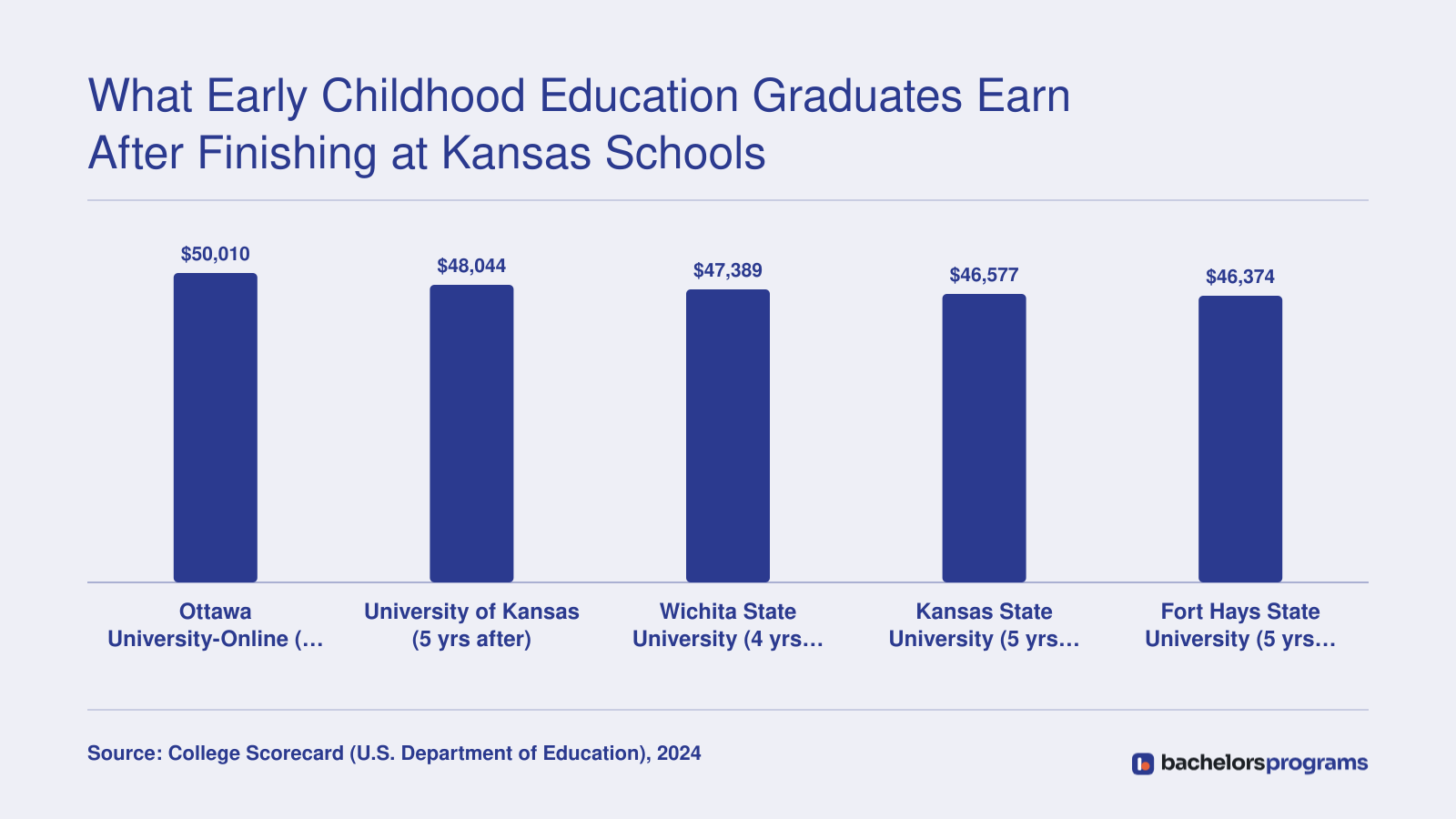
Program-level median earnings for early childhood education bachelor's completers fall in a tight band at these Kansas schools: Ottawa University-Online reports $50,010 and Wichita State University $47,389, both four years after completion, while the University of Kansas ($48,044), Kansas State University ($46,577) and Fort Hays State University ($46,374) are measured five years after completion. Because the windows differ, compare schools within the same window first. These figures are medians for program completers, not an offer of pay, and Fort Hays State's number reflects its online Bachelor of General Studies with a Child Development concentration rather than a licensure track.
Early Childhood Education Careers and Salaries in Kansas
The core tradeoff in early childhood careers is speed versus ceiling. Preschool roles are the quickest way into classrooms, while licensed public-school and kindergarten positions take more preparation but tend to pay more nationally.
How to Become a Preschool Teacher in Kansas
- Earn the degree: Complete a bachelor's in early childhood education at a school such as Kansas State University, the University of Kansas, Wichita State University, Pittsburg State University, Newman University or Ottawa University-Online.
- Finish your placement: Teacher preparation programs build in supervised classroom experience, which is where you apply coursework with real children before graduating.
- Get licensed: For public-school preschool positions, the Bureau of Labor Statistics notes that teachers must hold an early childhood education license, generally covering preschool through third grade.4 That license typically requires a bachelor's degree and a passing score on a competency exam.
- Search for jobs: Apply to public-school pre-K programs, private preschools and early learning centers. Licensure widens the range of employers open to you.
Where the Degree Leads
Most graduates start as preschool teachers. Unified programs, like the Early Childhood Unified tracks at Wichita State, Pittsburg State and Newman, and Unified Early Childhood at KU, prepare candidates for both general and special education settings, which can lead to early childhood special education roles. Because the license typically extends into the early elementary grades, kindergarten teaching is another path. With classroom experience, some teachers move into program director or coordinator positions.
How Much Early Childhood Education Teachers Make in Kansas
Kansas preschool teachers (excluding special education) earned a median annual wage of $47,750 in 2025, according to O*NET local wage data from the U.S. Department of Labor.1 The middle half earned between $37,450 and $55,640.1 The lowest-paid tenth earned $27,850 or less, and the top tenth earned $61,790 or more.
That Kansas median sits well above the national preschool teacher median of $38,140 reported by BLS for May 2025.2 Nationally, kindergarten teachers earned a median of $62,680 that same year,5 which shows why licensure for the early grades can raise earning potential.
BLS projects national preschool teacher employment to grow 4.5% from 2025 to 20353, adding about 26,200 jobs, with roughly 66,700 openings each year.4 Kindergarten and elementary teachers, counted together, are projected to hold flat at 0% over the same period, so openings there will come mainly from turnover.
Occupation Wages vs. Graduate Earnings
The wage figures above describe everyone working in the occupation, from first-year teachers to veterans with decades in the classroom. The graduate earnings cited in the ranking section above measure something different: what people who finished a specific program at a Kansas school earned shortly after completing it, in whatever job they held. Expect early-career graduate earnings to look different from occupation medians, and use each figure for its own purpose: one for judging a program, the other for judging the career.
Compare Early Childhood Education programs on the data that matters
Explore more Education & Teaching majors or browse every field of study.
All Education & Teaching programs Browse every field of study