Best Forensic Science Schools in Kansas
Compare 6 accredited Forensic Science programs in Kansas at 5 colleges, with net price after aid, graduation rates, earnings and debt from IPEDS and the U.S. College Scorecard.
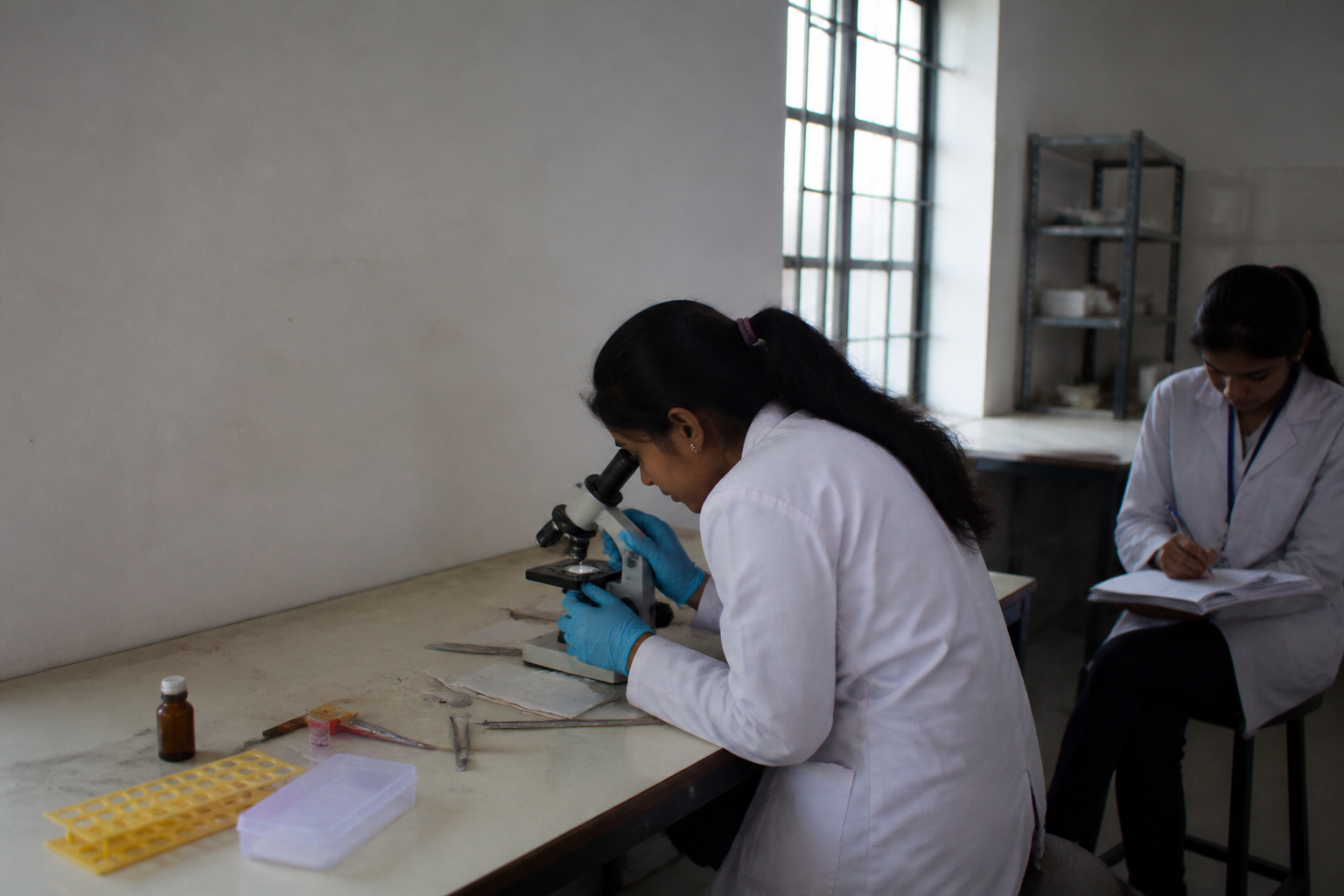
A bachelor's degree in forensic science is easy to want in Kansas and harder to find under that exact name. Schools award it as a Bachelor of Science (B.S.) or Bachelor of Arts (B.A.) in Forensic Science, but the title on the diploma varies from campus to campus.
Some Kansas schools offer forensic chemistry or criminal justice routes instead of a stand-alone major. Washburn University's B.S. in Forensic Biology and Fort Hays State University's chemistry degree with forensic study are two examples.
Crime labs typically hire for a strong natural science foundation, so the coursework behind the title counts for more than the title itself.
Key Points
- Washburn University students train in a lab shared with the KBI.
- Wichita State's Forensic Sciences B.S. requires a 2.0 GPA and 120 credits.
- Forensic science technicians earned a $72,060 median wage in 2025, per BLS.
Best Bachelor's in Forensic Science Schools in Kansas, Ranked
The strongest bachelor's degree in forensic science in Kansas for most students is Washburn University's B.S. in Forensic Biology in Topeka, because students train inside a laboratory shared with the Kansas Bureau of Investigation rather than only reading about casework. Best, on this list, means a program that pairs a real science core with access to working forensic practitioners and then holds up on cost after aid and completion. Wichita State is close behind, with federal and county crime laboratory partnerships and two science concentrations.
Washburn University
#1Topeka, KS · ~$15,000/yr (est.)
Best for: Hands-on learners wanting crime lab access
Washburn University is a public institution in Topeka whose forensic science footprint centers on a working crime laboratory. Its B.S. in Forensic Biology places students in the Washburn Forensics Laboratory inside the KBI Forensic Science Center, where Kansas Bureau of Investigation scientists work alongside students, and KBI staff guest lecture or serve as adjunct instructors. The university graduates 53% of its students and reports a net price after aid of $15,280. Forensic biology graduates had median earnings of $44,534 four years after finishing, with median program debt of $21,638.
- B.S. in Forensic Biology with 5 concentration options
- Forensics laboratory housed inside the KBI Forensic Science Center
- More than 10,000 square feet of academic lab space
- Vehicle bay for crime scene processing
- Outdoor laboratory for forensic anthropology study
- KBI scientists guest lecture and serve as adjunct instructors
- Forensic science internships with the KBI
- Dedicated lab space for each concentration area
Wichita State University
#2Wichita, KS · ~$13,000/yr (est.)
Best for: Science majors seeking federal lab partnerships
Wichita State University awards a B.S. in Forensic Science with separate Biology and Chemistry concentrations, each requiring at least 120 credit hours and 74 to 76 credits inside the major. The university has built forensic partnerships with the ATF, the Sedgwick County Regional Forensic Science Center and the Kansas Bureau of Investigation, and an ATF Forensic Crime Gun Intelligence Laboratory opened on its Innovation Campus in 2026. Every major completes an applied learning or research experience before graduating. The university graduates 51% of its students and reports a net price after aid of $13,194.
- 120 credit hours, with 74 to 76 in the major
- 2.000 overall, WSU and program GPA required
- Forensic serology and fingerprint development coursework
- Human osteology and forensic anthropology courses
- Criminal Evidence: Mock Trials course
- FS 499 capstone seminar in forensic science techniques
- Separate chemistry concentration alongside the biology track
- Core hard-science coursework built around lab work
- Applied learning or research experience required
- Hands-on labs and classroom experiments
Fort Hays State University
#3Hays, KS · ~$13,000/yr (est.)
Best for: Chemistry-focused students wanting a rural campus
Fort Hays State University awards a Bachelor of Science in Chemistry with a Forensic Science concentration, a 120-hour degree that pairs a full chemistry core with forensic science and environmental analysis. Undergraduates train on advanced scientific instrumentation, work in modern laboratories, and can add faculty-led research, internships and electives in criminal justice or biology. The campus sits in Hays, in rural western Kansas. The university graduates 48% of its students and reports a net price after aid of $12,569.
- 120 credit hours in the Bachelor of Science in Chemistry
- Forensic Science concentration inside the chemistry degree
- Coursework in general, organic, inorganic, physical and analytical chemistry
- Introduction to Forensic Science and Instrumental Analysis with laboratory
- Training on advanced scientific instrumentation
- Faculty-led research and internship opportunities
- Electives in criminal justice, biology or pre-health
- American Chemical Society certification for the chemistry program
Sterling College
#4Sterling, KS · ~$22,000/yr (est.)
Sterling College is a small private Christian college in Sterling that offers Pre-Forensic Science as a concentration inside its B.S. in Interdisciplinary Studies. Students combine a natural science core with criminal justice coursework and finish prepared for entry-level laboratory work or for graduate study in forensic science. The concentration is one of eight interdisciplinary studies tracks, so students can pair forensic interests with a related field. The college graduates 41% of its students and reports a net price after aid of $22,371.
- Pre-Forensic Science concentration in the B.S. in Interdisciplinary Studies
- Natural science core paired with criminal justice courses
- Prepares students for entry-level laboratory work
- One of eight interdisciplinary studies concentrations
- Pathway toward graduate programs in forensic science
Central Christian College of Kansas
#5McPherson, KS · ~$11,000/yr (est.)
Central Christian College of Kansas, in McPherson, offers a bachelor's in forensic science that blends evidence analysis and scientific method with a Christ-centered general education. The degree runs past 120 credits and typically takes four years of full-time study, with transfer or prior learning credit able to speed it up. Advisors guide course selection and internships, and a $0 application fee keeps the entry step simple. The college graduates 27% of its students and reports a net price after aid of $11,404.
- More than 120 credit hours, about four years full time
- Focus on evidence analysis, crime solving and scientific methods
- Prepares students for crime scene analysis and forensic research
- $0 application fee
- Transfer and prior learning credit can shorten the degree
- Christ-centered curriculum across all subjects
- Merit, athletic, artistic and faith-service scholarships
Cost & outcomes by school
Federal data for the highest-earning Forensic Science programs, independent of the ranking above. Earnings are this field's bachelor's graduates four years after completing where the Scorecard reports them, else the school's undergraduate median.
| School | Net price / yr | Grad rate | Earnings | Debt | Grads/yr | Format |
|---|---|---|---|---|---|---|
| Wichita State University KS | $13,194 | 51% | $51,532 | $20,500 | 12 | Campus |
| Fort Hays State University KS | $12,569 | 48% | $48,928 | $21,000 | — | Campus |
| Sterling College KS | $22,371 | 41% | $45,846 | $24,625 | — | Campus |
| Washburn University KS | $15,280 | 53% | $44,534 | $21,250 | 39 | Campus |
| Central Christian College of Kansas KS | $11,404 | 27% | $44,468 | $27,000 | — | Campus |
Sources: U.S. Department of Education. Net price, graduation rate, earnings and debt: College Scorecard (earnings and debt for this field's bachelor's graduates where reported, else school-wide); graduates: IPEDS. A dash means no figure is reported.
Cost, debt & payoff
Median earnings of this field's bachelor's graduates (4 yrs after completing, else the school's undergraduate median) vs. their median federal loan debt · U.S. College Scorecard
Across these programs the median graduate earns about $47,387 and finishes with roughly $21,125 in debt — a ratio that clears a common rule of thumb (keep debt below first-year salary). Net price and debt vary widely school to school, so check the per-school figures in the table above before you shortlist.
How We Ranked Kansas Forensic Science Schools
We kept the inputs simple and the same for every school.
- Outcomes: College Scorecard data on graduation and, where published, earnings.
- Net price: What students typically pay after grants and scholarships.
- Completions: How many students finish degrees in the relevant field.
- Program fit: How directly the degree prepares you for crime lab and forensic work.
Related Majors Count, With a Caveat
Not every Kansas school offers a degree titled forensic science. Fort Hays State University reaches the field through a Bachelor of Science in Chemistry. Washburn University offers Forensic Biology, and Sterling College offers a Pre-Forensic Science track. Wichita State University and Central Christian College of Kansas offer forensic science programs by name. We weighed related-major routes on how well their coursework matches what forensic employers look for, and flagged the difference.
What the Numbers Do and Don't Show
Graduation rate and net price are institution-wide averages. They describe the whole school, not the forensic program alone. Program-level earnings come from Scorecard only where they are published, and we leave them out where they are not. Use these figures to compare schools, then confirm details with each admissions office.
Choosing a Bachelor's Degree in Forensic Science: B.S., B.A., or a Related Major
The Bureau of Labor Statistics says forensic science technicians typically need a bachelor's degree2, and their median pay was $72,060 in 20251. It does not say whether those workers held a B.S., a B.A., or a related major, and no source here shows a pay premium for one label over another. Choose by the work you want and the lab courses you will actually take.
Dedicated Forensic Science B.S.
- Lab intensity: High, with chemistry, biology, and instrumentation alongside forensic courses.
- Coursework focus: Evidence analysis, laboratory methods, and courtroom testimony.
- Best-fit careers: Lab analyst, crime-scene work, and biology or DNA analysis.
- Graduate readiness: Strong if the science sequence is complete, so check it.
Take this route if you already know you want forensic work. Wichita State University (Forensic Sciences) and Central Christian College of Kansas (Forensic Science) are examples, and Washburn University's Forensic Biology program fits readers aiming at biology and DNA work.
Chemistry B.S. with Forensic Emphasis
- Lab intensity: Highest of the three, with heavy analytical and organic chemistry.
- Coursework focus: Core chemistry, with forensic electives where offered.
- Best-fit careers: Chemistry-based lab analyst roles, plus industrial and clinical labs as a fallback.
- Graduate readiness: Excellent, since the major is a standard science credential.
It offers the broadest science foundation and the most flexibility. Fort Hays State University offers a Bachelor of Science in Chemistry; ask the school which forensic electives are available.
Criminal Justice with a Forensic Investigation Focus
- Lab intensity: Low, with little bench science.
- Coursework focus: Law, procedure, investigation, and report writing.
- Best-fit careers: Crime-scene and investigative support, and digital forensics if you add technology coursework.
- Graduate readiness: Limited for science programs unless you add chemistry and biology.
This route suits readers drawn to fieldwork and the legal side more than the bench.
Because lab analyst postings often expect a natural science core, compare each curriculum's science credits before you apply, whatever the degree is called.
Which Kansas Forensic Science Programs Are Accredited?
FEPAC, the Forensic Science Education Programs Accreditation Commission run by the American Academy of Forensic Sciences, reviews bachelor's and master's programs in forensic science (and science degrees with a forensic concentration) against curriculum and lab standards that crime-lab employers recognize as a sign of rigorous training. FEPAC is programmatic accreditation, which is separate from the institutional accreditation that covers a whole college, and FEPAC only considers programs housed at regionally accredited institutions. The current FEPAC directory does not list any of the Kansas programs below. That reflects a voluntary review process rather than a weakness in the coursework, so ask each department how its chemistry, biology, and lab sequence lines up with crime-lab hiring requirements.
| School | Program / Degree Route | FEPAC Accredited? | Institutional Accreditor |
|---|---|---|---|
| Washburn University | Forensic Biology | Not on the current FEPAC directory (the former B.S. in Forensic Science held FEPAC accreditation from 2012 to 2017) | Regional accreditation (verify current status on the school's website) |
| Wichita State University | Forensic Sciences | Not on the current FEPAC directory | Regional accreditation (verify current status on the school's website) |
| Fort Hays State University | Bachelor of Science in Chemistry | Not on the current FEPAC directory | Regional accreditation (verify current status on the school's website) |
| Sterling College | Pre-Forensic Science | Not on the current FEPAC directory | Regional accreditation (verify current status on the school's website) |
| Central Christian College of Kansas | Forensic Science | Not on the current FEPAC directory | Regional accreditation (verify current status on the school's website) |
Related Articles
Admission Requirements for Kansas Forensic Science Programs
Wichita State University's Bachelor of Science in Forensic Sciences lists a 2.0 GPA minimum alongside 120 total credit hours, with 74 to 76 of those hours sitting inside the major itself. Fort Hays State University's forensic-oriented chemistry catalog sets the same 2.0 bar, on both FHSU coursework and all coursework combined, and notes that higher program-level requirements override it.
What Each School Publishes
- Wichita State University: A 2.0 GPA minimum for the forensic sciences major, plus an applied learning or research requirement before graduation. No separate 2026 test-optional statement is published for the forensic sciences program itself.
- Fort Hays State University: A 2.0 GPA on FHSU and cumulative coursework, per the catalog. The university-level admission GPA threshold and 2026 standardized-test policy are not stated on the program materials available to us, so treat those as no policy published and confirm directly.
- Washburn University: Forensic Biology is open to both new and transfer students. Washburn does not publish a program-specific minimum GPA, test policy, or prerequisite list for this major.
- Sterling College and Central Christian College of Kansas: Neither publishes forensic-specific admission criteria. Central Christian does state that it accepts transfer and prior learning credit and charges no application fee.
Science Prerequisites and Transfer Pathways
Expect a general chemistry sequence with labs, organic chemistry, and introductory biology. FHSU's track names CHEM 120/120L and CHEM 122/122L at the entry level, moving through CHEM 304/304L and CHEM 382 later. Students who have not yet met the natural and physical sciences general education requirement can use general chemistry to satisfy both at once.
Kansas community college credit transfers under state policy. Public institutions must establish articulation agreements for substantially equivalent courses, and those agreements take effect only after Kansas Board of Regents approval.1 The Regents set a 45-credit-hour general education block; receiving schools must accept fewer than 45 hours but can require you to finish the remainder, which may add a semester.2
Practical tip: take general chemistry with its lab in your first year. Nearly every upper-level forensic course sits behind it, and a late start pushes graduation back a full term.
Online and Hybrid Forensic Science Options at Kansas Schools
Forensic Science Majors Are Campus-Based
If you want a bachelor's degree in forensic science in Kansas, plan on being on campus. Every forensic science program on this page is delivered in person. That includes Washburn University's Forensic Biology option, Wichita State University's B.S. in Forensic Sciences, Fort Hays State University's chemistry-based forensic science track, Sterling College's Pre-Forensic Science concentration and Central Christian College of Kansas's Forensic Science major. Fort Hays State's B.S. in Criminalistics (Forensic Biology) is also on campus only. It runs 120 credit hours and includes extensive labs, simulated crime scenes and DNA projects.
Hybrid and Online Paths
Two schools here offer more flexible, forensic-adjacent routes:
- Washburn University: The Bachelor of Criminal Justice in Forensic Investigations (120 credits, normally four years) mixes online and on-campus classes. Many required courses are online, but lab work at the KBI Forensic Science Center on the Topeka campus requires you to attend in person.
- Fort Hays State University: The B.A./B.S. in Criminal Justice is available both online and on campus.
What This Means for Working Students
Forensic science is a lab science. Courses in chemistry, biology, serology and evidence analysis depend on instruments and supervised bench time that can't move online. If you work full time, a criminal justice degree with some forensic coursework can be easier to fit into your week. Washburn's hybrid model, for example, cuts down how often you need to be on campus. Crime lab analyst roles usually expect a natural science foundation. Before you choose a criminal justice route, confirm it matches the job you want.
Forensic Science Careers and Certification in Kansas
A bachelor's degree gets you into a Kansas crime lab, but the pay and the senior titles come with years of casework. Understanding the progression tells you what a degree can and cannot deliver at graduation.
Who Hires in Kansas
The Kansas Bureau of Investigation (KBI) Forensic Science Laboratory is the state's main employer of forensic scientists. Local and regional crime labs and police agencies also hire for evidence, latent print, and related roles. KBI requires a bachelor's degree from an accredited four-year institution, and it prefers biology, chemistry, or forensic science majors.3 That preference is why a Forensic Biology degree at Washburn University or a chemistry degree at Fort Hays State University can be as useful as a forensic science major.
KBI classifies scientists in three levels:
- Forensic Scientist I: bachelor's degree.
- Forensic Scientist II: bachelor's degree plus at least 24 months of forensic or equivalent experience.
- Forensic Scientist III: bachelor's degree plus at least 5 years of experience.
Every applicant faces a polygraph and a full background investigation.3 State budget documents indicate the lab has hired people with little lab experience and trained them, with training running 12 to 24 months.4 A recent KBI posting listed pay of $53,414 to $96,200 a year, depending on education and experience.3
Wages and Demand
BLS reports 20,100 forensic science technicians nationally in 2025, with a median wage of $72,060 a year ($34.65 an hour) as of May 2025.1 It projects employment to reach 22,800 by 2035, growth of 13 percent, or about 2,700 jobs.2 Those are national figures, so treat the KBI salary range as the closer guide to Kansas public-lab pay.
The earnings figures reported for the programs on this page measure what graduates of each program earn shortly after finishing. They include people in many jobs, not only lab analysts. They are not occupational wages, so do not read them as a forensic scientist's salary.
Licensure and Voluntary Certification
Kansas does not issue a state license for forensic scientists. Employers rely on degree, training, and background screening instead. Certification is voluntary. The American Board of Criminalistics (ABC) offers credentials that can strengthen a résumé once you are working in a lab.
FEPAC accreditation is a program-level signal. It indicates a forensic science curriculum has been reviewed against national academic standards. Ask each school whether its program holds it.
Internships and Crime Lab Experience for Kansas Students
Hands-on forensic experience means supervised time inside a working crime lab or alongside a scene unit, and in Kansas it mostly comes through agency internships rather than coursework alone.
Where Kansas Students Can Intern
- KBI Forensic Science Laboratory: Open to juniors, seniors, and graduates with a 3.0 GPA.1 Applications are due January 1, April 1, or September 1 (2026) and include a letter of interest, CV, recommendation, and transcripts. Expect a background check and at least 180 hours per semester.2 Paid slots are limited. The KBI Crime Scene Response Team does not take interns.2
- Sedgwick County Regional Forensic Science Center: A full-service facility housing the District Coroner and labs.3 A 2026 Washburn University list names it for firearms and evidence-warehouse work.
- Other agencies on that list: Johnson County Sheriff's Criminalistics Lab (CSI, ballistics, fingerprints) and Wichita Police Department (crime scene investigation).
- Kansas City Police Department: Its crime lab internship is unpaid and requires a 3.0 GPA.4 The summer program is suspended for 2026 and scheduled to return in 2027.
What the Schools Publish
Washburn University is the one school here that points students to a named agency list. The pages we reviewed for Wichita State, Fort Hays State, Sterling College, and Central Christian College of Kansas do not detail internships, capstones, or mock crime-scene facilities.
What to Ask Admissions
- Which agencies have placed students recently?
- Does credit apply, and is a capstone required?
- Is there a practice crime-scene space on campus?
Forensic Science Schools in Kansas: Frequently Asked Questions
These answers cover the questions Kansas students ask most about a bachelor's degree in forensic science. Policies change, so confirm details with each school's admissions office before you apply.
Can you get a forensic science bachelor's degree online from a Kansas school?
Do you need a license to work in forensic science in Kansas?
What should I major in if a Kansas school has no stand-alone forensic science major?
Can community college credits transfer toward a Kansas forensic science bachelor's degree?
Is a lab-focused or investigation-focused path the better first choice?
Compare Forensic Science programs on the data that matters
Explore more Criminal Justice & Law majors or browse every field of study.
All Criminal Justice & Law programs Browse every field of study