Best Information Technology Schools in Kansas
Compare 8 accredited Information Technology programs in Kansas, with net price after aid, graduation rates, earnings and debt from IPEDS and the U.S. College Scorecard.

Kansas employers hire IT staff through certifications and associate degrees, but a bachelor's degree in information technology is still the most direct path into systems, network and security roles. The common credential is the Bachelor of Science (B.S.) in Information Technology, though some schools here file similar coursework under computer science or business titles.
Price is the sharpest divide. Published in-state tuition runs from $9,684 at Wichita State University to $37,174 at MidAmerica Nazarene University. Rankings weigh cost, graduation rates and outcomes data, and cover Kansas schools alongside online programs based in the state.
Employers still weigh hands-on skills alongside the degree, so labs and capstones matter as much as the program title.
Key Points
- The University of Kansas posts the highest graduate median earnings here.
- KU, MidAmerica Nazarene and Ottawa University-Online offer fully online IT bachelor's paths.
- For Kansas residents, public universities remain cheapest even after financial aid.
Best Schools for a Bachelor's Degree in Information Technology in Kansas
Kansas has a small, varied field of bachelor's degree in information technology programs, and the schools here differ more in format and focus than in reputation. One carries ABET computing accreditation, several wrap IT inside a business degree, and a few are built entirely around adult transfer students. What follows is the ranked list, with the details that actually separate these programs.
University of Kansas
#1Lawrence, KS · $12,000 – $30,000/yr (est.)
Best for: Transfer students seeking a fully online degree
The University of Kansas is the state's flagship research university and the best-known name on this list. Its Bachelor of Science in Information Technology is the only program here with confirmed program-level accreditation, from ABET's Computing Accreditation Commission, and the university itself is accredited by the Higher Learning Commission. The degree is designed for students who arrive with college credit already in hand, and the coursework leans technical: Python, algorithms, data structures, security, software engineering and human-computer interaction.
- ABET accredited by the Computing Accreditation Commission
- Fully online through the School of Professional Studies
- Built for transfers: 24 transferable credits and a 2.5 GPA
- Rolling admissions with multiple start dates each year
- Most transfer students finish in two years of full-time study
- Coursework spans Python, data structures, cybersecurity and cloud
- Careers include cybersecurity analyst, network engineer and developer
Wichita State University
#2Wichita, KS · ~$13,000/yr (est.)
Best for: Business-track IT majors in Wichita
Wichita State University ties information technology to business through the W. Frank Barton School of Business, which holds AACSB accreditation. Every degree at the university carries a guaranteed applied learning or research experience, and IT students intern with Wichita employers that range from Spirit AeroSystems and Textron Aviation to NetApp and Deloitte. Admission runs in two steps, first to the university and then to the Barton School. No separate computing program accreditation is listed for the IT major itself.
- BBA housed in the AACSB-accredited Barton School of Business
- Guaranteed applied learning or research experience for every degree
- Internships with Wichita-area employers
- Two-step admission: first the university, then the Barton School
- Degree maps posted through the 2026-27 catalog year
- Graduates enter computer systems design, finance, insurance and manufacturing
MidAmerica Nazarene University
#3Olathe, KS · ~$32,000/yr (est.)
Best for: Working adults pursuing IT leadership
MidAmerica Nazarene University is a private institution in Olathe, on the southern edge of the Kansas City metro, and its IT offering is a management degree rather than a technical computing major. The Bachelor of Arts in Management and Leadership in Information Technology is an undergraduate major that sits alongside related management degrees in business and healthcare administration. The university catalog lists no IT-specific program accreditation, and its entry for the major is thin on credit totals and admission requirements.
- Management-focused IT major rather than a technical computing degree
- Undergraduate major at the Olathe campus
- Sits alongside related BA majors in business and healthcare administration
- Listed in the 2024-2025 academic catalog
- Leadership and management coursework at the core
Friends University
#4Wichita, KS · ~$28,000/yr (est.)
Friends University in Wichita reworked its computing curriculum in 2026, retiring the old computer systems and information systems degree in favor of a Bachelor of Science in Web Information Technologies. The program is hands-on by design: every course carries a lab, capstone projects often serve outside clients, and students prepare for CompTIA Network+, Linux+ and Security+ exams. The university also maintains corporate partner agreements that can support employer-sponsored study, and it charges the same tuition rate to Kansas and out-of-state residents. No program-specific IT accreditation is listed for the degree.
- Replaced the Computer Systems and Information Systems degree in 2026
- Every course includes a lab and applied project work
- Capstone projects often serve external clients
- Prepares students for CompTIA Network+, Linux+ and Security+
- 4+1 option toward a master's degree
- Corporate partner agreements for employer-sponsored study
- Coursework in web development, databases, networking and mobile apps
Ottawa University-Online
#5Overland Park, KS · ~$13,000/yr (est.)
Ottawa University's online operation, based in Overland Park, delivers the university's Bachelor of Science in Computer Science to students who want to study remotely. Three concentrations let students steer toward cybersecurity, game design and development, or information technology systems. Ottawa holds Higher Learning Commission accreditation and names ACBSP, CCNE, CAEP and NC-SARA among the accreditors of specific programs, though the computing degree itself carries no programmatic computing accreditation in the material the university publishes. The foundations sequence is heavy on math, including Calculus I and II.
- Three concentrations: cybersecurity, game design, IT systems
- 21-credit computer science foundations sequence
- Includes Calculus I and II, databases and networking
- Required cloud computing architecture course
- Ends with senior research capstone and senior capstone project
- Higher Learning Commission accredited
- Also taught at the Ottawa and Overland Park campuses
Rasmussen University-Kansas
#6Topeka, KS · ~$24,000/yr (est.)
Rasmussen University's Kansas campus in Topeka runs its information technology bachelor's fully online, using a project-based model in which students build work rather than sit tests and papers. Eight start dates a year and self-directed assessments, listed at $149, give students room to move quickly through material they already know. The IT Management track prepares students for CAPM, ITIL and Six Sigma White Belt credentials, while lower rungs of the IT ladder cover CompTIA A+, Network+ and Security+. No program-level computing accreditation is listed.
- Fully online through the Empowered Learning model
- Projects replace tests and papers; students set the pace
- Eight start dates each year
- Self-directed assessments cost $149 and can skip known material
- Prepares for CAPM, ITIL and Six Sigma White Belt credentials
- Virtual labs, simulations and live sessions with faculty
- Certificate-to-bachelor's ladder for IT credentials
Ottawa University-Kansas City
#7Overland Park, KS
Ottawa University's Overland Park location, in the Kansas City metro, offers the university's computer science degree with an Information Technology Systems concentration. The concentration is compact, at least four courses with at least 12 upper-division semester credits, and it is built around Advanced Database Systems, Routing and Switching, Production and IT Project Management. The university is accredited by the Higher Learning Commission, and ACBSP is named among the accreditors of its specific programs.
- IT Systems concentration inside the computer science degree
- At least four courses, with 12 credits at upper division
- Courses include Advanced Database Systems and Routing and Switching
- Production and IT Project Management each carry 4 credits
- Several pathway courses carry prerequisites
- Kansas City metro location in Overland Park
Ottawa University-Ottawa
#8Ottawa, KS · ~$28,000/yr (est.)
The residential campus in Ottawa, Kansas, grants the same Bachelor of Science in Computer Science with an Information Technology Systems concentration found at the university's other sites, with the same core of database, networking and project management coursework. Students here complete prerequisites in databases, networking and advanced programming techniques before starting the four-course pathway. Ottawa University is accredited by the Higher Learning Commission, and the campus publishes no separate computing program accreditation for the concentration.
- IT Systems concentration at the residential Ottawa campus
- Pathway courses include Advanced Database Systems and Routing and Switching
- Prerequisites include Introduction to Databases and Introduction to Networking
- Advanced Programming Techniques required before pathway work
- Higher Learning Commission accredited
- Four-course pathway with 4 credits per course
Cost & outcomes by school
Federal data for the highest-earning Information Technology programs, independent of the ranking above. Earnings are this field's bachelor's graduates four years after completing where the Scorecard reports them, else the school's undergraduate median.
| School | Net price / yr | Grad rate | Earnings | Debt | Grads/yr | Format |
|---|---|---|---|---|---|---|
| University of Kansas KS | $18,059 | 69% | $92,008 | $25,811 | 195 | Online |
| Wichita State University KS | $13,194 | 51% | $81,265 | $13,684 | 33 | Campus |
| MidAmerica Nazarene University KS | $32,165 | 54% | $62,972 | $15,000 | 1 | Online |
| Ottawa University-Online KS | — | 43% | $55,552 | $21,500 | — | Online |
| Ottawa University-Kansas City KS | — | — | $55,552 | $21,500 | — | Online or campus |
| Ottawa University-Ottawa KS | $27,963 | 28% | $55,552 | $21,500 | — | Online or campus |
| Friends University KS | $27,715 | 43% | $52,113 | $25,000 | 1 | Campus |
| Rasmussen University-Kansas KS | $23,980 | 46% | $39,080 | $20,899 | — | Online |
Sources: U.S. Department of Education. Net price, graduation rate, earnings and debt: College Scorecard (earnings and debt for this field's bachelor's graduates where reported, else school-wide); graduates: IPEDS. A dash means no figure is reported.
Cost, debt & payoff
Median earnings of this field's bachelor's graduates (4 yrs after completing, else the school's undergraduate median) vs. their median federal loan debt · U.S. College Scorecard
Across these programs the median graduate earns about $55,552 and finishes with roughly $21,500 in debt — a ratio that clears a common rule of thumb (keep debt below first-year salary). Net price and debt vary widely school to school, so check the per-school figures in the table above before you shortlist.
Cheapest Kansas Bachelor's Programs in Information Technology
Net price is the federal average a full-time student actually paid after grants and scholarships, per College Scorecard and IPEDS data, so treat it as a benchmark rather than a quote for your own bill. A lower price does not always mean lower borrowing: Rasmussen University-Kansas and Ottawa University-Ottawa both cost more than the University of Kansas after aid, yet their graduates' median debt ($20,899 and $21,500) sits close to KU's $21,000. The debt figure covers all of each school's graduates, not IT majors alone; see the cost section below for Kansas grants, scholarships and ways to lower your own net price.
| School | City | Program | Format | Average net price (after aid) | In-state tuition and fees | Median debt at graduation (all majors) |
|---|---|---|---|---|---|---|
| Wichita State University | Wichita | Information Technology and Management Information Systems | Campus | $13,194 | $9,684 | $20,500 |
| University of Kansas | Lawrence | Bachelor of Science in Information Technology | Online | $18,059 | $12,102 | $21,000 |
| Rasmussen University-Kansas | Topeka | Information Technology | Online | $23,980 | $17,160 | $20,899 |
| Friends University | Wichita | Web Information Technologies | Campus | $27,715 | $34,192 | $25,000 |
| Ottawa University-Ottawa | Ottawa | Bachelor of Science in Computer Science (Information Technology Systems) | Campus and online | $27,963 | $35,880 | $21,500 |
Online and Hybrid Bachelor's in Information Technology Options at Kansas Schools
You can earn an IT bachelor's degree fully online from a Kansas school, though how much of it you can finish online varies by school.
Fully Online, Hybrid and Campus-Only
- Online: University of Kansas, MidAmerica Nazarene University, Ottawa University-Online and Rasmussen University-Kansas.
- Online and on-campus: Ottawa University-Kansas City and Ottawa University-Ottawa, which also list a fully online option. Their programs are a Bachelor of Science in Computer Science with an Information Technology Systems concentration.
- Campus-based: Wichita State University and Friends University. Friends emphasizes hands-on labs in its Web Information Technologies major.
Delivery details can change, so confirm the current format with each school's admissions office before you apply.
University of Kansas: The Clearest Online Path
KU's B.S. in Information Technology is a degree-completion program built for transfer students. Major courses are fully online and asynchronous, usually in 16-week terms, with some summer courses running 8 weeks. No on-campus attendance is required for that coursework.
The catch is lower-level classes. Online offerings are limited, so you may need prerequisites at KU's Lawrence campus, a community college or another institution. KU's Edwards Campus does not offer lower-level courses. KU also does not state that every degree requirement can be finished through KU Online alone, so ask an advisor to map your full plan.
Online Tuition
KU lists online bachelor's-completion tuition at $445 or $495 per credit, depending on the program. Published sources do not say which rate applies to IT. KU describes the online rate as the same regardless of residency, so out-of-state online students do not pay a higher rate.
Per-credit online rates for the other schools were not verified. Rasmussen does publish one add-on cost: self-directed assessments run $149. Ask each school whether its online rate is flat, whether technology or course fees apply, and whether any proctored exams or orientations require a campus visit.
Admissions: GPA, Test Policy and Transfer Credit for Kansas IT Bachelor's Programs
Admission rules for a bachelor's degree in information technology in Kansas are set school by school, not by a statewide standard. The University of Kansas publishes the most detailed policy, covering first-year students and transfers separately. At the other schools, confirm current GPA, test and transfer rules on each admissions page before you apply; program-level requirements can differ from general university admission.
First-Year Admission at the University of Kansas
KU is test-optional. Students who apply without scores need a high school GPA of 3.4 or higher. Students who submit scores can qualify through the Business Index Pathway, which combines high school GPA with the ACT composite or the SAT math and evidence-based reading and writing scores; the minimum index is 5.55. The IT major adds its own math gate: a grade of C (2.0) or better in College Algebra or a higher-level math course.1
Transfer Credit and Community College Pathways
Transfer applicants with 24 or more transferable credits and a 2.5 GPA from a regionally accredited institution, including regionally accredited community colleges, qualify for assured admission.2 With fewer than 24 credits, KU reviews high school records: a 2.0 high school GPA alongside an ACT of 21 or an SAT of 1060, or a 3.25 if scores do not reach those marks or none are submitted. Transfer IT applicants also need the College Algebra grade.
Can technical college credits transfer into a bachelor's degree in information technology in Kansas? Often yes, when the credits come from a regionally accredited institution and match coursework in the program, but KU awards credit course by course and the total depends on your transcript and major. KU does not publish a separate technical college equivalency rule, so request a credit evaluation before enrolling. Associate's degree holders typically move into junior- and senior-level major courses after meeting with an advisor and building a degree-completion plan, though students arriving with 24 to 59 credits may still need lower-level prerequisites. Lower-level online options are limited, so budget for some in-person work at Lawrence or a community college. Plan on completing at least 30 credits at KU to earn the bachelor's.2
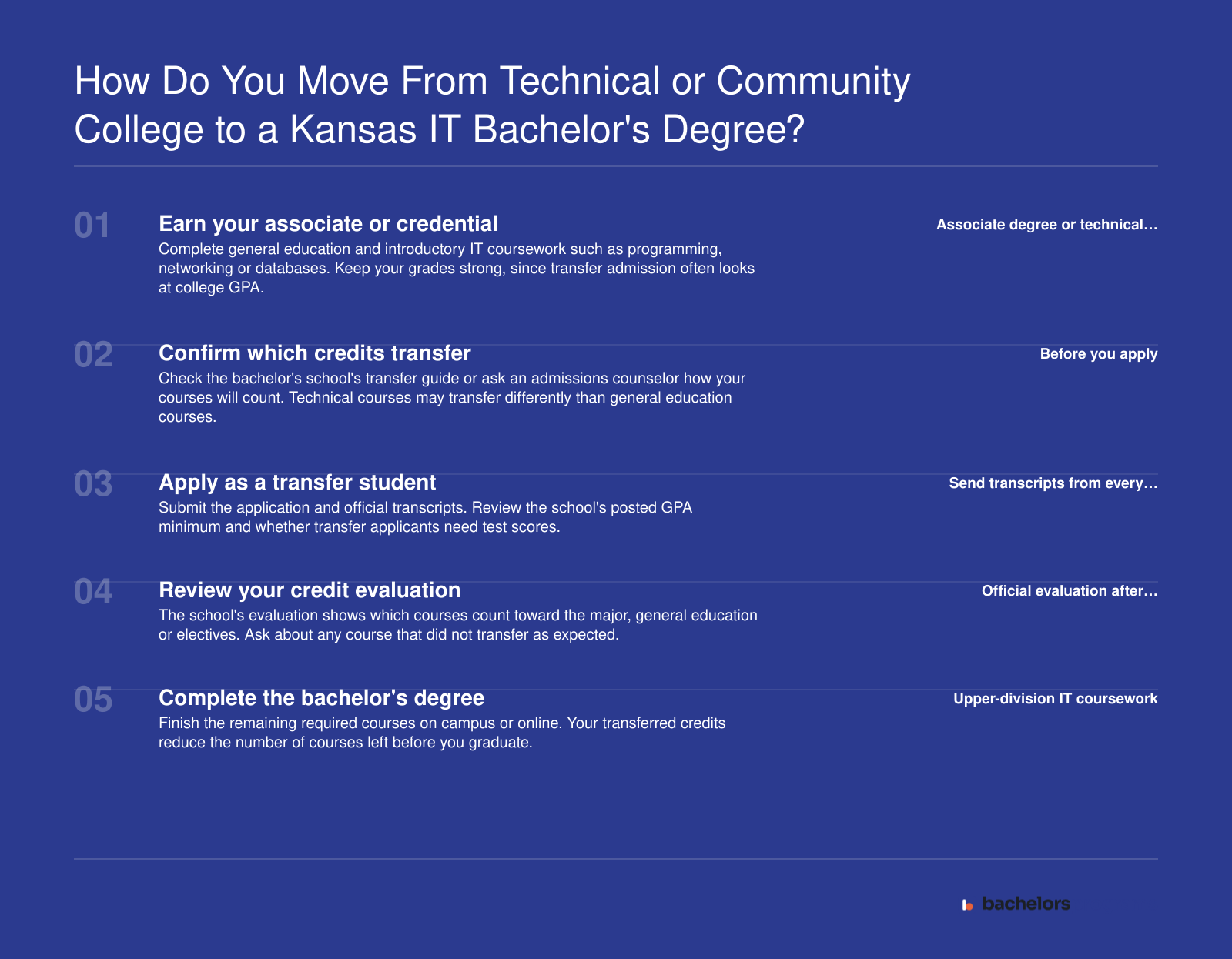
How Do You Move From Technical or Community College to a Kansas IT Bachelor's Degree?
Many Kansas students start an information technology education at a technical or community college and finish at a four-year school. Transfer rules differ by school and by course, so treat each step below as something to confirm directly with the bachelor's program you plan to attend.
Cost of an IT Bachelor's Degree in Kansas: Tuition, Net Price and State Aid
For Kansas residents, a public university is the cheapest route to an IT bachelor's degree, and that advantage holds even after financial aid.
Sticker Price vs. Net Price
Published in-state tuition and fees at the schools ranked here run from $9,684 at Wichita State University to $37,174 at MidAmerica Nazarene University. Out-of-state rates range from $17,160 to $37,174. Residency matters most at the public universities: Wichita State charges nonresidents $19,869, and the University of Kansas charges $30,432 against $12,102 for Kansans. Private schools such as Friends University and Ottawa University-Ottawa charge one rate regardless of residency.
Average net price is what aided students actually paid after grants and scholarships. It ranges from $13,194 at Wichita State to $32,165 at MidAmerica Nazarene. Read it as a sector-specific average: public universities report it for in-state students, while private schools report it across all aided students. Net price also includes housing and books, so it can exceed tuition at public schools. At private schools the gap runs the other way. Friends lists $34,192 in tuition but an average net price of $27,715.
Kansas Grants and Scholarships
- Kansas Comprehensive Grant: Need-based aid for Kansas residents enrolled full-time at 18 private Kansas colleges, the six state universities and one municipal university. There is no separate application; list an eligible Kansas school on your FAFSA.1 Awards run $200 to $10,000 at private institutions and $100 to $4,000 at public ones. Only about one in three eligible students receives it, so file early.
- Kansas State Scholarship: Up to $1,000 a year, generally $500 per semester, depending on need and state funding.2 It renews for four undergraduate years (five for designated five-year programs), but you must reapply every year. Applications open in January for the following academic year.
- Kansas Promise Scholarship: A last-dollar award for tuition, required fees, books and materials left after other gift aid, capped at 68 credit hours or $20,000. Applicants must be U.S. citizens and Kansas residents, generally within 12 months of high school graduation, and meet income limits ($150,000 for a family of three).3 They must also enroll in a Promise-eligible program, finish within 36 months and live or work in Kansas for two years afterward. The spring 2027 deadline is March 1, 2027, and funds are awarded first-come, first-served.4
Debt at Graduation
Median debt for completers ranges from $15,000 at MidAmerica Nazarene to $25,000 at Friends. Among IT graduates specifically, University of Kansas completers carry a median of $25,811, about $274 a month on a 10-year plan. Wichita State's carry $13,684, about $145 a month. Every grant dollar you secure first shrinks that payment.
Questions to Ask Yourself
How many of your technical or community college credits will actually transfer?
Would a school's online rate or an in-state campus rate leave you with less debt after Kansas grants?
Is the program's median debt reasonable compared with its reported earnings?
Related Articles
IT Careers and Salaries in Kansas for Bachelor's Graduates
The table below shows U.S. Bureau of Labor Statistics Occupational Employment and Wage Statistics (OEWS) figures for May 2025, the latest release, covering five core IT occupations statewide and in the Kansas City, MO-KS metro, where computer and mathematical occupations as a group posted a median wage of $103,230. Metro medians run above the statewide figures in every occupation where both are reported, and software development is the largest of these fields in Kansas by employment, so Kansas City, Wichita and Topeka graduates should weigh local pay alongside the statewide numbers. Kansas has no state license for IT work, so employers look to optional industry certifications such as CompTIA Security+, CompTIA A+ and Cisco CCNA to confirm job-ready skills.
| Occupation | Kansas Median Annual Wage | Kansas City Metro Median Wage | Employment in Kansas |
|---|---|---|---|
| Software developers | $105,050 | $119,860 | 11,770 |
| Information security analysts | $102,780 | $119,430 | 2,540 |
| Computer systems analysts | $93,740 | $109,490 | 4,580 |
| Network and computer systems administrators | $91,560 | N/A | 2,120 |
| Computer user support specialists | $52,740 | $59,040 | 6,950 |
What Top Kansas IT Programs' Graduates Earn
The University of Kansas posts the highest program-level median earnings among the Kansas schools ranked here.
How to Choose a Kansas IT Bachelor's Program
Choosing well starts with knowing which of three similar-sounding fields you actually want. Information technology is the applied side: networks, servers, cloud infrastructure, user support and security operations, the work of keeping systems running and protected. Information systems sits closer to business, connecting software and data to processes like accounting, supply chain and management reporting. Computer science is the theory-heavy option, built around algorithms, computation and software engineering. At Wichita State, for instance, the program pairs information technology with management information systems, so you can see the business-facing side in the same degree.
Check accreditation, then specializations
Ask where a program's accreditation sits. ABET's Computing Accreditation Commission reviews IT and computer science programs against technical standards, ACBSP and IACBE review business-oriented programs, and every regionally accredited institution meets the baseline for federal aid and transfer credit. The ranked cards note accreditation where it applies, so read those lines rather than assuming a school's overall reputation covers the major.
Concentrations matter just as much. Cybersecurity, cloud computing, networking and data analytics are the common tracks, but titles vary and a school may fold them into electives instead of a named concentration. Confirm the actual catalog language at each school rather than trusting a marketing page.
Ask about internships and employer ties
Kansas IT hiring clusters in the Kansas City metro, Wichita and Topeka. Ask each program who recruits on campus, whether internships are arranged or merely encouraged, and whether courses run in the evening for working students. A program with standing relationships at area health systems, insurers, manufacturers or government agencies will shorten your search for a first job.
A simple decision rule
Match format and net price first: online or campus, and what you will actually pay after aid. Then compare specializations against the roles you want, and finally weigh internship pipelines and graduate outcomes. Interest alone should not outrank a price tag you cannot carry.
Compare Information Technology programs on the data that matters
Explore more Computers & IT majors or browse every field of study.
All Computers & IT programs Browse every field of study