Best Public Health Schools in Pennsylvania
Compare 34 accredited Public Health programs in Pennsylvania, with net price after aid, graduation rates, earnings and debt from IPEDS and the U.S. College Scorecard.

You can study public health at Pennsylvania campuses from Philadelphia to Erie, and the state's schools also shape the online options. Most schools award the Bachelor of Science (B.S.) in Public Health, though a few grant a B.A. or a differently named degree.
Rankings here weigh net price, graduation rate, earnings and format, not research citations, so a small college can outrank a research university.
Cost is the real tension. Sticker prices vary widely between public and private schools, and aid narrows the gap unevenly. Entry-level roles such as health education specialist typically ask for a bachelor's degree, but practicum experience often counts as much as the school name.
Key Points
- West Chester University charges $10,775 in-state versus $22,599 out-of-state.
- The University of Pittsburgh sets separate GPA and credit thresholds for the major.
- Ranked public health bachelor's programs here are campus-format, with local agency placements.
Best Bachelor's in Public Health Schools in Pennsylvania: Top 10 Ranked
Pennsylvania's strongest bachelor's-level public health options range from an Ivy League program built on social science to large public research universities that place students inside county health departments. Every school below awards a bachelor's degree in public health or a closely related field such as population health, and the list spans Philadelphia, Pittsburgh, the Lehigh Valley, and smaller campuses across the state.
University of Pennsylvania
#1Philadelphia, PA · $29,000/yr (est. net price)
Best for: Social-science minded health policy students
The University of Pennsylvania is a private Ivy League university in Philadelphia where public health sits inside the Health and Societies major rather than standing alone. Students approach health through anthropology, history, and sociology instead of a purely scientific track, and the city gives them access to hospitals, municipal agencies, and nonprofit health organizations. It is the most selective school on this list, admitting a small fraction of applicants each year.
- 34 course units required for the major
- Built on anthropology, history, and sociology
- Adds a focused public health core plus electives
- Quantitative methods coursework and a capstone research seminar
- Optional honors track with an independent thesis
- Global outlook paired with local field experience
University of Pittsburgh-Pittsburgh
#2Pittsburgh, PA · ~$30,000/yr (est.)
Best for: Service-learning focused community health volunteers
The University of Pittsburgh is a public research university whose public health school maintains long-standing ties to the Allegheny County Health Department, including internship placement under a master affiliation agreement. Undergraduates take a four-year multidisciplinary curriculum and complete service-learning work with Pittsburgh community organizations such as farmers markets and food pantries. It pairs a large research base with a defined cohort of majors and offers internal transfer for current Pitt students.
- CEPH accredited Bachelor of Science in Public Health
- Four-year multidisciplinary curriculum
- Service-learning placements with Pittsburgh community groups
- Volunteer work at farmers markets and food pantries
- Coursework in climate change, data science, and health equity
- Covers health technology and innovation in health promotion
- Internal transfer available for current Pitt students
Lehigh University
#3Bethlehem, PA · ~$37,000/yr (est.)
Best for: Data-driven population health analysts
Lehigh University is a private research university in Bethlehem offering a BS in Population Health, a data-heavy alternative to a traditional public health degree. Coursework blends biostatistics, epidemiology, policy, and quantitative research methods, and undergraduates can join faculty research projects, internships, and community partnerships at an R1 institution. It suits students who want analytics training alongside health policy.
- BS in Population Health, one of few such programs nationally
- Combines data science, public health, and policy
- Foundation in biostatistics, epidemiology, and social sciences
- Research projects, internships, and community partnerships
- R1 research university with undergraduate research access
- Pairs well with business, psychology, or economics majors
- Prepares students for medical school and graduate public health study
Temple University
#4Philadelphia, PA · $23,000 – $39,000/yr (est.)
Temple University is a large public research university in Philadelphia with one of the earliest CEPH-accredited undergraduate public health programs in the country. The degree requires 300 hours of fieldwork in Philadelphia-area agencies, and eligible students can move into an accelerated BS-to-MPH track. Undergraduates can also work alongside faculty in research labs and centers while completing a 120-credit curriculum.
- CEPH accredited B.S. in Public Health
- 120 total credit hours
- 300 hours of hands-on fieldwork in Philadelphia agencies
- One of the country's earliest accredited undergraduate programs
- Accelerated BS-to-MPH +1 track for eligible students
- Coursework in epidemiology, biostatistics, and health policy
- Opportunities in faculty research labs and centers
Franklin and Marshall College
#5Lancaster, PA · ~$36,000/yr (est.)
Franklin & Marshall College is a private liberal arts college in Lancaster where public health is a full major spanning science, social science, and humanities. Students choose among biology, government, or sociology tracks, and they can pursue faculty research, workplace health and safety internships, or study abroad. Recent graduates have continued to public health graduate schools including Columbia, Harvard, and Johns Hopkins.
- Three concentration tracks: biology, government, sociology
- Draws on science, social science, and humanities
- Covers burden of disease, health measurement, and human rights
- Independent research with faculty as an undergraduate
- Internships in workplace health and safety and climate-and-health education
- Study abroad in Kenya, Vietnam, Argentina, and Senegal
- Graduates have entered Columbia, Harvard, and Johns Hopkins programs
Muhlenberg College
#6Allentown, PA · ~$29,000/yr (est.)
Muhlenberg College is a private liberal arts college in Allentown with a B.A. in Public Health built around epidemiology, environmental health, health communication, and policy. Small classes and a 9:1 student-faculty ratio support close work with faculty, and students take on community-based research and internships across the Lehigh Valley. The program emphasizes health equity and data-driven interventions.
- B.A. in Public Health combining science, policy, and practice
- Coursework in epidemiology, environmental health, and health policy
- Student research on vaping, air quality, and health communication
- Internships at Allentown health networks, shelters, and food banks
- 9:1 student-faculty ratio with small classes
- Peer Health Advocates campus outreach program
West Chester University of Pennsylvania
#7West Chester, PA · $20,000 – $25,000/yr (est.)
West Chester University of Pennsylvania is a public university in the Philadelphia suburbs with a CEPH-accredited B.S. in Public Health and some of the lowest in-state tuition in the region. The program requires a full-semester capstone internship at a county health department, hospital, or voluntary agency, and graduates are eligible to sit for the national CHES exam. Students can also pursue an accelerated B.S./M.S. pathway and more than 670 study abroad options.
- CEPH accredited B.S. in Public Health
- 120 total credit hours with a 2.5 GPA minimum
- Full-semester capstone internship at health agencies or hospitals
- Prepares graduates to sit for the national CHES exam
- Accelerated B.S./M.S. in Public Health pathway
- More than 670 study abroad options
- Service-learning projects in community health
Saint Francis University
#8Loretto, PA · $24,000/yr (est. net price)
Saint Francis University is a private Catholic university in Loretto offering a four-year, 128-credit B.S. in Public Health with four concentration options. Supervised research, summer internships, and an evidence-based capstone give students applied experience in a small-campus setting, and a faculty advisor guides course sequencing. Concentrations include epidemiology, environmental science, health policy, and pre-medicine.
- 128-credit, four-year B.S. in Public Health
- Four concentration options, including epidemiology and pre-medicine
- Evidence-based capstone project required
- Supervised research with faculty
- Summer internships and volunteer placements
- Must pass comprehensive Exam 401 to graduate
Immaculata University
#9Immaculata, PA · ~$24,000/yr (est.)
Immaculata University is a private Catholic university in Chester County that houses public health in its Department of Civic Engagement, alongside public administration, politics, and sociology. The B.A. draws on nutrition, biology, economics, political science, and psychology, and the department frames its programs as preparation for graduate study, law school, and government service. Students finish with a research seminar and a senior seminar.
- B.A. in Public Health in the Department of Civic Engagement
- Coursework spans nutrition, biology, economics, and political science
- Research seminar plus senior seminar to close the major
- Department describes the degree as preparation for graduate study and law school
- Grouped with public administration, politics, and sociology programs
Elizabethtown College
#10Elizabethtown, PA · $27,000/yr (est. net price)
Elizabethtown College is a private college in Lancaster County whose B.A. in Public Health focuses on the social and behavioral side of health. The major can be paired as a second major with political science or psychology, and the college advertises an early assurance pathway into a Penn State College of Medicine MPH for qualifying students. Graduates head into community wellness, health promotion, epidemiology, and health policy work.
- B.A. in Public Health focused on social and behavioral science
- Can be added as a second major with political science or psychology
- Early assurance pathway to a Penn State College of Medicine MPH
- Prepares students for advocacy, policy, and program administration
- Coursework emphasizes prevention and evidence-based decision-making
Cost & outcomes by school
Federal data for the highest-earning Public Health programs, independent of the ranking above. Earnings are this field's bachelor's graduates four years after completing where the Scorecard reports them, else the school's undergraduate median.
| School | Net price / yr | Grad rate | Earnings | Debt | Grads/yr | Format |
|---|---|---|---|---|---|---|
| University of Pennsylvania PA | $28,699 | 97% | $111,371 | $15,715 | — | Campus |
| Lehigh University PA | $36,931 | 88% | $105,584 | $21,960 | 58 | Campus |
| Franklin and Marshall College PA | $36,425 | 84% | $75,867 | $20,875 | 20 | Campus |
| Immaculata University PA | $24,258 | 71% | $75,701 | $27,000 | 1 | Campus |
| Commonwealth University of Pennsylvania PA | $15,699 | 55% | $75,679 | $26,000 | — | Campus |
| Duquesne University PA | $37,730 | 78% | $74,742 | $26,244 | 13 | Campus |
| Drexel University PA | $38,509 | 78% | $72,736 | $27,000 | 21 | Hybrid |
| Muhlenberg College PA | $28,905 | 82% | $69,107 | $24,497 | 16 | Campus |
| Gwynedd Mercy University PA | $27,483 | 57% | $67,145 | $25,000 | 8 | Campus |
| University of Pittsburgh-Pittsburgh PA | $30,434 | 86% | $66,125 | $24,250 | 35 | Campus |
| Misericordia University PA | $37,485 | 72% | $64,313 | $26,973 | — | Campus |
| Wilkes University PA | $27,743 | 63% | $63,454 | $26,000 | — | Campus |
Sources: U.S. Department of Education. Net price, graduation rate, earnings and debt: College Scorecard (earnings and debt for this field's bachelor's graduates where reported, else school-wide); graduates: IPEDS. A dash means no figure is reported.
Cost, debt & payoff
Median earnings of this field's bachelor's graduates (4 yrs after completing, else the school's undergraduate median) vs. their median federal loan debt · U.S. College Scorecard
Across these programs the median graduate earns about $60,530 and finishes with roughly $26,798 in debt — a ratio that clears a common rule of thumb (keep debt below first-year salary). Net price and debt vary widely school to school, so check the per-school figures in the table above before you shortlist.
Most Affordable Pennsylvania Schools for a Bachelor's Degree in Public Health
These Pennsylvania schools from our directory are sorted by average annual net price, which is what students pay after grants and scholarships, based on 2024 IPEDS and College Scorecard data from the U.S. Department of Education. Indiana University of Pennsylvania has the lowest net price at $16,804. Cedar Crest College and La Salle University show how much aid can matter: their published tuition is well above the public universities, but their net prices land within a few thousand dollars. East Stroudsburg University and La Salle University both list Council on Education for Public Health accreditation for their programs, and Central Penn College offers its B.S. in Public Health fully online.
| School | City | Type | Format | In-State Tuition & Fees | Out-of-State Tuition & Fees | Average Net Price | Graduation Rate |
|---|---|---|---|---|---|---|---|
| Indiana University of Pennsylvania | Indiana | Public | Campus | $11,380 | $16,297 | $16,804 | 55.5% |
| East Stroudsburg University of Pennsylvania | East Stroudsburg | Public | Campus | $11,536 | $19,502 | $18,134 | 43.1% |
| Cedar Crest College | Allentown | Private nonprofit | Campus | $46,314 | $46,314 | $18,659 | 60.4% |
| Central Penn College | Summerdale | Private for-profit | Online | $19,854 | $19,854 | $18,953 | 50.9% |
| La Salle University | Philadelphia | Private nonprofit | Campus | $37,800 | $37,800 | $19,409 | 57.1% |
Online and Hybrid Public Health Bachelor's Options at Pennsylvania Schools
Campus, Online, and Hybrid Formats Compared
Most of the public health bachelor's programs ranked here are campus-format degrees. That matters for fit: a residential program puts you in labs, in service-learning placements with local health agencies, and in faculty research projects, face to face. It suits students arriving from high school or transferring after a year or two elsewhere.
Central Penn College's Bachelor of Science in Public Health is built to be completed online, for students who are balancing work, family, and other responsibilities.1 Its published pages do not spell out whether any sessions require a campus visit, how many transfer credits it accepts, or the 2026 online rate, so put those three questions to an admissions counselor before you apply.1
Full Online Degrees vs. Completion Tracks
Online public health options come in two shapes. A full online B.S. admits first-year students and runs the entire curriculum remotely. A completion track assumes roughly two years of prior college credit and may still require an in-person lab, practicum, or internship near your home. Ask which of the two a program offers before you count the credits you already have.
Who Each Format Suits
Working adults with full-time jobs tend to do best in part-time online or hybrid formats that let them keep working while they study. Transfer students should favor programs with generous credit-transfer policies and clear grade minimums. Out-of-state students studying online at a Pennsylvania school pay no relocation costs, but tuition is usually set per credit rather than per semester.
Online rates are often priced separately from on-campus rates and may carry a distance-learning fee. Check the per-credit figure for the online plan against the resident and nonresident rates in our cost section.
Related Articles
Admissions: GPA, Test Policy and Transfer Credit for Pennsylvania Public Health Bachelor's Programs
Admission to a public health bachelor's program often happens in two stages: first you get into the university, then you qualify for the major itself. The University of Pittsburgh shows this most clearly, setting separate GPA and credit thresholds for current students, regional campus students and outside transfers.
Pitt Publishes the Most Detailed Transfer Path
Pitt's School of Public Health spells out who can enter the B.S. in Public Health and how:
- Current Pitt students: A 3.0 cumulative GPA and at least 12 credits earned at Pitt.1
- Regional campus students: At least 30 Pitt credits and a 3.0 GPA.
- External transfers: At least 24 transferable college credits. A 3.0 is preferred on the admissions page, and the program's FAQ lists 3.0 as the minimum to apply.2
- Applicants with 48 or more credits: Expected to have completed one college English composition course and one college algebra or higher math course with a C or better.
Pitt re-evaluates each transferred credit and prior exemption, and not all of them count toward the major. The pages reviewed do not state an SAT or ACT policy specific to the public health major.
West Chester and the Other Ranked Schools
West Chester University of Pennsylvania lists a 2.5 GPA minimum for its B.S. in Public Health. For the University of Pennsylvania, Lehigh University, Temple University, Franklin and Marshall College, Muhlenberg College, Saint Francis University, Immaculata University and Elizabethtown College, our research did not turn up a published public health minimum GPA, test policy or transfer-credit rule. Confirm the specifics with each school before you apply.
Selectivity at a Glance
These admission rates are institution-wide, not specific to public health:
- Most selective: University of Pennsylvania (5.4%), Lehigh (25.9%), Franklin and Marshall (28.2%).
- Moderately selective: University of Pittsburgh (58.1%), Muhlenberg (72.0%).
- Broadly accessible: Saint Francis (76.8%), Elizabethtown (77.9%), West Chester (78.4%), Temple (80.4%), Immaculata (85.8%).3
Key Takeaways
- Test policy: Confirm SAT and ACT rules with each school, since the program pages reviewed do not settle the question.
- Transfer-friendly: Pitt offers the clearest, most structured transfer route, with three defined pathways.
- GPA floors: Pitt expects a 3.0; West Chester sets a 2.5.
- Selectivity: Penn, Lehigh and Franklin and Marshall admit the smallest share of applicants.
In-State vs. Out-of-State Tuition at Pennsylvania's Ranked Schools
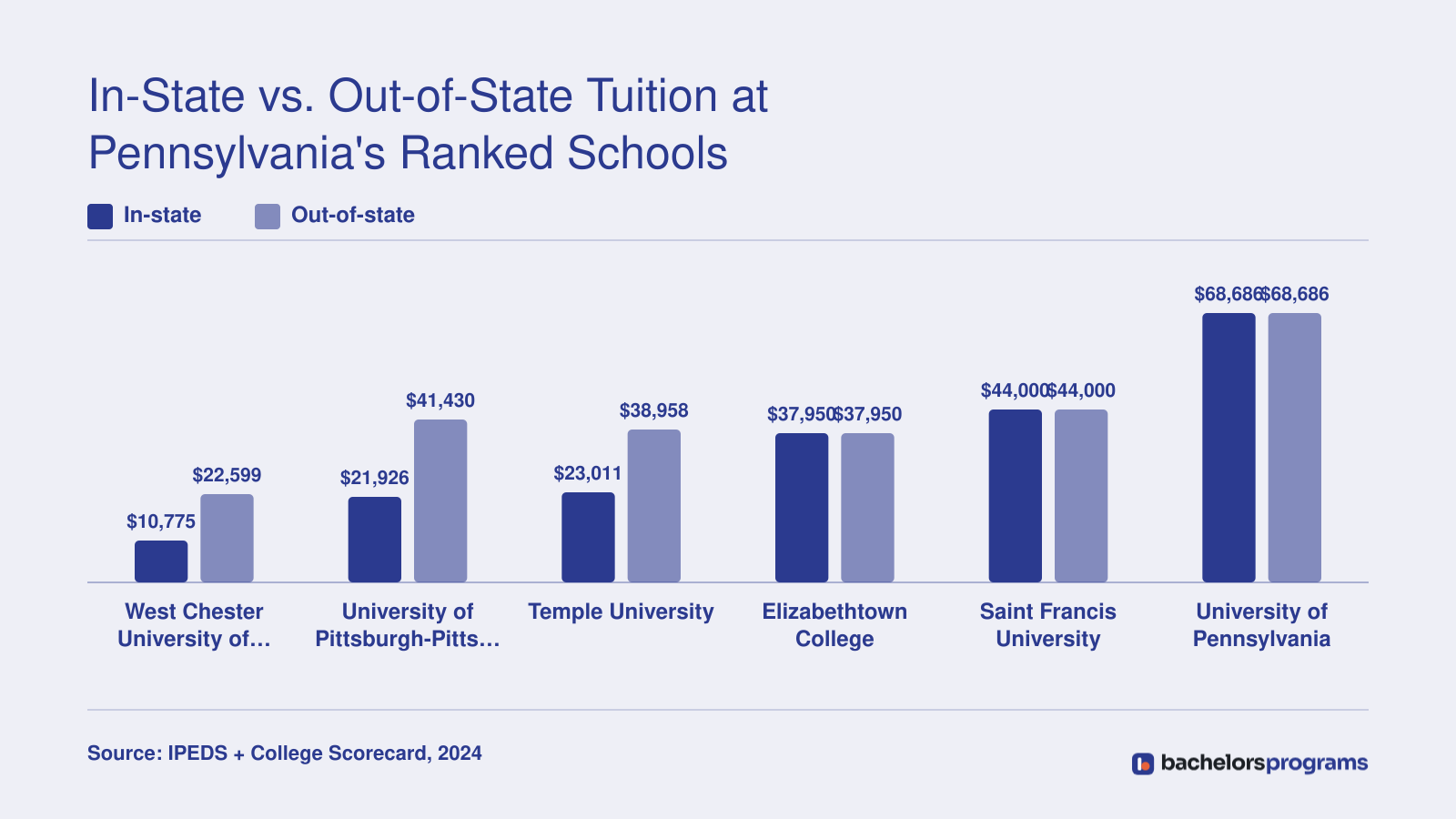
Residency matters most at Pennsylvania's public universities: West Chester University of Pennsylvania charges $10,775 in published in-state tuition and fees versus $22,599 out-of-state, and the gap reaches roughly $16,000 at Temple University and $19,500 at the University of Pittsburgh-Pittsburgh. The private colleges shown charge one rate regardless of residency, from $37,950 at Elizabethtown College to $68,686 at the University of Pennsylvania. These are sticker prices before grants and scholarships, so compare each school's net price after aid before ruling it out.
Questions to Ask Yourself
Can you realistically cover the net price at a private college, or does a state-grant-eligible public university make more sense?
Do you want to work in Pennsylvania health departments and hospital systems, or build a career elsewhere?
Do you plan to sit for the CHES credential, and does the coursework line up with it?
Does the format fit how you actually need to study?
What Health Education Specialists Earn in Pennsylvania
Health education specialist is one of the most direct career paths from a bachelor's degree in public health, so the federal wage benchmark is a useful starting point.
Compare Public Health programs on the data that matters
Explore more Healthcare majors or browse every field of study.
All Healthcare programs Browse every field of study