Best Animation Degree Programs
Compare 100+ accredited Animation programs at 90+ colleges, with net price after aid, graduation rates, earnings and debt from IPEDS and the U.S. College Scorecard.

Net price after aid for a bachelor's degree in animation runs from roughly $3,800 to $31,000 a year among the programs ranked here, and campus, online and hybrid formats all appear on that list. The credential is usually the Bachelor of Fine Arts (B.F.A.) in Animation, an undergraduate degree; graduate study is a separate track.
Cost and fit rarely point to the same school. A program with a strong stop-motion lab and thin 3D pipeline training can leave a graduate short of studio hiring standards.
Studios hire from reels far more than transcripts.
Key Points
- Cal State LA and Cal State Chico put California atop the ranking.
- A B.F.A. centers studio work, while a B.A. leaves room for liberal arts.
- Expect a portfolio: many top animation programs require or strongly recommend one.
Best Animation Schools Ranked: Top 10 Bachelor's Programs at a Glance
These ten programs span public and private campuses, large research universities and focused art colleges, and price points from a few thousand dollars to well past fifty thousand. Every entry below awards a bachelor's degree in animation, and each card shows what the school reports about cost, completion, and program focus.
Brigham Young University
#1Provo, UT · $15,000 – $20,000/yr (est.)
Best for: Portfolio-review applicants wanting rigorous BFA structure
Brigham Young University in Provo, Utah, runs a limited-enrollment BFA in Animation inside its Design area, where students move from a pre-major course through a June portfolio review before entering the major. The curriculum builds modeling, lighting, rigging, and character animation skills alongside animation history and a final project. The school's overall graduation rate is about 81%, and admitted students typically face an admission rate near 68%.
- 65-credit BFA in Animation housed in the Design area
- Limited enrollment with departmental approval required
- Students enter pre-BFA status after the intro course
- Admission decided through a June portfolio review
- Coursework in modeling, lighting, rigging and animation
- Includes animation history and critical theory
- Collaborative interdisciplinary production projects
- BFA final project or capstone in animation analysis
Fashion Institute of Technology
#2New York, NY · $6,000 – $17,000/yr (est.)
Best for: New York City students targeting industry connections
The Fashion Institute of Technology in New York City teaches animation within a BFA in Animation, Interactive Media, and Game Design, drawing on faculty who work in the industry and on the city's animation, visual effects, and motion graphics sector. Coursework runs from storyboarding and 3D modeling to rigging, game engines, and virtual reality, and every student finishes a thesis and reel. The school's overall graduation rate is about 81%.
- BFA in Animation, Interactive Media, and Game Design
- Competitive portfolio required for admission
- Coursework in storyboarding, 3D modeling and rigging
- Covers motion graphics, game design and virtual reality
- Students complete an individual thesis and reel
- Team projects staged in production-style classrooms
- Taught by active industry professionals
- Guest speakers and site visits across New York City
California State University-Los Angeles
#3Los Angeles, CA · ~$4,000/yr (est.)
Best for: Stop-motion hopefuls who want hands-on lab access
Cal State LA offers a BA in Art with an Animation Option that blends traditional and digital technique, and its dedicated stop-motion facility is described as the only one on a California State University campus. Students work in Adobe Suite, Maya, Blender, DragonFrame, Harmony ToonBoom, and Z-Brush while studying story, visualization, and abstract animation. The school's overall graduation rate is about 53%, with an admission rate above 90%.
- BA in Art with an Animation Option
- Combines traditional and contemporary animation techniques
- Coursework in stop-motion, 2D and 3D animation
- Labs use Maya, Blender, DragonFrame and ToonBoom
- Dedicated stop-motion facility, the only one in the CSU
- Students blend analog and digitally processed images
- Emphasis on experimentation with the animated form
- Story and visualization courses alongside studio art
The University of Texas at Dallas
#4Richardson, TX · $18,000/yr (est. net price)
UT Dallas awards a BA in Animation and Games through the Harry W. Bass Jr. School of Arts, Humanities, and Technology, with a studio-based curriculum covering 3D computer animation, motion capture, motion graphics, and game design. The 120-credit degree lets students shape a large share of upper-division work through their own course selections. The school's overall graduation rate is about 76%, and an 18-credit minor is available for students in other majors.
- 120-credit BA in Animation and Games
- Studio environment with 3D animation and motion capture
- Coursework in motion graphics and social gaming
- 28 lower-division and 21 upper-division major credits
- Six upper-level animation and games courses required
- At least two of those courses must be 4000 level
- Explores visual narrative, game mechanics, experimental animation
- 18-credit Animation and Games minor also offered
Northeastern University
#5Boston, MA · ~$31,000/yr (est.)
Northeastern University in Boston runs a BFA in Animation that follows the full production pipeline for film, visual effects, broadcast, visualization, and games, with coursework in 2D and 3D motion design and collaboration across VR, AR, and interactive media. A one-year capstone anchors a professional portfolio, and co-op placements have included DreamWorks Animation, Disney Research Imagineering, and ILM. The school's overall graduation rate is about 91%.
- BFA in Animation covering the full production pipeline
- Studio work in 2D and 3D motion design
- One-year capstone project required
- Co-op placements with major animation and VFX studios
- Collaboration with VR, AR, XR and game design students
- Portfolio development for professional presentation
- Prepares animators, VFX artists, modelers and art directors
- CAMD scholarships and financial aid available
Arizona State University
#6Tempe, AZ · ~$15,000/yr (est.)
Arizona State University's Tempe campus offers a BFA in art with an animation concentration through the Herberger Institute for Design and the Arts, teaching 2D, 3D, and stop-motion animation across 120 credit hours with a capstone that builds a presentation portfolio. Faculty specialize in independent animation filmmaking, computer-generated imagery, machine learning, and extended reality, and students work in the Media and Immersive eXperience Center. The school's overall graduation rate is about 68%.
- BFA in Art with an Animation concentration
- 120 credit hours including a capstone portfolio course
- Coursework in 2D, 3D and stop-motion animation
- Courses held at the Sidney Poitier Film School
- Access to the Media and Immersive eXperience Center
- Faculty work in CGI, machine learning and extended reality
- No extra requirements for current ASU students changing majors
- Western Undergraduate Exchange tuition may apply
California State University-Chico
#7Chico, CA · ~$14,000/yr (est.)
Chico State offers a BS in Computer Animation and Game Development with an Animation Production option, one of seven animation production programs in the California State University system. Students choose between 3D animation and CGI course groupings, take a required internship, and work in the Motion Capture Lab and the in-house Chico State Game Studios. The school's overall graduation rate is about 63%, and alumni have landed at Pixar, Blizzard, Epic Games, and Sony Imageworks.
- BS in Computer Animation and Game Development
- Animation Production option with 3D or CGI groupings
- Coursework in 3D character rigging and motion capture
- Required internship built into the degree
- Advanced capstone production studio class
- Work in the Motion Capture Lab
- In-house Chico State Game Studios publishes student games
- Two in-house faculty advisors for animation students
Illinois State University
#8Normal, IL · ~$19,000/yr (est.)
Illinois State University teaches animation through the Animation and Entertainment Arts sequence in its School of Creative Technologies, leading to a BA or BS in Interdisciplinary Technologies. Students cover character design, 2D and 3D animation, motion graphics, storyboarding, and game asset creation, with shared core classes in sound design, creative coding, and web development. Classes are studio-style with small enrollments, and the school's overall graduation rate is about 65%.
- BA or BS in Interdisciplinary Technologies
- Animation and Entertainment Arts sequence
- Character design and digital illustration coursework
- 2D and 3D animation and modeling
- Storyboarding and narrative, including comics
- Asset creation for games and interactive media
- Shared core in sound design, creative coding, web development
- Studio-style courses with small class sizes
University of Hawaii at Manoa
#9Honolulu, HI · $15,000 – $20,000/yr (est.)
The University of Hawaiʻi at Mānoa offers cinematic arts as a BA in its School of Cinematic Arts, with students choosing either an Animation concentration or a Digital Cinema concentration, each with its own entry path. The program sits in the College of Arts, Languages and Letters and appears in the 2026-2027 catalog. The school's overall graduation rate is about 64%, and the Animation concentration is the smaller, more focused of the two tracks.
- BA in Cinematic Arts in the School of Cinematic Arts
- Animation concentration with its own entry requirements
- Digital Cinema concentration also available
- General Cinematic Arts BA offered without a concentration
- Housed in the College of Arts, Languages and Letters
- Listed in the 2026-2027 UH Mānoa catalog
Indian River State College
#10Fort Pierce, FL · ~$3,800/yr (est.)
Indian River State College in Fort Pierce, Florida, awards a Bachelor of Applied Science in Digital Media with a concentration in Animation, Gaming, and Modeling, aimed at students who want advanced technical skill plus management and entrepreneurial grounding. Upper-level work covers interactive media, scriptwriting, ethics, and critical thinking about media, and graduates move into animation, simulation, gaming, and video production roles. The school's overall graduation rate is about 45%, and it is the most affordable entry on this list.
- Bachelor of Applied Science in Digital Media
- Concentration in Animation, Gaming, and Modeling
- Builds skills in graphic design and visual communication
- Upper-level coursework in interactive media and animation
- Includes scriptwriting, ethics and media criticism
- Management and entrepreneurial practices covered
- Prepares for animation, simulation, gaming and web design
- Financial aid, scholarships and low tuition offered
Cost & outcomes by school
Federal data for the highest-earning Animation programs, independent of the ranking above. Earnings are this field's bachelor's graduates four years after completing where the Scorecard reports them, else the school's undergraduate median.
| School | Net price / yr | Grad rate | Earnings | Debt | Grads/yr | Format |
|---|---|---|---|---|---|---|
| Northeastern University MA | $30,915 | 91% | $92,538 | $24,250 | 14 | Campus |
| Drexel University PA | $38,509 | 78% | $84,648 | $25,325 | 26 | Campus |
| Syracuse University NY | $38,793 | 84% | $79,164 | $26,000 | 6 | Campus |
| Loyola Marymount University CA | $48,381 | 79% | $76,522 | $19,500 | 15 | Campus |
| Ringling College of Art and Design FL | $57,742 | 72% | $75,213 | $27,000 | 132 | Campus |
| Brigham Young University UT | $15,564 | 81% | $73,941 | $11,069 | 25 | Campus |
| Art Center College of Design CA | $48,661 | 79% | $71,958 | $37,000 | 116 | Campus |
| Chapman University CA | $46,555 | 82% | $70,070 | $20,500 | 31 | Campus |
| The University of Texas at Dallas TX | $18,267 | 76% | $68,227 | $18,000 | 7 | Campus |
| Michigan State University MI | $19,680 | 81% | $67,253 | $23,250 | — | Campus |
| Azusa Pacific University CA | $22,212 | 62% | $66,677 | $23,219 | 8 | Campus |
| Woodbury University CA | $33,692 | 60% | $65,668 | $26,960 | 16 | Campus |
Sources: U.S. Department of Education. Net price, graduation rate, earnings and debt: College Scorecard (earnings and debt for this field's bachelor's graduates where reported, else school-wide); graduates: IPEDS. A dash means no figure is reported.
Cost, debt & payoff
Median earnings of this field's bachelor's graduates (4 yrs after completing, else the school's undergraduate median) vs. their median federal loan debt · U.S. College Scorecard
Across these programs the median graduate earns about $50,698 and finishes with roughly $24,803 in debt — a ratio that clears a common rule of thumb (keep debt below first-year salary). Net price and debt vary widely school to school, so check the per-school figures in the table above before you shortlist.
How We Ranked the Best Animation Degree Programs
Promotional "best animation school" lists rarely show their math. This one does, so you can check the results yourself.
The Four Criteria
Affordability carries real weight, measured as net price after aid rather than sticker tuition. Completion comes next, drawing on graduation and retention rates. Program-level outcomes follow: earnings and typical debt for graduates where those figures are published. Breadth is the last criterion: programs that teach multiple animation methods (traditional, 2D digital, 3D digital, stop motion) and offer more than one delivery format score higher.1
Sources and Their Limits
Figures come from the College Scorecard and IPEDS, using the most recent federal collection available as of 2026. One caveat matters: both measures describe the whole institution rather than the animation program, so they approximate a program's reality without guaranteeing it. Two students in the same animation cohort can face very different costs.
Recognitions Worth Checking
Institutional accreditation is the baseline, since a school generally needs it for students to receive federal aid.3 NASAD accreditation is separate and program-level, covering curriculum, facilities, faculty and a required capstone project.2 Treat it as an added signal, not a substitute. Beyond that, verify industry claims by their specifics: a named festival, category and year, plus whether the recipient was a student, graduate or faculty member. A wall of logos proves nothing.
What This Ranking Cannot Measure
Portfolio quality, faculty studio credits and how many alumni a particular studio actually hires do not appear in federal data. Read those claims on a school's own site with the same skepticism you brought here.
What Is the Best Degree for Animation? B.A. vs. B.F.A. Compared
The best degree for animation depends on how much of your bachelor's degree you want spent in the studio. A B.F.A. puts studio work at the center, while a B.A. leaves more room for liberal arts and a second field. In either case, animation hiring centers on your demo reel, so judge each program by how well it helps you build one.
| Factor | B.A. in Animation | B.F.A. in Animation |
|---|---|---|
| Studio vs. liberal arts coursework | Usually a larger liberal arts share, with a smaller studio core. The split varies by school, so check each curriculum. | Studio-heavy. NASAD guidelines call for a minimum of 72 credit hours in art and design. One catalog lists about 60 major credits against 39 general education credits (roughly 32 percent). |
| Typical total credits | Generally the standard bachelor's length of about 120 credits. | 120 to 122 credits is common (Syracuse lists 121). Some art schools run longer, and Kansas City Art Institute lists 135. |
| Portfolio and review requirements | Often a lighter portfolio expectation, depending on the school. Confirm admission and review rules with each program. | Portfolio-centered. Curricula combine foundations, digital and traditional animation, 3D CG, story and production studios, and professional development. |
| Flexibility to double major or minor | Higher. Extra liberal arts room makes a minor or second major easier to fit in. | Lower, since studio requirements fill most of the schedule. Double majors are possible but can add credits, as in the Kansas City Art Institute creative writing and studio option. |
| How studios weigh the credential vs. the reel | Studios evaluate your reel first. A B.A. works when your reel shows strong, polished animation. | Studios evaluate your reel first. A B.F.A. helps mainly by giving you more studio time and critique to build that reel. |
| Verdict: who should choose it | Choose it for career flexibility, a non-art school setting, or a lower-cost path that keeps other options open. | Choose it for intensive studio training and a portfolio-first career where most of your time goes into making work. |
Related Articles
Choosing a Bachelor's Degree in Animation: Specialty, Software and Fit
The right animation program is the one whose software and coursework match the jobs you actually want, not the one with the best-known name. Specialty comes first. Each one runs on a recognizable toolset that studios expect you to know before you arrive.
Match the Specialty to the Software
Structured 2D character work still centers on Toon Boom Harmony, which carries a production from rough drawing through rigging and compositing and lets artists share project files across a team. For 3D, Maya or Blender proficiency is typical for character animation roles, and recent postings for 3D gameplay animators pair Maya or Blender with Unreal Engine for engine implementation and real-time testing.1 Entry-level 3D game animator listings also name Unity, expect basic 3D modeling, and require a demo reel.2 VFX-adjacent work leans on Houdini for simulation and Nuke for compositing, while motion design roles group After Effects, Illustrator, Photoshop, and Premiere and expect fluency in the 12 Principles of Animation.3
Reading a Program's Real Focus
Program descriptions give the answer faster than the degree title. Cal State LA lists Maya, Blender, Toon Boom, and Z-Brush and runs the only dedicated stop-motion facility in the CSU system, so it covers traditional and digital pipelines. Chico State's computer animation and game development degree offers concentration options, a motion capture lab, and an in-house game studio pointing at games. UT Dallas builds its animation and games degree around real-time entertainment and 3D motion capture. Illinois State emphasizes storyboarding, character design, and asset creation for games. That is the pattern to look for: named software, named facilities, named output.
Non-Art Schools With Strong Animation Programs
Several ranked programs sit inside large public universities rather than standalone art schools. Texas at Dallas, Arizona State, and BYU all house animation within a broader institution, which usually means lower tuition, wider general education, and a minor or second major you can pair with animation. The trade-off is real: less studio immersion and fewer hours in a dedicated animation lab than a conservatory-style art school provides.
A Three-Question Fit Test
- Specialty: Does the curriculum lead with 2D, 3D, stop-motion, VFX, or games, and does that match your goal?
- Software: Are the tools you will be hired on taught in required courses, not one elective?
- Format and budget: In-state public, private art school, or online, and what will the net cost leave you owing after graduation?
Highest Early-Career Earnings Among Ranked Animation Programs
One program stands out for early-career pay.
Do You Need a Portfolio to Get Into an Animation Program?
Usually, yes. Many top animation programs require or strongly recommend a portfolio. Some university programs admit you to the school first and review your work later, so check both the application and the major's own requirements.
- Number of piecesCounts vary by school. RIT asks for 7 to 10 works, Woodbury for 8, College for Creative Studies for 8 to 12, USC for 10 to 15, and Carnegie Mellon for up to 20.
- Observational and life drawingCollege for Creative Studies requires five drawings from imagination or observation for its animation track. Woodbury's Animation + VFX applicants add at least four observational or life drawing pieces. Ringling emphasizes drawing from real-life references.
- Sketchbook pagesRingling, Woodbury and RIT accept sketchbook work that shows process. Carnegie Mellon takes a multi-page sketchbook as a single PDF of up to 10 MB.
- Animation or motion samplesUSC accepts individual MP4 files totaling no more than 15 minutes. Identify your role in any group project.
- Artist or personal statementUSC asks for a personal statement of up to 1.5 pages. Woodbury requires 250 to 500 words.
- Submission platform and AI rulesCarnegie Mellon, USC, Ringling, College for Creative Studies and New England College use SlideRoom. RIT's 2026 guidelines require original, non-AI work, and USC requires you to disclose any AI use.
- SelectivityNortheastern admits about 5% of applicants. Cal State LA and Cal State Chico admit more than 90%.
- Waivers and later submissionNew England College lets you apply without a portfolio but requires one before enrollment. College for Creative Studies waives it with a 3.0 high school GPA or a 2.5 college GPA.
- Mid-program portfolio reviewAt BYU, students start in pre-BFA status and enter the limited-enrollment major through a June portfolio review. Plan for this second checkpoint.
Best Value Animation Schools: Earnings vs. Debt
The earnings-to-debt ratio divides a school's institution-wide median earnings, measured 10 years after students first enroll, by the median debt its graduates carry. A ratio of 6.8 means typical earnings run about 6.8 times typical debt, but because that figure covers every student at the school, the animation program's own earnings appear in separate columns measured one and five years after graduation. Debt counts as much as salary: Indian River State College, a public school with a $3,815 net price, posts a ratio close to FIT's despite lower earnings, which is how a low-cost public option can outperform pricier schools on return. Median monthly loan payments on a 10-year plan are not reported for these programs in the IPEDS and College Scorecard data.
| School | Program | Average Net Price (per year) | Median Graduate Debt (institution-wide) | Program Median Debt | Program Median Earnings (1 Year After Graduation) | Program Median Earnings (5 Years After Graduation) | Institution Median Earnings (10 Years After Entry) | Earnings-to-Debt Ratio |
|---|---|---|---|---|---|---|---|---|
| Brigham Young University (Provo, UT) | Animation (BFA) | $15,564 | $11,069 | N/A | $38,725 | $87,288 | $75,790 | 6.8 |
| Fashion Institute of Technology (New York, NY) | Animation, Interactive Media, & Game Design | $19,095 | $12,000 | $19,875 | $12,261 | N/A | $62,696 | 5.2 |
| Indian River State College (Fort Pierce, FL) | Bachelor of Applied Science in Digital Media (Animation, Gaming, and Modeling) | $3,815 | $8,023 | $12,500 | $28,874 | $34,990 | $38,315 | 4.8 |
What Professional Animators Earn Nationally
This is a career-wide occupational wage covering animators at every experience level, so expect starting pay to fall below it.
Best Animation Schools by State: Where Are the Ranked Programs?
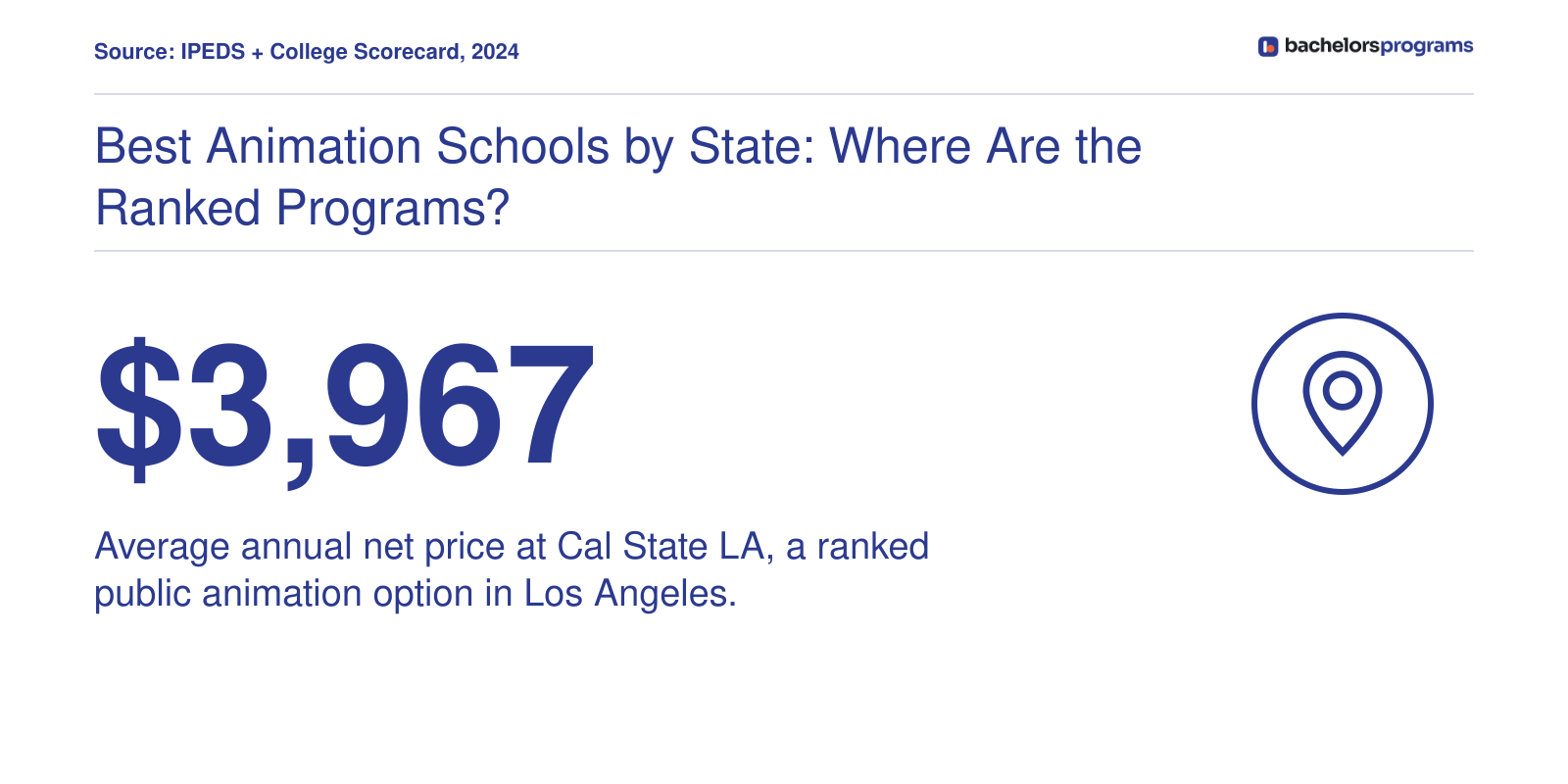
California leads the states on this list, with Cal State LA and Cal State Chico both ranked, and Cal State LA's Los Angeles campus sits close to the city's animation and entertainment studios while Chico is within driving distance of the Bay Area. Beyond California, the West and Southwest are well represented through BYU in Utah, Arizona State, UT Dallas and the University of Hawaii at Manoa. Smaller clusters appear in the Northeast (Fashion Institute of Technology in New York and Northeastern University in Boston), the Midwest (Illinois State) and the Southeast (Indian River State College in Florida), so check bachelorsprograms.com state and regional pages for deeper lists near you.
Animation programs by state
Compare Animation programs on the data that matters
Explore more Arts & Design majors or browse every field of study.
All Arts & Design programs Browse every field of study