Best Online Animation Degree Programs
Compare 12 accredited online Animation programs, with net price after aid, graduation rates, earnings and debt from IPEDS and the U.S. College Scorecard.
Average annual net price at the schools in this ranking runs from $3,815 at Indian River State College to $40,613 at Academy of Art University. The usual credential is a Bachelor of Arts (B.A.) in Animation, though B.S. and B.F.A. versions also appear.
Every program ranked here can be completed 100% online. Hybrid formats with required campus visits were excluded. Tuition is only part of the bill. A workstation that runs Maya or Houdini, a drawing tablet, and software licenses all cost extra. The choice between 2D and 3D tracks decides which tools you need.
Studios rarely ask where you studied. They open the demo reel first, and four years of coursework has to produce that reel.
Key Points
- Every program ranked here lets you finish without campus visits.
- Total price equals tuition per credit times required credits, plus fees.
- The typical animator salary nationally sits above $100,000.
Top 10 Best Fully Online Animation Degree Programs
These 10 programs make up the strongest fully online animation bachelor's cohort for 2026. Hybrid and in-person-only programs were excluded, and each entry here supports remote study of the animation curriculum. The cards below focus on what remote students compare most: credential, concentration, approximate institution-wide net price after aid, graduation rate, and program-level outcomes.
Indian River State College
#1Fort Pierce, FL · ~$3,800/yr (est.)
Best for: Cost-focused digital media students
Indian River State College is a public Florida college in Fort Pierce whose digital media degree emphasizes broad media production skills and affordable access. The animation concentration sits inside a Bachelor of Applied Science in Digital Media, and the institution-wide average net price after aid is about $3,815; the school's graduation rate is 44.9%. Program-level median earnings four years after finishing are $34,741, median debt is $12,500, and the program recorded 26 completions.
- Animation, gaming, and modeling concentration within a digital media degree
- Upper-level coursework in interactive media, animation, and scriptwriting
- Covers graphic design, visual communication, and media entrepreneurship
- Prepares for roles in animation, simulation, gaming, and web design
- Financial aid and scholarships available
Ferris State University
#2Big Rapids, MI · ~$9,000/yr (est.)
Best for: Working adults seeking flexible game-art study
Ferris State University runs its Digital Animation and Game Design program from Big Rapids and Grand Rapids, with a curriculum that spans game development and 3D animation. The bachelor's degree offers two concentration options, and classes are offered online, in blended formats, and face-to-face, so students who need a fully remote path should confirm the online sequence with the department. The institution-wide average net price after aid is about $8,624, and the school's graduation rate is 46.9%; program-level median earnings four years after finishing are $44,116, median debt is $27,000, and the program recorded 71 completions.
- Two concentration options: game development or 3D animation
- 2.5 high school GPA minimum plus SAT or ACT scores
- Named a top-50 game design program worldwide by Princeton Review
- Coursework in 3D modeling, rigging, lighting, and animation
- Portfolio and demo reel preparation
- Classes meet online, blended, or face-to-face
- Entrance exam required
Fairleigh Dickinson University
#3Madison, NJ · ~$23,000/yr (est.)
Best for: Applicants without a portfolio
Fairleigh Dickinson University is a private New Jersey university with a film and animation program that blends live-action study with digital animation. The Film and Animation BA offers 3D, 2D, or video game animation tracks and does not require a portfolio for admission, though submitting one is recommended. The institution-wide average net price after aid is about $22,829, and the school's graduation rate is 66.6%.
- Concentrations in 3D Animation, 2D Animation, and Video Game Animation
- 3D track requires 30 credits of theory and production
- 12 to 15 credits of major electives and 6 cognates
- Coursework includes storyboarding, After Effects, ZBrush, and CAT
- Portfolio not required for admission but recommended
- Thesis I and II cap the studio sequence
- Option to switch concentrations
University of Advancing Technology
#4Tempe, AZ · $29,000/yr (est. net price)
University of Advancing Technology is a small, technology-focused institution in Tempe, Arizona, where game art and animation sit alongside game design and development. The Game Art and Animation bachelor's program, listed as a BA, covers 2D and 3D asset creation for PC, console, mobile, online, and VR platforms, and a fully online option is available. The institution-wide average net price after aid is about $28,522, and the school's graduation rate is 35.1%; the program recorded 3 completions.
- Fully online option available
- 2D and 3D assets for PC, console, mobile, online, and VR
- Coursework in modeling, texturing, rigging, and motion capture
- Classes include Game Art and Animation Fundamentals and 3D Modeling
- Syncflex flexible learning option
- Targets roles such as character artist, animator, and rigger
Wilmington University
#5New Castle, DE · ~$16,000/yr (est.)
Wilmington University's Animation and 3D bachelor's degree runs on 8-week class starts and a 120-credit, 40-course sequence. The official catalog describes the Bachelor of Science as 100% online and does not list campus visits, residencies, or in-person orientations as requirements. The institution-wide average net price after aid is about $15,644, and the school's graduation rate is 19.8%; the program recorded 1 completion.
- 120-credit, 40-course Bachelor of Science completed fully online
- Covers hand-drawn, digital 2D, 3D sculpting, and 3D animation
- Trains in ToonBoom Harmony and SideFX Houdini
- Classes start every 8 weeks
- Typical 3-credit course costs $1,317
- Dual-Credit Certificates in 3D, graphic design, or video production
- Accelerated B.S. to M.S. in Digital Communication option
Los Angeles Film School
#6Hollywood, CA · $31,000/yr (est. net price)
The Los Angeles Film School is a Hollywood-based entertainment school with an online animation degree built around production tools and a supplied tech kit. The Bachelor of Science in Animation offers Visual Effects and Character Animation concentrations, each requiring 120 credit hours, and coursework runs through a learning management system with instructor video lectures and weekly assignments. The institution-wide average net price after aid is about $30,980, and the school's graduation rate is 41.3%; program-level median earnings four years after finishing are $34,138, median debt is $33,250, and the program recorded 67 completions.
- 120 credit hours covering storyboard through final compositing
- Real-time visual effects for games
- CGI combined with live-action plates
- Simulation work in Volumes, Pyro, FLIP, and Ocean
- Trains in Nuke, Houdini, and Marvelous Designer
- TechKit includes an MSI laptop and Huion Kamvas 13 tablet
- Military benefits, financial aid, and scholarships available
- Covers the 12 principles of animation
- Includes a Character Visual Effects course
- Projects built for video games and movies
- Weekly assignments with instructor video lectures
- Adobe Creative Cloud software provided
- Career Development team available
University of Silicon Valley
#7San Jose, CA · ~$28,000/yr (est.)
University of Silicon Valley sits in San Jose and structures its digital art degree around production studio work rather than a traditional semester load. The BA in Digital Art & Animation can be completed on campus or 100% online, and students take three courses per term and graduate with 3 to 5 shipped projects. The institution-wide average net price after aid is about $27,815, and the school's graduation rate is 28.7%; program-level median earnings four years after finishing are $49,968, median debt is $31,000, and the program recorded 35 completions.
- Taught on campus in San Jose or 100% online
- Three courses per term instead of four
- 3D animation, modeling, rendering, and entertainment design
- Technical art for games and media pipelines
- Client-driven projects in USV Studios
- Graduates finish with 3 to 5 shipped projects
- WSCUC accredited
Academy of Art University
#8San Francisco, CA · ~$41,000/yr (est.)
Academy of Art University is a large San Francisco art school with a professional-production bent and a long list of online art degrees. The Bachelor of Fine Arts in Animation and Visual Effects lets students choose an emphasis in visual effects, 3D modeling, 3D animation, 2D animation and stop motion, or storyboarding. The institution-wide average net price after aid is about $40,613, and the school's graduation rate is 34.3%; program-level median earnings four years after finishing are $50,833, median debt is $36,717, and the program recorded 95 completions.
- 120 units: 24 core, 39 major, 9 electives, 42 liberal arts
- Emphasis options include visual effects, 3D, 2D, stop motion, storyboarding
- Core study includes 3D production in Unreal and cinematics
- Portfolio development with faculty and a reel of best work
- Available online and on campus
- Minimum 2.0 GPA and C- in all major coursework
Rocky Mountain College of Art and Design
#9Lakewood, CO · ~$32,000/yr (est.)
Rocky Mountain College of Art and Design is a Colorado art school that runs classes year-round and locks tuition at the initial start date. The Bachelor of Fine Arts in 2D Animation trains students in Toon Boom Harmony and Storyboard Pro, while the 3D Animation track adds Autodesk Maya; a fully online option is available, and on-campus students take some courses online. The institution-wide average net price after aid is about $32,363, and the school's graduation rate is 31.8%; program-level median earnings four years after finishing are $37,239, median debt is $32,982, and the program recorded 36 completions.
- 2D Animation track lists 24 credits; 21 in animation courses
- Coursework in motion studies, character design, storyboarding, animatics
- Covers the 12 principles of animation
- Trains in Toon Boom Harmony and Storyboard Pro
- Portfolio reviews at three levels
- Fully online option available
- 3D Animation track requires 27 credits
- Industry tool: Autodesk Maya
- Portfolio reviews sophomore, junior, and senior years
- Careers include animator, character designer, storyboard artist
- Classes offered year-round
- Locked tuition rate from initial start date
Full Sail University
#10Winter Park, FL · ~$39,000/yr (est.)
Full Sail University is a Florida production school with monthly starts and a technology-included tuition model. The Computer Animation Bachelor of Science is offered on campus and online and moves from drawing and animation principles through modeling, rigging, texturing, lighting, character animation, motion capture, and compositing. The institution-wide average net price after aid is about $38,875, and the school's graduation rate is 44.3%; program-level median earnings four years after finishing are $34,818.
- On campus and online; ACCSC accredited
- Classes begin monthly with a set course sequence
- Covers modeling, rigging, texturing, shading, lighting, compositing
- Trains in Autodesk Maya, Nuke, ZBrush, and Adobe Firefly
- Graduates finish with a demo reel and portfolio
- Admission requires an interview and proof of education
- Up to $15,000 Full Sail Bound Scholarship for campus students
- Tuition covers textbooks and technology fees
Cost & outcomes by school
Federal data for the highest-earning Animation programs, independent of the ranking above. Earnings are this field's bachelor's graduates four years after completing where the Scorecard reports them, else the school's undergraduate median.
| School | Net price / yr | Grad rate | Earnings | Debt | Grads/yr | Format |
|---|---|---|---|---|---|---|
| Fairleigh Dickinson University NJ | $22,829 | 67% | $57,273 | $25,000 | 15 | Online or campus |
| Indian River State College FL | $3,815 | 45% | $34,741 | $8,023 | 37 | Online or campus |
Sources: U.S. Department of Education. Net price, graduation rate, earnings and debt: College Scorecard (earnings and debt for this field's bachelor's graduates where reported, else school-wide); graduates: IPEDS. A dash means no figure is reported.
Cost, debt & payoff
Median earnings of this field's bachelor's graduates (4 yrs after completing, else the school's undergraduate median) vs. their median federal loan debt · U.S. College Scorecard
Across these programs the median graduate earns about $50,698 and finishes with roughly $24,803 in debt — a ratio that clears a common rule of thumb (keep debt below first-year salary). Net price and debt vary widely school to school, so check the per-school figures in the table above before you shortlist.
How We Ranked the Best 100% Online Animation Programs
How do you tell a fully online animation program from one that quietly requires campus visits?
The Filter: Fully Online Only
A program qualifies only if a student can complete the entire animation bachelor's degree without setting foot on campus. Hybrid arrangements, weekend residencies, and degrees that require a summer studio term were excluded outright, even when the coursework itself is delivered online. That is a strict line, and it removes some otherwise strong schools.
What the Composite Measures
Each qualifying program is scored on four plain inputs:
- Cost after aid: average net price, not the sticker tuition printed on the brochure.
- Completion: how many students who start actually finish.
- Volume: how many animation credentials the institution awards each year.
- Outcomes: federal program-level median earnings and typical debt for animation graduates.
Read the Caveats Before You Trust the Order
Two of those inputs, net price and graduation rate, are institution-wide averages rather than animation-specific numbers. Only earnings and debt are reported at the program level, drawn from the most recent federal snapshot available. A small art school with a modest animation cohort is not measured the same way as a large public university.
What This Ranking Cannot Tell You
Nothing here measures the quality of student reels, whether faculty have shipped studio credits, or where graduates actually land. Those factors decide hiring, and you have to check them yourself: watch senior reels, look up instructors on studio credits, and ask about internship pipelines.
Bachelor's Degree in Animation Online: What the B.A. Covers
The real tradeoff in an online animation bachelor's degree is breadth versus studio depth: how much of your four years goes to liberal arts, and how much to drawing, timing, and building shots. The Bachelor of Arts (B.A.) in Animation is the most common online credential. It typically runs about 120 semester credits, split between general education and a studio core.
The Typical Curriculum Arc
Most programs build skills in a predictable order. You can measure any curriculum against this sequence:
- Foundations: Figure drawing, color theory, composition, and design principles come first, usually alongside general education courses.
- Storytelling and motion: Storyboarding, layout, and character animation teach timing, weight, and acting through movement.
- Specialization: Upper-level courses branch into a track such as 2D, 3D, motion graphics, or game animation.
- Capstone: A senior project or demo reel ties the degree together and becomes your main job-search asset.
B.A. vs. B.S. vs. BFA
The letters signal emphasis, not quality. A BFA carries a heavier share of studio credits and fewer general education requirements, which suits students who want maximum time on creative work. A B.A. balances studio courses with more liberal arts in writing, history, and the humanities. A B.S., where offered, tends to lean toward technical subjects such as scripting, visual effects pipelines, or game engines.
Choose based on how you learn and what you want to make. Studios hire on the reel, not on which letters appear on the diploma. A strong portfolio from a B.A. program will carry more weight than a weak one from a BFA program.
How Online Programs Handle Critique
Critique drives animation training, and online programs replace the physical studio with a few formats:
- Recorded reviews: Instructors draw over your frames or narrate feedback on video you can replay frame by frame.
- Async feedback: You post work to a course board and receive written or annotated notes within set windows.
- Cohort critiques: Scheduled live sessions let classmates review each other's shots, much like studio dailies.
Ask each school how often you get one-on-one feedback and whether your coursework builds toward a finished reel by graduation.
What an Online Animation Degree Really Costs: Tuition per Credit vs Total Price
Tuition per credit is the price of one course unit. Multiply it by the credits the animation bachelor's degree requires, add any mandatory online or technology fee, and you have the sticker price of the whole thing. That single calculation is the only fair way to compare schools, because a low per-credit rate attached to a long credit count can cost more than a higher rate on a shorter degree.
Run the Multiplication
Grand Canyon University's online animation emphasis lists $490 per credit across 120 credits, which works out to $58,800, with no mandatory online or technology fee stated. Full Sail prices by academic year rather than per credit, publishing a total of $68,500 with no separate mandatory fee listed, so it cannot be lined up credit-for-credit against a per-credit rate. UF Online publishes $111.92 per credit in tuition plus $17.26 per credit in required fees, but its official pages do not confirm a credit total for an animation bachelor's, so that rate belongs in your notes rather than in a total-cost column. Arizona State's online undergraduate rate climbs from $580 for a single credit to $6,089 at 11 or more, with an Advanced Technology Fee of $50 to $100 per term. Where a per-credit rate cannot be confirmed, leave the school out of the comparison instead of estimating.
Watch the Quarter-Credit Trap
Some schools count in quarter credits, where 180 quarter credits is roughly equivalent to 120 semester credits. A 180-credit program is not automatically 50 percent more expensive than a 120-credit one, so compare total tuition, never the raw credit count.
Net Price, Transfers, and the Cheapest-Rate Myth
Set each published total beside the average net price after aid. Treat that second number as approximate and institution-wide: it reflects all undergraduates at the school, not animation majors, and works as a directional signal rather than a promise. The lowest per-credit rate also does not always produce the lowest degree price. Transfer credit for studio art or general education coursework can remove a semester or more at one school and not another, and required software, a capable workstation, and a drawing tablet land on top of tuition.
The Hidden Line Items: Software, Workstation, and Drawing Tablet Costs
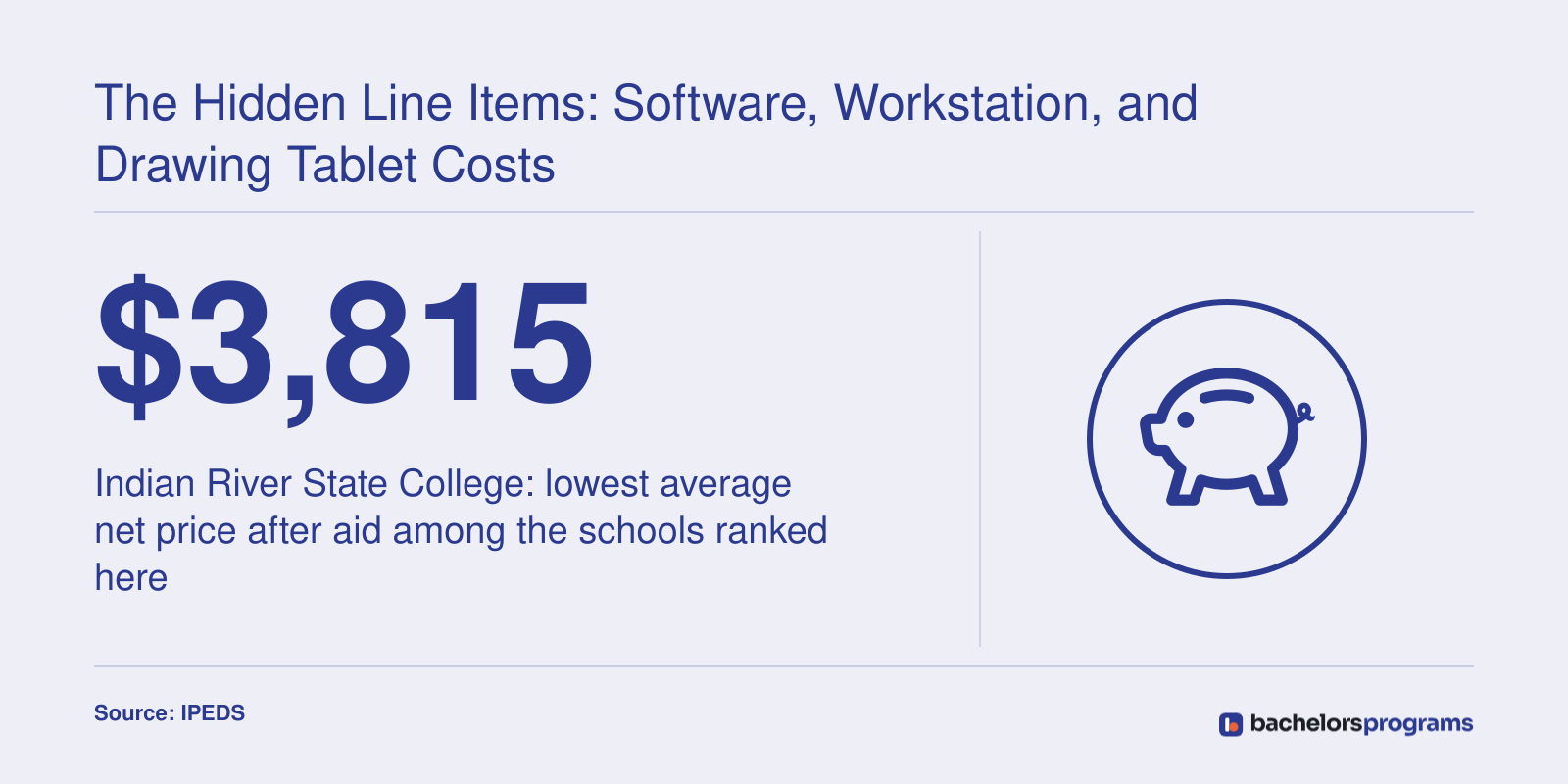
Tuition is only part of the bill. Plan for a workstation or laptop that can handle 3D work, a drawing tablet or pen display, and software such as Autodesk Maya, Toon Boom Harmony and Adobe Creative Cloud, where student or educational licenses generally cost less than commercial ones and Blender is free to use. Some schools cover software through technology fees or virtual labs, so ask each program what it supplies before you buy, and use the lowest net price among the schools ranked here as a baseline for the overall cost.
Related Articles
2D vs 3D vs Motion Graphics vs Game Animation: Which Track Fits You?
Which animation specialty gives an online graduate the widest range of jobs? For many students, the answer is motion graphics: it leads to freelance work and in-house corporate teams across marketing, media, and tech. 3D and game animation can lead to strong careers too, but they lean on production pipelines built around tools like Maya and Unreal. Expect a steeper software curve and a more powerful computer.
2D Animation
- Core software: Adobe Animate is the industry-standard tool for 2D work.1
- Entry-level roles: Animator is the most common starting title.
- Industries hiring: Television, streaming series, and educational content.
- Hardware: A pressure-sensitive drawing tablet matters more than raw processing power.
- Portfolio emphasis: Drawing fundamentals, timing, and short character sequences.
3D Animation
- Core software: Blender is widely used, and studio pipelines often run on Maya.
- Entry-level roles: Junior Cinematic Artist is a typical first title.2
- Industries hiring: Film, visual effects, and advertising.
- Hardware: Rendering and viewport work call for a strong graphics card and plenty of memory.
- Portfolio emphasis: Rigged characters, believable weight and movement, and polished final renders.
Motion Graphics
- Core software: Adobe tools dominate, with Animate appearing in many listings.
- Entry-level roles: Motion designer, with growth toward Motion Graphics Designer. One recent posting for that title listed $80,000 to $100,000 a year.3
- Industries hiring: Ad agencies, corporate communications, broadcast, and product teams.
- Portfolio emphasis: Brand-driven pieces, kinetic type, and interface animation.
Game Animation
- Core software: Engine work in Unity or Unreal, plus Adobe Animate for 2D game assets.
- Entry-level roles: Unity Game Artist/Animator. Students with coding skills can also aim for technical openings such as Animation Tools Programmer, a role PlayStation has posted.4
- Industries hiring: Game studios, from small independent teams to large console publishers.
- Hardware: Similar to 3D, since you often run a game engine and 3D software side by side.
- Portfolio emphasis: In-engine cycles (walk, run, attack) that loop cleanly and respond to player input.
Quick Chooser
Love drawing? Pick 2D. Love rigging and characters? Pick 3D. Drawn to branding and UI? Choose motion graphics. Want to animate what players control? Go with game animation.
Before You Apply: Portfolio and Transfer-Credit Checklist
Admission rules for animation bachelor's programs differ more than tuition does. Confirm each item below with the school's admissions office.
- Find out when the portfolio is dueFIU reviews a portfolio from every applicant. Kansas asks for one only if you miss guaranteed admission. SJSU skips the entry portfolio but holds a Mid-Program Review in the third fall semester.
- Build the portfolio to specCollege for Creative Studies asks for 5 to 12 works, with at least five drawings. CSULB's B.F.A. asks for 10 to 15 images, counts 10 seconds of animation as one piece, and has you choose a track. Life drawing, sketchbook pages and short animation tests suit most schools.
- Check GPA thresholdsArkansas State sets a 2.0 for transfers with 13 or more credits. Kansas pairs a 3.8+ freshman route with test and art-course conditions and expects a 3.5 from transfers. FIU wants a 3.0 in foundation art courses.
- Know the transfer-credit capArkansas State accepts up to 90 of its 120 credits. ArtCenter caps transfer at 60 units and takes studio courses only with a B or better.
- Ask about AP, CLEP and residencyGet a written credit evaluation and the school's residency-credit minimum before you enroll, since these policies vary.
- Gather your basic documentsHave your high school diploma or GED and official transcripts from every school you attended ready to send.
What Animators Earn Nationally
A bachelor's degree in animation prepares you for a field where the typical salary sits above $100,000.
Animation programs by state
Compare Animation programs on the data that matters
Explore more Arts & Design majors or browse every field of study.
All Arts & Design programs Browse every field of study