Best Entertainment Business Degree Programs
Compare 9 accredited Entertainment Business programs, with net price after aid, graduation rates, earnings and debt from IPEDS and the U.S. College Scorecard.

The degree alone rarely decides whether you get hired, internships, relationships and portfolio work carry more weight, but cost still runs from roughly $10,000 a year in net price to well over $30,000 across these programs. Most of these programs award a Bachelor of Science in Entertainment Business, though titles like Entertainment Management or Creative Media and Entertainment also appear.
The real question is which undergraduate programs offer access to music, film, live events and gaming without unmanageable debt. Only bachelor's programs are ranked here, no graduate study, and both campus and online formats appear.
Proximity to Orlando, Philadelphia or Hollywood helps, but the gap between sticker price and first-year pay is what separates programs.
Key Points
- University of Central Florida has the lowest average net price here, $10,411.
- Butler University graduates post the highest first-year earnings among ranked programs.
- Music-focused programs often add essays, portfolios or auditions to general admission.
Best Entertainment Business Schools Ranked
Every school below awards a bachelor's degree in entertainment business or a closely related management credential, and each entry lists format, location, net price and graduation rate alongside program details. The order weighs on-time completion and net price after aid most heavily, with the full criteria laid out in the methodology section below.
University of Central Florida
#1Orlando, FL · ~$10,000/yr (est.)
Best for: Students targeting theme-park entertainment careers
UCF's entertainment management degree is run by the Rosen College of Hospitality Management together with the College of Arts and Humanities, and its Orlando location puts students within minutes of Disney, Universal and SeaWorld. The curriculum builds in three internship levels, so industry experience is part of the degree rather than an optional extra. Students can complete the program on campus or online.
- 120-credit B.S. with 63 credits in the major
- Three required internship levels
- Coursework covers entertainment law, revenue strategies and production management
- Fully online option available
- 2.0 overall GPA minimum for admission
- Campus sits minutes from Disney, Universal and SeaWorld
- In-state tuition $212.28 per credit; out-of-state $891.07
- Program reports a 97% job placement rate
Temple University
#2Philadelphia, PA · $23,000 – $39,000/yr (est.)
Best for: Event management concentration seekers
Temple combines sport and entertainment management in one business-oriented degree, with required coursework in event and entertainment operations, revenue and digital portfolio building. Students complete two internships and may add an event and entertainment management concentration. The main campus setting places students in a city with professional sports, major venues and a large nonprofit events sector.
- 124 total credit hours, including 35-36 GenEd credits
- Optional Event and Entertainment Management concentration (9 credits)
- Two required internships: Internship I and Internship II
- Concentration electives include Event and Entertainment Revenues
- Also offered: Business of Social Events and Weddings
- C- minimum required in sport and entertainment management courses
- 12 free elective credits built into the degree
Drexel University
#3Philadelphia, PA · $39,000/yr (est. net price)
Best for: Co-op driven arts management students
Drexel's entertainment and arts management degree sits in the Westphal College of Media Arts & Design and runs on the quarter calendar with a built-in co-op. Students choose a concentration in visual, performing or media arts management at the end of freshman year. Co-op placements have included Live Nation, Disney and NBC Universal.
- 183-credit BS on the quarter calendar
- One co-op, four-year option
- Three concentrations: visual, performing and media arts management
- Each concentration carries 30 credits
- Built-in business minor
- Co-op placements include Live Nation, Disney and NBC Universal
- BS/MBA dual degree finishes in five years
- Core covers copyrights, trademarks and artist representation
Butler University
#4Indianapolis, IN · $36,000/yr (est. net price)
Butler's creative media and entertainment major is a storytelling and production degree with related coursework in entertainment law, authorship and distribution. It is a 45-credit major with a required capstone and internship, taught on the Indianapolis campus. Students produce, edit and deliver their own content while studying how entertainment media is made and sold.
- 45 credit hours inside the major
- Capstone required
- Coursework spans videography, post-production and narrative production
- Includes entertainment media and the law
- Internship in creative media and entertainment required
- Trains storytellers through recording, editing and delivery
University of North Alabama
#5Florence, AL · $12,000 – $22,000/yr (est.)
The University of North Alabama offers a four-year entertainment industry degree with two emphases, entertainment business and entertainment technology, taught in person in Florence. The business emphasis covers the legal and ethical sides of the music industry and points toward concert promotion, tour management and licensing work. The program is housed in the David and John Briggs Family Department of Entertainment Industry.
- Choose the Entertainment Business or Entertainment Technology emphasis
- Business emphasis covers legal and ethical sides of the music industry
- Technology emphasis focuses on record production equipment and techniques
- Four-year, in-person program
- Both BA and BS degree options
- Prepares students for concert promotion, tour management and licensing roles
- Housed in the Briggs Family Department of Entertainment Industry
Grand Canyon University
#6Phoenix, AZ · ~$22,000/yr (est.)
Grand Canyon University's sports and entertainment management degree sits in the Colangelo College of Business and requires 300 hours of industry experience before graduation. The 120-credit program runs on campus in Phoenix and fully online in 8-week terms, and accepts up to 90 transfer credits. A team-based simulation serves as the capstone.
- 120 credits, including 68 in the major
- 300 hours of paid or unpaid industry experience required
- Fully online option with 8-week terms
- Capstone uses a team-based strategic management simulation
- 2.8 unweighted GPA required, or 2.5 with ACT 19 or SAT 1000
- Up to 90 transfer credits accepted
- Campus tuition $8,250 per semester; online $490 per credit
Albright College
#7Reading, PA · $20,000/yr (est. net price)
Albright delivers its entertainment industry track inside the business administration major, so students take a full business core and then five courses in their chosen track. The entertainment track pairs music marketing and artist management with music law and concert promotion. Internships, site visits, Bloomberg training seminars and study abroad courses in Japan and India round out the program.
- Business administration core plus five courses in a chosen track
- Ten tracks, including Entertainment Industry, Marketing and Sport Management
- Entertainment track covers music marketing, artist management, music law and concert promotion
- Internships, site visits and financial literacy presentations
- Study abroad courses in Japan and India
- Bloomberg training seminars offered
- Annual Dearden Leadership Workshop
Full Sail University
#8Winter Park, FL · ~$39,000/yr (est.)
Full Sail's entertainment business bachelor's degree uses the same curriculum on campus in Winter Park, Florida and fully online, built around a threaded project and portfolio sequence. The campus version runs 21 months and the online version 27, with classes starting monthly. Admission requires no portfolio, audition or prior business coursework, only an interview and documentation.
- 120 credits, same curriculum on campus and online
- 21 months on campus; 27 months online
- Classes start monthly, about two courses per month
- No portfolio, audition or prior business coursework required
- Coursework covers digital marketing, event management and data analysis
- Tuition includes textbooks, manuals and lab and technology fees
- Threaded project and portfolio sequence
- Institutionally accredited by ACCSC
Los Angeles Film School
#9Hollywood, CA · $31,000/yr (est. net price)
The Los Angeles Film School teaches its entertainment business degree partly on campus in Hollywood and partly online, so students work in both formats. Coursework centers on the buying, selling, distribution and publicity of media deals across film, TV and music. Students receive a tech kit that includes a MacBook, Adobe Creative Cloud and Microsoft Office.
- 120 credit hours taken on campus and online
- Covers buying, selling, distribution and publicity of media deals
- Featured courses: Entertainment Marketing, Art of the Pitch, Brand Development
- TechKit includes a MacBook, Adobe Creative Cloud and MS Office
- Hollywood campus
- Accredited by ACCSC
Cost & outcomes by school
Federal data for the highest-earning Entertainment Business programs, independent of the ranking above. Earnings are this field's bachelor's graduates four years after completing where the Scorecard reports them, else the school's undergraduate median.
| School | Net price / yr | Grad rate | Earnings | Debt | Grads/yr | Format |
|---|---|---|---|---|---|---|
| Butler University IN | $36,041 | 80% | $77,235 | $25,000 | 28 | Campus |
| Temple University PA | $28,198 | 75% | $63,727 | $24,395 | 10 | Campus |
| University of Central Florida FL | $10,411 | 78% | $59,649 | $20,696 | 151 | Online or campus |
| Albright College PA | $20,024 | 51% | $58,700 | $27,000 | 3 | Campus |
| Drexel University PA | $38,509 | 78% | $54,328 | $24,808 | 105 | Campus |
| University of North Alabama AL | $12,170 | 55% | $48,020 | $24,437 | 20 | Campus |
| Grand Canyon University AZ | $22,472 | 44% | $47,821 | $27,000 | 26 | Online or campus |
| Full Sail University FL | $38,875 | 44% | $38,847 | $35,282 | 251 | Online or campus |
| Los Angeles Film School CA | $30,980 | 41% | $37,857 | $37,875 | 109 | Hybrid |
Sources: U.S. Department of Education. Net price, graduation rate, earnings and debt: College Scorecard (earnings and debt for this field's bachelor's graduates where reported, else school-wide); graduates: IPEDS. A dash means no figure is reported.
Cost, debt & payoff
Median earnings of this field's bachelor's graduates (4 yrs after completing, else the school's undergraduate median) vs. their median federal loan debt · U.S. College Scorecard
Across these programs the median graduate earns about $54,328 and finishes with roughly $25,000 in debt — a ratio that clears a common rule of thumb (keep debt below first-year salary). Net price and debt vary widely school to school, so check the per-school figures in the table above before you shortlist.
How We Ranked These Bachelor's Programs
A ranking is just a way of putting programs in order by the outcomes you can actually check. Five inputs do that work here: net price after grant aid, the institution-wide graduation rate, program-level earnings for graduates, median federal debt when students finish, and admission selectivity.
Why Net Price, Not Sticker Price
Sticker tuition is the number almost nobody pays. Net price is what a student actually pays in a year once grants and scholarships are subtracted. It is a better comparison because it rewards schools that put their own money behind the cost. Treat it as a benchmark, not a quote: your own aid offer will differ.
Where Earnings and Debt Come From
Earnings and debt figures come from federal College Scorecard program-level data, where a program has published them. Some do not, and those entries simply carry fewer statistics rather than a made-up estimate. A missing figure is honest; a guess is not.
What This Ranking Does Not Measure
Two limits are worth naming. Graduation rates are reported for the whole institution, not for the entertainment business major alone, so a strong arts unit can be hidden inside a weak overall number. The ranking also says nothing about internship quality, industry connections, or faculty reputation. Internship quality, industry connections and faculty reputation matter as much as any figure here, so they get direct treatment.
What a Bachelor's Degree in Entertainment Business Covers
A Bachelor of Science in Entertainment Business and a Bachelor of Arts in Music Business can lead to the same industry roles, but they are wired differently. The B.S. leans on a business core, the B.A. trades part of that core for liberal arts and music study, and the B.B.A. pushes furthest into business subjects.
The Three Degree Shapes
Belmont University's Nashville Music Business B.B.A. carries 33 credits of business coursework inside a 128-credit degree. Southern Illinois University's B.A. in Music Business requires 120 credits, 39 of them in the university core curriculum, which leaves more room for general study.1 A B.S. generally sits between the two, pairing a conventional business foundation with industry-specific courses.
What the Core Courses Cover
Course titles cluster into four families that most programs touch:
- Law and contracts: Entertainment Law and Ethics at the University of Central Florida; Law for Entertainment and Arts Management Managers at Drexel University.2
- Finance and accounting: Accounting for Professionals at Drexel; Financial Performance in Entertainment at UCF.
- Marketing and promotion: Digital Marketing in Entertainment at UCF; Digital Music Marketing at Belmont.
- Artist and talent management: Artist Management at Belmont, alongside copyright, publishing, and live events courses.
Credits and Built-In Experience
Most programs land near 120 credits, divided among general education, a business core, and industry coursework. UCF requires 120 credits with a 30-credit entertainment management core;3 Belmont spreads its balance across 17 major credits and a 15 to 21 credit emphasis area.
Supervised experience is often required rather than optional. American University builds a for-credit internship into its Business and Entertainment major, and Florida State University's 2026 B.A. Business combines a capstone with either a practicum or an internship.4
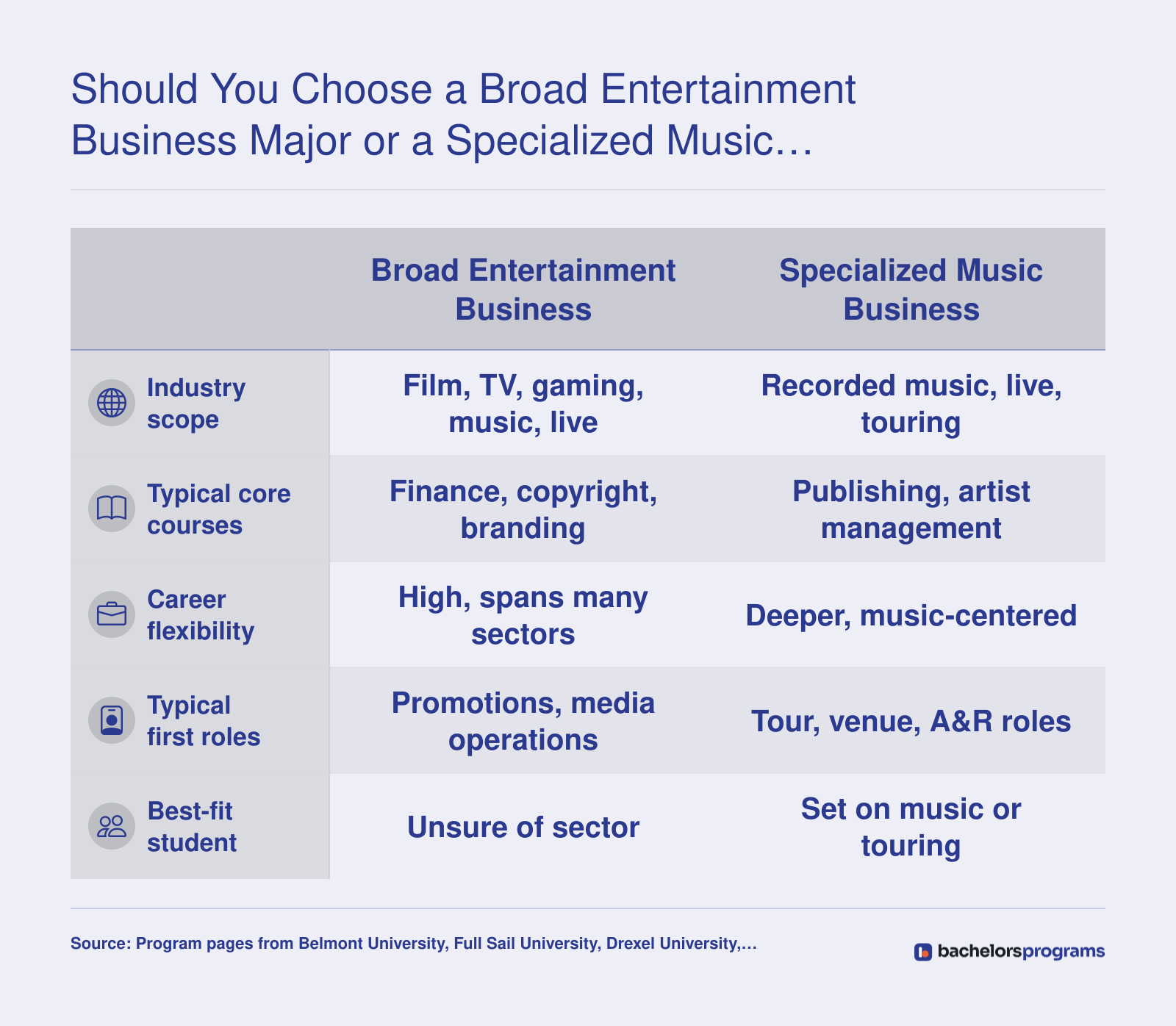
Should You Choose a Broad Entertainment Business Major or a Specialized Music Business Degree?
Broad programs, such as Full Sail University's Entertainment Business B.S. and Belmont University's Media & Entertainment Industries degree, span film, streaming, gaming, music and live events. Specialized music business majors at schools like Columbia College Chicago and Indiana University go deeper into copyright, publishing, artist management and touring, and some, such as Hofstra's B.S., require an audition. If you are unsure which sector you want, lean broad; if you are committed to the music or touring industry, a specialized program is worth a close look.
Cost, Net Price, and Student Debt Compared
The schools below run from lowest to highest average net price, the yearly cost after grants and scholarships reported in 2024 IPEDS and College Scorecard data. Public schools lead the list: the University of Central Florida ($10,411) and the University of North Alabama ($12,170) cost a fraction of private options like Drexel University ($38,509) and Full Sail University ($38,875), a gap of more than $28,000 a year. Program median debt ranges from $20,696 at UCF (about $219 a month for 10 years) to $37,875 at the Los Angeles Film School (about $402 a month). Net price is only an average, and out-of-state students at public schools pay more, as UCF's $6,368 in-state versus $22,467 out-of-state tuition shows.
| School | Sector | Cost Figure Used | Average Net Price per Year | Published Tuition and Fees (In-State / Out-of-State) | Program Median Debt | Est. Monthly Payment (10 Years) |
|---|---|---|---|---|---|---|
| University of Central Florida | Public | Net price after aid | $10,411 | $6,368 / $22,467 | $20,696 | About $219 |
| University of North Alabama | Public | Net price after aid | $12,170 | $12,120 / $22,320 | $24,437 | About $259 |
| Albright College | Private nonprofit | Net price after aid | $20,024 | $29,082 / $29,082 | N/A | N/A |
| Grand Canyon University | Private nonprofit | Net price after aid | $22,472 | $17,850 / $17,850 | $27,000 | About $286 |
| Temple University | Public | Net price after aid | $28,198 | $23,011 / $38,958 | N/A | N/A |
| Los Angeles Film School | Private for-profit | Net price after aid | $30,980 | N/A | $37,875 | About $402 |
| Butler University | Private nonprofit | Net price after aid | $36,041 | $47,560 / $47,560 | $25,000 | About $265 |
| Drexel University | Private nonprofit | Net price after aid | $38,509 | $62,412 / $62,412 | $24,808 | About $263 |
| Full Sail University | Private for-profit | Net price after aid | $38,875 | $26,906 / $26,906 | $35,282 | About $374 |
Related Articles
Weighing Debt Against Pay: Which Programs Pay Off
Debt-to-pay math asks a blunt question: will the first year of paychecks after a bachelor's degree in entertainment business cover what you borrowed to earn it? A practical rule of thumb is to keep total program debt at or below expected first-year earnings, then use each school's return-on-investment ratio as a tiebreaker rather than a promise.
Programs That Clear the Debt Test
UCF comes in at $20,696 in median program debt against $29,025 in first-year median earnings. Butler pairs $25,000 in debt with $34,911 in earnings; North Alabama $24,437 with $25,805; and Grand Canyon $27,000 with $34,904. Drexel is close but slightly upside down, at $24,808 in debt against $24,205 in earnings. Full Sail ($35,282 in debt vs. $28,947 in earnings) and Los Angeles Film School ($37,875 vs. $18,706) would require a faster-than-typical pay ramp to justify the borrowing.
What the ROI Ratio Does and Does Not Tell You
Drexel carries the strongest institution-level return-on-investment ratio here (3.34), followed by UCF (3.21) and Butler (2.97). Read that number as a school-wide proxy, not a verdict on the entertainment business program itself.
Employment and Poverty Rates
Where schools publish them, completion outcomes reinforce the split: UCF reports 94% employment one year out, Butler 100%, Grand Canyon 98%, Drexel 90%, North Alabama 88%, Full Sail 89%, and Los Angeles Film School 84%. Among the schools that publish it, the share earning above the poverty line runs from about 68% at Los Angeles Film School to roughly 75% at Drexel.
Highest Early-Career Earnings Among Ranked Programs
Butler University posts the highest first-year earnings of the entertainment business programs ranked here.
Online vs. Campus Entertainment Business Programs
You can complete an entertainment business bachelor's degree fully online, but the format decides how much of the industry you can physically reach. Delivery formats differ sharply from one school to the next. UCF's Entertainment Management BS, Full Sail University's Entertainment Business Bachelor of Science, and Grand Canyon University's sports and entertainment management degree each list a fully online option alongside campus study, while the Los Angeles Film School runs a hybrid model. Temple, Drexel, Butler, North Alabama, and Albright keep their programs campus-based.
Why location still matters
Entertainment is a relationship business, and the relationships cluster. Nashville means music, Los Angeles means film and television, Atlanta means film and music production, New York means media and live events. A campus inside one of those markets puts you in the room: guest speakers, part-time work at venues, and internships that turn into first jobs. A campus two hours from the nearest label office asks more of you.
Where the industry connections actually sit
Full Sail is the clearest example among the schools on this list. Its campus partnerships include Universal Orlando Resort, and WWE has partnered with the university since 2012, filming NXT weekly at Full Sail Live with qualifying students working beside WWE production staff as production assistants and camera operators. Full Sail has also sponsored the Florida Film Festival for 16 years as of 2020, and ION Television has filmed commercials on its backlot with student crews. The university describes these partnerships as real-world experience for campus students; it does not state they are required for graduation or that online students receive the same access. UCF lists three required internship levels and a large hospitality and entertainment partner network minutes from Disney, Universal, and SeaWorld. American University's Business and Entertainment program requires an internship outright.
Closing the gap as an online student
Online students can trade proximity for reach, but it takes deliberate work. Remote internships with labels, agencies, and production companies are increasingly common, and local venue or festival work in your own city counts as genuine experience. Where a program offers residencies or industry trips, take them. Before you enroll, ask admissions directly whether online students attend recruiting events, use the career center, and reach the same employers as campus students.
Questions to Ask Yourself
Do you already know your sector, or do you need a degree that keeps options open?
Can you relocate to or intern in an industry hub, or does online fit your life better?
Will an entry-level salary cover the loan payment?
Does the program require a credit-bearing internship, and can you complete it while working?
Admission Requirements for Entertainment Business Programs
Most entertainment business majors admit students through the university's general application, but music-focused programs often add essays, portfolios or auditions.
- High school diploma or equivalentFull Sail University requires proof of high school graduation and a photo ID, and Florida International University (FIU) requires a diploma or its equivalent.
- GPA expectationsWhere schools publish a minimum, it falls between 2.0 at Indiana University Southeast and 2.7 for Rowan University's Music Industry BS.
- Testing policyCheck each university's general SAT and ACT policy, since programs such as Rowan and FIU screen majors through essays and portfolios rather than test scores.
- Essay or statement of interestRowan wants a career-focused essay within one week of your university application, and FIU asks for a 500-word music business essay plus a letter of intent.
- PortfolioRowan accepts a website or social media links as a portfolio, FIU requires one, and Full Sail requires none.
- AuditionsBelmont's Music Business BBA, Drexel and Full Sail skip auditions, while Indiana University Southeast admits Music Business students by audition only and FIU holds remaining dates on November 14, 2026, February 6, 2027 and March 13, 2027.
- InterviewsFull Sail requires an admissions interview, and FIU requires a faculty interview.
- Prior industry experienceFull Sail requires no industry experience or prior business coursework, and American University builds a for-credit entertainment internship into the degree itself.
- DeadlinesAmerican University's regular decision deadline is January 15, 2027.
- Transfer creditIf you hold an associate degree, ask each school how your credits apply to the major and whether it has an articulation agreement with your community college.
Entertainment Business programs by state
Compare Entertainment Business programs on the data that matters
Explore more Arts & Design majors or browse every field of study.
All Arts & Design programs Browse every field of study