Best Online Entertainment Business Degree Programs
Compare 4 accredited online Entertainment Business programs, with net price after aid, graduation rates, earnings and debt from IPEDS and the U.S. College Scorecard.

Per-credit tuition for an online bachelor's degree in entertainment business runs from $212.28 in-state at the University of Central Florida to $490 at Grand Canyon University. Many schools market the Bachelor of Science (B.S.) in Entertainment Business as "online," yet few offer a fully online path, and competing pages rarely compare cost or outcomes.
Every program listed is 100% online, hybrids were excluded, and each is checked against College Scorecard data. Ranked programs come first, then cost, accreditation, business versus management, and jobs and salary.
Titles can mislead: UCF's version is called Entertainment Management.
Key Points
- Every ranked program runs fully online, with no required campus residencies.
- University of Central Florida lists $212.28 per in-state credit hour.
- Coursework applies marketing, finance, and contracts to film, music, and gaming.
Best 100% Online Bachelor's in Entertainment Business Programs Ranked
Every program below can be completed entirely online, with no required residencies or campus visits built into the online track. Hybrid and on-campus versions are left out of this list. The programs appear in order of overall quality and fit for entertainment business study, not cost alone and not name recognition alone.
University of Central Florida
#1Orlando, FL · ~$10,000/yr (est.)
Best for: Theme-park and live-event industry hopefuls
UCF's entertainment business path sits inside the Rosen College of Hospitality Management, placing coursework in entertainment law, revenue strategy, and production management a short drive from Orlando's theme parks and live-event venues. Students complete three levels of internship and draw on a partner network that includes Disney, Universal, and the Orlando Magic.
- 120 credits total, with 63 credits inside the major
- Coursework covers entertainment law and ethics, revenue strategies, production management
- Three required internship levels built into the degree
- In-state tuition $212.28 per credit hour; out-of-state $891.07
- Admission requires a 2.0 overall GPA and a C or better in core courses
- More than $225,000 in annual scholarships available
- 100+ hospitality and entertainment industry partners
- Campus sits minutes from Disney, Universal, and SeaWorld
Full Sail University
#2Winter Park, FL · ~$39,000/yr (est.)
Best for: Working adults who want monthly class starts
Full Sail built its reputation on accelerated, production-heavy media education, and its entertainment business bachelor's follows that model with monthly starts and a portfolio sequence threaded through the curriculum. Students work with business models, digital marketing, data analysis, and event management rather than a traditional liberal arts core. The Winter Park campus also hosts live productions: Electronic Arts returned for a third year of Madden Championship Series events in 2026 and planned to hire 100 Full Sail graduates for production roles.
- 120 credits; the online version takes 27 months to finish
- Classes begin monthly on a year-round accelerated schedule
- About two courses per month in the online format
- Coursework covers business models, digital marketing, data analysis, event management
- Threaded project and portfolio sequence runs through the curriculum
- No portfolio, audition, or prior business coursework needed to apply
- Tuition covers textbooks, technology fees, and a MacBook with Adobe Creative Cloud
- ACCSC accredited, with financial aid and scholarships available
Grand Canyon University
#3Phoenix, AZ · ~$22,000/yr (est.)
Best for: Transfer students with prior college credit
Grand Canyon University's Colangelo College of Business offers its entertainment program as a sports and entertainment management degree, so athletics and live events carry as much weight as music and media topics. Online courses run in eight-week terms at a published per-credit rate, which suits students who want a steady, predictable pace. The curriculum requires 300 hours of industry experience and closes with a team-based strategic management simulation.
- 120 credits, including 68 in the major and 34 to 40 in general education
- ACBSP-accredited business degree from the Colangelo College of Business
- 300 hours of paid or unpaid sports or entertainment experience required
- Online courses run in 8-week terms at $490 per credit
- Capstone uses a team-based strategic management simulation
- Up to 90 transfer credits accepted
- Admission needs a 2.8 unweighted GPA, or 2.5 with ACT 19 or SAT 1000
- Covers sports and entertainment analytics, law, marketing, and revenue generation
Cost & outcomes by school
Federal data for the highest-earning Entertainment Business programs, independent of the ranking above. Earnings are this field's bachelor's graduates four years after completing where the Scorecard reports them, else the school's undergraduate median.
| School | Net price / yr | Grad rate | Earnings | Debt | Grads/yr | Format |
|---|---|---|---|---|---|---|
| University of Central Florida FL | $10,411 | 78% | $59,649 | $20,696 | 151 | Online or campus |
| Grand Canyon University AZ | $22,472 | 44% | $47,821 | $27,000 | 26 | Online or campus |
| Full Sail University FL | $38,875 | 44% | $38,847 | $35,282 | 251 | Online or campus |
| Los Angeles Film School CA | $30,980 | 41% | $37,857 | $37,875 | 109 | Hybrid |
Sources: U.S. Department of Education. Net price, graduation rate, earnings and debt: College Scorecard (earnings and debt for this field's bachelor's graduates where reported, else school-wide); graduates: IPEDS. A dash means no figure is reported.
Cost, debt & payoff
Median earnings of this field's bachelor's graduates (4 yrs after completing, else the school's undergraduate median) vs. their median federal loan debt · U.S. College Scorecard
Across these programs the median graduate earns about $54,328 and finishes with roughly $25,000 in debt — a ratio that clears a common rule of thumb (keep debt below first-year salary). Net price and debt vary widely school to school, so check the per-school figures in the table above before you shortlist.
What a Bachelor's Degree in Entertainment Business Covers
What do you actually study in an entertainment business degree? You learn core business skills, marketing, finance, contracts, and management, and apply them to film, television, music, gaming, and live events. The focus is on how these industries make money, sign talent, and reach audiences.
Most bachelor's programs follow the roughly 120-credit norm. That usually means a general education core, a set of business foundations, and a block of industry-specific courses. Treat that as a typical pattern rather than a rule: individual schools set their own requirements.
Common Course Areas
- Entertainment law and contracts: how deals, rights, and agreements are structured.
- Artist and talent management: representing performers, creators, and athletes.
- Media marketing and distribution: getting films, shows, music, and games to audiences.
- Concert and event promotion: booking, budgeting, and running live productions.
- Intellectual property and licensing: protecting and monetizing creative work.
What the Degree Is Not
This is a business degree, not a production or performance program. Expect case studies, budgets, and industry analysis rather than hands-on filmmaking, songwriting, or acting. If you want to make the content yourself, a creative arts degree fits better. If you want to run the business behind it, this one does.
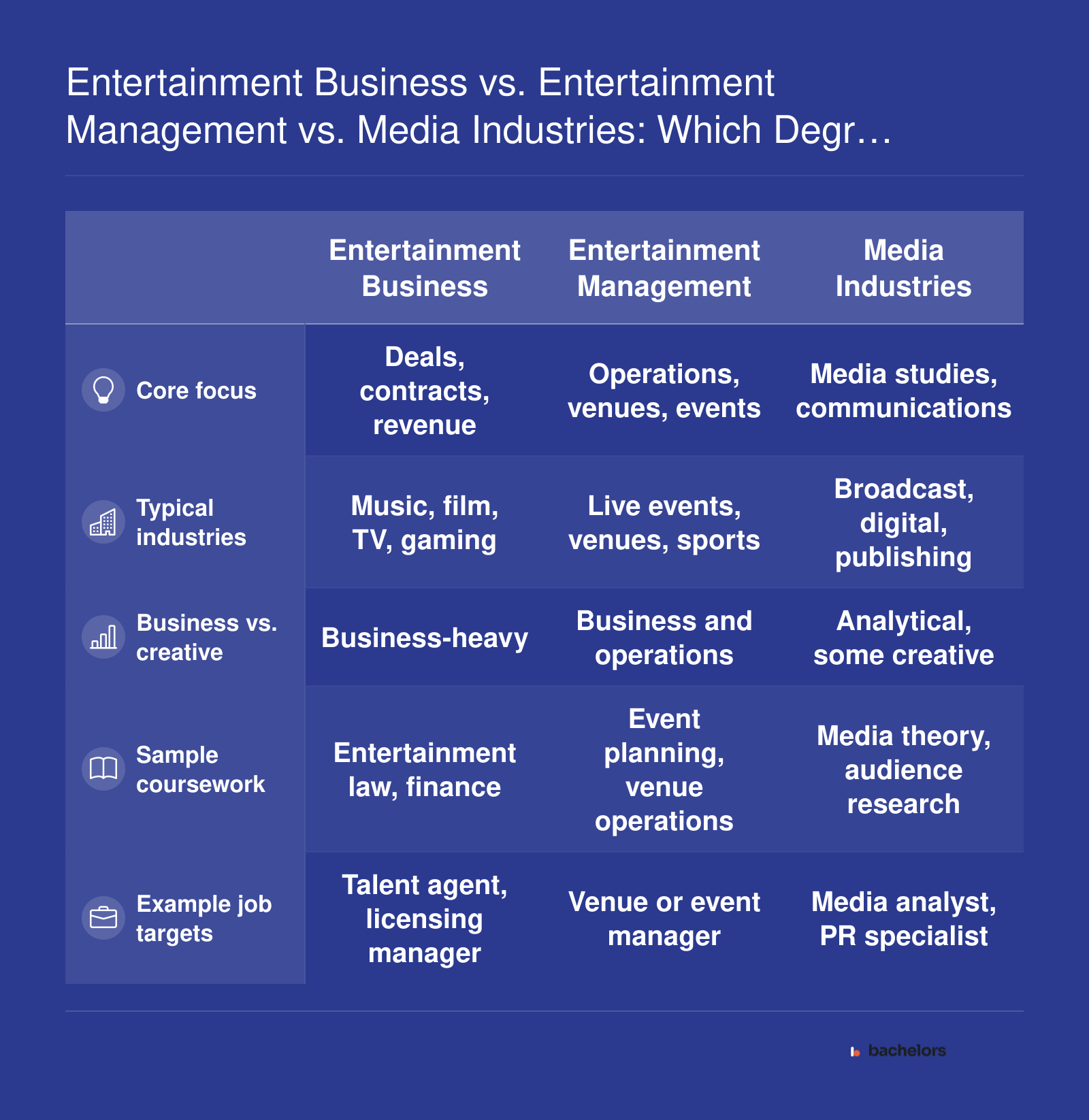
Entertainment Business vs. Entertainment Management vs. Media Industries: Which Degree Fits You?
These three degree labels sound alike but point in different directions: entertainment business centers on deals and revenue, entertainment management on running operations and events, and media industries on communications and analysis. Schools apply these titles inconsistently, so compare each program's course list rather than its degree name before you enroll.
Online Entertainment Business Degree Tuition, Net Price, and Debt Compared
Tuition below is published annual tuition and fees before aid, and net price is an approximate institution-wide yearly average after grants and scholarships, not a personal quote. By the credit hour, the University of Central Florida lists $212.28 in-state and $891.07 out-of-state, and Grand Canyon University lists $490 per credit. Full Sail University includes a MacBook, Adobe Creative Cloud, textbooks, and technology fees in tuition, while students at the other schools should budget separately for any laptop or software their courses require. Median debt and the estimated monthly payment on a standard 10-year plan reflect graduates of each school's entertainment business program.
| School | Program | Published In-State Tuition and Fees (per year) | Published Out-of-State Tuition and Fees (per year) | Average Net Price After Aid (per year, approx.) | Program Median Debt | Est. 10-Year Monthly Payment |
|---|---|---|---|---|---|---|
| University of Central Florida | Entertainment Management, BS | $6,368 | $22,467 | $10,411 | $20,696 | $219 |
| Grand Canyon University | Bachelor of Science in Sports and Entertainment Management | $17,850 | $17,850 | $22,472 | $27,000 | $286 |
| Full Sail University | Entertainment Business Bachelor of Science | $26,906 | $26,906 | $38,875 | $35,282 | $374 |
Related Articles
Accreditation, Transfer Credits, and State Availability
Two questions decide most of the value of an entertainment business bachelor's degree, and neither is about curriculum. They are whether the school's accreditation will carry your credits forward, and whether the school is even allowed to enroll you where you live.
Institutional vs. national accreditation
Look for institutional accreditation from a regional body, such as the Higher Learning Commission. Other universities and most employers recognize that standard, and it makes credits portable if you transfer later. National accreditors such as ACCSC are recognized by the U.S. Department of Education and cover distance education, but credits earned under national accreditation often transfer poorly to regionally accredited institutions. Ask each program who accredits it before you apply.
Transfer credit and state rules
Public universities commonly cap transfer credit at 90 semester hours.1 Some, like Missouri State University-West Plains, accept far more but require a residency period, such as the final 15 hours completed in house.2 Prior learning assessment, associate degrees, and military training may count, so ask specifically rather than assuming.
State authorization is the other gate.3 Approval requirements vary by state, and some institutions cannot enroll online students in certain states.4 Confirm yours is approved before you commit.
Then request an unofficial transfer evaluation before applying. It usually costs nothing and shows what you are really paying for.
Producers and Directors: Median Annual Wage
Entertainment Business Degree Jobs, Salary, and Whether It's Worth It
A bachelor's degree in entertainment business leads to the business side of music, film, TV, live events, and gaming: representing talent, planning tours, marketing releases, and managing productions. Federal wage data (May 2025) shows what experienced workers in related fields earn.3
Job Paths and Median Wages
- Talent or booking agent, artist manager: $141,5801 (agents and business managers of artists, performers, and athletes)
- Event or tour manager: $61,1602 (meeting, convention, and event planners)
- Marketing coordinator at a label or studio: the entry point to a marketing manager track, where the median is $165,7803
- Producer or production manager: $113,3001 (producers and directors)
These medians cover all experience levels. Graduates rarely start near them.
What Graduates Actually Earn
Program-level Scorecard figures are more realistic. University of Central Florida graduates earn a median of $59,649 four years after finishing. Grand Canyon University graduates earn $47,821 at the same mark. Full Sail University graduates earn $38,113 five years after finishing.
Is It Worth It?
It depends on cost. Median program debt runs from $20,696 at UCF to $27,000 at Grand Canyon and $35,282 at Full Sail. UCF pairs the lowest net price with the highest earnings here. Entry-level entertainment jobs often pay modestly, and advancement rewards networking and internships, so weigh programs with built-in internship requirements.
Your Next Step
Music-focused students should favor music business concentrations. Film, TV, and gaming students should check for matching electives. Then request information from two or three programs ranked here and compare internship support and total cost.
Entertainment Business programs by state
Compare Entertainment Business programs on the data that matters
Explore more Arts & Design majors or browse every field of study.
All Arts & Design programs Browse every field of study