Best Fashion Design Degree Programs
Compare 90+ accredited Fashion Design programs, with net price after aid, graduation rates, earnings and debt from IPEDS and the U.S. College Scorecard.

A bachelor's degree in fashion design is a four-year undergraduate program covering sketching, draping, pattern making, garment construction, and collection development, usually ending in a portfolio. Bachelor's degrees in the field carry several titles, including the B.F.A., the B.S. and the B.A., depending on the school.
The real question is which programs combine solid studio training, industry access, and a price you can carry. Those goals pull against each other: schools near major fashion hubs offer internships and recruiters, but often at higher living costs and heavier debt.
Design hiring is competitive and clustered in a few metro areas, so a strong portfolio and employer connections often outweigh the diploma.
Key Points
- Graduate earnings and debt, not runway prestige, drive this ranking's order.
- WashU's B.F.A. runs 121 credits and builds toward a capstone collection.
- Illinois and Minnesota require portfolio review before students enter the major.
Best Fashion Design Schools Ranked: Our Top 10 Bachelor's Programs
Net price after aid across these ten programs runs from about $10,400 a year at Cal State Long Beach to roughly $21,800 at Washington University in St. Louis, the only private institution on the list; the public universities between them cluster in the middle of that range. All ten deliver their fashion coursework on campus, so there is no fully online or hybrid bachelor's degree in fashion design among these picks. What separates them is studio depth, runway and internship requirements, and how close each campus sits to a working apparel industry.
University of Illinois Urbana-Champaign
#1Champaign, IL · ~$14,000/yr (est.)
Best for: Sustainability-minded apparel design students
A large public research university in Champaign, Illinois, where fashion sits inside the School of Art and Design rather than a standalone fashion college. The BFA in Studio Art with a fashion concentration blends fine-art studio practice with garment construction, patternmaking and sewing, and the curriculum leans into sustainable design and digital fabrication. Students show ensembles and mini-collections in a spring runway show, and the critique-heavy studio sequence leaves them with a portfolio built from finished work.
- 122 total credit hours: 17 first-year, 9 art history, 48 in concentration
- Required courses include Sustainable Fashion Development and Branding
- Capstone pairs Current Art Issues Seminar with BFASA Capstone Studio
- Portfolio review required for admission
- Students show ensembles and mini-collections in a spring runway show
- Studios hold 3D printers, sewing and embroidery machines and dress forms
- Electives include Flat Pattern Drafting, Costume Draping and Leatherworking
The University of Texas at Austin
#2Austin, TX · ~$20,000/yr (est.)
Best for: Texas residents wanting a research campus
UT Austin pairs a textiles and apparel program with the resources of a flagship public university in the state capital. The product development and design concentration is built around pattern making, technical design and computer-aided design, with studio and lab work run alongside industry partners and coursework offered in New York City and Paris. A required internship and a capstone collections course give students finished garments and professional experience before they graduate.
- 120 credit hours on a suggested four-year plan
- Concentration in Product Development and Design
- 3-hour internship course built into the degree
- Capstone Collections course required
- Courses offered in New York City and Paris
- Studios and labs run with industry partners
- C- minimum in required math and science courses, with a 2.00 GPA in them
- 21 upper-division hours must be completed in residence
Fashion Institute of Technology
#3New York, NY · $6,000 – $17,000/yr (est.)
Best for: Designers wanting New York industry access
FIT is a fashion-specific institution in Manhattan, and its Fashion Design BFA is among the most industry-connected programs in the country. Students work with designer mentors on a senior collection shown in the professionally produced Future of Fashion runway show, and internships have placed them at Calvin Klein, Donna Karan, Ralph Lauren, Tommy Hilfiger, Michael Kors and Victoria's Secret. The degree builds on an FIT Fashion Design AAS, so most students arrive having already completed foundational design training.
- Five concentrations: children's wear, intimate apparel, knitwear, special occasion, sportswear
- Required internship and senior collection
- Designer mentors guide senior collections
- Work shown in the Future of Fashion runway show
- Internships at Calvin Klein, Ralph Lauren and Tommy Hilfiger
- Design electives customize the degree
- Requires an FIT Fashion Design AAS to apply
- Training in advanced technologies and presentation skills
University of Wisconsin-Madison
#4Madison, WI · ~$17,000/yr (est.)
A flagship public university in Madison, Wisconsin, where textiles and fashion design sits in the School of Human Ecology. Studio work spans weaving, dyeing, printing, garment construction, patternmaking and illustration, supported by the on-site Helen Louise Allen Textile Collection. Students pick a fashion or textiles sequence, complete a 150-hour internship and a capstone, and those with a 3.0 GPA can spend senior year at FIT in New York while earning the Wisconsin degree.
- Choose the Fashion Sequence or the Textiles Sequence
- 120 degree credits, including 21 in textiles and fashion design and 15 depth credits
- 3-credit internship of at least 150 hours required
- Capstone is a senior thesis or collection development
- No application or prerequisites to declare the major as a first-year
- 3.0 GPA students may spend senior year at FIT in New York
- Studios cover weaving, dyeing, printing, garment construction and patternmaking
- On-site Helen Louise Allen Textile Collection
North Carolina State University at Raleigh
#5Raleigh, NC · $9,000 – $33,000/yr (est.)
NC State's fashion program lives in the Wilson College of Textiles, a nationally known textiles school in Raleigh. The fashion design concentration pairs studio work in draping, illustration and garment construction with fiber science and fabric structure, so students understand both the design and the material it is made from. Seniors produce a full runway collection, and alumni design for brands including The North Face, Belk and Anthropologie.
- 120 credit hours in the Wilson College of Textiles
- 6-credit Senior Fashion Design Studio
- Coursework in draping, fashion illustration, CAD for fashion and workroom practices
- Seniors send a full collection down the runway
- Adds fiber science, textile fabric structure and wet processing
- Electives from fashion product development, retail buying and brand management
- Alumni design for The North Face, Belk and Anthropologie
- Sustainable design practices that minimize waste
University of Minnesota-Twin Cities
#6Minneapolis, MN · ~$17,000/yr (est.)
The University of Minnesota's apparel design program sits in the College of Design in Minneapolis, a city with a working retail and fashion industry. The fashion design track mixes trend research, illustration and 3D rendering with cross-functional coursework shared with retail merchandising and technical design students. A portfolio review, an internship and a senior fashion show that dates to 1968 round out the degree, and study abroad runs to London, Florence and Sydney.
- 120 credits total, 77 to 89 of them in the major
- Portfolio review and an internship required for the degree
- Senior fashion show, a public showcase running since 1968
- Coursework in trend research, fashion illustration and 3D rendering
- Shared courses with retail merchandising and technical design students
- Study abroad in London, Florence and Sydney
California State Polytechnic University-Pomona
#7Pomona, CA · $10,000 – $15,000/yr (est.)
Cal Poly Pomona's fashion program is a hands-on, polytechnic-style degree in Los Angeles County, built around making rather than theory alone. Students work in advanced prototyping facilities, develop a clothing line sold at the Bronco Bookstore and attend industry tradeshows, with the program describing its workload as roughly equivalent to two years of industry experience. Internships with established and emerging brands, plus a study-abroad option in Italy, add professional exposure.
- Design and Production option within the fashion major
- Coursework in apparel product development, technical design, garment construction and digital design
- Students develop a clothing line sold at the Bronco Bookstore
- Internships with established and emerging brands
- Industry tradeshow attendance built into the program
- Study abroad in Italy
- Advanced prototyping facilities and two years of industry-equivalent experience
- Scholarships available through apparel merchandising and management
California State University-Long Beach
#8Long Beach, CA · $7,000 – $20,000/yr (est.)
Cal State Long Beach offers fashion through its College of Health and Human Services, with a design option covering sketching, trend analysis and the selection of styles, colors and fabrics for a collection. Students train on computer-aided design and graphic editing software, complete a required internship and can join short study-abroad sessions in Paris and Italy. The campus sits in the Los Angeles metro, close to one of the country's largest apparel and retail job markets.
- Fashion Design option within Fashion Merchandising and Design
- Internship required, recommended in the final semester
- Two-week Paris study abroad in June on the luxury fashion industry
- Two-week Italy study abroad in January on manufacturing and retailing
- Training in CAD and graphic editing software
- Prepares students for roles as apparel designer, pattern maker or product developer
- Separate Fashion Design minor available
Washington University in St Louis
#9St. Louis, MO · ~$22,000/yr (est.)
Washington University in St. Louis runs fashion design through the Sam Fox School of Design and Visual Arts, a studio-heavy BFA inside a private research university. Roughly half of the degree is studio coursework, and seniors design a capsule collection that travels from research and muslin to finished garments on a runway reviewed by outside fashion professionals. A BA in Design with an optional fashion concentration offers a lighter studio path for students who want more liberal arts coursework.
- 65 credits of studio coursework, about half the degree
- Senior capstone capsule collection from concept to final garment
- Collection shown at the annual Fashion Design Show before fashion professionals
- Individual studio workspaces in the senior year
- Curriculum centered on sustainability, purpose-driven design and technology
- Dedicated academic advisor from year one
- BFA also available as a dual degree
Iowa State University
#10Ames, IA · $19,000/yr (est. net price)
Iowa State's fashion design and merchandising program in Ames offers four options spanning design, product development, merchandising and communication, so students can move toward studio work or the business side of the industry. The creative and technical design option is accredited by the National Association of Schools of Art and Design and sends graduates out with an industry-ready portfolio. Facilities include a 3-D body scanner, an industrial-sized digital printer and a clothing museum, and the student-produced fashion show draws more than 2,000 people.
- Four options, including Creative and Technical Design
- Creative and Technical Design is accredited by the National Association of Schools of Art and Design
- Coursework in patternmaking, illustration, technical design and surface and structure design
- Graduate with an industry-ready portfolio
- Student-produced fashion show draws more than 2,000 people
- Facilities include a 3-D body scanner and an industrial-sized digital printer
- Study abroad at the London College of Fashion
- Concurrent bachelor's and master's pathway in five to five and a half years
Cost & outcomes by school
Federal data for the highest-earning Fashion Design programs, independent of the ranking above. Earnings are this field's bachelor's graduates four years after completing where the Scorecard reports them, else the school's undergraduate median.
| School | Net price / yr | Grad rate | Earnings | Debt | Grads/yr | Format |
|---|---|---|---|---|---|---|
| University of Redlands CA | $30,031 | 67% | $75,374 | $26,000 | 5 | Campus |
| University of Cincinnati OH | $25,648 | 75% | $71,605 | $25,500 | 142 | Campus |
| Syracuse University NY | $38,793 | 84% | $71,527 | $27,000 | 114 | Campus |
| The University of Texas at Austin TX | $19,857 | 89% | $69,846 | $18,000 | 67 | Campus |
| Washington State University WA | $14,971 | 61% | $69,224 | $24,604 | 29 | Campus |
| Seattle Pacific University WA | $24,488 | 62% | $68,547 | $25,000 | 29 | Campus |
| Miami University OH | $28,384 | 80% | $67,981 | $26,000 | 18 | Campus |
| Washington University in St Louis MO | $21,786 | 94% | $67,771 | $19,089 | 70 | Campus |
| Rhode Island School of Design RI | $50,507 | 89% | $67,771 | $27,000 | 119 | Campus |
| University of Delaware DE | $17,799 | 81% | $67,742 | $26,000 | 61 | Campus |
| California State University-Long Beach CA | $10,440 | 69% | $66,435 | $16,500 | 120 | Campus |
| Drexel University PA | $38,509 | 78% | $66,294 | $27,000 | 127 | Campus |
Sources: U.S. Department of Education. Net price, graduation rate, earnings and debt: College Scorecard (earnings and debt for this field's bachelor's graduates where reported, else school-wide); graduates: IPEDS. A dash means no figure is reported.
Cost, debt & payoff
Median earnings of this field's bachelor's graduates (4 yrs after completing, else the school's undergraduate median) vs. their median federal loan debt · U.S. College Scorecard
Across these programs the median graduate earns about $55,744 and finishes with roughly $25,750 in debt — a ratio that clears a common rule of thumb (keep debt below first-year salary). Net price and debt vary widely school to school, so check the per-school figures in the table above before you shortlist.
Earnings, Debt, and Completions: The Scorecard Math Behind Our List
Runway prestige makes for striking photos, but a fashion degree is better judged by what graduates earn and what they owe. That practical lens shapes the order of the schools here.
The Numbers That Matter
- Earnings: College Scorecard program-level earnings for fashion design graduates, measured one to five years after they finish.
- Debt: Median federal debt and the monthly payment that comes with it.
- Completions: How many students finish the fashion design program, a rough signal of program size.
- Graduation rate: The share of students who finish at the institution overall.
- Net price: What students pay on average once grants and scholarships are applied.
Read the Limits Before You Compare
Graduation rate and net price are school-wide figures, not fashion-program-specific. Cal State Long Beach graduates about 69% of its students and Washington University in St. Louis about 94%, but those rates cover every major on campus. Net price averages what aided students paid, not what you will pay. Your own offer will depend on your finances and the aid you qualify for.
Some schools do not have published program-level earnings. They stay on the list and are ranked on the remaining measures, so one missing figure does not disqualify a school.
The list covers all delivery formats: campus, online, and programs that combine both. Check each program's format before you build a shortlist.
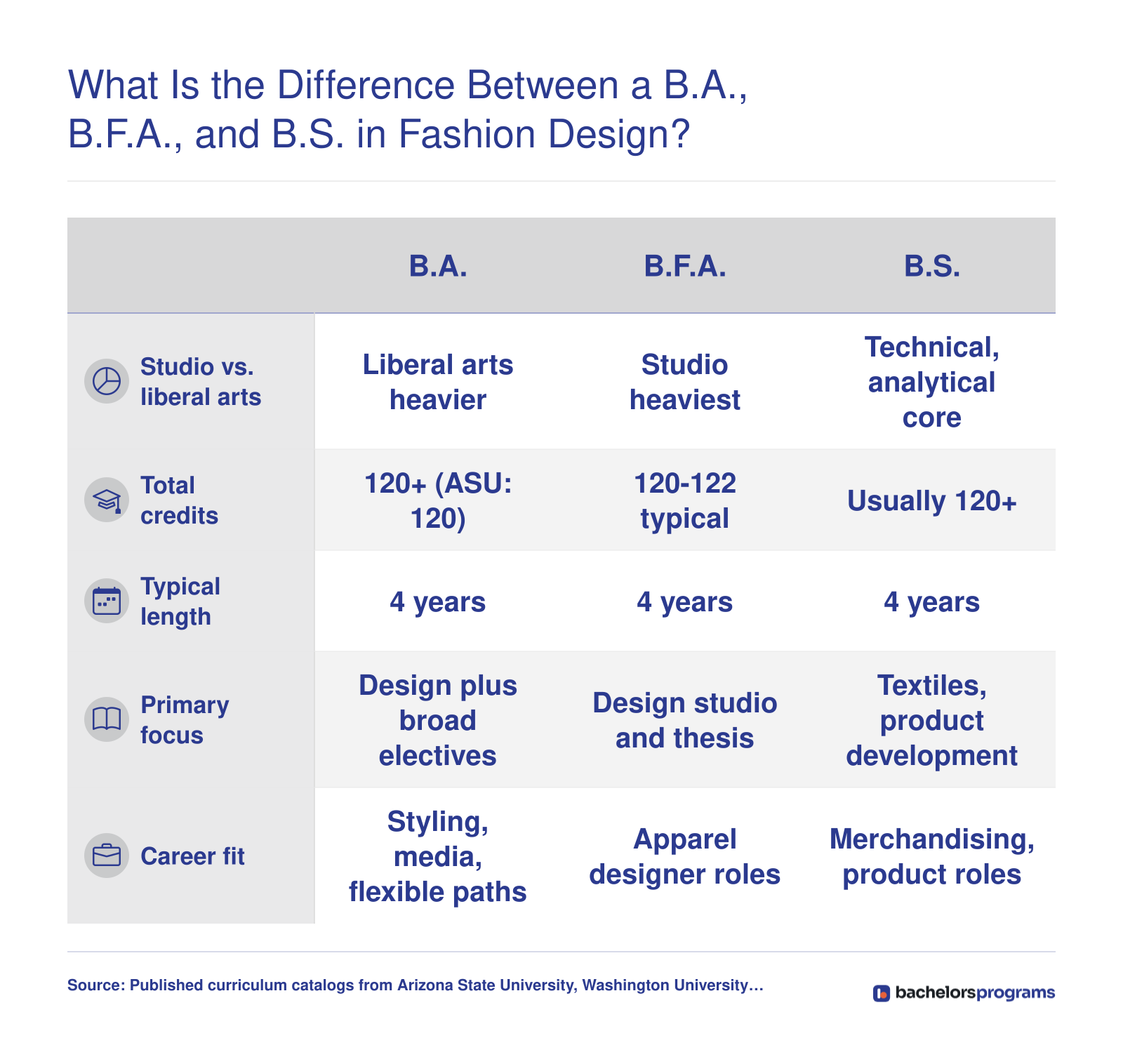
What Is the Difference Between a B.A., B.F.A., and B.S. in Fashion Design?
A B.A. usually gives the largest share of credits to liberal arts and electives. The B.F.A. is the most studio-intensive, building toward a thesis or capstone collection, as at Washington University in St. Louis (121 credits, including 39 in the fashion major and 15 in art history). The B.S. typically leans toward textiles, product development, or merchandising, though exact credit splits vary by school, so check each program's published curriculum.
What Fashion Design School Really Costs: Public vs. Private Net Price
Net price at the schools on this list runs from $4,195 at CUNY Queens College to $14,355 at the University of Illinois Urbana-Champaign. That is a spread of more than $10,000 for what looks on paper like the same credential, and it is the most useful number for comparing cost.
Sticker Price Versus Net Price
The published tuition figure is the one that scares families off, and it is usually the least informative number in the packet. Queens College lists $7,538 for New York residents and $15,488 for out-of-state students, yet its students pay an average of $4,195 after grants and scholarships. Private art schools follow the same pattern more dramatically: their sticker prices sit far above what aid recipients actually pay, because institutional scholarships absorb much of the gap. Enter your own family income into a net price calculator rather than comparing tuition tables side by side.
What Graduates Actually Owe
Median federal debt among graduates who borrowed varies just as widely. It sits at $10,298 at Queens College, rises to $18,000 at the University of Wyoming, and reaches $22,858 at UNC Greensboro. A low net price paired with heavy borrowing usually signals thin aid packages in later years, so read the two figures together.
Costs Tuition Does Not Cover
Fashion is a materials-heavy major, and supply costs land every semester. Plan for fabric by the yard, muslin for draping, a sewing machine and serger, a dress form, cutting tools, pattern paper, and portfolio printing for reviews and internship applications. Add a laptop that can run design software, plus licenses for the CAD and Adobe tools your courses require. Optional industry trips and study-abroad terms add airfare and housing on top of tuition.
Fashion Design Degree Salary and Job Outlook
Program-level earnings for fashion design graduates are the first reality check. The schools ranked here report median earnings for graduates at one, four, or five years after completion, and the spread is wide. One year out, reported earnings run from about $29,500 to $47,300. By four years, the range is roughly $59,600 to $69,800. At five years, the University of Texas at Austin reports $88,050, while the middle of the group sits near $68,200. That gap of roughly $20,000 shows how much a school, a city, and a first job shape early pay.
Program Earnings vs. Occupational Wages
Those figures describe graduates of specific programs.1 They are not the same as occupation-wide wages reported by the Bureau of Labor Statistics. Data from May 2023 put the mean annual wage for fashion designers in the New York metro at $99,650 and in Boston at $104,330; Seattle averaged $80,950.2 Wholesale trade roles averaged $106,4003, and retail trade roles averaged $85,950.4 The occupation is concentrated in top metros led by New York (7,910 jobs) and Los Angeles (4,180 jobs).2
Slow Growth, Steady Openings
The Bureau of Labor Statistics projects the fashion designer occupation to go from 32,700 to 32,800 jobs between 2025 and 2035, a change of 0% and about 100 jobs.5 Even so, the agency projects 2,500 annual openings over that decade, mostly from turnover.5 About 36% of fashion designers are self-employed, followed by retail trade (20%), wholesale trade (16%), and apparel manufacturing (7%).5
Is the Degree Worth It?
Is a bachelor's degree in fashion design worth it? For students set on design, it can be, but early earnings can be modest. Many graduates move into technical design, product development, or merchandising, where titles and salaries differ from design roles. Treat early earnings as a starting point, not a lifetime ceiling.
Related Articles
Portfolio Requirements and How Selective These Fashion Programs Are
Your portfolio decides more fashion design admissions than your transcript does. Several programs ranked here, including University of Illinois Urbana-Champaign and University of Minnesota Twin Cities, list portfolio review as a condition of entry into the major itself, separate from admission to the university.
What Applicants Actually Submit
- Drawing from observation: Pratt asks for 10 to 20 recent works, with 3 to 5 drawn directly from observation. The work does not have to be fashion-specific.
- Design images and sewn garments: FIT's fashion design applicants have been asked for 10 to 14 design images plus photographs of two garments the applicant constructed personally.
- Written components: Pratt sets a 250 to 500 word essay. FIT requires a short essay. Parsons asks for essays and letters of recommendation.
- Where it goes: SCAD accepts 10 to 20 pieces through SlideRoom for a $10 submission fee, reviewed for scholarship consideration rather than as an admission requirement. FIT, by contrast, tells applicants not to use SlideRoom; instructions arrive from Admissions or the department after the application is processed.
How Selective the Field Really Is
Institutional admit rates across the schools ranked here run from roughly 12 percent at Washington University in St. Louis and 27 percent at UT Austin up to about 60 percent at FIT, 75 percent at Cal Poly Pomona, and 89 percent at Iowa State. A generous university-wide rate does not mean an easy admit: at campuses with portfolio-gated majors, the studio review is the real filter, and your work carries the decision.
Three Things to Get Right
SCAD's published guidance favors quality over quantity, asks that concept and fabrication be your own, requires you to identify your role in any group project, and expects outside references to be cited. FIT does not permit AI-generated work. Build around those rules rather than volume.
Timing is tight. FIT's fashion design deadlines fall on February 1 for fall entry and November 1 for spring. Parsons uses November 1 for Early Action and Early Decision, with Regular Decision closing January 15. Start assembling work a full semester ahead of whichever date applies.
Questions to Ask Yourself
Is your strongest work in illustration or in constructed garments, and does your target program weight one over the other?
Do you want a studio-heavy B.F.A. or a B.S. that blends design with textiles or merchandising?
Can you commit to in-person draping and construction labs several days a week, or do you need an online or hybrid format?
Questions to Ask Yourself
Does this program build in an internship, and can you actually reach a fashion market from campus?
Would a lower-debt public program with solid graduate earnings beat a high-cost private art school?
Is the school accredited in a way that protects your credits and your federal aid?
Does the portfolio this program expects match the work you can produce before you apply?
Fashion Design programs by state
Fashion Design Degree FAQs
Which fashion design degree programs are best for international students?
Is a bachelor's degree in fashion design worth it?
Can you transfer community college credits into a fashion design B.F.A.?
Compare Fashion Design programs on the data that matters
Explore more Arts & Design majors or browse every field of study.
All Arts & Design programs Browse every field of study