Best Fashion Merchandising Degree Programs
Compare 50+ accredited Fashion Merchandising programs, with net price after aid, graduation rates, earnings and debt from IPEDS and the U.S. College Scorecard.

Which fashion merchandising programs leave graduates with manageable debt and early-career pay that justifies the tuition? Net price after aid across the schools ranked here runs from roughly $11,000 to $40,000 a year, so the answer depends heavily on which campus you choose.
Programs here award the Bachelor of Science (B.S.) in Fashion Merchandising, a business degree built on buying, planning and assortment math rather than design studio work. Every program in this ranking is undergraduate; none is graduate study. Median earnings four years after completion for merchandising, sales and marketing programs are $56,702, with the middle half of graduates earning between $51,429 and $62,296.
Internship placements, not the diploma alone, tend to set that number.
Key Points
- Dominican University ($11,745) and Texas Woman's University ($11,963) cost least after aid.
- Six federal data measures, not reputation surveys, determine the ranking order.
- Fashion merchandising is a business degree focused on product, pricing and assortment.
The 10 Best Fashion Merchandising Schools at a Glance
Every entry on this list is a bachelor's degree in fashion merchandising, never a graduate program, and the ranking is open to every format: online, campus or a mix. This year all ten programs are delivered on campus, and each card carries the same facts so you can compare them side by side: city and state, format, net price after aid, admission rate and the median earnings of the program's graduates one year after finishing.
University of Georgia
#1Athens, GA · ~$14,000/yr (est.)
Best for: Students targeting brand management or product development
A large public research university in Athens, Georgia, where the fashion merchandising major splits into two emphases: Fashion Brand Management and Product Development and Design. The Product Development track admits by separate application and asks for work samples, so interested students should plan ahead. Program graduates report median earnings of about $37,600 one year after finishing and about $62,000 four years out, and the school graduates roughly 90% of its students overall.
- Two emphases: Fashion Brand Management or Product Development and Design
- 120-credit, four-year degree with an internship or capstone requirement
- Product Development track needs a separate application and five work samples
- Study away in London, New York and Peru
- Double Dawgs pathway allows early entry to a master's degree
- Internships for course credit are offered in the summer
- Scholarships available through the College of Family and Consumer Sciences
- Careers include buying, planning, brand sales and trend forecasting
University of Missouri
#2Columbia, MO · ~$20,000/yr (est.)
Best for: Midwest students eyeing omnichannel retail careers
A flagship public university in Columbia, Missouri, where merchandising sits inside textile and apparel management rather than in a standalone fashion school. The curriculum leans current, covering digital merchandising across websites, mobile apps and social channels alongside brick-and-mortar retail, plus a dedicated course on sustainability and ethics in the global supply chain. Institution-wide, about 75% of students graduate.
- Emphasis in Apparel Retailing and Digital Merchandising
- Second emphasis available in Apparel Product Development
- Coursework covers both digital and brick-and-mortar retailing
- Prepares students for buying, planning, allocation and omnichannel roles
- Four-year graduation plan published for the major
- Sustainability and ethics across the global supply chain are covered
University of Rhode Island
#3Kingston, RI · ~$21,000/yr (est.)
Best for: New Englanders wanting internships and study abroad
A midsize public university in Kingston, Rhode Island, with a degree that pairs fashion merchandising with textile science rather than treating apparel as pure business. Students can add a dual degree with Italian or French, an unusual fit for buyers and coordinators who work with European suppliers, and internships and study abroad are built in. The school graduates about 73% of its students.
- Combines fashion merchandising with textile science coursework
- Supporting work in marketing, management, consumer studies or art
- Internships and study abroad built into the degree
- Dual degree option with Italian or French
- Optional bachelor's to master's path completed in five years
- Covers buying, promotion and sale of apparel and home furnishings
Texas Christian University
#4Fort Worth, TX · $35,000 – $40,000/yr (est.)
A private university in Fort Worth, Texas, with a merchandising major that requires a minor and a supervised internship before graduation. The program covers buying, planning, product development and trend forecasting, and graduates report median earnings near $42,700 one year after finishing and about $66,100 four years out. About 86% of students graduate.
- 60 hours in fashion merchandising and related coursework
- 42 required major hours plus 15 elective hours
- Supervised internship required, typically full time for 10 weeks
- A minor is required as part of the degree
- 120 undergraduate hours, including 36 upper-level hours at TCU
- Covers buying, planning, product development and trend forecasting
- Internship placements have included Neiman Marcus, Ralph Lauren and Fossil
Oklahoma State University
#5Stillwater, OK · ~$17,000/yr (est.)
A public land-grant university in Stillwater, Oklahoma, with a merchandising program that leans digital and keeps an advisory board of 21 retail executives involved in the curriculum. A required internship places students with companies such as Anthropologie, Ralph Lauren and Target, and the department runs an annual New York City trip plus faculty-led travel to London, Paris and Spain. About 68% of students graduate overall.
- Required professional internship, with placements at Anthropologie and Ralph Lauren
- Advisory board of 21 retail executives shapes the curriculum
- Annual New York City trip and faculty-led travel to London, Paris and Spain
- Digital emphasis using industry software applications
- Minors offered in Apparel Design and Technology and Marketing
- Delaware residents may qualify for in-state tuition via the Academic Common Market
Texas Tech University
#6Lubbock, TX · $15,000 – $20,000/yr (est.)
A large public university in Lubbock, Texas, where fashion merchandising sits inside hospitality and retail management, so the degree pairs merchandising courses with marketing, accounting and finance. Students complete a 300-hour internship, and graduates report median earnings around $36,700 one year after finishing and about $66,400 four years out. About 69% of students graduate.
- 120 credits over four years, with a required 300-hour internship
- Business foundations in marketing, accounting, finance and consumer behavior
- Study abroad visits to fashion headquarters in Europe and Asia
- Dallas industry visits and National Retail Federation conferences in New York
- Dean's Scholar Program guarantees scholarships across all four years
- Recent employers include Neiman Marcus, Louis Vuitton, Macy's and Target
- B.A.A.S. option available for holders of an A.A.S. degree
Kent State University
#7Kent, OH · ~$21,000/yr (est.)
A public university in Kent, Ohio, whose fashion school reports more than 1,500 industry partners and requires every merchandising student to complete both an internship and a study away experience. Semesters are available in New York City, Florence and Paris. Program graduates report median earnings near $36,600 one year after finishing and about $61,100 four years out, and about 64% of students graduate.
- 120-credit program taught in person at the Kent Campus
- Internship required of every student
- Study away required, with semesters in New York City, Florence or Paris
- Minimum 2.750 GPA to be admitted, 2.500 to graduate
- Students must declare and complete a minor
- Combined B.S. and M.B.A. option admits high-achieving students early
- School reports 93% of graduates employed in the field within a year
- Partnerships in Hong Kong, South Korea and London
University of North Texas
#8Denton, TX · $11,000 – $21,000/yr (est.)
A large public university in Denton, Texas, with a merchandising degree built alongside Dallas-Fort Worth retail leaders and an explicit fashion merchandising concentration. The program requires 120 semester hours, including 42 advanced hours, and places an internship in merchandising and hospitality management in the sample four-year plan. Graduates report median earnings around $39,800 one year after finishing and about $55,900 four years out, and the school graduates about 61% of students.
- 120 semester hours, 42 of them advanced, plus 18-21 elective hours
- Concentration in fashion merchandising inside a merchandising BS
- Curriculum developed with Dallas-Fort Worth retail industry leaders
- 2.0 GPA required overall and in the professional field
- Internship in merchandising and hospitality management in the sample plan
- Coursework in consumer studies, textiles, trend analysis and brand development
- Grade of C or better required in every major course
Thomas Jefferson University
#9Philadelphia, PA · ~$29,000/yr (est.)
A private university in Philadelphia with a fashion and textiles college and a merchandising and management degree built around live industry projects. Second-year students take part in a New York immersion with weekly company visits, first-year students can join a Paris trip over spring recess, and each semester pairs students with a designer to plan a line. Graduates report median earnings near $40,400 one year after finishing and about $57,800 four years out.
- Four-year, full-time program on the East Falls campus
- New York Immersion in year two with weekly visits to fashion companies
- First-year Paris Experience over spring recess
- Each semester pairs students with a designer on a line plan
- Products from the line plan are developed in Ghana
- Internships and jobs through faculty and alumni connections
Lipscomb University
#10Nashville, TN · ~$25,000/yr (est.)
A private university in Nashville, Tennessee, with a merchandising degree that combines fashion and interior merchandising and offers a corporate track for students aiming at larger companies. A required internship, a senior capstone and a one-week New York or month-long Florence option give the program an experiential spine. The school graduates about 72% of students.
- Corporate Track offered alongside an Entrepreneurship Concentration
- Fashion and interior merchandising combined in one degree
- Required three-credit internship
- One-week New York immersion or a month in Florence
- Senior Seminar serves as the capstone
- Student-run mobile retail concept called 1891
- Coursework in sourcing, sales, forecasting, sustainability and consumer behavior
- Internship placements include Johnston & Murphy and Warby Parker
Cost & outcomes by school
Federal data for the highest-earning Fashion Merchandising programs, independent of the ranking above. Earnings are this field's bachelor's graduates four years after completing where the Scorecard reports them, else the school's undergraduate median.
| School | Net price / yr | Grad rate | Earnings | Debt | Grads/yr | Format |
|---|---|---|---|---|---|---|
| Drexel University PA | $38,509 | 78% | $84,648 | $25,325 | 38 | Campus |
| Northwood University MI | $27,232 | 63% | $77,647 | $25,000 | 43 | Campus |
| Sacred Heart University CT | $46,174 | 74% | $75,059 | $25,000 | 29 | Campus |
| Marist University NY | $41,544 | 80% | $74,534 | $25,000 | 86 | Campus |
| University of Rhode Island RI | $21,440 | 73% | $69,743 | $22,250 | 6 | Campus |
| Lasell University MA | $27,511 | 59% | $69,156 | $26,500 | 17 | Campus |
| Baylor University TX | $41,104 | 80% | $67,066 | $20,625 | 26 | Campus |
| LIM College NY | $38,667 | 51% | $66,968 | $24,429 | 85 | Campus |
| Texas Tech University TX | $19,070 | 69% | $66,440 | $21,500 | 1 | Campus |
| Texas Christian University TX | $36,660 | 86% | $66,108 | $17,750 | 59 | Campus |
| University of Missouri MO | $20,268 | 75% | $63,403 | $20,500 | 61 | Campus |
| Seattle Pacific University WA | $24,488 | 62% | $62,392 | $19,500 | 6 | Campus |
Sources: U.S. Department of Education. Net price, graduation rate, earnings and debt: College Scorecard (earnings and debt for this field's bachelor's graduates where reported, else school-wide); graduates: IPEDS. A dash means no figure is reported.
Cost, debt & payoff
Median earnings of this field's bachelor's graduates (4 yrs after completing, else the school's undergraduate median) vs. their median federal loan debt · U.S. College Scorecard
Across these programs the median graduate earns about $56,878 and finishes with roughly $25,000 in debt — a ratio that clears a common rule of thumb (keep debt below first-year salary). Net price and debt vary widely school to school, so check the per-school figures in the table above before you shortlist.
How We Ranked These Fashion Merchandising Programs
Six measures set the order of the programs below, all of them drawn from federal data rather than reputation surveys or editorial opinion.
The factors we weighed
- Net price after aid: what students actually pay after grants and scholarships, not the published sticker price.
- Graduate earnings: median pay reported for graduates of the fashion merchandising program specifically, not the university as a whole.
- Debt load: median federal loan debt at graduation and the monthly payment that debt implies.
- Completions: how many fashion merchandising degrees the school actually awards each year, which signals whether the program is a real department or a thin concentration.
- Graduation rate: the share of first-time, full-time students who finish.
- Format flexibility: whether the degree is available online, on campus, or both.
Where the numbers come from
The figures come from the U.S. Department of Education's College Scorecard and IPEDS, using the most recent releases available in 2026. Program-level earnings and debt are tied to the federal classification code for fashion merchandising, so they reflect graduates of that major rather than the average across all degrees at the institution.
What the data cannot tell you
Net price is an institution-wide average, so your figure will shift with family income. The graduation rate is school-wide, not major-specific. Smaller fashion merchandising programs sometimes fall below federal reporting thresholds and have no published earnings at all, which limits direct comparison. Even with those gaps, this approach beats a reputation-only list: it shows what graduates earn and what they owe.
What a Bachelor's Degree in Fashion Merchandising Covers
A bachelor's degree in fashion merchandising is a business degree, not a design degree. The focus is commercial: deciding what product to carry, in what assortment, at what price, and making sure it reaches the right place at the right time. Most schools award the Bachelor of Science (B.S.) in Fashion Merchandising, and programs typically run about 120 credits, roughly four years of full-time study.1 Texas Woman's University and Sam Houston State University both list 120 credit hours; the University of the Incarnate Word lists 125.
Core Course Areas
- Buying: Selecting product and negotiating with vendors. Sam Houston State splits it into Buying I: Merchandise Control and Buying II: Planning and Allocation1; Long Island University teaches Buying for Omnichannel Retail.
- Merchandise planning and allocation: Forecasting demand and spreading inventory across stores and channels. Texas Woman's University requires Merchandise Planning and Control2; St. Catherine University requires Retail Planning and Allocation.
- Sourcing and product development: Finding suppliers, costing goods, and building private-label lines. St. Catherine covers Global Sourcing and Supply Chain Management.
- Retail analytics: Reading sales data and margins. Oklahoma State University lists Retail Analytics and Insights3; Johnson & Wales University requires Retail Math, Forecasting, and Business Analytics.
- Visual merchandising: Presenting product in store and online. Oklahoma State and St. Catherine both list it as a core course.
Merchandising vs. Marketing
The distinction is focus. Merchandising owns product, assortment, and inventory; marketing owns brand, promotion, and consumer research. Expect overlap, since merchandising curricula usually include a fashion marketing course and consumer behavior. Labels are not absolute either: Johnson & Wales lists fashion marketing and buying among the career paths for its merchandising and retailing degree.4
Apparel Merchandising and Fashion Management
Apparel merchandising is the product-specific version, heavy on textiles, fit, construction, costing, and production, and often housed at land-grant universities. Fashion management is the broadest of the three, pairing fashion with leadership, finance, business law, and operations; the University of the Incarnate Word requires Fashion Operations Management II and Business Law.5 Where a program sits matters too: some merchandising degrees live in business schools, others in design or human ecology colleges, which shifts the mix toward analytics or toward product and textiles.
Fashion Merchandising Degree Cost and Net Price Compared
Dominican University ($11,745) and Texas Woman's University ($11,963) post the lowest average net prices here, but net price is an approximate institution-wide average after grants and scholarships, not a quote for your family. At public schools such as TWU ($8,640 in-state vs. $18,480 out-of-state) and the University of Georgia ($11,450 vs. $31,688), in-state tuition sits far below the roughly $39,000 sticker price at private Dominican and Ursuline, which is why staying in-state at a public university is often the budget play. Figures come from U.S. Department of Education IPEDS and College Scorecard data, and the rule of thumb is simple: compare the 10-year monthly loan payment against first-year earnings before you commit.
| School | Sector | In-State Tuition and Fees | Out-of-State Tuition and Fees | Average Net Price | Program Median Debt | 10-Year Monthly Payment | Median Earnings 1 Year After Graduation |
|---|---|---|---|---|---|---|---|
| Dominican University (River Forest, IL) | Private | $38,978 | $38,978 | $11,745 | $26,585 | $282 | $29,907 |
| Texas Woman's University (Denton, TX) | Public | $8,640 | $18,480 | $11,963 | $20,950 | $222 | $35,299 |
| Eastern Illinois University (Charleston, IL) | Public | $13,679 | $16,217 | $12,786 | N/A | N/A | N/A |
| University of Georgia (Athens, GA) | Public | $11,450 | $31,688 | $13,936 | $19,500 | $207 | $37,643 |
| Western Michigan University (Kalamazoo, MI) | Public | $15,252 | $19,034 | $15,273 | $24,885 | $264 | $28,765 |
| University of North Texas (Denton, TX) | Public | $11,309 | $21,149 | $15,649 | $21,250 | $225 | $39,787 |
| Ursuline College (Pepper Pike, OH) | Private | $38,990 | $38,990 | $16,164 | N/A | N/A | N/A |
| Sam Houston State University (Huntsville, TX) | Public | $9,228 | $19,068 | $16,404 | $25,000 | $265 | $32,444 |
| Texas State University (San Marcos, TX) | Public | $11,450 | $22,930 | $16,805 | $22,014 | $233 | $33,040 |
| Oklahoma State University (Stillwater, OK) | Public | $10,234 | $25,754 | $17,447 | N/A | N/A | N/A |
Related Articles
Accreditation and What to Look for in a Program
No single accreditor reviews every fashion merchandising program, so accreditation works in layers. Use this checklist to confirm each layer and the program details that matter most before you apply.
- Institutional accreditationConfirm the school holds accreditation from a recognized accreditor by searching its legal name and campus in the U.S. Department of Education's DAPIP database or the CHEA directory, keeping in mind that this covers the institution, not the merchandising program itself.
- Business accreditation (AACSB or ACBSP)If the major sits in a business school, check that the accreditor's listed scope actually includes the fashion merchandising degree, since business accreditation can exclude departments outside that scope.
- Art and design accreditation (NASAD)At art and design schools, look for NASAD, which CHEA lists for Academy of Art University's BFA in Fashion Merchandising, while some programs cite other bodies, such as TAPAC at Bowling Green State University.
- Admissions requirementsMerchandising programs in business or human sciences departments usually skip the portfolio that design majors need, but GPA, test-optional and portfolio rules vary by school, so check each admissions page directly.
- Internship or industry practicumTexas Tech requires a 300-hour industry internship, Bowling Green requires at least two, and Virginia Commonwealth University recommends one without requiring it.
- Study abroad and fashion-capital programsLook for optional programs such as Clark Atlanta University's trips to London, Milan and Paris, Marist University's Florence option, or Bowling Green's study in New York City, Paris and London.
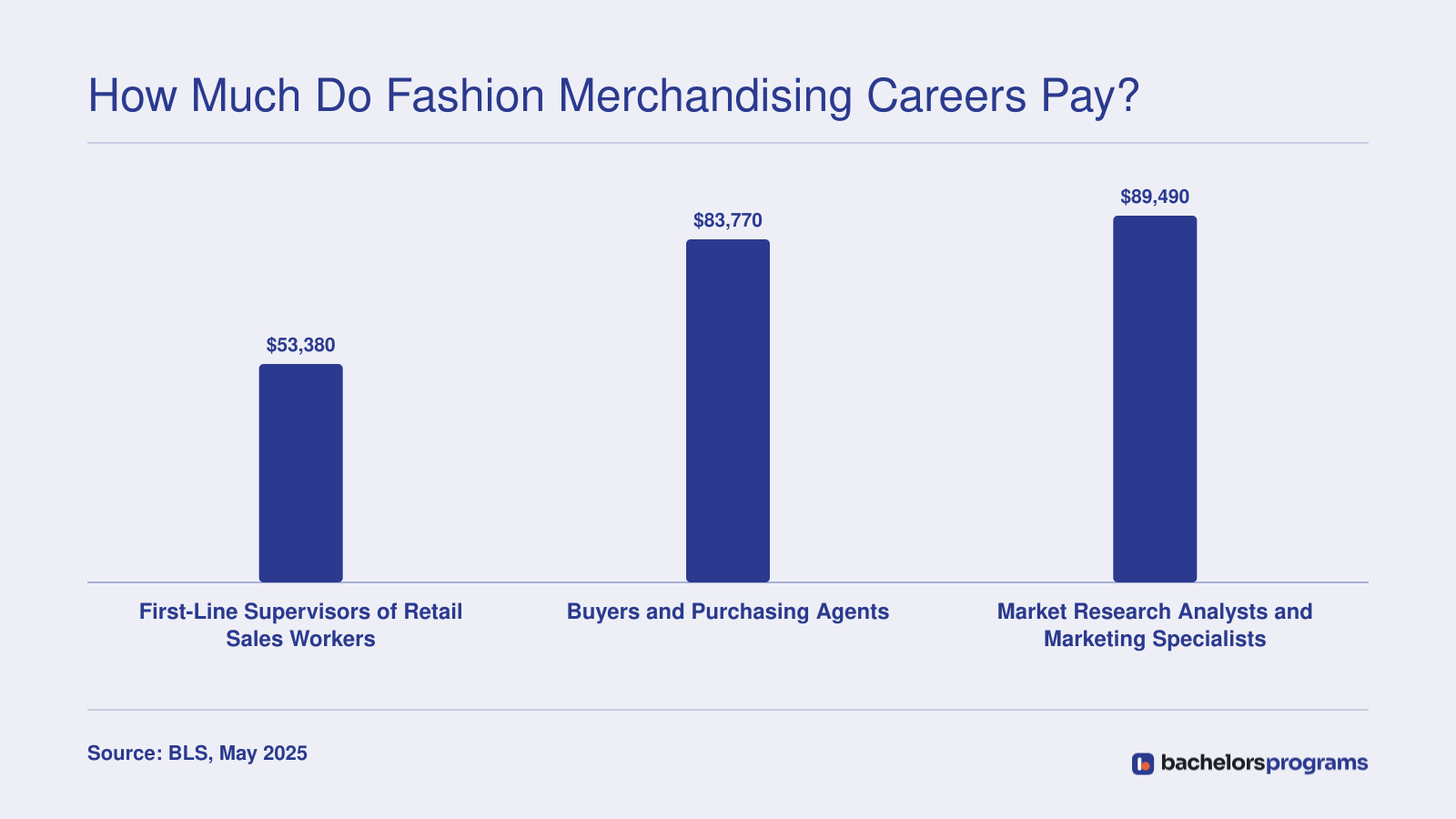
How Much Do Fashion Merchandising Careers Pay?
These are national median annual wages from the Bureau of Labor Statistics May 2025 occupational estimates, released in 2026. They cover everyone working in each occupation, not only fashion merchandising graduates, so treat them as a general guide rather than a promise of what your degree will earn. The pattern is still useful: pay climbs as you move from managing a sales floor into buying and into market research and analytics.
Questions to Ask Yourself
Do you picture yourself buying assortments for a department store, or forecasting inventory with data for an e-commerce brand?
If you study online, can you relocate for a summer internship in New York or Los Angeles?
Would a business-school program fit your corporate retail goals better than an art and design school?
Can an in-state public program get you the same outcomes for a lower monthly loan payment?
Fashion Merchandising programs by state
Fashion Merchandising Degree FAQs
These answers cover the questions prospective students ask most often about a bachelor's degree in fashion merchandising. Use them alongside the school comparisons above, and confirm details with each program before you apply.
What is the best school for fashion merchandising?
Is a fashion merchandising degree worth it?
Do I need to live in New York or Los Angeles to build a fashion merchandising career?
Can I transfer an associate degree in fashion merchandising toward a bachelor's?
Compare Fashion Merchandising programs on the data that matters
Explore more Arts & Design majors or browse every field of study.
All Arts & Design programs Browse every field of study