Best Online Fashion Merchandising Degree Programs
Compare 7 accredited online Fashion Merchandising programs, with net price after aid, graduation rates, earnings and debt from IPEDS and the U.S. College Scorecard.

A campus fashion program puts you in a showroom; an online one puts you in front of the same assortment math and merchandise planning coursework from wherever you already live. A bachelor's degree in fashion merchandising, most often awarded as a Bachelor of Science (B.S.) in Fashion Merchandising, runs roughly 120 credit hours either way.
The harder problem is visibility. Buying and planning roles are competitive, and plenty of schools keep tuition and graduate earnings behind a lead form. Each program on the list is delivered 100 percent online, with no hybrid sessions or residency weekends.
Median pay four years out tends to land between roughly $47,000 and $60,000, so net price deserves scrutiny before a deposit.
Key Points
- Liberty University's online B.S. in Fashion Merchandising holds SACSCOC institutional accreditation.
- Compare federal average net price, not sticker tuition, when weighing cost.
- Assistant buyer and visual merchandiser jobs start on different pay floors.
Best 100% Online Fashion Merchandising Degree Programs Ranked
These six programs are the full set of fashion merchandising bachelor's degrees we could confirm as available 100 percent online this year, so the list runs six deep rather than ten, with no filler entries. Programs that require any on-campus time were left out. Each is ordered by a blended quality composite that weighs cost, completion and graduate outcomes together, which makes this neither a cheapest-tuition list nor a highest-earnings list.
Sam Houston State University
#1Huntsville, TX · ~$16,000/yr (est.)
Best for: Busy Texans who prefer short terms
Sam Houston State pairs its fashion merchandising major with a required minor, so graduates leave with a second business credential in marketing, finance, supply chain management or entrepreneurship already built into the degree. Fashion courses run in 7.5-week blocks across fall, spring and summer, and students can apply each semester for the university's New York Fashion Week program. The school's overall graduation rate is about 55 percent.
- 120 total credit hours, including a required minor
- Minor options include Marketing, Finance and Supply Chain Management
- Fashion courses run in 7.5-week blocks in fall, spring and summer
- Each fashion merchandising course is offered once per academic year
- Internship requires 90 completed credit hours and departmental approval
- 2.0 GPA required overall, in the major and at SHSU
- Coursework covers buying, forecasting and brand management
- Capstone seminar in clothing, textiles and merchandising
Central Michigan University
#2Mount Pleasant, MI · $18,000/yr (est. net price)
Best for: Students set on a fashion buying track
Central Michigan is one of the few fashion programs that treats buying as a stand-alone specialty, with concentrations running from fashion buying and merchandising to design, product development and visual merchandising. The department keeps close industry ties through corporate partners such as Carhartt, Target and Adidas, a required internship, and an optional month-long summer course in Paris. Six online entry points each year mean students are not locked into a single fall start, and the school's overall graduation rate is about 59 percent.
- Five concentrations, including Fashion Buying and Visual Merchandising
- Fashion Buying concentration can be completed online
- Six online start dates per year, two inside each semester
- Required internship; past placements include Target and Bloomingdale's
- Coursework uses CAD, 3-D printers and virtual design software
- Corporate partners include Carhartt, Target and Adidas
- Optional one-month summer course in Paris
- Student-run Threads fashion show
Berkeley College-Woodland Park
#3Woodland Park, NJ · ~$27,000/yr (est.)
Best for: Associate degree holders continuing to a bachelor's
Berkeley College houses its fashion merchandising and management degree inside a business school, which shows in a curriculum built on consumer behavior, supply chain, retail distribution and product development rather than studio work. Students choose from thirteen specialization sequences of 12 to 15 credits that replace electives and are noted on the transcript, then finish with a Fashion Industry Immersion capstone built around interviews with working professionals. The school's overall graduation rate is about 44 percent.
- Business school curriculum with IACBE specialized accreditation
- Thirteen specialization sequences of 12 to 15 credits
- Specializations are noted on the transcript
- Rolling admissions; entrance exam or SAT/ACT scores required
- Fourth-year capstone is the Fashion Industry Immersion
- Internship or job-related assignment option
- Associate in Applied Science in the same field feeds the BBA
- Coursework covers global supply chain and retail distribution
Johnson & Wales University
#4Providence, RI · ~$20,000/yr (est.)
Johnson & Wales built its reputation on industry-facing programs, and the online fashion merchandising and retailing degree follows that pattern with a retail and fashion lab, forecasting and strategic planning coursework, and an internship or experiential education option. Transfer students get an express credit evaluation with most decisions returned within 48 hours, and a scholarship launched in fall 2026 trims tuition by 20 percent. The university reports a 97.7 percent career outcomes rate for undergraduate degree recipients.
- Catalog lists 121 credits for the online program
- Courses run 7 or 15 weeks
- $495 per credit hour
- Four-year online degree with a 19:1 student-to-faculty ratio
- Start dates include January 11 and March 15
- Express transfer credit evaluation, most decisions in 48 hours
- Career Catalyst Scholarship cuts tuition 20 percent from Fall 2026
- Internship, experiential education or study abroad options
Berkeley College-New York
#5New York, NY · $34,000/yr (est. net price)
Berkeley College's New York campus delivers the same business-centered fashion merchandising and management degree, set against the city's retail, showroom and wholesale ecosystem that supplies its field trips and guest speakers. Students pick from eleven specialization sequences spanning artificial intelligence to supply chain management, each a 12- or 15-credit block that replaces electives and is recorded on the transcript. The school's overall graduation rate is about 44 percent.
- Eleven specialization sequences of 12 or 15 credits
- Fourth-year capstone interviews industry professionals
- Rolling admissions with an entrance exam or SAT/ACT scores
- Larry L. Luing School of Business holds IACBE accreditation
- Associate in Applied Science offers a direct path into the BBA
- Coursework spans consumer behavior and global fashion supply chain
- Concentrations range from artificial intelligence to supply chain
- Courses offered online per the semester course schedule
Academy of Art University
#6San Francisco, CA · ~$41,000/yr (est.)
Academy of Art University runs fashion merchandising as one of seven bachelor's tracks inside its School of Fashion, sitting alongside design, textile design, fashion marketing, product development, costume design and fashion communication. That range gives merchandising students access to studio resources, an industry advisory board and study abroad options that a stand-alone merchandising department rarely matches. The school's overall graduation rate is about 34 percent.
- One of seven BFA tracks in the School of Fashion
- Sibling tracks include Fashion Marketing and Product Development
- Associate of Arts in Fashion Merchandising also offered
- Study abroad available within the School of Fashion
- Industry advisory board guides the school's curriculum
Cost & outcomes by school
Federal data for the highest-earning Fashion Merchandising programs, independent of the ranking above. Earnings are this field's bachelor's graduates four years after completing where the Scorecard reports them, else the school's undergraduate median.
| School | Net price / yr | Grad rate | Earnings | Debt | Grads/yr | Format |
|---|---|---|---|---|---|---|
| Academy of Art University CA | $40,613 | 34% | $60,284 | $31,000 | 7 | Online or campus |
| Central Michigan University MI | $17,597 | 59% | $57,513 | $26,125 | 17 | Online or campus |
| Johnson & Wales University RI | $31,027 | 55% | $53,539 | $26,982 | 12 | Online or campus |
| Johnson & Wales University RI | $20,252 | — | $53,539 | $26,982 | 23 | Online |
| Sam Houston State University TX | $16,404 | 55% | $47,823 | $25,000 | 15 | Online |
| Berkeley College-Woodland Park NJ | $27,100 | 44% | $47,104 | $31,000 | 7 | Online or campus |
Sources: U.S. Department of Education. Net price, graduation rate, earnings and debt: College Scorecard (earnings and debt for this field's bachelor's graduates where reported, else school-wide); graduates: IPEDS. A dash means no figure is reported.
Cost, debt & payoff
Median earnings of this field's bachelor's graduates (4 yrs after completing, else the school's undergraduate median) vs. their median federal loan debt · U.S. College Scorecard
Across these programs the median graduate earns about $56,878 and finishes with roughly $25,000 in debt — a ratio that clears a common rule of thumb (keep debt below first-year salary). Net price and debt vary widely school to school, so check the per-school figures in the table above before you shortlist.
How We Ranked Each Online Bachelor's Degree in Fashion Merchandising
Fashion merchandising has migrated online faster than the outcome data has kept up. That gap shapes how the bachelor's programs on this list were compared, because the numbers a prospective student most wants, real earnings and real debt, are the ones colleges publish least often.
Eligibility Comes First
A program had to be a bachelor's-level fashion merchandising degree that can be completed 100% online. Any program requiring campus visits, summer residencies, or hybrid studio coursework was set aside, since it cannot be finished from another state.
What the Comparison Weighs
Three things, in plain terms:
- Affordability: the average net price students actually pay after grants and scholarships, not the published sticker tuition.
- Completion: institution-wide graduation and retention rates, which hint at how well a school carries students through to a degree.
- Outcomes: program-level earnings and debt from federal College Scorecard data, wherever the government publishes them.
Where the Data Stops
Graduation rates and net price are school-wide averages, so they describe the institution rather than the fashion merchandising major alone. Some programs graduate too few students for federal data to report earnings at all, and that is stated plainly rather than guessed at.
That is also why the ranking does not simply repeat what schools say about themselves. A marketing page can call itself a top program and publish no outcomes whatsoever. Setting net price, completion, and reported earnings side by side gives you something independent to check.
Online Fashion Merchandising Degree Tuition Cost: Sticker Price vs. What Students Actually Pay
The online fashion merchandising degree tuition cost on a school's website is the sticker price. The average net price after grants and scholarships, drawn from federal data, is an approximate institution-wide yearly figure rather than a personal quote: it runs from $16,404 at Sam Houston State and $17,597 at Central Michigan (both public) to $20,252 at private nonprofit Johnson & Wales and $27,100 to $40,613 at the private for-profit schools, and only Sam Houston State publishes a higher out-of-state rate ($19,068 vs. $9,228), while the others list one rate for everyone. To price a per-credit program, multiply the rate by the credits you still need: Johnson & Wales lists $495 per credit for a 90 to 91 credit degree, so 90 x $495 = $44,550, each 3-credit course you transfer in cuts $1,485, and as a reality check, median federal debt at completion ranges from $25,000 to $34,500, or about $265 to $366 a month on a 10-year plan.
| School | Sector | Published In-State Tuition and Fees (per year) | Published Out-of-State Tuition and Fees (per year) | Average Net Price After Aid (per year) | Online Per-Credit Rate | Estimated Program Tuition at Per-Credit Rate | Median Federal Debt at Completion | Estimated Monthly Payment (10 years) |
|---|---|---|---|---|---|---|---|---|
| Sam Houston State University | Public | $9,228 | $19,068 | $16,404 | N/A | N/A | $25,000 | $265 |
| Central Michigan University | Public | $14,760 | $14,760 | $17,597 | N/A | N/A | $26,125 | $277 |
| Johnson & Wales University | Private nonprofit | $13,365 | $13,365 | $20,252 | $495 (2026-2027) | $44,550 to $45,045 (90 to 91 credits) | $26,982 | $286 |
| Berkeley College-Woodland Park | Private for-profit | $29,800 | $29,800 | $27,100 | N/A | N/A | $31,000 | $329 |
| Berkeley College-New York | Private for-profit | $29,800 | $29,800 | $34,124 | N/A | N/A | $34,500 | $366 |
| Academy of Art University | Private for-profit | $30,736 | $30,736 | $40,613 | N/A | N/A | N/A | N/A |
Related Articles
Accreditation, Admissions, and Transfer Credit Policies to Compare
Are Online Fashion Merchandising Degrees Accredited?
Liberty University's online Bachelor of Science in Fashion Merchandising falls under the university's institutional accreditation from the Southern Association of Colleges and Schools Commission on Colleges (SACSCOC). That is the standard to look for. An accredited online fashion merchandising degree carries the same institutional accreditation as the campus version, because accreditation covers the institution, not the delivery format.
Fashion merchandising has no single mandatory programmatic accreditor, so institutional accreditation is the check that matters most for federal financial aid, credit transfer, and future graduate study. Some schools add business-school recognition on top. Berkeley College, for example, lists International Accreditation Council for Business Education (IACBE) accreditation for its fashion merchandising and management program. Treat recognition like this as a bonus, not a substitute.
Verify each school's accreditor yourself before applying. The U.S. Department of Education's Database of Accredited Postsecondary Institutions and Programs (DAPIP) and the Council for Higher Education Accreditation (CHEA) directory are both free and searchable by school name.
Admissions Selectivity
Getting in is rarely the main hurdle. Based on the most recent federal data, Sam Houston State University admits about 90% of applicants, Central Michigan University about 90%, and Johnson & Wales University about 91%. Sam Houston State lists a 2.0 GPA minimum for its program. Berkeley College lists an entrance exam requirement, with SAT or ACT scores accepted, and uses rolling admissions, so confirm testing policies early.
Transfer Credit and Time to Degree
Transfer rules shape how quickly you finish:
- Old Dominion University: Up to 90 transfer credits toward its 120-credit online B.S., with at least 30 credits earned at ODU.1
- Liberty University: Up to 75% of the degree total in transfer credit. On a typical 120-credit degree that would mean up to 90 credits, but confirm the total for your specific option.
- Johnson & Wales University: An Express Transfer Credit Evaluation, with transfer decisions within 48 hours.
- Berkeley College: A built-in path from its associate degree into the bachelor's.
A full-time online bachelor's degree typically takes about four years starting from scratch. With a completed associate degree and a generous transfer policy, many students finish in roughly two more years. Residency minimums cap how much you can bring in, and policies vary by school, so request an official transcript evaluation before you enroll.
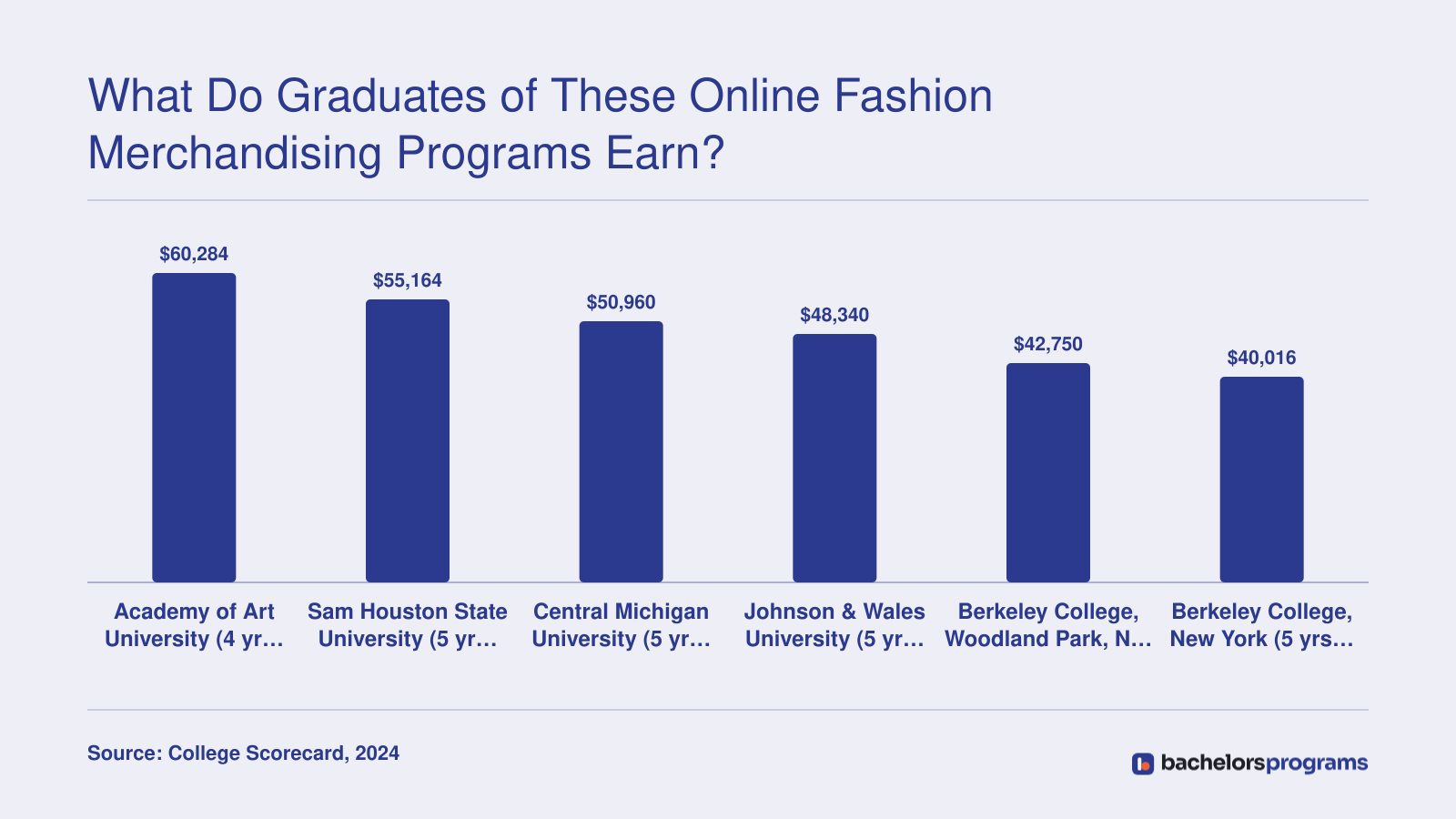
What Do Graduates of These Online Fashion Merchandising Programs Earn?
These bars show College Scorecard median earnings for graduates of each school's bachelor's degree in fashion merchandising, measured four or five years after finishing. That program-level pay is separate from each school's institution-wide figure, which covers all majors 10 years after entry (for example, $39,008 at Academy of Art University and $55,874 at Central Michigan University). Early-career fashion salaries tend to rise as graduates are promoted into buyer and planner roles.
Fashion Merchandising Degree Salary and Career Outcomes
An assistant buyer and a visual merchandiser can both start out with the same bachelor's degree in fashion merchandising, but they begin on different pay floors. The title you target matters as much as the degree itself.
Career Paths and What They Do
Common roles include assistant buyer, buyer, merchandise planner, allocation analyst, visual merchandiser, and e-commerce merchandiser. Assistant buyers and allocation analysts support the buying team with purchase orders, sales data, and inventory moves. Merchandise planners decide how much product each store or online channel should carry. Buyers negotiate with vendors, select assortments, and answer for sales and margin. Visual merchandisers turn a plan into displays. E-commerce merchandisers manage online assortments, product pages, and promotions.
Pay and Outlook
The Bureau of Labor Statistics reports a median annual wage of $77,710 for buyers and purchasing agents as of May 2025.1 Employment in the occupation is projected to grow 6% from 2025 to 2035, and the broader group that includes purchasing managers is expected to have about 53,600 openings per year over that period.1 Not every fashion merchandising job pays at that level. Merchandise displayers and window trimmers, a closer match for entry-level visual work, had a median annual wage of $39,390 in May 2025.2
The Advancement Ladder
Most graduates start as an assistant buyer or allocation analyst, move into a buyer or planner role after a few years, and later advance to merchandising manager. Each step adds ownership of a category, a budget, or a team, and pay typically rises with that scope.
Reading the Earnings Data Above
The program-completer earnings figures offer a useful reality check. Those figures generally reflect graduates early in their careers, so they often trail the all-career median for buyers. Treat the BLS median as a mid-career target, not a guaranteed starting salary.
Buyer Pay at a Glance
Buying is one of the most common career targets for fashion merchandising graduates. Here is what the broader occupation pays nationally.
Bachelor's vs. Associate Degree vs. Certificate in Fashion Merchandising
The tradeoff is how much time and money you spend up front versus which job titles open up later. A certificate can be finished in a semester or two; a bachelor's takes roughly four years of full-time study. The shorter credentials cost less and get you working sooner, but they rarely satisfy employers hiring for buying, planning, and brand management roles.
How the three credentials compare
- Bachelor's: Typically 120 credits over about four years. Covers merchandise math, retail buying, textiles, visual merchandising, and business coursework. This is the credential most buyer, planner, and merchandising manager postings ask for, and the Bureau of Labor Statistics lists a bachelor's as the typical entry requirement for fashion designers,1 noting that degrees in fine arts, business, or fashion merchandising are common paths in.
- Associate degree: Usually around 60 credits across two years, at a lower total price, especially at a community college. Strong fit for store-level and assistant roles, and often the cheapest on-ramp to a four-year degree if the credits transfer.
- Certificate: Commonly under 30 credits and focused on one skill set, such as CAD, textiles, or portfolio work. Fastest and least expensive, with the narrowest job reach on its own.
Choosing based on where you want to land
If buyer or planner work is the goal, aim for the bachelor's. Federal earnings data for 2025 shows workers whose highest credential is a bachelor's earning a median of $1,558 per week against $1,229 for associate degree holders, a gap of about 27 percent, though that figure spans all fields and does not isolate fashion.2
If cost is the barrier, start with an associate degree and confirm the transfer agreement in writing before you enroll. Certificates make the most sense for career changers who already hold a bachelor's in another field and need the industry-specific coursework, not a second degree.
Fashion Merchandising programs by state
Online Fashion Merchandising Degree FAQs
These answers distill the findings above for students comparing a bachelor's degree in fashion merchandising online. Details such as credit transfer and campus requirements vary by school, so confirm them with each admissions office.
What is the best online fashion merchandising degree program?
How long does it take to earn an online bachelor's degree in fashion merchandising?
Can you get a fashion merchandising degree online without ever visiting campus?
Is a fashion merchandising degree worth it compared with a general business degree?
Compare Fashion Merchandising programs on the data that matters
Explore more Arts & Design majors or browse every field of study.
All Arts & Design programs Browse every field of study