Best Online Illustration Degree Programs
Compare 8 accredited online Illustration programs, with net price after aid, graduation rates, earnings and debt from IPEDS and the U.S. College Scorecard.

A bachelor's degree in illustration can be completed entirely online, with no campus studio visits at all, though you will still spend most of your week drawing. The standard credential is the Bachelor of Fine Arts (B.F.A.) in Illustration, a 120-credit degree built on studio critique, media electives, and a capstone portfolio.
The ranking below admits only 100% online programs, so hybrid formats are out. Cost varies widely, accreditation splits between institutional and NASAD review, and portfolio requirements differ by school.
The market still judges illustrators by the work, not the transcript. No tuition figure changes that.
Key Points
- Illustrators' federal occupation group earned a $55,290 median wage in May 2025.
- Rankings weigh net price, graduation rate, earnings, and debt from federal data.
- Without institutional accreditation, you lose federal financial aid and most credit transfer.
Best Fully Online Illustration Bachelor's Programs for 2027
These are the illustration bachelor's programs you can complete online, ordered by a combined measure of net price after aid, the school's graduation rate, program earnings and typical graduate debt, not by any single number. Only the programs the data returned are listed, and where a school also teaches the degree on campus or in mixed formats, the entry says so.
Ferris State University
#1Big Rapids, MI · ~$9,000/yr (est.)
Best for: Learners wanting optional on-campus studio time
Ferris State University awards its Bachelor of Fine Arts in Illustration through Kendall College of Art and Design, a studio-heavy degree with 39 credits of major studio work on top of supportive studio and art history. Classes run on the Grand Rapids campus, online, or in a mixed format, so online students should confirm section availability before applying. Admission is test optional with a 2.50 GPA and a portfolio of 8 to 10 works. Net price after aid is about $8,624 and the school's graduation rate is 47 percent.
- 39 credit hours of major studio coursework
- Portfolio of 8 to 10 recent works required for admission
- 2.50 GPA minimum; ACT or SAT scores not required
- NASAD accredited through Kendall College of Art and Design
- Classes offered on campus, online, or in mixed delivery
- Coursework covers rendering, watercolor, inking and children's book illustration
Liberty University
#2Lynchburg, VA · ~$29,000/yr (est.)
Best for: Busy adults who need frequent start dates
Liberty University's online Bachelor of Science in Digital Design with an Illustration Design concentration is a 120-credit degree whose 33-credit illustration core runs from drawing studio and vector graphics labs to a portfolio capstone and internship. Courses are delivered online in eight-week terms, and applicants should confirm that each term is asynchronous. Net price after aid is about $29,357 and the school's graduation rate is 65 percent.
- 120 total credit hours, fully online
- 33-credit illustration design concentration
- Eight-week online courses without set login times
- 2.0 GPA minimum with a C in upper-level major courses
- 30 upper-level hours required; 25% of the major taken at Liberty
- 18 to 27 free elective credits; 45+ transfer credits waive RLGN 104
- Design portfolio and self-promotion capstone plus an internship
Sessions College
#3Tempe, AZ · ~$15,000/yr (est.)
Best for: Self-directed learners wanting asynchronous art classes
Sessions College offers a Bachelor of Fine Arts in Illustration built on 120 credits and roughly 10 semesters of full-time study, with part-time schedules and transfer credit available. Coursework moves from drawing and life drawing through painting, digital illustration and visual storytelling to a client internship, and classes are asynchronous with no mandatory login times. Admission asks for 5 to 10 art samples and a short interview. Net price after aid is about $15,149 and the school's graduation rate is 40 percent.
- 120 credits across about 10 full-time semesters
- Fully online and asynchronous, no mandatory login times
- $400 per credit, $48,000 total tuition, plus a $200 registration fee
- 5 to 10 art samples plus a 15-minute interview required
- Internship with a real client and a capstone
- Part-time schedules and credit transfer available
- Accredited by the Distance Education Accrediting Commission
Rocky Mountain College of Art and Design
#4Lakewood, CO · ~$32,000/yr (est.)
Rocky Mountain College of Art and Design teaches its Bachelor of Fine Arts in Illustration fully online, with 33 credits of illustration courses, 45 in liberal arts and 24 in foundation studio work. Students can add a children's book, concept art or sequential art focus, and tuition is locked at the rate in place when they start. Online students get a dedicated adviser, tutoring and library access. Net price after aid is about $32,363 and the school's graduation rate is 32 percent.
- Fully online BFA in Illustration
- 33 credits of illustration courses, 45 liberal arts, 24 foundations
- Children's Book concentration, 6 credits
- Concept Art concentration, 15 credits
- Sequential Art emphasis, 6 credits
- Tuition locked at the rate in effect at a student's start date
- Dedicated adviser, tutoring and online library for online students
None of the ranked Illustration programs match the online lens yet. The full ranking is at the link above.
Cost, debt & payoff
Median earnings of this field's bachelor's graduates (4 yrs after completing, else the school's undergraduate median) vs. their median federal loan debt · U.S. College Scorecard
Across these programs the median graduate earns about $53,514 and finishes with roughly $24,250 in debt — a ratio that clears a common rule of thumb (keep debt below first-year salary). Net price and debt vary widely school to school, so check the per-school figures in the table above before you shortlist.
How We Ranked Online Illustration Programs
These rankings rest on federal data, not advertising or reputation surveys. We drew net price, graduation rate, program-level earnings, and median debt from the College Scorecard and IPEDS, two public databases from the U.S. Department of Education.
Only programs delivered fully online were eligible. Hybrid programs were removed before any scoring began.
Two caveats apply to these figures. Graduation rates are institution-wide, so they describe the whole school rather than the illustration program alone. Reported net price reflects the average after grant aid, not a personal quote. Your own cost will depend on your aid package and any transfer credits.
No school pays for placement. Every number comes from public sources, so you can verify it yourself.
How to Choose a Bachelor's Degree in Illustration Online
Online studio instruction now works well enough that the real question is not whether critique survives video, but which format fits how you learn. Start with the credential itself, then work down to the weekly rhythm of the program.
B.A. or B.F.A.
A Bachelor of Arts in Illustration pairs studio work with a wider general education core, which suits students eyeing art direction, publishing, marketing, or a second field. A B.F.A. loads roughly two-thirds of the degree into studio coursework and serves portfolio-driven paths like editorial, concept art, or children's book illustration. Neither is better in the abstract: pick by the career you want.
Schedule and critique
Asynchronous courses let you paint at 2 a.m. around a job. Synchronous sessions supply the live critique that makes studio culture work. Ask admissions how often critiques happen, whether they are group or one-on-one, and how quickly faculty return feedback.
Faculty, portfolio, and credits
- Faculty: Look for instructors who still take professional illustration work, and for small studio sections.
- Portfolio courses: Confirm there is a dedicated portfolio sequence or senior capstone that leaves you with professional-ready pieces.
- Transfer credit: Ask how prior coursework applies, since accepted credits shorten the path.
- Beginners: Favor programs with foundational drawing requirements and no portfolio barrier at admission.
Questions to Ask Yourself
Do you want a studio-heavy B.F.A. path or a broader B.A. with room for marketing, writing, or business electives?
Will recorded, asynchronous critiques work for you, or do you need live feedback from faculty and peers?
Which niche pulls you most: children's books, editorial, concept art, or surface design?
Can you budget for a drawing tablet and Adobe or Procreate software on top of tuition?
Online Illustration Degree Cost: Net Price, Tuition, and Tech
Average net price is what students actually paid after grants and scholarships, according to U.S. Department of Education data (IPEDS and College Scorecard). Treat it as a benchmark, not a quote, and run each school's net price calculator for a personal estimate. Where a school publishes a per-credit rate, multiply it by total credits to estimate tuition for the full degree. Sessions College lists $400 per credit plus a $200 registration fee. Liberty University lists $410 per credit for full-time 2026-2027 students, $475 part-time and $250 for military students. Budget for tools as well. Sessions requires Adobe Creative Cloud and a desktop or laptop that meets Adobe's minimum specs (Chromebooks and iPads do not qualify), and many illustration students add a drawing tablet or pen display, so price that equipment before you enroll.
| School | Average Net Price (After Aid) | In-State Tuition and Fees (Annual) | Out-of-State Tuition and Fees (Annual) | Per-Credit Tuition | Total Credits | Estimated Program Tuition |
|---|---|---|---|---|---|---|
| Ferris State University | $8,624 | $14,778 | $14,778 | N/A | N/A | N/A |
| Sessions College | $15,149 | $7,400 | $7,400 | $400 | 120 | $48,000 |
| Liberty University | $29,357 | $22,465 | $22,465 | $410 (full-time, 2026-2027) | 120 | $49,200 |
| Rocky Mountain College of Art and Design | $32,363 | $20,190 | $20,190 | N/A | N/A | N/A |
Related Articles
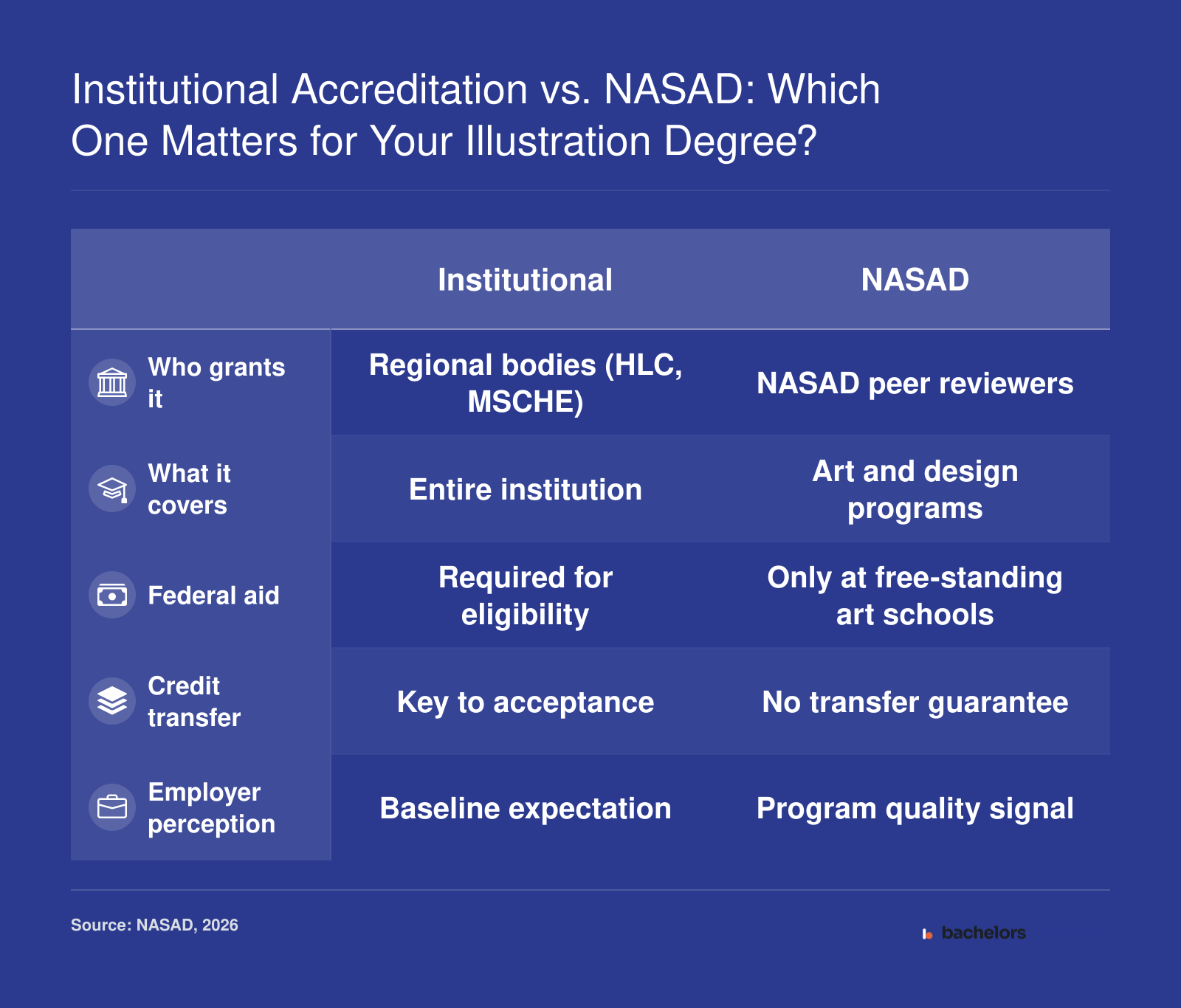
Institutional Accreditation vs. NASAD: Which One Matters for Your Illustration Degree?
Institutional accreditation is non-negotiable: without it, you lose access to federal financial aid and most credit transfer. NASAD accreditation is a separate, peer-reviewed signal that a school's art and design programs meet basic threshold standards, including programs delivered by distance education, but NASAD does not rank schools. Before you enroll in any program below, confirm its institutional accreditor on the school's website, then search NASAD's directory, which lists each member's initial accreditation year, most recent and next evaluations, and approved art and design degrees.
Admissions, Portfolio Requirements, and Transfer Credit
Most online illustration programs ask for a high school diploma or GED, an application, and official transcripts. Portfolio rules vary more from school to school.
- PortfolioSome programs require one. Sessions College asks for 5 to 10 art or design samples, and beginners can submit an alternative written assignment instead. Kendall College of Art and Design asks for 8 to 10 recent pieces. Maryville and Lindenwood describe building a portfolio during the program.
- Minimum GPALiberty lists a 2.0 GPA, Maryville 2.5, and Kendall 2.50.
- Test scoresMaryville and Kendall do not require the SAT or ACT.
- Transfer creditLiberty accepts up to 75% of the degree in transfer. Lindenwood's policy cites up to nine credits.
- FeesSessions College charges a $75 application fee.
What Illustrators Earn Nationally
Craft and fine artists, the federal occupation group that includes illustrators, earned a median annual wage of $55,290 as of May 2025.
Is an Online Illustration Degree Worth It?
An illustration degree asks you to trade a predictable paycheck for creative work, so the math deserves a look before you enroll.
What the Numbers Show
Five years after finishing, median earnings for illustration graduates are $45,743 at Rocky Mountain College of Art and Design, $45,177 at Liberty University, and $43,252 at Ferris State University. Median debt is $31,750 at RMCAD (about $337 a month), $24,998 at Liberty ($265), and $25,500 at Ferris ($270).
What BLS Says
The Bureau of Labor Statistics projects fine artists, including illustrators, to decline 3% from 2025 to 2035, from 28,900 jobs to 28,000.1 The broader craft and fine artists group still averages about 4,300 openings a year, and 58% of that group is self-employed.1 Expect freelance income to vary from year to year.
Realistic Paths
- Freelance: editorial and children's book illustration.
- In-house: staff roles at publishers, game studios, and animation studios.
- Adjacent: graphic design and art direction.
Verdict
It is worth it if you treat the degree as a place to build a professional portfolio and a network of working contacts. Keep debt low by choosing a lower-net-price program. Ferris State's average net price of $8,624 is far below the other two schools here, which sit above $29,000.
Illustration programs by state
Compare Illustration programs on the data that matters
Explore more Arts & Design majors or browse every field of study.
All Arts & Design programs Browse every field of study