Best Illustration Degree Programs
Compare 180+ accredited Illustration programs, with net price after aid, graduation rates, earnings and debt from IPEDS and the U.S. College Scorecard.

A bachelor's degree in illustration is a four-year studio degree, most often a Bachelor of Fine Arts (B.F.A.), where you build a portfolio of drawing, painting, and narrative work for editorial, publishing, game, and design employers. Many programs admit by portfolio review, and some require a 3.0 GPA.
The trade-off is that schools differ sharply. Among the programs here, annual net price runs from about $6,555 at Cal State Fullerton to $21,786 at Washington University in St. Louis, and graduation rates span roughly 69% to 94%.
A school's name alone says little about what you will pay or earn. Employers hire on portfolios, not diplomas, so the work you produce matters most.
Key Points
- CUNY Queens College has the lowest average net price, $4,195 a year.
- First-year median earnings range from $27,023 (FIT) to $43,530 (Temple).
- Fully online illustration degrees are rare; every ranked program is campus-based.
Best Illustration Schools for a Bachelor's Degree: Top 10 Ranked
The ten programs below were weighed on what families actually pay after aid, how many students finish, and what graduates go on to earn. Each card notes the concentration, the campus-based format and the school's completion rate so you can compare fit as well as cost. The full method is spelled out in the ranking criteria section that follows.
University of Georgia
#1Athens, GA · ~$14,000/yr (est.)
Best for: Scientific illustration track toward medical illustration
A large public research university in Athens, the University of Georgia runs one of the broadest art programs in the South, with ten concentration options inside its BFA in Art. Scientific Illustration is the illustration route, pairing studio technique with figure drawing, art history and a senior capstone, and it is a high-demand major that admits by portfolio review. Schools offering this program graduate about 90% of students, and the average net price after aid comes to roughly $13,900, a figure that in-state tuition keeps low for Georgia residents.
- Scientific Illustration concentration inside the BFA in Art
- 120 credit hours, including 45 hours of required coursework
- 15 hours of major electives plus 18 related hours
- 2.5 GPA and portfolio review to enter the concentration
- Capstone, figure drawing and art history required
- Named scholarships include the Lamar Dodd and Christ-Janer awards
- Preparation for medical illustration graduate study
University of Illinois Urbana-Champaign
#2Champaign, IL · ~$14,000/yr (est.)
Best for: Aspiring illustrators wanting business and storytelling coursework
The University of Illinois Urbana-Champaign pairs a 122-credit BFA in Studio Art with an Illustration concentration built on drawing, painting, layout and visual storytelling. Students also study business models and industry practice, which is unusual for a studio degree, and finish with a capstone studio. Schools offering this program graduate 85% of students, and the average net price after aid is around $14,400. Program graduates report a median of $65,186 four years after finishing.
- 122 credit hours with 48 in the illustration concentration
- Portfolio review required for the School of Art and Design
- Seven-hour capstone including BFASA Capstone Studio
- At least 40 upper-division hours needed to graduate
- Coursework includes Digital Coloring and Composition and Storytelling
- Business models and industry practice built into the curriculum
Washington University in St Louis
#3St. Louis, MO · ~$22,000/yr (est.)
Best for: Design-minded students at a private research university
Washington University in St. Louis is a private research university whose Sam Fox School of Design & Visual Arts houses the illustration path inside Communication Design. The program is small and studio-driven, sits alongside a full liberal arts curriculum, and lives on a campus with a 12% admit rate. Schools offering this program graduate 94% of students, the highest completion rate in this group, while the average net price after aid runs near $21,800. Program graduates report a median of $67,771 four years after finishing.
- Illustration path within the Communication Design area
- Housed in the College of Art at the Sam Fox School
- Offered as a BFA or BA in Studio Art & Design
- Highly selective campus with a 12% admit rate
University of Central Florida
#4Orlando, FL · ~$10,000/yr (est.)
UCF is a large public university in Orlando whose BFA in Studio Art splits into nine specializations, including a Drawing/Illustration combination. The program is built for scale and flexibility, with fall, spring and summer starts, a 120-credit path and a 3.0 GPA standard across major coursework. Schools offering this program graduate 78% of students, and the average net price after aid is about $10,400, among the lowest in this ranking.
- 120 credits, with 57 in the studio art major
- Drawing/Illustration Combination takes 18 upper-level credits
- Includes Intermediate Illustration and Advanced Illustration
- Studio Art Portfolio review (ART3950) required for admission
- 3.0 GPA across major requirements to graduate
- Capstone BFA Exhibit/Seminar required
- Fall, spring and summer start terms
- Honors in the Major available
University of South Florida
#5Tampa, FL · ~$10,000/yr (est.)
USF places its illustration concentration inside a BFA in Graphic Arts on the St. Petersburg campus, so students get design training alongside illustration rather than illustration alone. Classes are small and taught by practicing designers, and advanced work covers narrative, editorial, storyboards, graphic novels and concept art. Schools offering this program graduate 77% of students, and the average net price after aid is roughly $9,800. Program graduates report a median of $54,770 four years after finishing.
- Illustration concentration inside a BFA in Graphic Arts
- Balances graphic design courses with illustration studios
- Advanced work covers narrative, editorial, advertising and concept art
- Storyboards and graphic novels included in coursework
- Based at the St. Petersburg campus
- Small classes with one-on-one instruction from practicing designers
- Fall 2027 applications due March 21, 2027
California State University-Fullerton
#6Fullerton, CA · $7,000 – $20,000/yr (est.)
Cal State Fullerton runs a 132-unit BFA in Art with eight studio concentrations, and its illustration track is one of the more structured offerings in the California State University system. Admission is by portfolio review only, with two attempts allowed, and the curriculum builds from a lower-division core into 30 units of illustration. Schools offering this program graduate 70% of students, and the average net price after aid is about $6,600, the lowest in this ranking.
- 132 units, including a 30-unit illustration concentration
- 27-unit lower-division core and 18-unit upper-division core
- Admission by portfolio review only, in fall or spring
- Two B.F.A. portfolio attempts allowed
- 3.0 GPA across ART 103, 104, 107A and 107B to apply
- C or better required in all required art courses
- One of eight studio concentrations in the BFA in Art
Brigham Young University
#7Provo, UT · $15,000 – $20,000/yr (est.)
BYU offers a standalone BFA in Illustration rather than a concentration tucked inside a general studio art degree, and the whole major runs only 72 credits. It is a limited-enrollment program with a pre-BFA gate and a June portfolio review, and coursework runs through digital illustration, environment design and narrative work before a senior studio. Schools offering this program graduate 81% of students, and the average net price after aid is about $15,600. Program graduates report a median of $52,929 four years after finishing.
- 72 credit hours in the major
- Limited-enrollment program with pre-BFA status required
- Online portfolio for pre-BFA; June portfolio review for the BFA
- Coursework includes digital illustration and environment design
- Senior Illustration Studio plus professional practices
- Up to 6 credits of internship available
- 12 hours of electives such as storyboarding and character design
Fashion Institute of Technology
#8New York, NY · $6,000 – $17,000/yr (est.)
FIT is a specialized public college in New York City devoted to art, design and business, and illustration is a flagship major in its School of Art and Design. The degree runs as a 2+2: students arrive with an AAS or equivalent and complete the upper-division sequence, including a portfolio thesis and a course on the business of illustration. Schools offering this program graduate 81% of students, and the average net price after aid is about $19,100. Program graduates report a median of $60,882 four years after finishing.
- 63 credits across semesters five through eight
- 2+2 structure requires an earned AAS or equivalent
- Illustration Portfolio Thesis and The Business of Illustration
- Coursework in book illustration and visual storytelling
- Related area and liberal arts credits round out the degree
California State University-Long Beach
#9Long Beach, CA · $7,000 – $20,000/yr (est.)
Cal State Long Beach awards a 132-unit BFA in Illustration as a stand-alone degree, with a four-year plan and a five-year option for students who need more room. The upper division is unusually deep, with Illustration Anatomy, Sequential Illustration and a senior project, and the program points toward editorial, comics and biomedical illustration work. Schools offering this program graduate 69% of students, and the average net price after aid is about $10,400. Program graduates report a median of $66,435 four years after finishing.
- 132 units with a four-year or five-year degree plan
- 49 upper-division units in the major
- Includes Illustration Anatomy and Sequential Illustration
- Advanced Studio Illustration 3 and 4 plus a senior project
- 2.5 GPA and portfolio submission for admission
- C or higher in key art and art history courses
- Careers in editorial, comics and biomedical illustration
San Jose State University
#10San Jose, CA · ~$14,000/yr (est.)
San José State folds illustration into a BFA in Animation & Illustration that trains students across color theory, perspective, 2D and 3D animation, storyboarding and character design. Admission is settled when students apply to the university, and a BA in Design Studies with the same specialization exists for students who do not clear the BFA portfolio review. Schools offering this program graduate 69% of students, and the average net price after aid is about $13,800. Graduates report a median of $93,917 five years after finishing.
- No internal transfer; admission decided at university application
- Milestone portfolio review required to stay in the program
- Covers 2D and 3D animation, storyboarding and character design
- Upper-division specialization in an area of choice
- Professional internship recommended
- Color theory, design and perspective in the foundation
- Alternative for students who do not pass the BFA portfolio review
- Animation & Illustration specialization inside Design Studies
- Shares animation and illustration coursework with the BFA
Cost & outcomes by school
Federal data for the highest-earning Illustration programs, independent of the ranking above. Earnings are this field's bachelor's graduates four years after completing where the Scorecard reports them, else the school's undergraduate median.
| School | Net price / yr | Grad rate | Earnings | Debt | Grads/yr | Format |
|---|---|---|---|---|---|---|
| University of Michigan MI | $13,138 | 93% | $83,648 | $19,500 | — | Campus |
| San Jose State University CA | $13,760 | 69% | $78,988 | $15,000 | 229 | Campus |
| Molloy University NY | $24,347 | 70% | $77,789 | $27,000 | — | Campus |
| Art Center College of Design CA | $48,661 | 79% | $76,093 | $31,000 | 205 | Campus |
| Merrimack College MA | $37,927 | 70% | $75,584 | $27,000 | 6 | Campus |
| Sacred Heart University CT | $46,174 | 74% | $75,059 | $25,000 | 5 | Campus |
| University of Connecticut CT | $25,097 | 83% | $73,997 | $21,500 | — | Campus |
| The Catholic University of America DC | $29,561 | 80% | $73,250 | $26,000 | — | Campus |
| Salve Regina University RI | $36,967 | 77% | $72,975 | $27,000 | — | Campus |
| Syracuse University NY | $38,793 | 84% | $71,527 | $27,000 | 114 | Campus |
| California State University-East Bay CA | $9,320 | 48% | $71,401 | $16,544 | — | Campus |
| University of Georgia GA | $13,936 | 90% | $68,726 | $18,500 | — | Campus |
Sources: U.S. Department of Education. Net price, graduation rate, earnings and debt: College Scorecard (earnings and debt for this field's bachelor's graduates where reported, else school-wide); graduates: IPEDS. A dash means no figure is reported.
Cost, debt & payoff
Median earnings of this field's bachelor's graduates (4 yrs after completing, else the school's undergraduate median) vs. their median federal loan debt · U.S. College Scorecard
Across these programs the median graduate earns about $53,514 and finishes with roughly $24,250 in debt — a ratio that clears a common rule of thumb (keep debt below first-year salary). Net price and debt vary widely school to school, so check the per-school figures in the table above before you shortlist.
How We Ranked Illustration Programs
A strong illustration ranking should reward schools whose graduates can pay their bills, not just schools with famous names. That principle shaped every factor below.
What We Measured
- Graduate outcomes: Program-level earnings and federal student loan debt for illustration graduates, drawn from College Scorecard. These figures describe people who finished the illustration program specifically, not the whole university.
- Affordability: Average net price, or what students pay once grants and scholarships come off the sticker price.
- Completion: Graduation rates, plus first-year retention rates that show how many students return for a second year.
- Program size: The number of illustration degrees a school awards each year. Larger programs often mean more course sections, more faculty, and more peers in critique.
- Selectivity: Admission rate, used as context rather than a goal in itself.
Where the Data Falls Short
Graduation and retention rates are institution-wide, so they describe the whole college, not the illustration department alone. Your own cost depends on family income and the aid offers you receive, so the published figure is only a starting point. Where a program graduates too few students to report earnings, we left the figure blank instead of estimating it. All figures come from College Scorecard and IPEDS, the federal data systems run by the U.S. Department of Education, and reflect the latest data available as of November 2026.
How to Use This Ranking
Treat the list as a shortlist to compare, not a verdict. A school ranked lower may be the better choice if its faculty specialize in children's books, editorial work, or concept art and that is the portfolio you want to build. Weigh portfolio requirements, studio access, and total cost against your budget, then visit campus or sit in on a virtual portfolio review.
What a Bachelor's Degree in Illustration Covers: B.A. vs. B.F.A.
A bachelor's degree in illustration usually comes as a Bachelor of Arts (B.A.) or a Bachelor of Fine Arts (B.F.A.), and the main difference is how much of your time is spent in the studio. The B.A. leaves room for a minor or double major in fields like writing, marketing, or education. The B.F.A. is studio-intensive and built around a portfolio. Credit splits below come from the NASAD Handbook 2025-26 and published program catalogs, so exact numbers vary by school.
| Factor | B.A. in Illustration | B.F.A. in Illustration |
|---|---|---|
| Studio vs. liberal arts share | Visual arts work normally equals 30 to 45% of the curriculum, with at least 20% in studio courses and at least 5% in art and design history (NASAD) | A minimum of 65% of total credits in studio (NASAD) |
| Typical total credits | Set by each school; check the catalog | 138 to 139 credits in one program catalog; another lists an 81-hour major |
| Foundation year | Varies by school; foundation work is usually a smaller part of the degree | About 20 credits of foundation year in one catalog; 24 hours of art foundation courses in another |
| Specialization depth | Broader; illustration shares space with general education and electives | 18 hours of illustration concentration plus 27 hours of electives in at least two other studio areas (one catalog example) |
| Senior thesis or portfolio | Varies; often a capstone or portfolio review | Portfolio-driven, with a 3-hour B.F.A. seminar in one catalog |
| Studio vs. academic credits | Academic and general education courses make up most of the degree, leaving room for a minor or double major | 77 to 80 studio credits plus 45 to 46 academic credits in one catalog |
| Common specializations | Editorial, children's book, concept art, sequential and comics, surface design, scientific illustration | Editorial, children's book, concept art, sequential and comics, surface design, scientific illustration |
| Best-fit career paths | Illustration combined with writing, marketing, or art education; freelance work with a second skill set | Studio-heavy roles in concept art, editorial, publishing, comics, and design, where a deep portfolio decides hiring |
Which Illustration Programs Cost the Least After Financial Aid?
Every school in this chart is a public university, and CUNY Queens College has the lowest average net price at $4,195 a year. Pell Grant shares here run from 68.6% at the University of South Florida to 88.2% at Queens College, a strong signal that these campuses serve many lower-income students; Fresno State (86.3%), CSUN (86%) and Cal State Fullerton (80.1%) fall in between. Keep in mind that net price is an institution-wide average for all undergraduates, not a figure specific to illustration, and your actual cost will vary with your family's income and the aid you receive.
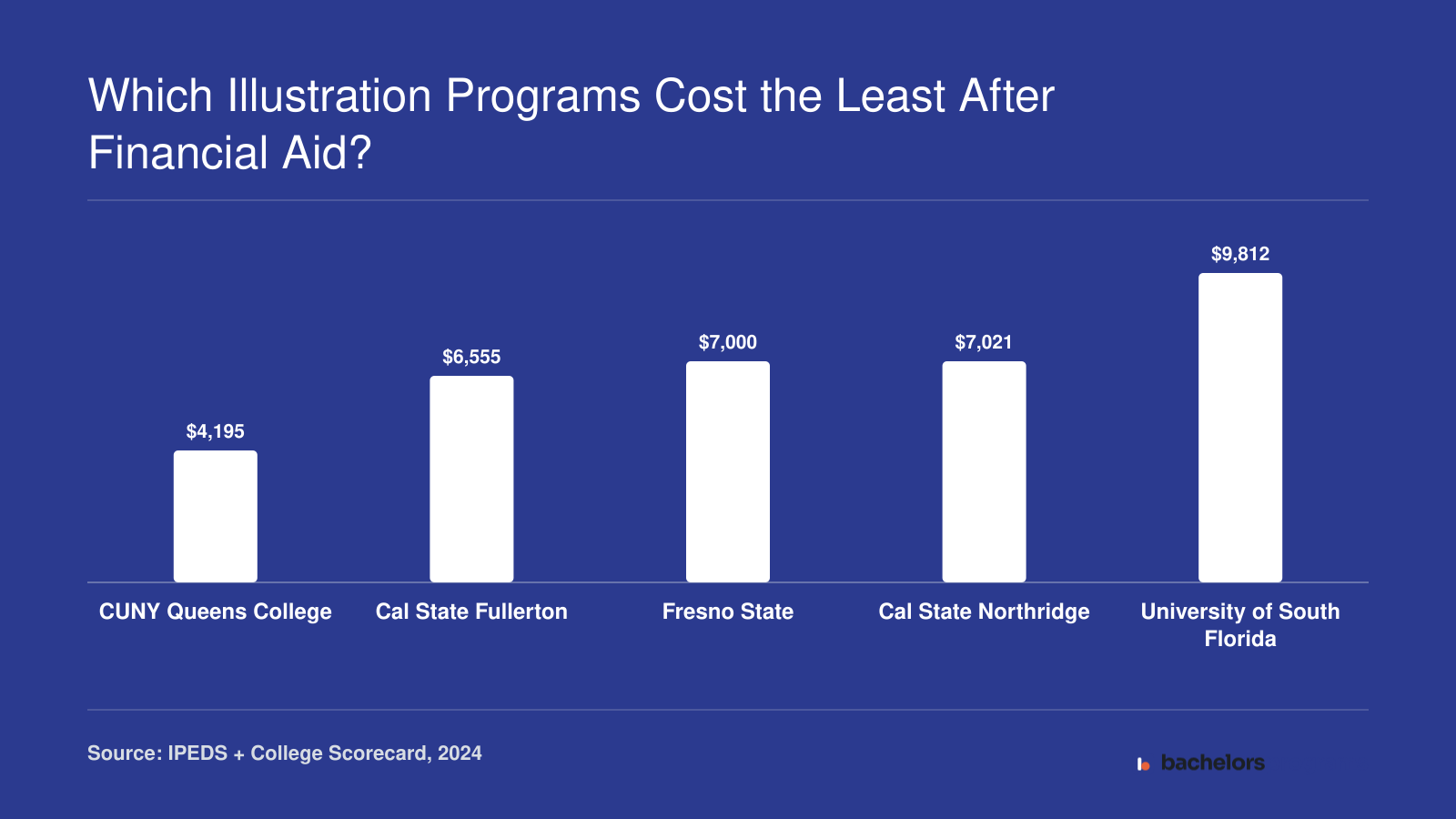
Illustration Degree Salary and Return on Investment
Program-Level Earnings
Earnings for illustration graduates start modest and climb. One year after completion, median pay at the schools that report it runs from $27,023 at Fashion Institute of Technology to $43,530 at Temple University. University of Delaware graduates earn $42,585 at that point, California State University-Long Beach $37,395, and University of Illinois Urbana-Champaign $34,670.
By year five the picture improves. Median earnings reach $70,925 at Delaware, $70,046 at Illinois, $67,824 at Long Beach and $63,888 at Temple. San Jose State University reports the highest five-year figure, $93,917. Washington University in St. Louis reports a four-year median of $67,771.
Debt Against Early Pay
What graduates owe when they finish varies widely, and so does the monthly bill on a 10-year repayment plan:
- Brigham Young University: $12,065 in debt, about $128 a month, against $59,245 five years out.
- Long Beach: $16,500 in debt, about $175 a month, against $67,824 five years out.
- Illinois: $18,178 in debt, about $193 a month, against $70,046 five years out.
- Temple: $26,000 in debt, about $276 a month, against $63,888 five years out.
At Illinois, a year of repayment costs roughly $2,300. Temple's runs closer to $3,300 on slightly lower pay. Neither is unmanageable, but the gap is real when first-year earnings sit in the mid-$30,000s.
The Early-Career Picture
Most graduates are working within a year. Reported employment one year out is about 92% at Long Beach, 95% at Illinois, 96% at Temple and 98% at Delaware. The share earning above 150% of the poverty line is lower at some schools, roughly 84% at Illinois and 70% at BYU, so a meaningful minority of graduates are still earning very little early on.
Is It Worth It?
For most students, yes, with conditions. Illustration pays less at the start than many professional fields, and results differ sharply from school to school. Freelance income, portfolio strength and your chosen specialty matter as much as the school's name. That makes borrowing the most controllable variable. A program with a strong portfolio track and a median debt near $12,000 to $18,000 gives you more room than a pricier option with similar pay. Treat prestige as a bonus, not a substitute for a manageable monthly payment.
What Working Illustrators Earn Nationally
Many illustration graduates move into art direction as they gain experience, and that role carries a clear national pay benchmark.
Related Articles
Online and Hybrid Illustration Degree Options
Fully online bachelor's degrees in illustration exist, but they are uncommon, and every program in the ranking above is delivered on campus. If you need flexibility, your short list falls outside that group.
Online, Hybrid, or Campus
Sessions College offers its B.F.A. in Illustration online. Liberty University offers a B.S. in Digital Design with an Illustration Design concentration that runs 100% online in 8-week courses, generally without set login times, though practicums, internships, or field experiences may follow different rules. Academy of Art University and SCAD both run illustration degrees and offer online study in some form, but confirm directly whether their illustration programs can be completed fully online, in a hybrid format, or only on campus before you apply.
How Online Studio Courses Work
Online studio classes typically replace live demonstrations with recorded, asynchronous demos you can replay. Critiques may happen in scheduled video sessions or through recorded and written instructor feedback. Assignments and portfolio pieces are usually submitted as digital files, so scanning or photographing traditional work well becomes part of the job.
Equipment to Budget For
Academy of Art University requires online students to have a personal computer that meets its minimum system requirements.3 Beyond that, illustration students commonly need:
- Input device: A drawing tablet or pen display for digital work.
- Software: Illustration tools such as Adobe Creative Cloud or Procreate.
- Computer: A machine capable of running large image files smoothly.
Check each school's technology requirements page, since exact lists vary.
Credits, Start Dates, and Accreditation
Most bachelor's degrees in illustration require about 120 credits and take roughly four years of full-time study. Sessions College requires 120 credits (90 in art and design, 30 in general education); full-time students can finish in 10 semesters, about 3.3 years, with transfer credit and part-time schedules available. Its next listed start is January 4, 2027.1 Liberty requires 120 credit hours and offers eight start dates a year, including January 18, February 15, and March 22, 2027.2
Liberty is institutionally accredited by the Southern Association of Colleges and Schools Commission on Colleges (SACSCOC). For any online program, verify institutional accreditation through the U.S. Department of Education's database before enrolling.
Questions to Ask Yourself
Does the faculty actively publish or exhibit in the niche you want?
Will you graduate with debt you can repay on early-career illustration earnings?
Does the program build in internships, client projects, or industry portfolio reviews before senior year?
Illustration programs by state
Illustration Degree FAQs
These answers cover the questions prospective illustration majors ask most often about value, transfer, location, and timing. Policies vary by school, so confirm details with each admissions office.
Is a bachelor's degree in illustration worth it?
Can I transfer community college credits into an illustration bachelor's program?
What are the best illustration degree programs in California?
How long does an illustration bachelor's degree take if I transfer in with an associate degree?
Compare Illustration programs on the data that matters
Explore more Arts & Design majors or browse every field of study.
All Arts & Design programs Browse every field of study