Best Industrial Design Degree Programs
Compare 80+ accredited Industrial Design programs, with net price after aid, graduation rates, earnings and debt from IPEDS and the U.S. College Scorecard.

A bachelor's degree in industrial design trains students to shape the physical products people use every day, from insulin pens and car interiors to kitchen tools. Schools award it as a Bachelor of Science (B.S.) or Bachelor of Arts (B.A.) in Industrial Design, and most of the learning happens in studios, fabrication labs, and portfolio reviews.
Admission rules vary widely. The University of Washington admits about 20 students a year into its major, while Purdue lets students start without a portfolio and reviews their work in sophomore spring.
The rankings here rest on College Scorecard outcomes: net price, graduation rates, and program-level earnings. Reputation and popularity play no part. Programs with similar numbers can still differ sharply in studio access.
Key Points
- Cal State Long Beach posts one of the lowest net prices here.
- Commercial and industrial designers earn a $76,250 median, per BLS data.
- Thomas Jefferson University's NASAD listing includes a healthcare industrial design B.S.
Top 10 Industrial Design Schools for 2027
An industrial design degree pays off when students finish on schedule, leave with a portfolio employers recognize, and avoid unnecessary debt. The ten programs below are listed for those outcomes: strong completion rates, manageable net cost after aid, and studio sequences that put real products in students' hands. Each card names the credential the school awards, what students actually build, and the institution-wide graduation rate so the programs can be compared on the same terms.
The University of Texas at Austin
#1Austin, TX · ~$20,000/yr (est.)
Best for: Fabrication-focused product design students
UT Austin runs a 120-credit design degree with 66 studio hours and a required concentration in 3D Product Design or Graphic Design. Product studios cover fabrication, engineering, spatial design and 3D interaction, closing with a capstone and a portfolio course. Students share two digital fabrication labs, two woodshops and a print studio. The school has a graduation rate of 89%.
- 120 credit hours, 66 in design
- Required concentration: 3D Product Design or Graphic Design
- Studios in product fabrication, engineering and spatial design
- Capstone Studio plus Portfolio & Professional Development course
- Two digital fabrication labs, two woodshops, one print studio
- Shared facilities with Texas Robotics
- B.A. option for double majors and minors
University of Notre Dame
#2Notre Dame, IN · ~$27,000/yr (est.)
Best for: Liberal arts students adding design
Notre Dame's Bachelor of Arts in Design pairs a five-course core with a concentration in Industrial Design or Visual Communication. Industrial design students work in 2D and 3D computer studios and a model shop with rapid prototyping, and can add a 48-credit Professional Track. The program holds an IDSA student chapter affiliation and arranges internships and sponsored projects. The school has a graduation rate of 95%.
- 36 credit hours in art and design, including a five-course core
- Concentrations in Industrial Design or Visual Communication
- Professional Track requires 48 credit hours
- IDSA student chapter affiliation
- 20-station 2D studio and 16-station 3D computer studio
- Model shop with rapid prototyping and 3D printing
- Internships, sponsored projects and field trips
Carnegie Mellon University
#3Pittsburgh, PA · ~$32,000/yr (est.)
Best for: Students exploring several design disciplines
Carnegie Mellon's Bachelor of Design starts with a foundation year across product, communication and environments before students choose a track. Studios run all four years and end with a research studio and capstone, and product students use an analog and digital prototyping facility. The school has a graduation rate of 94%, and graduates report median earnings of $138,588 four years after finishing.
- Minimum 360 units; studio courses run all four years
- First year covers product, communication and environments
- Tracks in Products, Communications or Environments
- Analog and digital prototyping facility with CAD and 3D printers
- Sustainable approaches include cradle-to-cradle and lifecycle analysis
- Senior fall research studio, spring capstone project
- Dual path of study available
University of Washington-Seattle Campus
#4Seattle, WA · ~$14,000/yr (est.)
The University of Washington admits about 20 students a year to its cohort-based industrial design major, which requires 180 credits and 92 to 96 design credits. The sequenced curriculum moves from foundations through advanced studios, materials and manufacturing, digital fabrication and a capstone exhibition. An advanced studio has included a collaboration with Seattle fitness-equipment maker Precor. The school has a graduation rate of 85%.
- Cohort-based major; about 20 students admitted each year
- 180 credits, including 92 to 96 credits of design coursework
- Sequenced studios from foundations to advanced industrial design
- Courses in materials and manufacturing and digital fabrication
- Design Capstone with public exhibition
- Project work in consumer electronics, medical and aerospace
- Advanced studio has included a Precor collaboration
Brigham Young University
#5Provo, UT · $15,000 – $20,000/yr (est.)
BYU's product and user experience design BFA requires 71 credits and admits students through a portfolio review and interview. Students first earn pre-BFA status, then take typography, 3D modeling, materials and processes, product studio, UX research methods and a required internship. The school has a graduation rate of 81%.
- 71 credit hours; limited-enrollment BFA
- Portfolio review and interview required for admission
- Pre-BFA status granted through a fall portfolio review
- Required academic internship
- Coursework in typography, 3D modeling, materials and processes
- UX research methods and product studio sequence
- History options in design theory or design psychology
University of Illinois Urbana-Champaign
#6Champaign, IL · ~$14,000/yr (est.)
Illinois awards a BFA in Industrial Design through the School of Art and Design, with 122 credits and 41 in industrial design. Studios emphasize human-centered product design, materials and production processes, and sustainability, and a second-year portfolio review gates progress into upper-level work. The school has a graduation rate of 85%.
- 122 credit hours, including 41 in industrial design
- Portfolio review in the second year
- Studios in user experience, materials and production processes
- Coursework in human-centered product design and sustainability
- 9 hours art history, 12 hours art and design electives
- Minimum 40 upper-division hours
- Third-semester language requirement
Purdue University
#7West Lafayette, IN · ~$15,000/yr (est.)
Purdue's industrial design BFA is a professional program aimed at manufactured consumer products, and students can begin the major without a portfolio. A selective review in the spring of sophomore year decides who continues into upper-level studios; students who are not selected move to a second-choice major. The school has a graduation rate of 83%.
- No portfolio required to start the major
- Selective portfolio review in spring of sophomore year
- Professional program focused on manufactured goods
- Transfer applicants need a minimum 2.5 GPA
- Transfers usually need four years because of sequencing
- Career paths include product, furniture and toy design
North Carolina State University at Raleigh
#8Raleigh, NC · $9,000 – $33,000/yr (est.)
NC State awards a Bachelor of Industrial Design, a four-year professional degree of 120 credits built on eight studios. Coursework covers visualization, manufacturing processes, human-centered design and experience design, with project areas from furniture to medical instruments. An international experience is built into the plan, and majors must earn a C- or better in major courses. The school has a graduation rate of 85%.
- 120 credit hours across eight industrial design studios
- Studio areas: furniture, appliances, transportation, electronics
- Courses in human-centered design and research methods
- International experience built into the degree plan
- C- or higher required in major courses
- Bachelor of Industrial Design professional degree
Ohio State University
#9Columbus, OH · $17,000/yr (est. net price)
Ohio State's industrial design major is a Bachelor of Science in Design with more than 65% of credit in art and design. All design students start in a shared Design Foundations year and apply to the major in spring, then follow a fixed studio sequence into a capstone and portfolio. The school has a graduation rate of 88%.
- Bachelor of Science in Design, a professional degree
- Over 65% of credit in art and design
- Shared first-year Design Foundations program
- Apply to the major in spring of the first year
- Lock-step studios ending in capstone and portfolio
- First-year applicants encouraged to apply by November 1
- Study abroad and internships available
University of Minnesota-Twin Cities
#10Minneapolis, MN · ~$17,000/yr (est.)
Minnesota's product design BS builds on industrial design foundations but adds physics, engineering, computer programming and entrepreneurship. Students pass a second-semester portfolio review, complete at least one internship, and can steer electives toward furniture design, marketing or human factors. The school has a graduation rate of 85%.
- 120 credits, 84 to 87 in the major
- Coursework in physics, engineering, programming and entrepreneurship
- Portfolio review after the second semester; 2.5 GPA required
- At least one internship required to graduate
- Electives in furniture design, marketing and human factors
- Study abroad in London, Copenhagen and Auckland
- Career paths include design researcher and UX designer
Cost & outcomes by school
Federal data for the highest-earning Industrial Design programs, independent of the ranking above. Earnings are this field's bachelor's graduates four years after completing where the Scorecard reports them, else the school's undergraduate median.
| School | Net price / yr | Grad rate | Earnings | Debt | Grads/yr | Format |
|---|---|---|---|---|---|---|
| Carnegie Mellon University PA | $31,944 | 94% | $138,588 | $24,500 | 37 | Campus |
| Lehigh University PA | $36,931 | 88% | $105,584 | $21,960 | 29 | Campus |
| Lawrence Technological University MI | $32,918 | 61% | $99,444 | $27,000 | 36 | Campus |
| University of Washington-Seattle Campus WA | $14,091 | 85% | $89,193 | $12,250 | 41 | Campus |
| University of Michigan MI | $13,138 | 93% | $83,648 | $19,500 | — | Campus |
| University of Notre Dame IN | $26,780 | 95% | $83,414 | $19,250 | 27 | Campus |
| San Jose State University CA | $13,760 | 69% | $78,988 | $15,000 | 229 | Campus |
| University of the Pacific CA | $25,447 | 69% | $78,445 | $19,500 | 14 | Campus |
| Art Center College of Design CA | $48,661 | 79% | $76,093 | $31,000 | 205 | Campus |
| Virginia Polytechnic Institute and State University VA | $24,953 | 86% | $72,213 | $23,900 | 74 | Campus |
| University of Cincinnati OH | $25,648 | 75% | $71,605 | $25,500 | 142 | Campus |
| Syracuse University NY | $38,793 | 84% | $71,527 | $27,000 | 114 | Campus |
Sources: U.S. Department of Education. Net price, graduation rate, earnings and debt: College Scorecard (earnings and debt for this field's bachelor's graduates where reported, else school-wide); graduates: IPEDS. A dash means no figure is reported.
Cost, debt & payoff
Median earnings of this field's bachelor's graduates (4 yrs after completing, else the school's undergraduate median) vs. their median federal loan debt · U.S. College Scorecard
Across these programs the median graduate earns about $59,660 and finishes with roughly $24,750 in debt — a ratio that clears a common rule of thumb (keep debt below first-year salary). Net price and debt vary widely school to school, so check the per-school figures in the table above before you shortlist.
How We Ranked Bachelor's Programs in Industrial Design
An industrial design program earns its place by what it does for graduates, not by how many students it enrolls or how famous its name is. That principle shaped every input behind the schools ranked here.
What We Measured
- Program earnings: Median earnings for bachelor's graduates in industrial and product design specifically, matched by federal program code and credential level in the College Scorecard, not school-wide averages.
- Program debt: Median federal loan debt for those same graduates.
- Net price: The average annual cost after grants and scholarships.
- Graduation and retention: How many first-year students come back for a second year, and how many go on to finish a degree.
Institution figures come from the 2024 College Scorecard release. Program-level earnings and debt come from the Scorecard's 2022 outcomes data.
What We Left Out
We did not reward completion volume, popularity, or reputation surveys. Many rankings treat size as a stand-in for quality, but a large program is not automatically a better one. Several of the strongest results on this list come from small, selective cohorts.
Limits and How to Use This List
Graduation and retention figures cover the entire university, not the design department alone. Net price is averaged across students, so your own aid package could land higher or lower. Some small programs publish no earnings figures at all, which can keep otherwise solid schools off an outcomes-based ranking.
Treat the list as a shortlist, not a final answer. Before you apply, compare each school's portfolio requirements, studio and fabrication facilities, and internship connections against the kind of design career you want.
What a Bachelor's Degree in Industrial Design Involves: B.S. vs. B.A. vs. BFA
Treat this table as a checklist for comparing programs, not a ranking of degree types. Employers and the Bureau of Labor Statistics group all three under one occupation, so the label on the diploma matters less than what you actually study and build. Confirm details on BLS.gov, on each school's curriculum map, and with professional groups such as IDSA, and do not rely on any single source.
| What to Compare | B.S. in Industrial Design | B.A. in Industrial Design | BFA in Industrial Design |
|---|---|---|---|
| Emphasis to look for | Often leans toward engineering, materials, and manufacturing coursework | Often leans toward liberal arts breadth and design strategy | Often leans toward studio-intensive work and portfolio preparation |
| Coursework BLS says programs commonly include | Drawing, CADD, 3D modeling, business, materials and processes, manufacturing methods | Same core areas; check how much room remains for electives and outside fields | Same core areas; check how many studio hours each term |
| Typical entry-level education (May 2025) | Bachelor's degree | Bachelor's degree | Bachelor's degree |
| Median annual wage for industrial designers (May 2025) | $83,910, reported for the occupation, not by degree type | $83,910, reported for the occupation, not by degree type | $83,910, reported for the occupation, not by degree type |
| Projected job growth, 2025 to 2035 | 2%, about 900 jobs | 2%, about 900 jobs | 2%, about 900 jobs |
| Portfolio expectation | An electronic portfolio of design projects is typically required for employment | An electronic portfolio of design projects is typically required for employment | An electronic portfolio of design projects is typically required for employment |
| Questions to ask each program | Which internships, maker spaces, and employer connections support technical work? | Which internships, maker spaces, and employer connections support strategy and research? | Which internships, maker spaces, and employer connections turn studio projects into portfolio pieces? |
| Who to ask for first-hand views | Program advisors, alumni, and hiring employers | Program advisors, alumni, and hiring employers | Program advisors, alumni, and hiring employers |
Which Industrial Design Schools Are NASAD Accredited?
Thomas Jefferson University lists a four-year Bachelor of Science in Industrial Design in the NASAD directory, along with a separate Industrial Design (Healthcare) B.S. and named options in Furniture Design, Lighting Design, Soft Goods, and User-Experience Design. That level of detail is what NASAD listing offers: a program-by-program record, not just a school name.
What NASAD Accreditation Signals
NASAD, the National Association of Schools of Art and Design, reviews studio standards, faculty qualifications, and facilities for art and design units. Its standards recognize the Bachelor of Fine Arts in Industrial Design, the Bachelor of Industrial Design, and the Bachelor of Science in Industrial Design as titles normally used for professional undergraduate programs.5
This is separate from the regional or institutional accreditation that every U.S. college needs. Institutional accreditation covers the whole university and underpins federal financial aid and credit transfer. NASAD is specialized, so it speaks to the quality of the design curriculum itself.
Verified Listings
The directory shows these as NASAD-accredited institutional members with a bachelor's-level industrial design listing:
- Thomas Jefferson University: Bachelor of Science: Industrial Design, four years.
- New Jersey Institute of Technology: Bachelor of Science: Industrial Design, four years.
- Virginia Tech: Bachelor of Science: Industrial Design, four years.
- University of Louisiana at Lafayette: Bachelor of Industrial Design, four years.
Kansas State University shows why precision matters. It is an accredited institutional member, but the directory result lists Art, Apparel and Textiles, Interior Design, and Art Education programs, not an industrial design bachelor's.7 Institutional membership does not mean every program is covered.
Reading Absence Correctly
Some strong industrial design programs sit inside engineering or architecture colleges, which may never pursue NASAD review. A missing listing is not automatically a red flag; treat it as a prompt to ask about faculty, studio access, and internships.
Check It Yourself
Search the accredited-institutions directory at nasad.arts-accredit.org for the school, then confirm that the industrial design bachelor's appears among its listed curricular programs. Do this for every school on this list before you apply.
Portfolio and Admissions Requirements for Industrial Design Programs
Most top industrial design schools ask for a portfolio, but what they want varies by school and by applicant pool. Requirements change every cycle, so confirm the current-year rules on each school's admissions site before you build or submit anything.
- Portfolio sizeRISD asks first-year applicants for 12–20 recent examples, and Pratt asks Industrial Design applicants for 10–20 artworks. ArtCenter asks Product Design applicants for 3–5 projects. Because these counts serve different applicant pools, they are not directly comparable.
- Sketching and process workArtCenter wants plenty of sketches. Each project should move from problem and research through ideation, multiple directions and rough prototypes to final renderings or a model. Pratt favors final, resolved work and asks applicants to keep process material minimal.
- Recency and labelingPratt wants pieces made within the last 18 months, with media, dimensions and year listed for each. RISD looks for work that shows both making and thinking about what you make.
- Upload limitsArtCenter caps portfolio documents at 75 pages and 64 MB. Media files can run up to 5 GB.
- Reviews after you enrollAt ArtCenter, Product Design students face a required portfolio review and Department Chair review in their 6th term. At that review, they present their 3 best projects.
- Transfer students and creditAt SCAD, the portfolio is optional for both first-year and transfer applicants and is used for scholarship consideration. It does not need to match your intended major. Pratt awards up to 9 credits for qualifying exam scores, such as AP 4s and 5s. RISD's Portfolio Day reviews are open to prospective transfers.
- Application deadlinesDeadlines shift from year to year and can differ by entry term. Check each school's current calendar early, since portfolios take months to assemble.
Related Articles
Industrial Design Degree Cost: Most Affordable Schools on Our List
Cal State Long Beach, the University of Illinois Chicago, and San Jose State University post the lowest average net price after aid among the schools ranked here, according to 2024 U.S. Department of Education data. That figure is an average across aided students, not a personal quote, and all of these schools are public universities, so in-state students pay far less in published tuition than out-of-state students. Where a program reports median debt at graduation, the table also shows the estimated monthly payment on a 10-year plan. Keep in mind that studio programs bring extra costs for laptops, CAD software, model materials, and printing that net price may not fully capture.
| School | Location | Average Net Price After Aid | In-State Tuition and Fees | Out-of-State Tuition and Fees | Program Median Debt at Graduation | Est. Monthly Payment (10-Year Plan) |
|---|---|---|---|---|---|---|
| California State University-Long Beach | Long Beach, CA | $10,440 | $7,350 | $19,950 | $16,500 | $175 |
| University of Illinois Chicago | Chicago, IL | $10,974 | $14,338 | $29,884 | $22,881 | $243 |
| San Jose State University | San Jose, CA | $13,760 | $8,410 | $21,010 | N/A | N/A |
Top First-Year Earnings Among Ranked Industrial Design Programs
Among the schools ranked here, one program stands out for early-career pay.
Industrial Design Degree Salary and Career Outlook
Industrial design hiring increasingly favors hybrid product roles, where physical form, connected software, and manufacturing feasibility carry equal weight. The Bureau of Labor Statistics still tracks the field as a single occupation, commercial and industrial designers, and its May 2025 figures put the median annual wage at $83,910, or $40.34 an hour.1
Where Program Earnings Land
Program-level earnings run well above that median at the top of the list, and the measuring window matters. Carnegie Mellon reports a median of $138,588 four years after completion. San Jose State reports $93,917 and UT Austin $88,050, both five years after completion. Each figure describes graduates of that specific industrial design program, not the parent university, and a four-year number is not interchangeable with a five-year number.
Why New Graduates Earn Below $83,910
The occupation median blends designers who have a decade or more of experience. New graduates start in junior roles, and some take positions coded outside the occupation entirely, such as design research, CAD support, or product marketing. That early gap narrows as a portfolio accumulates shipped work and a recognizable specialty.
Demand and the Factors That Move Pay
BLS projects 2% growth from 2025 to 2035, an increase of 900 jobs from 35,400 to 36,300, with about 2,800 openings a year on average.1 Replacement demand drives most of that hiring, so portfolio quality and hands-on experience decide who gets the jobs. Co-op programs help here: Cincinnati builds five full semesters of co-op into the degree. Sector and metro matter too, since medical devices, consumer electronics, and transportation pay differently and regions with dense engineering and manufacturing talent tend to pay more.
In May 2023, mean annual wages ran highest in computer and peripheral equipment manufacturing ($128,920), motor vehicle manufacturing ($125,000), and semiconductor and electronic component manufacturing ($123,140).2 Those are averages from an earlier year, so treat them as direction rather than a direct benchmark against the 2025 median.
Industrial Designer Pay Range: From Entry Level to Top Earners
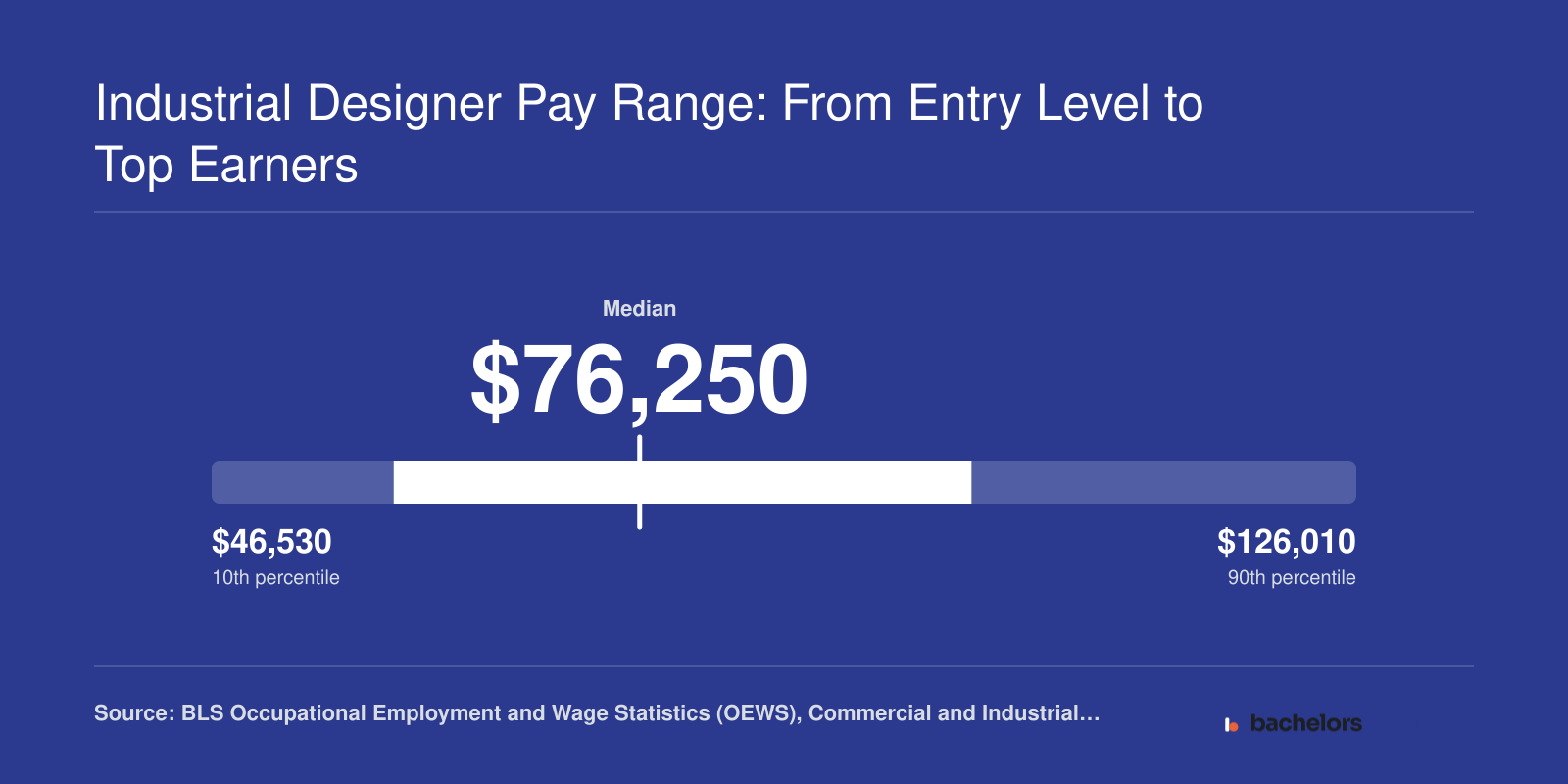
Federal wage data shows how widely pay varies for commercial and industrial designers. The middle half of the occupation earns between $59,170 and $99,290 a year, with a median of $76,250. New graduates with a bachelor's degree in industrial design typically start near the lower percentiles. Years of experience, a strong portfolio, and specialization in a product category are what move designers toward the top of the range.
Industrial Design programs by state
Compare Industrial Design programs on the data that matters
Explore more Arts & Design majors or browse every field of study.
All Arts & Design programs Browse every field of study