Best Online Industrial Design Degree Programs
Compare 7 accredited online Industrial Design programs, with net price after aid, graduation rates, earnings and debt from IPEDS and the U.S. College Scorecard.

Industrial design is the discipline of shaping physical products, from power tools to medical devices, and a bachelor's degree is the standard entry credential. Schools award it as a Bachelor of Science (B.S.), a Bachelor of Arts (B.A.), or a Bachelor of Fine Arts (BFA) in Industrial Design, and nearly every one of those programs was built around a shop floor and a studio critique.
The tension is tactile: the work happens in the hand, so genuinely 100% online programs are rare. Employers hire on portfolios, and portfolios need prototypes, which pushes remote students to line up local fabrication access themselves. The degree gets you screened in; the models get you hired.
Key Points
- Few U.S. industrial design bachelor's programs can be completed fully online.
- Ferris State University carries the lowest average net price here.
- Industrial design pays well above the national median for all occupations.
Best Fully Online Industrial Design Bachelor's Programs for 2027
Only a handful of U.S. bachelor's programs in industrial design can be completed entirely online, so this list is short by necessity rather than by design. Every entry below is a fully online option, and hybrid formats or programs that require an in-person residency were left out. Each card shows what the program covers, what it costs and where the school sits, so you can weigh them against each other.
University of Central Missouri
#1Warrensburg, MO · ~$14,000/yr (est.)
Best for: Hands-on learners drawn to CAD and 3D printing
The University of Central Missouri is a public regional university in Warrensburg, about an hour southeast of Kansas City, and its design and drafting programs sit in the School of Industrial Sciences and Technology. The engineering design technology track carries ATMAE accreditation and leans on CAD, 3D modeling and machine design rather than fine-art studio work. Online students get the same industry partners, paid internship listings and 3D printing access as the Warrensburg cohort. The school's overall graduation rate is 54%, undergraduate tuition runs about $10,050 in state and $18,600 out of state, and net price after aid averages roughly $14,500.
- ATMAE-accredited engineering design technology curriculum
- 120 credit hours, available online or on campus in Warrensburg
- Coursework in 3D modeling, CAD, machine design and product design
- Paid internships with industry partners
- Access to 3D printing equipment and design labs
- Graduates work as CADD technicians and product design engineers
- Named scholarships and financial aid available
Ferris State University
#2Big Rapids, MI · ~$9,000/yr (est.)
Best for: Studio artists choosing furniture or metals tracks
Ferris State University is a public university in Big Rapids, Michigan, and its product design program is taught through Kendall College of Art and Design in Grand Rapids. The curriculum is studio-heavy, with 30 supportive studio credits, 39 major studio credits, 12 credits of art history and a two-course thesis, and students choose a furniture, industrial or metals/jewelry concentration. The degree can be completed online. The school's overall graduation rate is 47%, tuition runs about $14,800 a year for in-state and out-of-state students alike, and net price after aid averages roughly $8,600.
- NASAD-accredited program taught through Kendall College of Art and Design
- Three concentrations: Furniture Design, Industrial Design, Metals/Jewelry
- 30 supportive studio credits, 39 major studio credits, 12 art history credits
- Portfolio of 8-10 recent pieces required for admission
- No ACT or SAT scores required
- 2.50 GPA minimum for admission and for transfer
- Two-course thesis sequence inside the major studio
- Electives may count toward a minor
Arizona State University
#3Scottsdale, AZ
Best for: Busy adults wanting accelerated online coursework
Arizona State University runs its industrial design bachelor's degree through the Herberger Institute for Design and the Arts, with the program available online as well as in Tempe. The online version is built on accelerated 7.5-week courses, 40 in total, and the next listed start date is January 11, 2027. Students complete an internship before graduation and can stack the bachelor's with a master's in five years. The program has held NASAD accreditation since 2001, and undergraduate tuition is about $11,500 in state and $13,800 out of state.
- NASAD-accredited since 2001 and regionally accredited
- 120 credit hours with an internship required before graduation
- Accelerated 7.5-week online courses, 40 classes in total
- Sample courses: Drawing for Industrial Design, Introduction to Computer Modeling
- Current ASU students need a 2.75 GPA to change into the major
- Accelerated bachelor's plus master's option
- Not eligible for the STEM-OPT extension
Design Institute of San Diego
#4San Diego, CA · $40,000 – $45,000/yr (est.)
Design Institute of San Diego is a private, single-focus design school in San Diego that runs its product design and management degree by distance education. California's Bureau for Private Postsecondary Education approved the 120-credit program in January 2026, and the school's institutional approval on the state list runs through February 2032. The school's overall graduation rate is 80%, tuition is about $29,300 a year for all students, and net price after aid averages roughly $44,000.
- 120-credit Bachelor of Science delivered by distance education
- Approved by California's Bureau for Private Postsecondary Education
- Program added to the state approved list in January 2026
- Institutional approval on the state list runs through February 2032
- Same school also offers a BS in Interaction and Experience Design
Academy of Art University
#5San Francisco, CA · ~$41,000/yr (est.)
Academy of Art University is a private art and design school in San Francisco that has built out a large online operation, with more than 900 online courses across 35 online majors. Its industrial design BFA carries a STEM designation and lets online students work asynchronously with the same instructors and curriculum used on campus, and they can also join live San Francisco classroom sessions by Zoom or mix online and on-site classes. The school's overall graduation rate is 34%, tuition is about $30,700 a year, and net price after aid averages roughly $39,000.
- STEM-designated BFA in Industrial Design
- Concentrations in transportation design and product design
- Asynchronous online classes on the Brightspace platform
- Online students learn from the same instructors as on-campus students
- Option to join San Francisco classroom sessions by Zoom
- Students can combine online and on-site classes and set their own pace
- More than 900 online courses across 35 online majors
Cost & outcomes by school
Federal data for the highest-earning Industrial Design programs, independent of the ranking above. Earnings are this field's bachelor's graduates four years after completing where the Scorecard reports them, else the school's undergraduate median.
| School | Net price / yr | Grad rate | Earnings | Debt | Grads/yr | Format |
|---|---|---|---|---|---|---|
| Weber State University UT | $10,258 | 46% | $62,281 | $20,500 | 27 | Hybrid |
| Arizona State University AZ | $14,967 | 68% | $59,641 | $20,702 | 237 | Online or campus |
Sources: U.S. Department of Education. Net price, graduation rate, earnings and debt: College Scorecard (earnings and debt for this field's bachelor's graduates where reported, else school-wide); graduates: IPEDS. A dash means no figure is reported.
Cost, debt & payoff
Median earnings of this field's bachelor's graduates (4 yrs after completing, else the school's undergraduate median) vs. their median federal loan debt · U.S. College Scorecard
Across these programs the median graduate earns about $59,660 and finishes with roughly $24,750 in debt — a ratio that clears a common rule of thumb (keep debt below first-year salary). Net price and debt vary widely school to school, so check the per-school figures in the table above before you shortlist.
Can You Really Earn an Industrial Design Degree 100% Online?
Yes, but the list of schools that let you do it is short. Industrial design grew up around wood shops, machine shops, spray booths and the Friday pin-up critique, and most of the field's best known undergraduate programs still build the degree around that physical studio. Online delivery in this discipline is the exception, not the norm; expect to choose from a narrow set of programs, not from hundreds of options.
What ASU Actually Offers
The search for "ASU industrial design online" turns up a real program. Arizona State University lists its Bachelor of Science in Design in Industrial Design as available both online and in person, built on 120 credits across roughly 40 classes delivered in 7.5-week terms, with virtual project-based studios carrying the design work. ASU's pages describe an internship as an option rather than a graduation requirement, and the university notes that diplomas and transcripts do not identify delivery mode. What ASU's published pages do not spell out is whether every required activity can be finished without ever setting foot in Tempe, so treat "online" as the starting point of a conversation with an advisor, not the end of one.
How to Spot a Hybrid in Disguise
Several programs marketed as online quietly expect campus time. The tells are usually in the catalog rather than the marketing page:
- Vocabulary: scan the program page and the academic catalog for "residency," "immersion," "intensive," "on-ground" or "studio session."
- Studio and shop courses: check whether fabrication, model-making or prototyping courses have a separate lab component and where that lab meets.
- Portfolio reviews: some schools gate advancement on a juried review; confirm whether yours can be submitted digitally.
- Proctoring and exams: look for anything requiring a testing center rather than remote proctoring.
Verify Before You Apply
Put the question in writing to admissions: can every graduation requirement, including studio and capstone work, be completed remotely from my location? Ask for the answer by email so you have it on record. If the reply includes a required campus visit and you cannot travel, move on to the fully online alternatives ranked above.
What a Bachelor's Degree in Industrial Design Involves (B.S. vs. B.A.)
Design schools have stopped arguing over whether a designer should be a craftsperson or a strategist; the live question is whether either can get hired without fluency in 3D software. The bachelor's degree now tries to produce both: a student who can sketch an idea on Monday, model it on Tuesday, and defend the manufacturing plan on Friday.
B.S. Versus B.A.
A B.S. leans technical: materials and processes, manufacturing fundamentals, ergonomics, mechanical and structural basics, and more studio hours on CAD. A B.A. trades some of that for breadth: design history, theory, research methods, and liberal arts courses. Neither is automatically better. The B.S. suits students aiming at product development teams, while the B.A. suits those heading toward design strategy, research, or a double major. Some programs label near-identical curricula differently, so read the course list rather than the letters, and confirm which credential the school actually awards before you apply.
The Core Sequence Most Programs Share
- Drawing and sketching: freehand ideation and visual communication, usually in year one.
- Design research: user observation, ergonomics, and problem framing.
- CAD and rendering: 2D drafting, then 3D modeling and visualization.
- Model-making and prototyping: foam, wood, plastics, and increasingly 3D printing.
- Capstone and portfolio: a final project that pulls every skill together.
Software Categories, Not Brand Loyalty
Students typically touch parametric CAD for engineered parts, surface modeling for organic forms, rendering engines for presentation images, and Adobe tools for layout and print. Which package a program teaches matters less than whether you leave able to learn the next one.
The Portfolio Is the Real Output
Studio courses, research projects, and even liberal arts electives should produce portfolio-ready work. Hiring managers read the portfolio before the transcript. In an online program, that means photographing and rendering physical models carefully, since nobody handles them in person. Treat every assignment as a future page.
Related Articles
What Does Each Fully Online Industrial Design Program Cost After Aid?
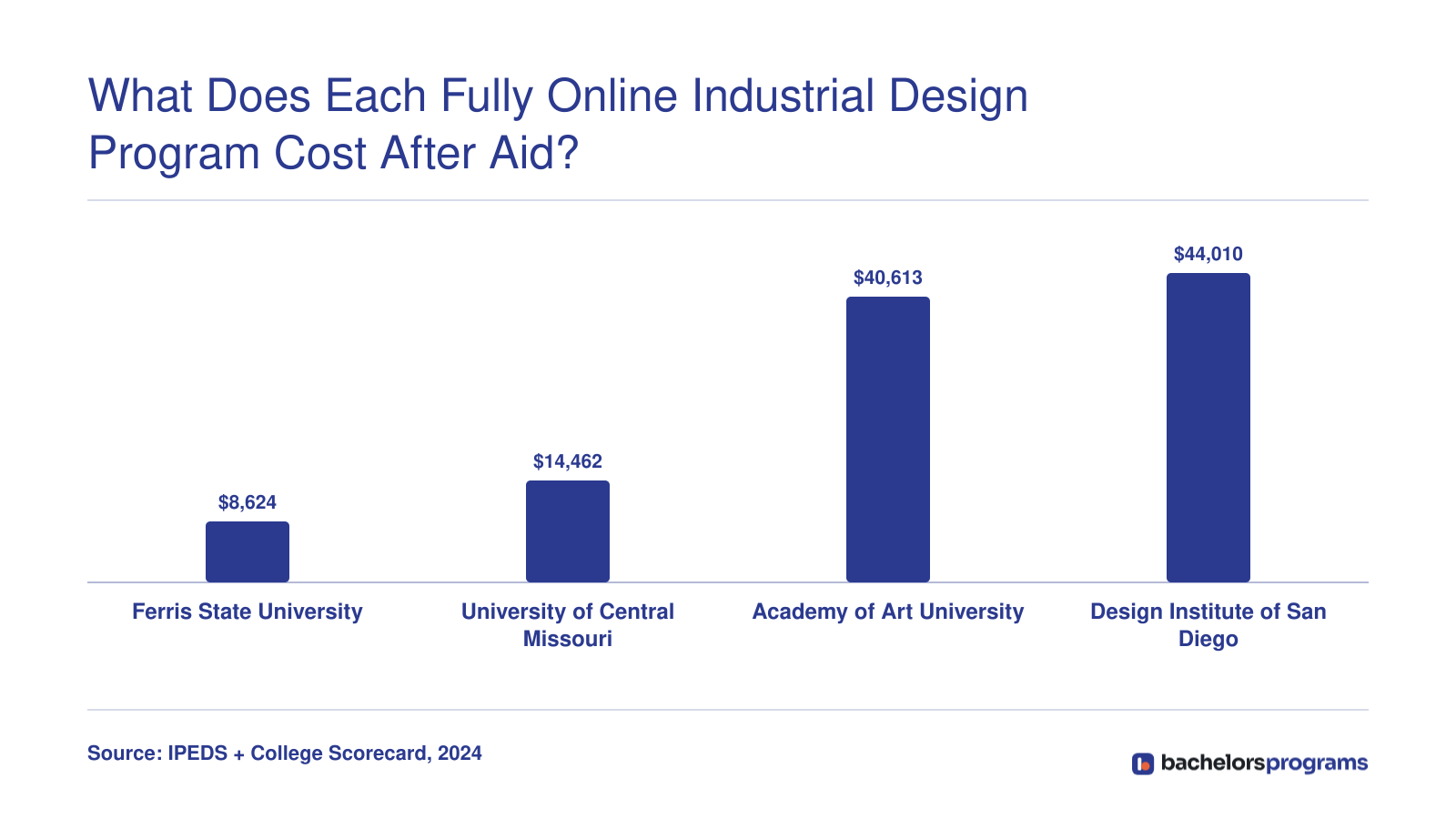
Net price is the average yearly amount undergraduates pay after grants and scholarships. It is measured across the whole institution, not the industrial design major alone, so treat these figures as approximate. Ferris State University is the most affordable option here at $8,624, while Design Institute of San Diego averages $44,010, a gap of $35,386 a year.
What Industrial Designers Earn Nationally
A bachelor's degree in industrial design is the typical entry point into a field that pays well above the national median for all occupations.
Admission, Portfolio and Transfer Credit Requirements
Requirements vary by school, so confirm each one with admissions before you apply. Use this checklist to compare what the programs below and similar campus programs publish.
- High school diploma or GEDEvery bachelor's program expects one. Transfer applicants also submit college transcripts.
- Minimum GPAFerris State lists a 2.5 minimum and ASU lists 2.8. ASU also expects a 3.00 GPA in its designated competency courses.
- Portfolio at admissionFerris State asks for 8 to 10 recent pieces. Strong portfolios typically mix sketches, 3D or model work and process pages that show how an idea developed.
- Mid-program reviewSome programs check progress partway through instead of at entry. Wentworth Institute of Technology (a campus program) requires no entry portfolio but sets a 2.5 GPA across 49 design credits by the end of sophomore spring.
- Transfer GPA and credit limitsFerris State requires a 2.50 transfer GPA. Ask each school how many credits it will accept toward the degree.
- Studio course transferExpect a portfolio review. Iowa State, for example, evaluates transferred studio work through its department before you register.
- Entrance examsFerris State requires no entrance exam. Check each school's current SAT and ACT policy.
- Drawing and design prerequisitesMost programs teach drawing and design foundations in the first year rather than requiring them before you enroll.
Industrial Design vs. Product Design vs. Engineering Degrees
These three majors overlap, and graduates often work on the same teams, but each trains you for a different part of the process. Industrial design centers on form, usability and manufacturability. Product design often leans toward digital experience or broader product strategy, while mechanical engineering centers on analysis, physics and tolerances. Wage figures below are May 2025 federal data. The Bureau of Labor Statistics does not report product designers separately, so the product design column uses the closest category, commercial and industrial designers, and the figures are only a rough guide.
| Factor | Industrial Design (B.S./B.A.) | Product Design | Mechanical Engineering (B.S.) |
|---|---|---|---|
| Core focus | Physical product form, ergonomics, usability and manufacturability | Often UX and digital products, or wider product strategy that blends user needs with business goals | Analysis, physics, materials and the performance of mechanical systems |
| Typical coursework | Sketching, form studies, prototyping, materials and processes, design studios | User research, interaction design, prototyping, product strategy (varies widely by school) | Statics, dynamics, thermodynamics, fluid mechanics, materials, machine design |
| Math intensity | Light to moderate, mostly geometry and applied measurement | Light to moderate, with some data and research methods | High, including calculus, differential equations and physics sequences |
| Key software | CAD and 3D modeling tools, rendering software, Adobe Creative Cloud | Figma or similar interface tools, prototyping apps, some CAD for hardware-focused roles | CAD plus simulation and analysis tools such as finite element software |
| Typical entry roles | Industrial designer, junior product designer, design studio assistant | Product designer, UX/UI designer, associate product manager (title use varies by employer) | Mechanical engineer, design engineer, manufacturing or test engineer |
| How hiring is evaluated | Portfolio of projects, process documentation and bachelor's degree | Portfolio and case studies showing research and problem solving | Accredited degree and technical skills, with the Fundamentals of Engineering exam and later licensure valued in some fields |
| Median annual wage (May 2025) | $83,910 for industrial designers | $93,260 for commercial and industrial designers (closest BLS category) | $104,110 for mechanical engineers |
| Typical entry education (BLS) | Bachelor's degree | Not separately classified by BLS | Bachelor's degree in mechanical engineering or engineering technology |
Questions to Ask Yourself
Do you want to shape how a product looks and feels in the hand, or calculate whether it will hold up?
Do you already have sketches or 3D work you could turn into an admissions portfolio?
Is there a campus industrial design program within commuting distance whose shop access would justify the extra cost?
Will you be working full time while enrolled?
Industrial Design programs by state
Online Industrial Design Degree FAQs
These answers summarize what the rest of this page covers. Where published figures are thin, the answers say what to confirm directly with each school before you commit.
Can you get an industrial design degree online?
How much does an online industrial design degree cost?
Should I choose an online program or an industrial design degree near me?
Can transfer credits shorten an online industrial design bachelor's degree?
Compare Industrial Design programs on the data that matters
Explore more Arts & Design majors or browse every field of study.
All Arts & Design programs Browse every field of study