Best User Experience Degree Programs
Compare 90+ accredited User Experience programs, with net price after aid, graduation rates, earnings and debt from IPEDS and the U.S. College Scorecard.

A bachelor's degree in user experience carries no standard price: tuition among the programs ranked here starts near $6,400 a year at the University of Florida and reaches beyond $69,000 at Cornell. What employers screen for is more predictable. Hiring managers want a portfolio of shipped work and evidence you can run a study and defend a design decision.
That spread is the real trade-off. A public informatics major can cost a fraction of a private studio degree, yet portfolio depth at graduation often tracks studio hours and client projects more than tuition.
Programs that put students on real client work before commencement hold up best; a transcript alone rarely survives a portfolio review.
Key Points
- UX graduates at Northeastern University earned a $115,587 median one year out.
- Web and digital interface designers earned a $104,000 median in May 2025.
- General-admission UX majors rarely require portfolios; selective studio programs often do.
Best Schools for a Bachelor's Degree in User Experience: Our Top 10
This list mixes online and campus options, and every entry is a bachelor's degree in user experience or a closely related design and information major. Cards appear in ranked order, with the strongest combination of program focus, cost, and completion outcomes first. The criteria behind the order are laid out in the methodology section further down the page.
University of Florida
#1Gainesville, FL · ~$7,000/yr (est.)
Best for: Interdisciplinary designers drawn to animation and games
The University of Florida is a large public research university in Gainesville that pairs a broad liberal arts core with strong technology and design offerings. Its Digital Arts & Sciences program sits between art and computer science, so students work in production studios and project teams rather than lecture-only courses, and a separate online route serves students who cannot relocate. Undergraduates can build a portfolio across UX, motion design, and games without committing to one narrow track.
- Interdisciplinary blend of art, storytelling, design, and computer science
- Experience Design & Production concentration covers UX and virtual production
- Project-based work in high-tech studios and team environments
- Covers the 12 principles of animation and the full game production pipeline
- Prepares students for UI/UX designer and AR/VR developer roles
University of California-San Diego
#2La Jolla, CA · $10,000 – $15,000/yr (est.)
Best for: Cognitive science students leaning toward UX research
UC San Diego is a research-intensive public university on the La Jolla coast, widely known for cognitive science and engineering. The design and interaction specialization inside cognitive science lets students approach UX through how people think, perceive, and process information rather than through visual design alone. Project courses have teams build working prototypes and package the results into an online portfolio before graduation.
- 11 courses and 44 units at the lower-division level
- 12 courses and 48 units at the upper-division level
- Six core courses plus six electives, four from the specialization list
- At least three of the electives must be cognitive science courses
- Project teams build prototypes and assemble an online portfolio
- Leads to product designer, UX researcher, or UI designer roles
Brigham Young University
#3Provo, UT · $15,000 – $20,000/yr (est.)
Best for: Portfolio-driven designers wanting a studio BFA
Brigham Young University is a private religious university in Provo, Utah, with a design program that treats physical product design and user experience as one discipline. The BFA is selective and studio-based, with a portfolio review and interview standing between pre-majors and full admission. Students graduate with a portfolio, an internship, and coursework in research methods, typography, and 3D modeling.
- 71 credit hours, including an academic internship
- Admission requires departmental approval, portfolio review, and interview
- Students first earn pre-BFA status by completing Product & UX Design 1
- The BFA portfolio review is held in June
- Coursework spans typography, 3D modeling, UX research methods, and professional practice
- 12 elective hours from options such as programming, advanced HCI, and data visualization
Cornell University
#4Ithaca, NY · $29,000/yr (est. net price)
Cornell University is a large private land-grant institution in Ithaca, New York, where information science is housed in the College of Agriculture and Life Sciences but draws students from across the university. The major is unusually flexible, with seven concentrations and room for electives, and the UX track leans on research and human-computer interaction rather than studio art. Classes run in person, and the program accepts a limited number of transfer credits.
- 120 credits, at least 50 of them inside the major
- Five core information science courses plus programming, calculus, and statistics
- Four courses in the UX concentration and three electives to finish the major
- UX concentration covers design principles, design in context, users, and technology
- Declaring the major requires a 2.5 GPA in four courses and a 2.3 cumulative GPA
- Up to 21 transfer credits accepted
The University of Texas at Austin
#5Austin, TX · ~$20,000/yr (est.)
The University of Texas at Austin is a flagship public university with an informatics program housed in the School of Information. The UX design concentration is compact at 24 hours inside a 120-hour degree, which leaves room for a minor, a certificate, or a second field of study. Austin's technology and design employer base gives students a deep local market for internships and first jobs.
- 120 total hours, 24 of them in the informatics major
- Introduction to User Experience Design plus three Topics in UX Design courses
- Capstone required; honors students may substitute the honors thesis
- 2.0 GPA required in informatics courses, with at least a C- in each
- 36 upper-division hours required, with 60 hours completed in residence
- Prepares for UX, interaction design, human factors, and mobile design roles
Purdue University
#6West Lafayette, IN · ~$15,000/yr (est.)
Purdue University is a public land-grant university in West Lafayette, Indiana, and its UX Design major sits in the Purdue Polytechnic Institute rather than a traditional art or design school. The curriculum runs on Learning Studios for skill building and Experience Studios for industry projects, so students spend much of the degree working with real clients. Graduates leave with a portfolio and close to three and a half years of client work behind them.
- Learning Studios for skills, Experience Studios for industry projects
- About 3.5 years of work with real clients before graduation
- Graduates finish with a design portfolio
- Transfer applicants need a minimum 3.5 GPA
- High school preparation includes four years each of math and English
- Career paths include UX/UI designer, front-end developer, and user researcher
University of Michigan
#7Ann Arbor, MI · $18,000 – $61,000/yr (est.)
The University of Michigan is a large public research university in Ann Arbor with a School of Information that admits students at the sophomore level. The Bachelor of Science in Information splits into a User Experience Design pathway and an Information Analysis pathway, and every student works on projects for outside organizations. Career coaching and a portfolio at graduation are built into the degree.
- Students enter as sophomores or above with 24 transferable credits
- Two pathways: User Experience Design and Information Analysis
- Every student works on projects for real client organizations
- Partners with more than 100 organizations each year
- Coursework blends psychology, business, and ethics with programming and design
- Personalized career coaching and a portfolio at graduation
University of Maryland-College Park
#8College Park, MD · $16,000/yr (est. net price)
The University of Maryland, College Park is a public research university close to Washington, D.C., and its human-centered AI major is run out of the philosophy department with the campus AI institute. The degree treats design as one specialization among several and pairs UX coursework with ethics, policy, and machine learning. Students with no prior computing background can start the major, and a four-year academic plan is published.
- Seven pre-built specializations, including Design and user experience
- A custom specialization is possible with departmental approval
- No prior AI or computer science experience required
- Led by the Department of Philosophy with the campus AIM institute
- Coursework in programming, logic, probability, machine learning, and ethics
- Sample courses include Designing Fair Systems and AI and Human Creativity
- A four-year academic plan is posted for the major
New Jersey Institute of Technology
#9Newark, NJ · $20,000 – $38,000/yr (est.)
New Jersey Institute of Technology is a public research university in Newark with a computing-centered curriculum and a strong engineering culture. Its human-computer interaction degree is a 120-credit science program built on required usability and user research courses rather than a design-school studio sequence. Co-op work experience is available, and the degree closes with a capstone project or an undergraduate thesis.
- 120-credit Bachelor of Science in Human-Computer Interaction
- Core sequence includes Designing the User Experience and Usability & Measuring UX
- Five HCI electives chosen from game design, mobile apps, and content systems
- Capstone project required; an undergraduate thesis can substitute
- Co-op work experience available
University of Illinois Urbana-Champaign
#10Champaign, IL · ~$14,000/yr (est.)
The University of Illinois Urbana-Champaign is a large public research university whose information school is consistently ranked at the top of its field. The BS in Information Sciences is a STEM-designated interdisciplinary degree that lets students commit to one pathway or sample across six, including human-computer interaction and UX. Graduates move into product management, web development, and UX roles, and the school highlights a graduate now working as a UX designer at Twitch.
- Six pathways, including Human Computer Interaction and User Experience
- STEM-designated interdisciplinary degree from the iSchool
- Coursework in programming, databases, research methods, and information ethics
- Students take electives within one pathway or across several
- Information school ranked first by U.S. News among library and information studies programs
Cost & outcomes by school
Federal data for the highest-earning User Experience programs, independent of the ranking above. Earnings are this field's bachelor's graduates four years after completing where the Scorecard reports them, else the school's undergraduate median.
| School | Net price / yr | Grad rate | Earnings | Debt | Grads/yr | Format |
|---|---|---|---|---|---|---|
| Carnegie Mellon University PA | $31,944 | 94% | $187,437 | $21,750 | 143 | Campus |
| University of Michigan MI | $13,138 | 93% | $172,904 | $19,475 | 1,323 | Campus |
| Northeastern University MA | $30,915 | 91% | $163,708 | $22,583 | 748 | Campus |
| Northeastern University MA | — | — | $163,708 | $22,583 | 46 | Campus |
| The University of Texas at Austin TX | $19,857 | 89% | $155,168 | $20,500 | 562 | Campus |
| University of Illinois Urbana-Champaign IL | $14,355 | 85% | $146,946 | $19,199 | 278 | Campus |
| University of Maryland-College Park MD | $15,678 | 89% | $144,501 | $19,000 | — | Campus |
| Cornell University NY | $28,690 | 95% | $144,389 | $15,500 | 329 | Campus |
| University of Florida FL | $6,541 | 91% | $126,268 | $15,000 | 626 | Campus |
| Weber State University UT | $10,258 | 46% | $116,453 | $15,113 | 39 | Campus |
| Brigham Young University UT | $15,564 | 81% | $113,338 | $13,500 | 69 | Campus |
| Texas Tech University TX | $19,070 | 69% | $113,062 | $19,500 | 297 | Online or campus |
Sources: U.S. Department of Education. Net price, graduation rate, earnings and debt: College Scorecard (earnings and debt for this field's bachelor's graduates where reported, else school-wide); graduates: IPEDS. A dash means no figure is reported.
Cost, debt & payoff
Median earnings of this field's bachelor's graduates (4 yrs after completing, else the school's undergraduate median) vs. their median federal loan debt · U.S. College Scorecard
Across these programs the median graduate earns about $76,845 and finishes with roughly $22,583 in debt — a ratio that clears a common rule of thumb (keep debt below first-year salary). Net price and debt vary widely school to school, so check the per-school figures in the table above before you shortlist.
How We Ranked These User Experience Schools
A UX program's ranking can reflect real outcomes, or it can reflect name recognition alone. We built this list so you can check the reasoning instead of trusting the order.
What We Counted
Our order comes from federal College Scorecard and IPEDS data, not reputation surveys or a school's own marketing. For each program we weighed average net price, the institution-wide graduation rate, program-level median earnings and median debt where those are published, the number of recent completions in the field, and whether the program runs on campus, online, or both. Outcomes and affordability carry the weight. Most other UX rankings never disclose what they measured or how much any single factor counted.
Where the Numbers Stop
Federal data has limits, and we state them plainly. The graduation rate and the 10-year earnings figure describe the entire institution, not the UX major alone. Program-level earnings appear only for programs with enough reporting graduates to protect student privacy, so a missing figure is a reporting gap rather than a weak result.
How to Use the Ranking
Treat net price as a starting estimate. Across the schools ranked here, average net price runs from $6,541 to $28,690, and your own number depends on family income and aid. Run the net price calculator at each college before you apply, then set that number beside first-year earnings for graduates of the program you are considering.
User Experience Degree Program Cost and Return on Investment
The cheapest UX degree is not always the one that pays back fastest, so weigh sticker price against what graduates earn. Average net price, what families pay after grants, runs from $6,541 at the University of Florida to $14,158 at Northern Arizona University among the lowest-cost schools here. Brigham Young University-Idaho ($8,221) and New Mexico State University ($8,889) sit near the bottom of that range.
In-State vs. Out-of-State Tuition
Residency changes the bill sharply at public schools. Published annual tuition at the University of Florida is $6,381 in-state and $28,659 out-of-state. New Mexico State runs $8,183 versus $25,307. Southern Utah University charges $6,962 versus $21,192. Brigham Young University-Idaho is the exception, at $4,800 for everyone.
Debt and Monthly Burden
Median federal debt at graduation stays modest at several schools. Here is how it translates into a 10-year monthly payment:
- Brigham Young University-Idaho: $13,300 in debt, about $141 per month.
- University of Florida: $15,000, about $159 per month.
- University of Michigan: $19,475, about $206 per month.
- New Mexico State University: $19,508, about $207 per month.
- Arkansas State University: $19,736, about $209 per month.
Pairing Cost With Early Earnings
These figures describe graduates in the program's federal field category, so treat them as a guide rather than a UX-only guarantee. One year after graduation, median earnings are $113,634 at Michigan, $90,651 at Florida, $63,674 at New Mexico State, $63,444 at Brigham Young University-Idaho and $46,227 at Arkansas State. Four years out, they reach $172,904 at Michigan, $126,268 at Florida, $96,249 at Brigham Young University-Idaho and $79,309 at Arkansas State. Florida pairs the lowest net price with some of the strongest earnings, which makes it the standout value here.
Three Ways to Cut the Cost
- Choose an in-state public school: Florida's in-state tuition is less than a quarter of its out-of-state rate.
- Start at a community college: Michigan's program admits students at sophomore standing and above with 24 transferable credits, so two years of lower-cost coursework can count toward the degree.
- Look at flat or online pricing: Brigham Young University-Idaho charges the same tuition regardless of residency. Arkansas State's online program lists $8,090 in-state and $14,522 out-of-state, a much smaller gap than at most public campuses here.
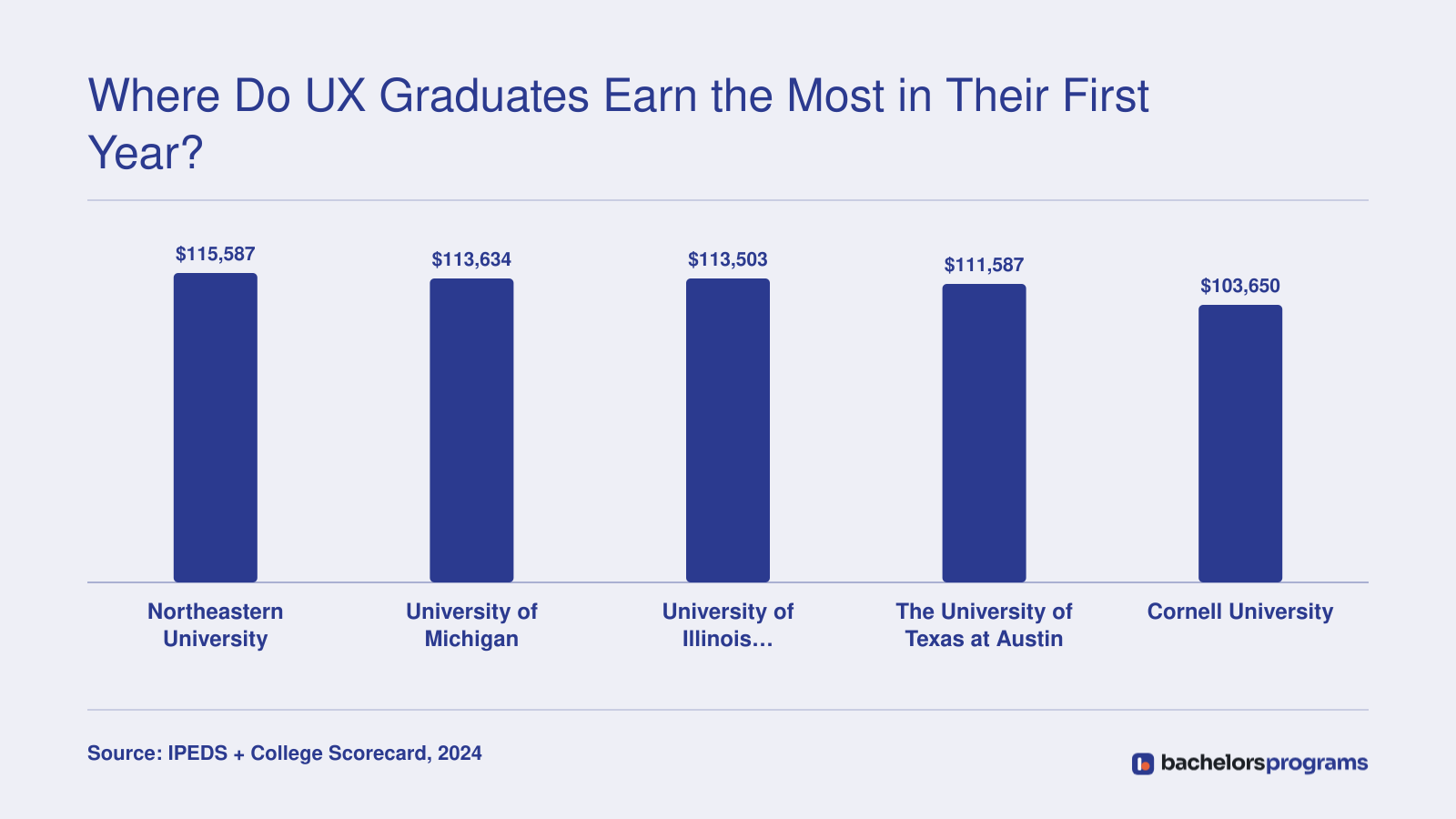
Where Do UX Graduates Earn the Most in Their First Year?
This chart shows program-level median earnings one year after finishing for the five schools here with the highest first-year figures, from Northeastern University's $115,587 to Cornell University's $103,650. Early earnings vary widely by school and region, and a single year of pay says little about long-term growth. When judging value, pair these figures with each school's net price in the cost section, since a strong first-year salary means more when the price of the degree is lower.
Related Articles
UX vs. HCI, Interaction Design, and Technical Communication Degrees
These four bachelor's pathways overlap, but they train you for different daily work. Federal labor data groups UX, HCI, and interaction design graduates mostly under web and digital interface designers, who earned a median of $104,000 in May 2025. Technical writers, the usual destination for technical communication majors, earned a median of $90,390. Program names and department placement vary by school, so treat the rows below as typical patterns, not guarantees.
| Factor | UX Design | Human-Computer Interaction (HCI) | Interaction Design | Technical Communication |
|---|---|---|---|---|
| Core focus | Designing usable, useful digital products from research through interface | Understanding how people use computing systems and evaluating those systems | Designing how interfaces behave, including flows, states, and micro-interactions | Explaining complex information clearly through documentation, instructions, and content |
| Research vs. design emphasis | Balanced, with usability testing alongside visual and interface work | Leans toward research, user studies, and evaluation methods | Leans toward design practice and prototyping | Leans toward writing, editing, and information design, with audience research |
| Typical home department | Art and design, communication, or information studies | Computer science, information science, or psychology | Art and design or a digital media program | English, communication, or a professional writing program |
| Math and programming load | Light to moderate, often basic front-end coding | Moderate to heavy, often with statistics and programming | Light to moderate, with some prototyping or scripting | Light, with tools for authoring and content management |
| Common first jobs | UX designer, UX researcher, product designer, usually in the web and digital interface designer category | UX researcher, usability analyst, front-end or software roles | Interaction designer, UI designer, prototyper | Technical writer, content designer, documentation specialist |
| Typical entry-level education and pay reference | Bachelor's degree; $104,000 median for web and digital interface designers (May 2025) | Bachelor's degree; same $104,000 median applies to the interface designer category | Bachelor's degree; same $104,000 median applies to the interface designer category | Bachelor's degree; $90,390 median for technical writers (May 2025) |
Accredited Online UX Degree Programs vs. Campus Options
You can earn a bachelor's degree in user experience online. Accreditation does not hinge on delivery format, so a distance program can carry the same institutional recognition as a campus one. Many programs on this list are campus-based, though, so format is a genuine comparison point rather than a formality.
Which accreditation actually applies
Institutional accreditation from an agency recognized by the U.S. Department of Education is the baseline.1 It governs access to federal financial aid, transfer credit, and admission to graduate study. The Department recognizes accrediting agencies; it does not accredit schools or programs itself, so a college that markets itself as "Department accredited" misstates how the system works.2
Programmatic accreditation is narrower. NASAD covers art and design units, so a graphic design or interaction design degree inside one may hold it. ABET's computing commission accredits computing programs, and a UX or HCI major can sit inside one without being accredited itself.3 No UX-specific accreditor exists, so accreditation is program-specific: check the exact degree title, campus, and accrediting body.
Async, sync, and studio critique
Asynchronous courses suit students who work, but synchronous critique sessions are where UX students learn to defend design decisions. Online programs typically run critique through recorded walkthroughs and live video reviews. Team projects move to shared files and scheduled standups, and internships take extra planning because local employers may not recruit through a distance program. Ask how critique is graded and whether any campus residency is required.
Verify before you enroll
Search the school in DAPIP, the Department's Database of Accredited Postsecondary Institutions and Programs, and confirm the campus and delivery format listed.4 Cross-check in the CHEA directory or on the accreditor's own site. DAPIP entries are reported by accrediting and state agencies rather than audited, so confirm dates and any separate program-level accreditation.5
What You'll Learn: Core Courses, Figma, Usability Testing, and Capstones
Curricula vary by school and degree type, and no single national core exists. Still, most bachelor's programs in UX design, interaction design, and HCI draw on the same building blocks.
Core Courses
Expect user research methods (interviews, contextual inquiry, surveys), information architecture, wireframing, interaction and visual design, rapid prototyping, usability testing, accessible design, and often UX writing. Purdue's catalog, for example, covers contextual inquiry, hallway testing, usability heuristics, and prototypes at multiple fidelity levels.1 Programs built on computer science lean harder on programming, math, and statistics. Carnegie Mellon's B.S. in HCI requires at least 360 units, including five CS core courses, four math and statistics courses, seven HCI core courses, and a psychology course.2
Tools You'll Use
Figma is the most consistently named tool, taught at MICA and ASU Online among others. Adobe Creative Cloud and Adobe XD also appear, and MICA adds web development.4 ASU Online students work with Qualtrics and Google Forms for research. Specific testing platforms such as Maze or UserTesting are not reliably listed in catalogs, so ask each school which ones students actually use. Tool fluency matters because hiring managers open your portfolio and want to see working files, prototypes, and test results, not just polished screens.
Internships and Capstones
Internships are often optional. WGU does not require one, and its capstone instead pairs you with a real business client.3 Franklin University requires a practicum (UXGD 490) followed by a capstone (UXGD 495) with an external client. At Carnegie Mellon, an interdisciplinary team builds a digital solution for a client problem, while MICA requires both a capstone and a professional portfolio. Most capstones run the full cycle: research, define, ideate, prototype, test, present.
Compare the Catalogs
Before you apply, count research courses against design studios. A research-heavy plan points toward UX researcher roles, while a studio-heavy plan builds visual and interaction design portfolios.
Portfolio, Admissions, and Transfer Credit: What to Expect
Do you need a portfolio to get into a UX degree program? Usually not at entry. General-admission UX majors tend to focus on transcripts and GPA. Selective studio programs and art and design schools are the main exception. Use this checklist to see what each type of program asks for.
- High school transcript and GPAExpect to submit a diploma or equivalent and transcripts. ASU Online's UX B.S. programs require a 3.00 GPA across 14 competency courses and treat applicants with fewer than 12 transferable credits as first-year students.
- Test-optional statusMany online programs skip exams entirely. Tulane's online Digital Design: Interactive UX/UI B.A. requires no test scores or recommendations and admits on a rolling basis.
- Portfolio, if requiredSelective programs set specific requirements. The University of Washington's 2026 Interaction Design BDes application asks for 5 to 10 design samples plus a take-home response, and it accepts sketch-to-prototype work, so process sketches can count alongside polished pieces.
- Mid-program portfolio reviewSome programs admit you first and review your work later. Seattle University holds its review near the end of sophomore year, and BYU's limited-enrollment Product & UX Design BFA uses a fall portfolio for pre-BFA students and a June review for the professional BFA.
- Transfer limits and residencyFranklin University accepts up to 75 percent of required credits. That works out to as many as 90 on a 120-credit degree, but transferred, exam, and outside-portfolio credit can't satisfy residency hours.
- Online degree-completion studentsFranklin waives the high school diploma requirement for applicants with 60 or more semester hours from an accredited college, a common associate degree pathway. Tulane caps transfer credit at 60 and grants up to 24 credits for work-based portfolios.
What UX and Digital Designers Earn Nationally
UX graduates often work as web and digital interface designers, the federal category closest to user experience work.
User Experience programs by state
Compare User Experience programs on the data that matters
Explore more Arts & Design majors or browse every field of study.
All Arts & Design programs Browse every field of study