Best Cybersecurity Schools in Minnesota
Compare 8 accredited Cybersecurity programs in Minnesota, with net price after aid, graduation rates, earnings and debt from IPEDS and the U.S. College Scorecard.

A bachelor's degree in cybersecurity trains students to defend networks, cloud systems and data. In Minnesota, that demand concentrates in the Twin Cities, where medical device makers, retailers and manufacturers all hire security staff. Most Minnesota programs award a Bachelor of Science (B.S.) in Cybersecurity; a few house the subject inside an information technology degree.
Programs differ most on cost and format. Published tuition runs from $9,840 a year at Metropolitan State University to $45,080 at Saint Mary's University of Minnesota, and delivery ranges from campus labs to fully online study.
Employers still weigh hands-on skill and certifications heavily alongside the diploma.
Key Points
- Metropolitan State's Cybersecurity BS runs in person or online, lab-intensive either way.
- Capella folds cybersecurity into an IT bachelor's as an Information Assurance specialization.
- Minnesota security analysts' middle half earned $100,714 to $147,950 in early 2025.
Best Bachelor's in Cybersecurity Schools in Minnesota, Ranked
Eight Minnesota schools award a bachelor's degree in cybersecurity, and they split between campus programs in Moorhead, St. Cloud, Saint Paul and Roseville and online options run from Minnesota. Each card gives the net price, the institution-wide graduation rate, the format and any specialization, plus the details that put the school where it sits. The graduation rate shown describes the whole institution, not the cybersecurity major.
Capella University
#1Minneapolis, MN · $15,000 – $20,000/yr (est.)
Best for: Working adults needing self-paced online study
Capella University is a Minneapolis-based online institution built around flexible, career-focused degree paths, and its cybersecurity offering sits inside a broader information technology bachelor's. Learners choose between a structured GuidedPath format and a self-paced FlexPath option, so the program suits adults balancing work with school. The specialization adds hands-on labs and simulations plus the chance to earn entry-level IT certifications at no extra cost.
- IT bachelor's with information assurance and cybersecurity specialization
- $350 per credit with a locked tuition rate
- Tuition capped at $30,000 for the degree
- GuidedPath structured or FlexPath self-paced formats
- Prepares for CompTIA A+, Google IT Support and AWS certifications at no cost
- Capstone required; 180 total credit hours
- 2.8 GPA minimum; no entrance exam, test optional
- No-cost general education courses through Sophia Learning
Saint Mary's University of Minnesota
#2Winona, MN · $12,000/yr (est. net price)
Best for: Transfer students bridging into graduate cybersecurity
Saint Mary's University of Minnesota is a private university in Winona whose online information technology bachelor's carries an optional cybersecurity specialization. The core covers IT fundamentals plus a communications course, a management course and a capstone, while the specialization adds forensics, network security, cyberwarfare and hacker techniques. Students can apply any time and start in one of three semesters, and qualified credits can bridge into graduate cybersecurity coursework.
- B.S. in Information Technology with a cybersecurity specialization
- 42 total credit hours with the specialization; 36 for the core
- Covers forensics, network security, cyberwarfare and hacker techniques
- Prepares for CompTIA Security+ certification
- Fully online with synchronous and asynchronous options
- Rolling admissions with three start dates per year
- Bridge pathway into the M.S. in Cybersecurity
- 12 college credits can waive the high school transcript requirement
Rasmussen University-Minnesota
#3St. Cloud, MN · ~$18,000/yr (est.)
Best for: Certificate holders stacking credits toward a bachelor's
Rasmussen University's Minnesota campus in St. Cloud serves the surrounding region with career-focused programs, and its cyber security bachelor's runs fully online. The curriculum emphasizes hands-on work with Windows, Linux, Cisco, VMware and Microsoft Azure, along with virtualization, hacker techniques and malware reverse engineering. A laddering design lets students stack credits from certificates up to the bachelor's, and exam fees for selected certifications are reimbursed.
- 90-credit, 23-course cyber security bachelor's
- $322 per credit, about $28,980 total program tuition
- Hands-on work in Windows, Linux, Cisco, VMware and Azure
- Coursework in virtualization, hacker techniques and malware reverse engineering
- Prepares for SSCP, CCNP and CISA certifications
- Reimbursement for up to three certification exam fees
- Self-directed assessments convert prior learning into credit
- Credits stack from certificate through associate to bachelor's
Minnesota State University Moorhead
#4Moorhead, MN · ~$18,000/yr (est.)
Minnesota State University Moorhead is a public university in the Red River Valley with a dedicated on-campus cybersecurity bachelor's inside its computing department. Students work in three computer facilities, including a 32-machine Windows lab and a 21-workstation Linux lab, and can take internships with area employers. The department also offers related majors in computer science, computer information systems and computer information technology, which makes double or triple majors practical.
- On-campus Bachelor of Science in Cybersecurity
- Windows lab with 32 computers and a Linux lab with 21 workstations
- Advanced technologies research facility on campus
- Internship opportunities with area companies
- Practice communicating security needs to technical and non-technical audiences
- STEM learning community available
- Double or triple major options with computer science or information systems
- Curriculum covers evaluating, designing and implementing secure systems
University of Northwestern-St Paul
#5Saint Paul, MN · ~$28,000/yr (est.)
University of Northwestern-St. Paul is a private Christian university in Roseville, just outside the Twin Cities, with an on-campus cybersecurity bachelor's in its School of Science and Engineering. The 125-credit major combines mathematics, computer science, data communications and security fundamentals, and a spring study group prepares students for the CISSP exam. Students manage routers and switches in a data communications lab and take on projects for Twin Cities employers.
- 125-credit Bachelor of Science in Cybersecurity
- Curriculum built around CAE Cyber Defense education outcomes
- Spring study group prepares students for the CISSP certification
- Data communications lab with routers and switches
- Off-campus projects for Twin Cities firms
- Featured courses in cryptography, digital forensics and data communications
- Graduates typically employed within three months of completion
- Recent hires at the FBI, Medtronic, 3M, Target and U.S. Bank
Saint Cloud State University
#6Saint Cloud, MN · ~$14,000/yr (est.)
St. Cloud State University is a public university in central Minnesota whose cybersecurity bachelor's sits in the Department of Computing, Informatics and Data Science within the College of Business, Engineering and Technology. The major covers computer and network security, ethical hacking, intrusion detection, high-level programming, cryptography and the legal and ethical side of the field. Students take a core plus electives, and the campus fielded the winning team at the 2026 Minnesota State Collegiate Cyber Defense Competition.
- 120-credit degree with an 81 to 82 credit cybersecurity major
- Coursework in ethical hacking and intrusion detection
- Cryptography, privacy, legal and ethical issues covered
- High-level programming required
- Core courses plus electives for depth
- Housed in the College of Business, Engineering and Technology
- Campus team won the 2026 Minnesota State Collegiate Cyber Defense Competition
Herzing University-Minneapolis
#7St. Louis Park, MN · $15,000 – $20,000/yr (est.)
Herzing University's Minneapolis campus in St. Louis Park anchors a cybersecurity bachelor's delivered entirely online. The program covers incident response, ethical hacking, artificial intelligence and machine learning, cloud computing and digital forensics, with a capstone or internship at the end. Up to 90 transfer credits are accepted, courses align with CompTIA Security+, Certified Ethical Hacker and Cisco CCNA objectives, and selected credits can count toward a master's in cybersecurity.
- 100% online Bachelor of Science in Cybersecurity
- 120 credits, with up to 90 accepted in transfer
- Concentrations in ethical hacking, artificial intelligence and cloud computing
- Coursework in incident response, digital forensics and cloud security
- Aligns with CompTIA Security+, Certified Ethical Hacker and Cisco CCNA
- Capstone or internship required
- Dual credit toward the Master of Science in Cybersecurity
- Lifelong career coaching and a waived enrollment fee
Metropolitan State University
#8Saint Paul, MN · ~$17,000/yr (est.)
Metropolitan State University in Saint Paul runs a lab-intensive cybersecurity bachelor's with a strong public-service and statewide bent. Its Minnesota Cyber Institute leads education, research and public-private partnerships across the state, and the university coordinates a 12-state, NSA-supported effort to measure cybersecurity education outcomes. Students get access to IT and operational technology cyber ranges and cloud-based virtual labs, and a Cyber Clinic places them with community organizations.
- Lab-intensive Bachelor of Science in Cybersecurity
- NSA-designated Cyber Defense program
- Access to IT and OT cyber ranges and cloud-based virtual labs
- Certification-aligned curriculum
- Minimum 2.5 GPA in prerequisite courses for admission
- C programming competency and a capstone sequence required
- 16-credit residency requirement at Metro State
- Combined B.S. to M.S. Cyber Operations pathway totaling 142 credits
Cost & outcomes by school
Federal data for the highest-earning Cybersecurity programs, independent of the ranking above. Earnings are this field's bachelor's graduates four years after completing where the Scorecard reports them, else the school's undergraduate median.
| School | Net price / yr | Grad rate | Earnings | Debt | Grads/yr | Format |
|---|---|---|---|---|---|---|
| Metropolitan State University MN | $16,863 | 44% | $64,705 | $17,100 | — | Hybrid |
| Saint Mary's University of Minnesota MN | $11,704 | 66% | $58,170 | $21,500 | — | Online |
| Saint Cloud State University MN | $13,529 | 40% | $55,813 | $21,058 | — | Campus |
| University of Northwestern-St Paul MN | $27,705 | 68% | $50,755 | $21,325 | — | Campus |
| Minnesota State University Moorhead MN | $17,997 | 57% | $50,527 | $20,000 | — | Campus |
| Capella University MN | $17,956 | 20% | $42,189 | $14,968 | — | Online |
| Rasmussen University-Minnesota MN | $17,962 | 54% | $39,080 | $20,899 | — | Online |
| Herzing University-Minneapolis MN | $16,670 | 47% | $36,909 | $21,500 | — | Online |
Sources: U.S. Department of Education. Net price, graduation rate, earnings and debt: College Scorecard (earnings and debt for this field's bachelor's graduates where reported, else school-wide); graduates: IPEDS. A dash means no figure is reported.
Cost, debt & payoff
Median earnings of this field's bachelor's graduates (4 yrs after completing, else the school's undergraduate median) vs. their median federal loan debt · U.S. College Scorecard
Across these programs the median graduate earns about $50,641 and finishes with roughly $20,979 in debt — a ratio that clears a common rule of thumb (keep debt below first-year salary). Net price and debt vary widely school to school, so check the per-school figures in the table above before you shortlist.
What Drives the Order: Cost, Outcomes and Format
The ranking follows verifiable measures, not reputation or campus size. Four measures set the sequence.
- Cost after aid: published tuition and net price after grant aid, so a school with a high sticker price but generous aid does not get unfairly buried.
- Earnings after completion: reported pay for graduates, which signals how the credential is valued in the labor market.
- Institution outcomes: graduation and retention rates, a proxy for whether students who start actually finish.
- Delivery format: campus, fully online and hybrid options, since format decides whether a program fits around a full-time job.
Read the numbers with care
Net price is a sector-average estimate, not a quote for your situation. Graduation rate and 10-year earnings describe the whole school, not the cybersecurity program, so read them as background, not a forecast.
Sort it your way
If cost is your hard limit, start with the most affordable options and work up. If you need to keep working while you study, weight format first. The right order is the one that matches your constraint.
Lowest-Cost Minnesota Cybersecurity Bachelor's Programs
These Minnesota schools post the lowest average net price, the yearly cost after grants and scholarships, according to IPEDS and College Scorecard (2024) data from the U.S. Department of Education. Sticker price and net price can point in opposite directions: Saint Mary's University of Minnesota lists the highest tuition here but the lowest net price, while Metropolitan State University has the lowest published tuition. Graduation rates and median debt are institution-wide figures, not cybersecurity-specific ones.
| School | City | Program | Format | Published Tuition and Fees (In-State, per Year) | Average Net Price After Aid | Institution Graduation Rate | Median Graduate Debt |
|---|---|---|---|---|---|---|---|
| Saint Mary's University of Minnesota | Winona | Information Technology, B.S. (Cybersecurity concentration) | Online | $45,080 | $11,704 | 66% | $21,500 |
| Saint Cloud State University | Saint Cloud | Cybersecurity | Campus | $10,245 | $13,529 | 40% | $21,058 |
| Herzing University-Minneapolis | St. Louis Park | Cybersecurity | Online | $13,450 | $16,670 | 47% | $21,500 |
| Metropolitan State University | Saint Paul | Cybersecurity BS | Hybrid | $9,840 | $16,863 | 44% | $17,100 |
| Capella University | Minneapolis | B.S. in Information Technology, Information Assurance and Cybersecurity specialization | Online | $14,400 | $17,956 | 20% | $14,968 |
Online and Hybrid Bachelor's Degree in Cybersecurity Options at Minnesota Schools
Metropolitan State University lists its Cybersecurity BS as available "in-person or online," and the coursework stays lab-intensive either way: students work in IT/OT cyber ranges and cloud-based virtual labs rather than watching demonstrations. That dual listing is the most explicit hybrid arrangement among the Minnesota schools ranked here.
Fully Online at Minnesota-Based Schools
Each of these online options is run by a Minnesota institution, not an out-of-state provider:
- Capella University (Minneapolis): an online BS in Information Technology with an Information Assurance and Cybersecurity specialization, including a self-paced FlexPath track.
- Saint Mary's University of Minnesota (Winona): a fully online option with synchronous and asynchronous scheduling and instructor-facilitated online lab environments.
- Rasmussen University-Minnesota (St. Cloud): online delivery with full-time and part-time pacing and multiple start dates per year.
- Herzing University-Minneapolis (St. Louis Park): 100% online courses, with part-time enrollment available.
Campus Programs With Lab Access
Minnesota State University Moorhead, University of Northwestern-St Paul and Saint Cloud State University list their cybersecurity bachelor's as on-campus. Moorhead's dedicated Windows and Linux labs are the kind of facility time that remote study cannot fully replace.
Online or Campus for Working Adults
Online programs cut the commute and usually allow part-time pacing; campus programs give you physical lab hours and closer ties to local employers. Transfer students should ask two questions before committing: how many credits each format will accept, and what upper-division residency each school requires. Metropolitan State, for instance, requires 16 credits completed in residence.
Related Articles
Cybersecurity, Cyber Operations, Cybercrime or Computer Science: Picking the Right Bachelor's Label
Security education has split into narrower degree labels, so the title on a diploma tells you less than it once did. Each label signals a distinct emphasis and points to a distinct first job.
How the Labels Differ
- Cybersecurity: A broad defensive degree covering networks, risk, policy and incident response. It points toward security analyst roles that protect an organization's systems.
- Cyber operations: A more technical, hands-on track built around offensive and defensive techniques such as penetration testing. It points toward defense and threat-hunting work, often tied to government missions.
- Cybercrime or digital forensics: Blends technology with criminal justice, evidence handling and law. It points toward investigation roles that recover and analyze data for legal cases.
- Computer science: Centers on programming, algorithms and software design, with security as an elective layer. It points mainly toward development jobs, including secure coding.
Read the Course List, Not the Title
Program names at the Minnesota schools ranked here vary. Minnesota State University Moorhead, Metropolitan State University and Saint Cloud State University list a cybersecurity bachelor's. Capella University places cybersecurity inside a B.S. in Information Technology as an Information Assurance and Cybersecurity specialization. Saint Mary's University of Minnesota offers an IT bachelor's, so confirm how much security coursework it requires.
Whatever the label, pull the required course list and look for network security, ethical hacking, digital forensics, scripting and a hands-on capstone. The concentration you choose will shape your first job more than the word printed on the diploma.
Questions to Ask Yourself
Does your schedule allow campus attendance, or do you need a fully online program?
Are you aiming at defense, federal contracting or state government work?
Do you want to defend networks, investigate incidents, or write secure code?
How much of your existing credit will actually transfer?
What Do Information Security Analysts Earn in Minnesota?
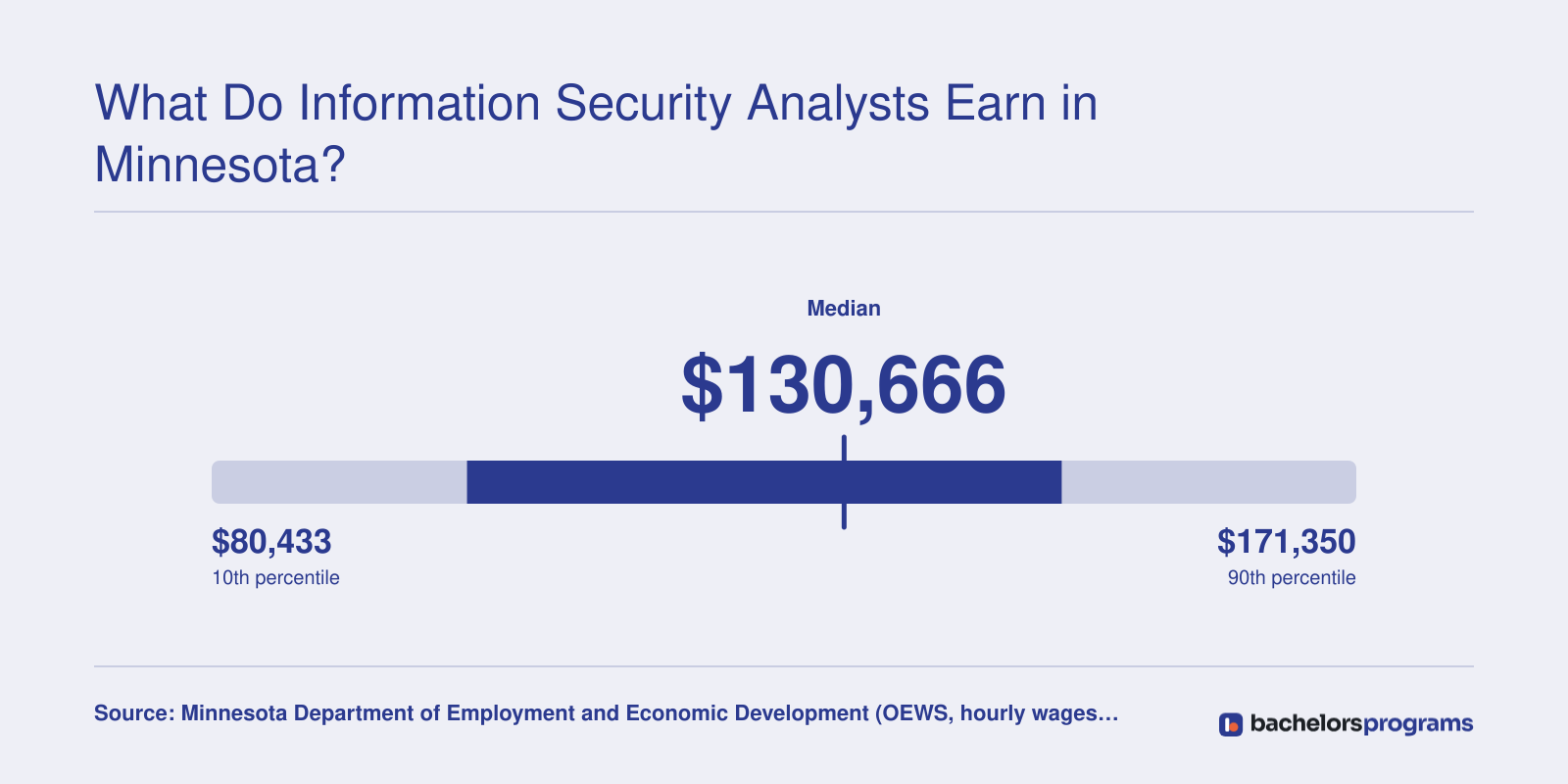
Minnesota's state labor-market data for the first quarter of 2025 put information security analyst pay at about $80,433 at the 10th percentile and $171,350 at the 90th, with the middle half earning roughly $100,714 to $147,950. The Bureau of Labor Statistics' May 2025 estimates show a statewide median of $130,710 across 2,680 jobs. In the Minneapolis-St. Paul-Bloomington metro, the average (mean, not median) annual wage was $132,220.
Compare Cybersecurity programs on the data that matters
Explore more Computers & IT majors or browse every field of study.
All Computers & IT programs Browse every field of study