Best Healthcare Administration Schools in Minnesota
Compare 19 accredited Healthcare Administration programs in Minnesota at 16 colleges, with net price after aid, graduation rates, earnings and debt from IPEDS and the U.S. College Scorecard.

Sticker price tells you little about real cost. Saint Mary's University of Minnesota lists $45,080 a year yet reports the lowest average net price here at $11,704, about $5,000 under Metropolitan State.
Most programs here award a Bachelor of Science (B.S.) in Healthcare Administration, the credential Minnesota employers from hospital systems to long-term care operators ask for.
Format drives much of the real difference: several programs run fully online, some at per-credit rates near $448, while others tie enrollment to a campus schedule. Licensure and the setting you want to work in should decide the choice.
Key Points
- Saint Mary's University of Minnesota posts the lowest net price: $11,704 yearly.
- University of Minnesota-Crookston offers Health Management fully online at $448 per credit.
- Borrowers finish with median federal debt between $14,165 and $22,011.
Best Bachelor's Degree in Healthcare Administration Programs in Minnesota: Our Top 10
Minnesota's bachelor's degrees in healthcare administration come in several shapes: an AUPHA-certified management degree in the Twin Cities, online completion programs built for people who already hold an associate degree, and business-school options with a healthcare concentration. Every school below is based in Minnesota, and each entry notes where the program is taught and what makes it distinct. Institution-wide graduation rates at these schools run from 44% to 85%, and the net prices shown are sector-wide averages rather than program-specific figures.
University of Minnesota-Twin Cities
#1Minneapolis, MN · ~$17,000/yr (est.)
Best for: Metro Minneapolis students seeking flexible formats
Minnesota's largest public research university offers healthcare management through its College of Continuing and Professional Studies, with AUPHA certification and a choice of classroom, live online, self-paced, and community-based courses. Students can add a concentration, complete an internship and capstone, and join an annual study abroad trip to Costa Rica. Admission happens at the upper-division level, so most students arrive with roughly 30 transferable credits already in hand.
- 120 credits, including 22 elective credits for customization
- Classroom, live online, self-paced, and community-based formats
- Internship and capstone both built into the degree path
- Admission requires 30 transferable credits and a 2.5 GPA
- 12 concentration options with two start dates a year, fall and spring
- Partially online delivery across multiple course formats
- Annual study abroad trip to Costa Rica
- Advisory board of industry leaders; long-term care licensure support
- Capstone required; 2.5 GPA minimum
Saint Mary's University of Minnesota
#2Winona, MN · $12,000/yr (est. net price)
Best for: Online learners wanting a private university
A private Lasallian university based in Winona, Saint Mary's delivers its healthcare management major online and rounds it out with a broad liberal arts core. Students can pair the major with any of about 20 minors, and internships are designed into the curriculum. The university also runs a specialized online track tied to the Latin American Sisters Partnership.
- Online bachelor's in healthcare management
- 20 different minors available to personalize the degree
- Internships designed into the curriculum
- Coursework in human resources, ethics, and business principles
- Lasallian general education core
- Online human services specialization inside the management degree
- Specialization lists 36 total credit hours
- Rolling admissions; entrance exam required (TOEFL, IELTS)
- Capstone required; bachelor's-to-master's bridge pathway
- Take up to 50% graduate coursework
- Community Health Worker Certificate option
- Limited to the Latin American Sisters Partnership
Rasmussen University-Minnesota
#3St. Cloud, MN · ~$18,000/yr (est.)
Best for: Working adults with prior college credit
Rasmussen University is a career-focused system with Minnesota campuses and a long record of online delivery for working adults. Its healthcare management bachelor's is a completion program: students enter with an associate degree or transfer credit and finish 90 credits in as few as 18 months. Eight start dates a year and an accelerated path to a master's degree make it one of the more flexible options on this list.
- Completion program: enter with an associate degree or transfer credit
- 90 total credit hours across 23 courses; finish in as few as 18 months
- $332 per credit, about $29,880 total program tuition
- Eight start dates a year, fully online
- Accelerated pathway to a master's in healthcare administration
- Public Health specialization; Empowered Learning self-paced option
- Eligible to sit for CAPM and PMP certifications
- Transfer credit estimate returned in one day
University of Minnesota-Duluth
#4Duluth, MN · $15,000 – $20,000/yr (est.)
The University of Minnesota Duluth houses its health care management B.B.A. in the AACSB-accredited Labovitz School of Business and Economics, so students take a full business core alongside health policy and systems coursework. A full-time internship director oversees a large internship program, and students can join a health care management association and an honor society chapter. This is a campus-based program on the Duluth campus.
- B.B.A. pairing a full business core with health policy and regulation
- AUPHA and AACSB accredited
- Full-time internship director manages more than 200 internships
- Student Health Care Management Association and Upsilon Phi Delta chapter
- Hands-on projects with real-world datasets
- Independent research through UROP
The College of Saint Scholastica
#5Duluth, MN · $28,000/yr (est. net price)
The College of Saint Scholastica is a private Duluth university whose business management degree carries a healthcare administration concentration. Students take healthcare operations, finance, communication, and risk management courses and can finish online or in face-to-face classes on campus. The application is free, and a customized concentration can be built with an advisor.
- Healthcare Administration concentration inside the business management major
- 5 concentration options, including a customized plan built with an advisor
- Finish in as little as two years
- 100% online or face-to-face on the Duluth campus
- 2.5 GPA for new students, 2.0 for transfer students
- $0 application fee; deposits refundable until May 1
- Internships with employers such as Target, Best Buy, and 3M
Winona State University
#6Winona, MN · ~$18,000/yr (est.)
Winona State University is a public regional university in southeastern Minnesota with a long record of preparing healthcare managers. Its healthcare leadership and administration bachelor's is an online completion degree for people who already hold an associate degree and some healthcare work experience. Classes are asynchronous, assignments tie back to real projects at students' own workplaces, and students can start in fall, spring, or summer.
- Online completion degree for associate degree holders with healthcare experience
- 120 total credit hours
- Asynchronous classes with three start dates a year
- Assignments tied to real projects in your own workplace
- Option to earn a bachelor's and master's degree together
- Aligned with the Healthcare Leadership Alliance
Minnesota State University Moorhead
#7Moorhead, MN · ~$18,000/yr (est.)
Minnesota State University Moorhead offers healthcare management and leadership through its health services department, with online, hybrid, and face-to-face sections. The program is approved for Minnesota nursing home administrator licensure, and students are advised by a council of practicing healthcare executives. Transfer-friendly policies and a five-year path to a master's degree suit students who want to keep moving.
- Online, hybrid, and face-to-face course options
- Internship with a regional healthcare organization
- Approved for Minnesota nursing home administrator licensure
- AUPHA member; advised by a council of healthcare executives
- Five-year pathway from the bachelor's to the MHA
- Generous transfer credit for associate degrees
- Emphasis in long term care administration
- Long Term Care Administration certificate option
- RN-BSN and Project Management double major options
- Specializations in elder and ambulatory services
University of Minnesota-Crookston
#8Crookston, MN · ~$12,000/yr (est.)
The University of Minnesota Crookston is a small public campus that delivers its health management bachelor's entirely online. The 120-credit curriculum covers medical terminology, healthcare finance, law and ethics, performance improvement, and leadership, with no on-campus requirement. Students can start in spring, summer, or fall and transfer credits from regionally accredited colleges.
- 100% online with no on-campus component required
- 120 total credit hours at $448 per credit
- Three start dates a year: spring, summer, and fall
- Coursework in medical terminology, finance, law, and ethics
- Transfer credits accepted from regionally accredited colleges
- Prepares students to plan, direct, and coordinate health services
Metropolitan State University
#9Saint Paul, MN · ~$17,000/yr (est.)
Metropolitan State University in Saint Paul serves a largely adult and transfer student population, and its health systems degree is built for people who already hold a health-related associate degree. Students complete 120 credits, including a capstone in the final spring semester, online or in a mix of online and in-class meetings. Admission requires a 2.0 GPA and an official degree plan worked out with an advisor.
- Degree completion for holders of a health-related associate degree
- 120 semester credits; 2.0 GPA minimum
- Online or hybrid course formats
- Capstone course in the final spring semester
- Official degree plan worked out with an academic advisor
- Coursework includes Global Health Issues and Racism and Health
Concordia College at Moorhead
#10Moorhead, MN · ~$25,000/yr (est.)
Concordia College at Moorhead is a private liberal arts college whose healthcare leadership major includes a healthcare administration concentration. The major requires 48 credits and the concentration adds 9, including a three-credit internship in healthcare administration. A published four-year plan and the option to combine healthcare administration with long-term care make the path easy to map out.
- 48-credit leadership major plus a 9-credit concentration
- 3-credit healthcare administration internship included
- 3 concentration options; a four-year plan is published
- Core covers healthcare systems, law and ethics, finance, and quality
- Combines with long-term care for a second focus area
Cost & outcomes by school
Federal data for the highest-earning Healthcare Administration programs, independent of the ranking above. Earnings are this field's bachelor's graduates four years after completing where the Scorecard reports them, else the school's undergraduate median.
| School | Net price / yr | Grad rate | Earnings | Debt | Grads/yr | Format |
|---|---|---|---|---|---|---|
| Capella University MN | $17,956 | 20% | $76,334 | $27,657 | 448 | Online |
| Concordia University-Saint Paul MN | $18,462 | 46% | $75,912 | $22,011 | 24 | Online |
| University of Minnesota-Crookston MN | $12,212 | 50% | $75,308 | $26,610 | 22 | Online |
| University of Minnesota-Twin Cities MN | $16,778 | 85% | $72,862 | $19,400 | 48 | Hybrid |
| Winona State University MN | $17,503 | 57% | $72,716 | $20,500 | 41 | Online |
| The College of Saint Scholastica MN | $27,846 | 71% | $71,540 | $26,427 | 15 | Hybrid |
| University of Minnesota-Duluth MN | $18,743 | 65% | $68,386 | $20,715 | 16 | Campus |
| Saint Mary's University of Minnesota MN | $11,704 | 66% | $66,139 | $14,165 | 16 | Online |
| Metropolitan State University MN | $16,863 | 44% | $64,705 | $17,100 | 14 | Hybrid |
| Rasmussen University-Minnesota MN | $17,962 | 54% | $62,100 | $26,217 | 89 | Online |
| Concordia College at Moorhead MN | $24,902 | 61% | $59,317 | $26,847 | 18 | Campus |
| St Catherine University MN | $19,764 | 61% | $59,282 | $24,181 | — | Online |
Sources: U.S. Department of Education. Net price, graduation rate, earnings and debt: College Scorecard (earnings and debt for this field's bachelor's graduates where reported, else school-wide); graduates: IPEDS. A dash means no figure is reported.
Cost, debt & payoff
Median earnings of this field's bachelor's graduates (4 yrs after completing, else the school's undergraduate median) vs. their median federal loan debt · U.S. College Scorecard
Across these programs the median graduate earns about $66,139 and finishes with roughly $20,980 in debt — a ratio that clears a common rule of thumb (keep debt below first-year salary). Net price and debt vary widely school to school, so check the per-school figures in the table above before you shortlist.
Cheapest Bachelor's Programs in Healthcare Administration in Minnesota
Saint Mary's University of Minnesota has the lowest average net price below, at $11,704 a year. That is $508 less than the University of Minnesota-Crookston and about $5,159 less than Metropolitan State University, even though Saint Mary's lists $45,080 in tuition and fees. Net price is a sector-conditional average from IPEDS and College Scorecard (2024): public schools show the average for in-state students after grants and scholarships, and private schools show the average for all aided students. Earnings are program-level medians for bachelor's graduates, measured 1 year and 4 years after completion.
| School | City | Sector | Tuition and Fees (In-State) | Average Net Price After Aid | Program Median Earnings, 1 Year After Completion | Program Median Earnings, 4 Years After Completion |
|---|---|---|---|---|---|---|
| Saint Mary's University of Minnesota | Winona | Private nonprofit | $45,080 | $11,704 | $51,660 | $66,139 |
| University of Minnesota-Crookston | Crookston | Public | $13,288 | $12,212 | $61,965 | $75,308 |
| Herzing University-Minneapolis | St. Louis Park | Private nonprofit | $13,450 | $16,670 | $39,231 | $51,098 |
| University of Minnesota-Twin Cities | Minneapolis | Public | $17,214 | $16,778 | $52,113 | $72,862 |
| Metropolitan State University | Saint Paul | Public | $9,840 | $16,863 | N/A | N/A |
Online and Hybrid Bachelor's Degrees in Healthcare Administration at Minnesota Schools
University of Minnesota-Crookston delivers its Health Management bachelor's degree entirely online at $448 per credit, with no on-campus component and three start dates a year.
Fully online programs for working students
Several Minnesota-based schools build the degree around asynchronous coursework, which suits registered nurses, clinic staff and other working health care employees who need to fit classes around shifts.
- Saint Mary's University of Minnesota: the Healthcare Management major is offered online from the Winona campus.
- Rasmussen University-Minnesota: an accelerated online Healthcare Management degree at $332 per credit, with eight start dates a year and employer reimbursement support.
- Winona State University: Healthcare Leadership & Administration is delivered fully online and asynchronously, with fall, spring and summer starts.
- University of Minnesota-Crookston: Health Management online, a practical fit for rural students and transfer students.
Hybrid formats that mix campus and online
The University of Minnesota-Twin Cities offers its Bachelor of Applied Science in Health Services Management in a hybrid format with synchronous and asynchronous options. At Minnesota State University Moorhead, the Healthcare Management and Leadership program runs online, hybrid or face to face, and Health Systems Studies students at Metropolitan State University can choose online or hybrid courses. The College of Saint Scholastica's business management degree carries a healthcare administration concentration in both formats, including a fully online route.
Campus programs for traditional-age students
The University of Minnesota-Duluth teaches Health Care Management on campus, with an accredited BBA and a student Health Care Management Association. Concordia College at Moorhead runs its Healthcare Leadership major and Healthcare Administration concentration on campus. These suit students who want internships, faculty advising and campus life.
Transfer credit and associate-degree completion pathways differ by school, so ask each one how it handles them before you apply.
Related Articles
Cost of a Healthcare Administration Bachelor's Degree in Minnesota
Public universities such as Metropolitan State, Winona State, and Minnesota State Moorhead post in-state tuition and fees near $10,000 to $11,000, while private Saint Mary's University of Minnesota lists $45,080 but has the lowest average net price after aid in this table at $11,704. Sticker price, net price after aid, and Pell share come from the U.S. Department of Education's IPEDS and College Scorecard (2024), and the 2026-27 column comes from the schools' own published tuition pages where available. Median debt is the figure for each school's healthcare administration bachelor's program, and net price is a school-wide average for all undergraduates.
| School | Sector | In-State Tuition and Fees (Scorecard 2024) | 2026-27 Published Tuition and Fees (School) | Average Net Price After Aid | Pell Grant Share | Program Median Debt at Completion |
|---|---|---|---|---|---|---|
| Saint Mary's University of Minnesota | Private nonprofit | $45,080 | N/A | $11,704 | 51% | $14,165 |
| University of Minnesota-Crookston | Public | $13,288 | N/A | $12,212 | 52% | $26,610 |
| Herzing University-Minneapolis | Private nonprofit | $13,450 | N/A | $16,670 | 82% | $37,778 |
| University of Minnesota-Twin Cities | Public | $17,214 | N/A | $16,778 | 42% | $19,400 |
| Metropolitan State University | Public | $9,840 | $10,929 | $16,863 | 68% | N/A |
| Winona State University | Public | $10,576 | N/A | $17,503 | 42% | $20,500 |
| Capella University | Private for-profit | $14,400 | N/A | $17,956 | 68% | $27,657 |
| Rasmussen University-Minnesota | Private for-profit | $11,490 | N/A | $17,962 | 73% | $26,217 |
| Minnesota State University Moorhead | Public | $10,428 | $11,679 | $17,997 | 46% | N/A |
| Concordia University-Saint Paul | Private nonprofit | $25,600 | N/A | $18,462 | 55% | $22,011 |
Median Debt at Completion: Where Minnesota Graduates Borrow Least
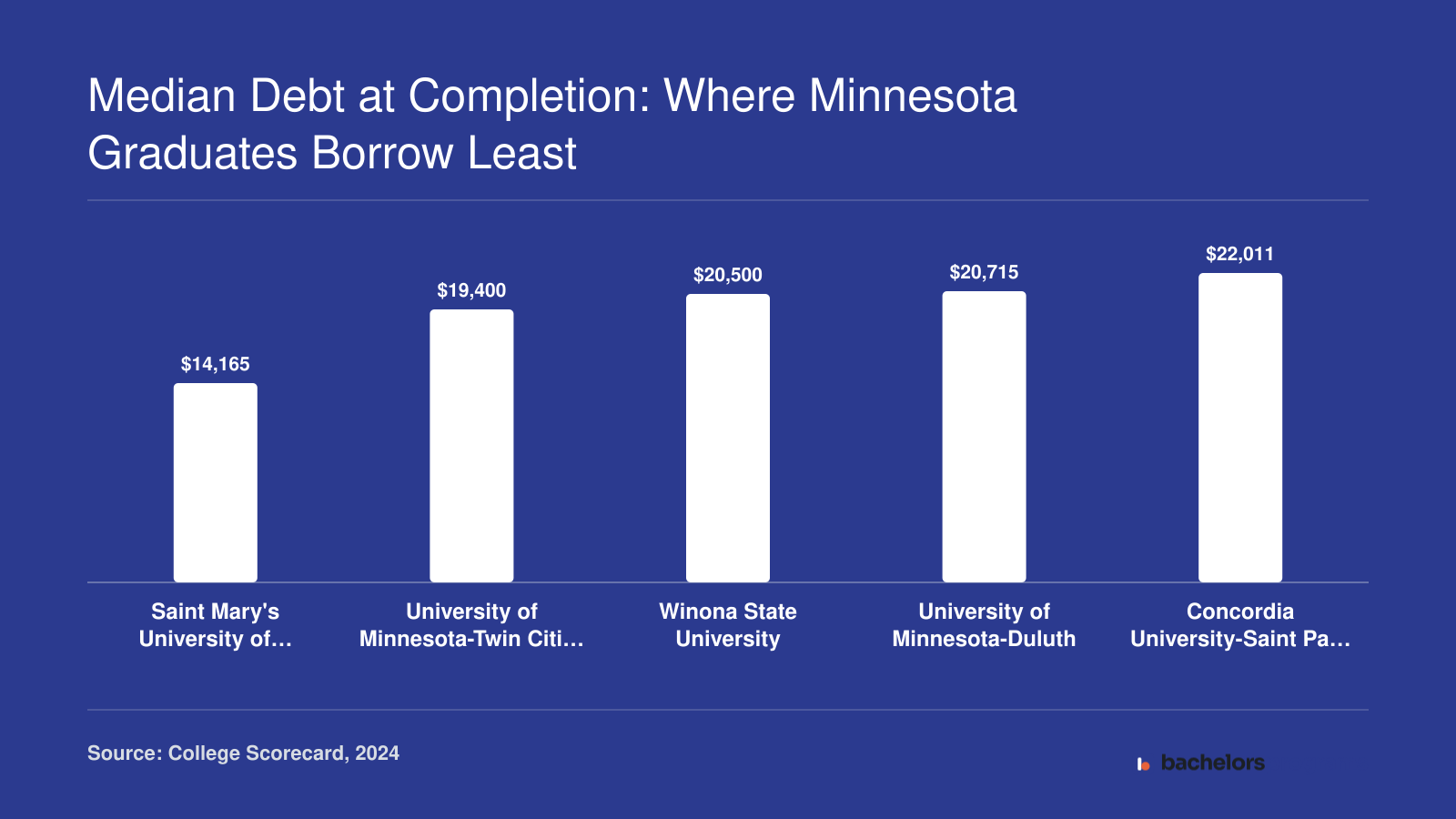
Among Minnesota healthcare administration bachelor's graduates, median federal loan debt at completion runs from $14,165 at Saint Mary's University of Minnesota to $22,011 at Concordia University-Saint Paul. On a standard 10-year repayment plan, the median monthly payment is about $150 at Saint Mary's, $206 at the University of Minnesota-Twin Cities, $217 at Winona State University, $220 at the University of Minnesota-Duluth and $233 at Concordia University-Saint Paul. The three public universities fall close together, between $19,400 and $20,715.
Minnesota State Grant, North Star Promise, and Other Aid for Bachelor's Students
Minnesota offers two state aid programs that matter for a bachelor's degree in healthcare administration. The Minnesota Office of Higher Education (OHE) runs both, and amounts change yearly, the figures here reflect 2026-27.
Minnesota State Grant
The Minnesota State Grant is need-based aid for Minnesota residents in certificate, associate, or bachelor's programs at eligible institutions.1 For 2026-27, students generally need to enroll at least half time (6 credits) and make satisfactory academic progress.1 Award size depends on financial need, enrollment level, cost of attendance, and the school's tuition and fees. Confirm with each school's financial aid office that it participates and what you would receive.
North Star Promise
North Star Promise is a last-dollar scholarship. After other gift aid is applied, it covers remaining base tuition and mandatory fees.2 To qualify for 2026-27, you need to:
- Residency: Be a Minnesota resident.
- Income: Have family adjusted gross income below $80,000 as reported on the FAFSA or state application.2
- Degree status: Have no prior bachelor's degree.
- Standing: Not be in loan default, and keep satisfactory academic progress.
- Enrollment: Take at least one credit.
It applies at Minnesota State and University of Minnesota institutions.2 Among the schools here, that includes the University of Minnesota campuses in Twin Cities, Duluth, and Crookston, plus Winona State, Minnesota State University Moorhead, and Metropolitan State. It does not apply at the private colleges on this list. Coverage runs up to eight full-time semesters (about 120 credits) for a four-year degree.3
Your Next Step
File the FAFSA, or the Minnesota Dream Act application if you are not eligible for federal aid. Both feed the state programs and the federal aid you may also qualify for. The North Star Promise deadline for 2026-27 was June 1, 20262, so check the date for your start term and each school's own priority deadline. OHE's Paying for College guide has current figures.
Healthcare Administration Careers and Pay in Minnesota
Healthcare administration careers in Minnesota center on the business side of care: scheduling, billing, compliance, staffing, and budgets for hospitals, clinics, and long-term care operators. The credential most often attached to those roles is the bachelor's degree in healthcare administration, and the state has steady demand for people who hold one.
What the Pay Looks Like
Medical and health services managers in Minnesota earned a median of $59.98 an hour in the first quarter of 2026, roughly $125,000 a year, across about 11,350 jobs2 (Minnesota DEED). Pay shifts by region: the Seven County Minneapolis-St. Paul area shows a median of $62.37 an hour and Southeast Minnesota $63.73, while Northeast ($50.70) and Southwest ($51.58) run lower2. Nationally, the Bureau of Labor Statistics projects 24% growth for the occupation from 2025 to 20351.
Where the Jobs Are
Health care and social assistance was Minnesota's largest employing industry in 2025, with 556,992 jobs, projected to add more than 57,800 by 2034, or 11.1% growth3 (Minnesota DEED). Commonly represented large systems include M Health Fairview, Mayo Clinic, Allina Health, HealthPartners, Essentia Health, Sanford Health, Children's Minnesota, CentraCare, and Hennepin Healthcare, alongside independent clinics, long-term care and senior living providers, and county and state public health agencies.
Entry-Level Roles First
A bachelor's degree rarely leads to a management title on day one. Graduates typically enter as patient access representatives, medical office coordinators, scheduling and billing specialists, health unit coordinators, or intake and insurance verification staff, then move into supervisor and manager roles after a few years of hands-on experience.
Minnesota Nursing Home Administrator Licensure: What a Bachelor's Degree Covers
According to the Minnesota Board of Executives for Long Term Services and Supports (BELTSS), a bachelor's degree is only the starting point for Nursing Home Administrator (NHA) licensure.
- Bachelor's degreeYou need a bachelor's degree from an accredited college or university. A healthcare administration bachelor's qualifies when its NHA coursework and practicum are completed through a NAB-accredited or BELTSS-approved program. Before enrolling, ask the school whether its program holds that approval.
- Long-term-care courseworkBELTSS requires coursework in eight long-term-care subject areas. Confirm with BELTSS that your program's courses cover each required area.
- Administrator-in-training practicumThe practicum must earn academic credit and take place in a licensed nursing home, not an assisted living facility or corporate office. Your supervisor must be a licensed NHA with at least two years of practice who is not related to you. Plan on at least 20 hours per week and at least 1,000 hours if you have no prior nursing-home experience.
- National and state examsYou must pass the NAB national exam, which has 150 multiple-choice items covering NAB Core and NHA LOS. You must also pass the open-book Minnesota state exam, which has 34 items in 80 minutes. Your completed application must be on file before you can sit for either exam.
- Application and background checkApply online through BELTSS under the NHA Education basis. You will submit proof of your degree, coursework and practicum, and you must complete a background check.
How to Choose the Right Minnesota Healthcare Administration School
Does it matter whether the degree says healthcare administration, healthcare management, or healthcare leadership? Usually less than you would expect. Across the schools here, titles range from Healthcare Management at Saint Mary's University of Minnesota to Healthcare Leadership & Administration at Winona State University and Health Systems Studies at Metropolitan State University. Administration tends to point toward operations and compliance, management toward staff and budgets, and leadership toward organizational behavior. The title matters only when it signals a different curriculum, as with a business degree that has a health care management track. Read the course list for finance, health law, quality improvement, and health informatics.
Check Accreditation First
Regional accreditation is essential. It affects credit transfer, federal financial aid, and employer recognition. AUPHA certification and CAHME accreditation are specialized signals worth confirming, but verify them yourself on the AUPHA and CAHME directories. CAHME mainly accredits graduate programs, so a bachelor's program without it is not a red flag.
Questions to Ask Admissions
- Internships: Is a practicum or internship required, and does the school help place you with Minnesota hospitals, clinics, or long-term care providers?
- Licensure pathway: Does the curriculum support Minnesota nursing home administrator licensure requirements if that is your goal?
- Format: Do classes run on campus, online, or hybrid, and does the schedule fit your work and family life?
A Simple Decision Rule
Start with net price after aid, not sticker tuition. Among programs with comparable graduate outcomes, choose the lower net price. Then pick the format you can realistically finish, since a program you complete beats a better-known one you abandon.
Common Questions About Healthcare Administration Bachelor's Programs in Minnesota
These answers cover the questions Minnesota students ask most often when comparing bachelor's degree options in healthcare administration. Confirm details with each school's admissions office before you apply.
Can I earn a healthcare administration bachelor's degree online in Minnesota?
What is the difference between healthcare administration and healthcare management degrees?
Do I need a bachelor's degree in healthcare administration to work in a Minnesota hospital or clinic?
Can I transfer an associate degree into a Minnesota healthcare administration bachelor's program?
Compare Healthcare Administration programs on the data that matters
Explore more Business & Management majors or browse every field of study.
All Business & Management programs Browse every field of study