Best Healthcare Administration Schools in Oregon
Compare 10 accredited Healthcare Administration programs in Oregon at 7 colleges, with net price after aid, graduation rates, earnings and debt from IPEDS and the U.S. College Scorecard.

The standard credential for this work is the Bachelor of Science (B.S.) in Healthcare Administration, available in Oregon on a Portland or Corvallis campus and through fully online programs. BLS projects 24% growth for medical and health services managers nationally from 2025 to 2035, roughly 62,300 openings a year.
The practical tension is cost against pace. In-state tuition at the public options runs from $11,679 to $14,400 a year before aid, and several programs are cohort-based, one-night-a-week formats built for working adults rather than four-year residential students. The diploma title is identical; the schedule and the price are not.
Key Points
- Portland State posts the lowest average net price after aid: $9,552.
- BLS projects 24% growth in health services manager jobs, 2025 to 2035.
- Oregon nursing home administrator licensure starts with an accredited bachelor's degree.
Best Oregon Schools for a Bachelor's Degree in Healthcare Administration
Seven Oregon schools award a bachelor's degree in healthcare administration or a close variant, and they split between public campuses, private universities and fully online programs. Some are built for traditional undergraduates on a four-year plan; others are cohort-based completion degrees designed around a full-time job. The entries below cover both, so you can compare format, location and academic focus side by side.
Portland State University
#1Portland, OR · ~$10,000/yr (est.)
Best for: Portland students drawn to public health
Portland State University is Oregon's largest public research university, and its health services administration degree is delivered through the OHSU-PSU School of Public Health, a joint venture with Oregon Health & Science University. The curriculum is CEPH-accredited and requires 180 credits plus a mentored internship, with five Health Studies concentrations and two minors to choose from. Students who want to keep going have a clear in-house path into the two universities' joint graduate programs in healthcare management. Classes meet in person in Portland, with online sections offered when available.
- CEPH-accredited curriculum through the OHSU-PSU School of Public Health
- 180 total credits, with rolling starts in any term
- Health Services Administration concentration covers policy and finance
- Mentored internship built into the degree
- Five Health Studies concentrations plus two minors
- In-person classes; online sections when available
Oregon Institute of Technology
#2Klamath Falls, OR · $15,000 – $20,000/yr (est.)
Best for: Allied health professionals moving into management
Oregon Institute of Technology is a public polytechnic based in Klamath Falls, with a second campus in the Portland metro and a large online catalog. Its healthcare management bachelor's is IACBE-accredited and runs at both Oregon campuses or fully online, so students pick the format that fits their schedule and location. The degree splits into an Administration option for students moving into management and a Clinical option built for certified allied health professionals who already hold a credential. Both tracks finish with a capstone project or internship.
- IACBE-accredited program at Klamath Falls and Portland-Metro
- Administration option includes a Medical Sociology minor
- Clinical option designed for certified allied health professionals
- Capstone project or internship closes out the degree
- Coursework in quality improvement and healthcare information systems
- Same accredited degree delivered fully online
- Administration track adds a Health Informatics minor
- Clinical track open to credentialed professionals
- Prepares students for entry- and mid-level management roles
- Capstone required for all online students
George Fox University
#3Newberg, OR · $30,000 – $35,000/yr (est.)
Best for: Working adults needing an accelerated online degree
George Fox University is a private Christian university in Newberg that runs healthcare administration through its adult-degree division. The bachelor's is fully online and cohort-based, with students taking one class at a time through 90 credits in as few as 16 months. Prior work and life experience can convert into free credits, and the coursework is mapped to the NCHL competency model used by healthcare employers. It is built squarely for someone already working who needs a credential without pausing their career.
- 90 credits completed in as few as 16 months
- 100% online, one class at a time
- Cohort model launched with a synchronous Zoom session
- Free credits awarded for work and life experience
- Curriculum aligned to the NCHL competency model
- Courses in healthcare finance, ethics, informatics and leadership
Warner Pacific University
#4Portland, OR · $25,000 – $30,000/yr (est.)
Warner Pacific University is a small private Christian university in Portland with two routes into healthcare administration. Traditional undergraduates can take a BS in Business Administration with a health care administration emphasis, mixing in-person business courses with accelerated five-week online health care courses, while adult learners have a separate degree-completion option. The university's broader partnership network includes Providence Health Systems, Kaiser Permanente, Multnomah County and the State of Oregon. Small cohorts and an internship component keep the program practical.
- 120 total credits on a four-year plan
- 2.5 GPA minimum with rolling admissions
- In-person business core, online health care courses
- Health care courses run in accelerated five-week blocks
- Internship and networking opportunities included
- IACBE educational member; NWCCU-accredited university
- 120 total credits in an accelerated adult format
- Classes meet one night a week
- Prior learning assessment and credit by examination accepted
- Transfer credit accepted for prior college work
- Assigned academic advisor plans the degree path
Southern Oregon University
#5Ashland, OR · ~$17,000/yr (est.)
Southern Oregon University is a public liberal arts university in Ashland, and its healthcare administration major is deliberately interdisciplinary. Students earn a BA or BS built on a 68-credit core spanning health systems, ethics and safety, data management, and cultural competence, then add one of four concentrations. Admission to the major requires a 2.75 cumulative GPA, and core and concentration courses require a C- or better. It suits students who want room to pair healthcare administration with analytics, aging studies or personnel management.
- 80-credit major built on a 68-credit interdisciplinary core
- Concentrations in data analytics and aging studies, among others
- At least 12 credits required in the chosen concentration
- 2.75 cumulative GPA required for admission to the major
- C- or better required in core and concentration courses
- No more than 8 credits from any single subject prefix
Warner Pacific University Professional and Graduate Studies
#6Portland, OR · $10,000 – $15,000/yr (est.)
The Professional and Graduate Studies division is Warner Pacific's adult degree-completion arm, based in Portland and aimed at students returning to college with existing credits. Classes meet one night a week in accelerated terms, and the division accepts prior learning assessment, credit by examination and up to 72 transferred quarter credits. The health care administration coursework covers leadership, quality management, health policy, finance and ethics. An assigned advisor maps the path to completion for each student.
- Degree completion format totaling 120 semester credits
- One night a week classes for working professionals
- Transfer up to 72 quarter credits
- Prior learning assessment and credit by examination available
- Coursework in leadership, quality management and health policy
- Assigned advisor helps plan the path to completion
- 120 total credits with rolling admissions
- 2.5 GPA minimum; prerequisite courses required
- Hybrid format with an in-person core and online emphasis
- Health care courses run in accelerated five-week blocks
- Two-year transfer degree plans available
- Financial aid available to qualifying students
Oregon State University
#7Corvallis, OR · $15,000 – $20,000/yr (est.)
Oregon State University is the state's land-grant research university in Corvallis, and its healthcare administration bachelor's is delivered fully online through Ecampus. The degree was built jointly by the College of Health and the College of Business, so students get public health and management coursework inside one 180-credit program. Ecampus states that online students pay no additional nonresident charge, which matters for students living outside Corvallis or outside Oregon. A capstone and at least 60 upper-division credits anchor the final years.
- 180-credit, four-year plan delivered fully online by Ecampus
- Built jointly by the College of Health and College of Business
- At least 60 upper-division credits required
- Capstone project in healthcare administration
- Coursework in health economics, law, quality improvement and informatics
- Health equity and analytics woven through the curriculum
Cost & outcomes by school
Federal data for the highest-earning Healthcare Administration programs, independent of the ranking above. Earnings are this field's bachelor's graduates four years after completing where the Scorecard reports them, else the school's undergraduate median.
| School | Net price / yr | Grad rate | Earnings | Debt | Grads/yr | Format |
|---|---|---|---|---|---|---|
| Oregon Institute of Technology OR | $15,706 | 54% | $80,944 | $22,500 | 5 | Campus |
| Oregon State University OR | $19,604 | 70% | $64,010 | $21,221 | — | Campus |
| George Fox University OR | $31,679 | 72% | $59,761 | $24,250 | 20 | Online |
| Warner Pacific University OR | $25,629 | 49% | $58,518 | $32,378 | 1 | Campus |
| Warner Pacific University Professional and Graduate Studies OR | — | — | $58,518 | $32,378 | 2 | Hybrid |
| Portland State University OR | $9,552 | 53% | $57,906 | $20,500 | 6 | Campus |
| Southern Oregon University OR | $16,732 | 43% | $49,175 | $20,332 | 8 | Campus |
Sources: U.S. Department of Education. Net price, graduation rate, earnings and debt: College Scorecard (earnings and debt for this field's bachelor's graduates where reported, else school-wide); graduates: IPEDS. A dash means no figure is reported.
Cost, debt & payoff
Median earnings of this field's bachelor's graduates (4 yrs after completing, else the school's undergraduate median) vs. their median federal loan debt · U.S. College Scorecard
Across these programs the median graduate earns about $58,518 and finishes with roughly $23,375 in debt — a ratio that clears a common rule of thumb (keep debt below first-year salary). Net price and debt vary widely school to school, so check the per-school figures in the table above before you shortlist.
How We Ranked Oregon Healthcare Administration Schools
Ranking Oregon's healthcare administration schools means placing the same measurable facts side by side for every program, so you can compare a bachelor's degree at one campus with another on equal terms. The comparison rests on the measures below.
The Inputs
- Net price after aid: what students typically pay once grants and scholarships are applied, which matters more than the published tuition rate.
- Graduation rate: the share of students who finish their degree.
- Earnings and debt: program-level figures where they exist.
- Completions: how many students finish the program, a sign of its size and track record.
- Delivery format: campus, online, or hybrid.
Read the Averages Carefully
Both figures average the whole institution, not the program alone. Treat both as context about the school rather than a promise about your own experience there.
Whenever an earnings figure appears, it carries its time window, median pay four years after finishing, for example. It is described as a program's result only when it is measured at the program level. Institution-wide earnings are never presented as what healthcare administration graduates make.
Why an Independent Ranking Looks Different
Pages run by schools lead with their own strengths and rarely set a competitor's numbers next to theirs. An independent, data-driven ranking applies the same measures to Portland State University, Oregon State University, Oregon Institute of Technology, and every other school here, so strengths and gaps show up the same way for each.
Online and Hybrid Healthcare Administration Options at Oregon Schools
A fully online bachelor's degree in healthcare administration lets you keep a hospital or clinic job while you study; a campus or hybrid program trades that flexibility for scheduled class time and face-to-face cohort contact. Oregon schools offer all three formats, and the right one depends mostly on how many credits you already hold and how much of your week is spoken for.
How the formats break down
- Fully online: George Fox University delivers its Healthcare Administration degree entirely online in an accelerated, cohort-based format, one class at a time, with a synchronous cohort launch over Zoom and a capstone at the end.
- Hybrid: Warner Pacific University's Professional and Graduate Studies BA in Health Care Administration meets one night a week in an accelerated adult format. Warner Pacific's campus-based business administration degree with a health care administration emphasis pairs an in-person core with online emphasis coursework and five-week accelerated healthcare classes.
- Campus with online reach: Oregon Tech's Health Care Management degree is offered at Klamath Falls, at Portland-Metro, and online. Oregon State University's Healthcare Administration degree is a Corvallis program that is also delivered online through Ecampus.1 Portland State University and Southern Oregon University run their programs on campus, with online courses at PSU subject to availability.
Realistic timelines
At Oregon State, the degree requires at least 180 quarter credits, including at least 60 upper-division credits.1 A full-time student attending three quarters a year typically finishes in four years2; anything less than full time stretches that out. Transfer students are the clearest winners in the adult-oriented programs: George Fox lists 90 total credit hours and a 16-month timeline, and awards credit for work and life experience, while Warner Pacific's evening program accepts prior learning assessment and credit by examination toward its 120 credits. A part-timer taking one course at a time in an accelerated format can still progress steadily, but should plan on several years rather than months.
In-person requirements to plan for
Online does not mean entirely remote. Oregon State requires an internship, either the health management and policy internship or the general public health internship, and students may arrange the placement locally or elsewhere. Site requirements vary by state; Colorado students, for example, must use a site that provides workers' compensation, which rules some placements out.3 PSU includes a mentored internship, and several programs close with a capstone.
Who each format suits
Working adults with transfer credit belong in the accelerated online and evening programs. Traditional freshmen, and career changers with no healthcare experience, generally get more from a campus program where internships, advising and local employer contacts are built in.
Admission Requirements: GPA, Test Policy and Transfer Credit
What GPA and test scores do Oregon schools require for a healthcare administration bachelor's, and how much transfer credit will they take? Only Oregon State University publishes clear answers in the material reviewed, so the details below come from its admissions pages.
Oregon State University
Oregon State's B.S. in Healthcare Administration is delivered online through Ecampus. The published standards are specific:
- GPA: Transfer applicants with at least 24 quarter credits (16 semester) of graded, transferable work and a 2.25 transfer GPA are considered if they meet the listed prerequisites. A separate standard applies at a 2.50 transfer GPA, with additional prerequisites. Applicants with fewer than 24 quarter credits need a 2.25 on all college work attempted.1
- Tests: SAT and ACT scores are optional. There is no minimum score, and not submitting carries no penalty in admission or scholarship review.
- Transfer limits: Up to 135 quarter credits (90 semester units) from a regionally accredited institution may count.3 Upper-division requirements still apply, and at least 45 of your last 75 credits must be earned at Oregon State.
Community College Pathways
Budget-first students often start at a community college, and Oregon State lists the Oregon Transfer Module as a transfer option.3 The pages reviewed do not confirm that it guarantees junior standing or a named associate-degree route for healthcare administration. Ask an advisor before you build a two-year plan around it.
One point matters for online students. Oregon State reviews your earlier credits after you are admitted, not before. Expect to wait for confirmation of how courses apply, and keep syllabi on hand for any course that might be questioned.
Campus Versus Online
The pages reviewed for Oregon State describe the same admission and transfer rules for the Ecampus program. The 45-of-last-75 residency rule can be met online or on campus, so distance students are not held to a separate in-person requirement.
Other Schools Here
Portland State University, Oregon Institute of Technology, George Fox University, Warner Pacific University, Southern Oregon University and Warner Pacific University Professional and Graduate Studies did not have a minimum GPA, test policy, transfer-credit cap or associate-degree pathway that could be confirmed from the pages reviewed. Treat those points as unpublished for now. Contact each admissions office directly, and ask specifically whether requirements differ between campus and online formats before you apply.
What a Bachelor's in Healthcare Administration Costs in Oregon
Portland State University has the lowest in-state tuition and fees ($11,679) and the lowest average net price after aid ($9,552) among the schools ranked here. The two private schools, Warner Pacific and George Fox, charge the same rate regardless of residency. Oregon State's online B.S. in Healthcare Administration through Ecampus costs $409 per credit for 2026-27, a rate that includes the $15-per-credit distance education fee, applies to residents and nonresidents alike, and excludes course materials. The annual figures below are school-wide undergraduate costs from federal data, not program-specific charges.
| School | In-State Tuition and Fees (per year) | Out-of-State Tuition and Fees (per year) | Average Net Price After Aid (per year) | Published Online Per-Credit Rate |
|---|---|---|---|---|
| Portland State University | $11,679 | $31,074 | $9,552 | N/A |
| Oregon Institute of Technology | $13,260 | $37,196 | $15,706 | N/A |
| Southern Oregon University | $12,762 | $31,887 | $16,732 | N/A |
| Oregon State University | $14,400 | $38,190 | $19,604 | $409 (Ecampus, 2026-27, same for residents and nonresidents) |
| Warner Pacific University | $22,220 | $22,220 | $25,629 | N/A |
| George Fox University | $42,750 | $42,750 | $31,679 | $499 (online adult degree program) |
Oregon Opportunity Grant, Oregon Promise and Other Ways to Lower the Price
One state grant can follow you to a four-year campus. The other only pays at a community college. Knowing which is which shapes how you plan a bachelor's degree in healthcare administration in Oregon.
Oregon Opportunity Grant
The Oregon Opportunity Grant is Oregon's main need-based award for undergraduates. It can be used at community colleges, public universities and private bachelor's institutions based in Oregon, such as George Fox University and Warner Pacific University.
- How to apply: File the FAFSA or the ORSAA.1 The tentative 2026-27 cutoff was May 15, 2026, so file early every year.
- Need limit: For 2026-27, the Student Aid Index limit is $8,000.1
- Enrollment: New rules allow less-than-half-time students to qualify, with awards prorated from 1 to 12 credits.
- Award size: HECC has not published a 2026-27 maximum. Its 2023-24 evaluation reported that the maximum was reset to cover 75% of tuition at Oregon public universities.2
Oregon Promise as a Starting Point
Oregon Promise is a last-dollar grant for recent Oregon high school graduates and GED earners. It applies only at Oregon community colleges. Students graduating between July 1, 2026 and June 30, 2027 need a 2.0 GPA (or a GED score of 145 on every test), 12 months of Oregon residency, and a Student Aid Index below $27,000.3 They must also file by June 1 each year.4 Full-time 2026-27 awards range from $2,280 to $4,716.3
Nonresident Students
Neither state grant lowers out-of-state tuition at a public university. Western Undergraduate Exchange (WUE) discounts are set by each school, and participation can vary by program, so confirm terms on the university's tuition page.
Putting the Numbers Together
Picture a student who uses Oregon Promise at the top award for two full-time years. That student could cover up to $9,432 of lower-division costs before transferring to a program such as Oregon State University's or Southern Oregon University's. After transfer, an Opportunity Grant could then trim the bill further.
Remember that net price is a school-wide average after aid. Your own cost will vary, so run each school's net price calculator.
Related Articles
How Much Do Oregon Healthcare Administration Graduates Borrow?
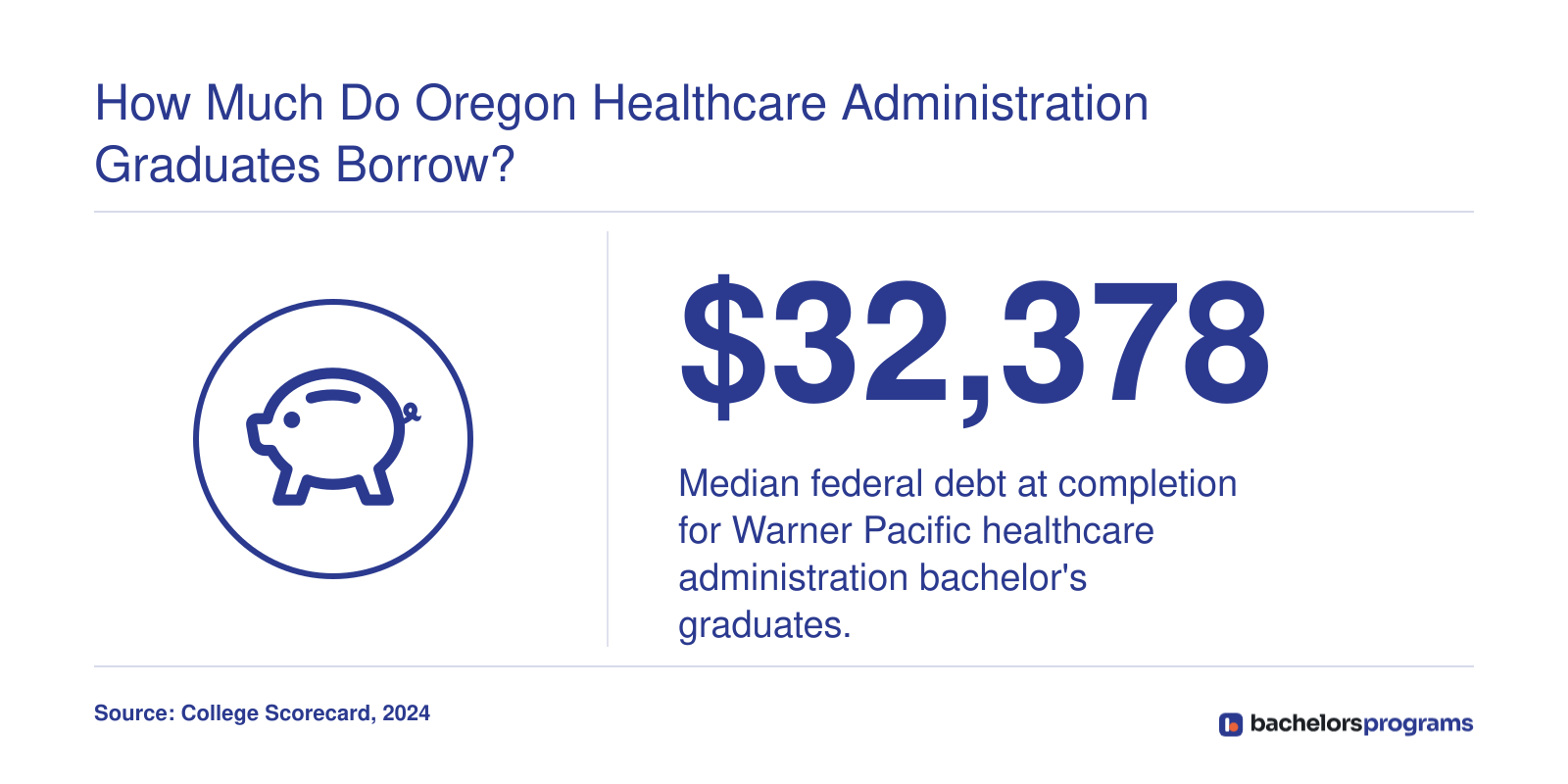
Warner Pacific University reports a median federal debt of $32,378 for graduates of its healthcare administration bachelor's program. The same figure covers its Portland campus program and its Professional and Graduate Studies degree for working adults. Across all Warner Pacific graduates, the university-wide median is lower, at $25,000. Program-level debt is not reported for the other Oregon schools ranked here, so compare their net price and aid packages directly. Debt is only half the value picture: weigh this balance against the early-career earnings in the cost and salary sections, since a manageable loan depends on what the degree pays in the first few years after graduation.
Median Pay for Medical and Health Services Managers in Oregon
Nationally, medical and health services managers earned a median of $123,860 in May 2025. BLS projects 24% job growth from 2025 to 2035, with about 62,300 openings a year.
Healthcare Administration Careers and Employers in Oregon
A bachelor's degree in healthcare administration typically leads to coordinating and supervising roles rather than executive posts. Executive paths generally require years of experience, and many people pursue further study along the way.
Entry and Mid-Level Job Paths
Common first roles for graduates of the programs here include:
- Practice management: Running the daily operations, scheduling, billing and staffing of a clinic or physician group.
- Department coordination: Supporting a hospital unit's budget, supplies, compliance paperwork and staff schedules.
- Long-term care: Assistant roles in nursing facilities and assisted living, where the work can build toward licensure as a nursing home administrator.
- Quality, compliance and health information: Analyst or specialist jobs that track patient outcomes and regulatory requirements.
With experience, these roles move toward division manager, operations manager or administrator titles. Oregon State's BioHealth Sciences graduates, for example, list healthcare division manager, regulatory compliance specialist and healthcare administrator among their outcomes.3
Who Hires in Oregon
The state's largest health systems are the main employers: Providence, Legacy Health and Kaiser Permanente. They also work together through the Oregon Medical Coordination Center1 and Health Share of Oregon, the Portland-area Medicaid collaboration founded in 2012.2 Oregon State's BioHealth Sciences page names all three as graduate employers.3 Public sources do not describe a formal management-trainee ladder or hiring pipeline at any of them for graduates of the programs on this list, so treat these systems as places to apply, not guaranteed destinations.
What Moves Pay
- Setting: Hospitals, physician groups, insurers and long-term care facilities pay differently.
- Organization size: Larger systems tend to have more management layers and higher ceilings.
- Region: Portland metro roles usually pay more than rural ones, though rural employers may offer broader responsibility earlier.
- Experience: Pay rises as you take on budgets and staff.
The graduate earnings figures shown here are measured within a short window after completion, so they reflect early-career pay. Occupational wages for medical and health services managers cover all experience levels and run higher. The two figures measure different things, so do not compare them directly.
Oregon Nursing Home Administrator Licensure at a Glance
Compare Healthcare Administration programs on the data that matters
Explore more Business & Management majors or browse every field of study.
All Business & Management programs Browse every field of study