Best Criminal Justice Schools in Oregon
Compare 6 accredited Criminal Justice programs in Oregon, with net price after aid, graduation rates, earnings and debt from IPEDS and the U.S. College Scorecard.
A bachelor's degree in criminal justice is the usual route into Oregon policing, corrections, courts and legal support, and the standard award is the Bachelor of Science (B.S.) in Criminal Justice. DPSST certification still governs who carries a badge; the degree shapes who gets promoted, who moves into detective or analyst work, and who clears federal hiring screens.
Cost is where the decision turns: Southern Oregon University reports median earnings of $40,553 one year after completion, while net price, graduation rate and program earnings still spread widely across the Oregon-based schools ranked here, on campus and online.
Key Points
- Portland State University offers a fully online 180-credit criminal justice major.
- Median debt spans $20,500 at Southern Oregon to $22,630 at PSU.
- Southern Oregon graduates earn a median $40,553 one year after finishing.
Best Criminal Justice Schools in Oregon: Our Ranked List
The strongest bachelor's degree in criminal justice in Oregon, on the measures we track, is at Portland State University. PSU combines a 180-credit Criminology and Criminal Justice major with a fully online pathway, guaranteed seats for online students, and optional internships of 80 to 200 hours. Its program-level median earnings four years after finishing land in the same range as the other Oregon programs on this list.
Portland State University
#1Portland, OR · ~$10,000/yr (est.)
Best for: Portland-based students seeking internship placements
Portland State University sits in downtown Portland, close to the courts, agencies and advocacy organizations where its criminology students build experience. The major leads to a Bachelor of Arts, Bachelor of Science or Bachelor of Applied Science in Criminology and Criminal Justice, and the department runs both an on-campus version and a fully online one built on five-week courses. Optional internships of 80 to 200 hours and a summer study abroad course in Denmark, Sweden and the Netherlands take students beyond the classroom, and graduates move into law enforcement, corrections, victim advocacy and policy work.
- 180 total credits for the BA, BS or BAS
- Fully online pathway with five-week courses
- Asynchronous online classes, no set login times
- Guaranteed seats for every online student
- Optional internships of 80 to 200 hours
- Study abroad in Denmark, Sweden and the Netherlands
- Median earnings of $58,109 four years after finishing
- Median debt at graduation around $22,630
Western Oregon University
#2Monmouth, OR · ~$17,000/yr (est.)
Best for: Future officers wanting a concentration track
Western Oregon University in Monmouth runs one of the state's established criminal justice majors and one of the few Oregon Bachelor of Applied Science routes in the field. Students either pick 20 upper-division elective credits or choose a named concentration, with options running from Juvenile Justice and Homeland Security to Forensic Anthropology, Law Enforcement and Corrections. A senior capstone seminar and a practicum are built into the degree, and the department points graduates toward the Oregon Department of Justice, the Department of Corrections and local agencies.
- Bachelor of Science and Bachelor of Applied Science tracks
- Five concentrations, including Juvenile Justice and Forensic Anthropology
- 4-credit Senior Capstone Seminar required
- 4 to 8 credit practicum
- Cybercrime Investigations electives count toward the major
- Median earnings of $60,363 four years after finishing
- Median debt at graduation around $21,500
Warner Pacific University
#3Portland, OR · $25,000 – $30,000/yr (est.)
Best for: Working adults with prior college credit
Warner Pacific University is a small private Christian college in Portland whose criminal justice major is built for students who want a fully online bachelor's degree in criminal justice without a campus commute. The 120-credit program runs in five-week courses with monthly start dates and fully asynchronous coursework, plus a required practicum taught by instructors working in the field. Admission assumes students arrive with 48 to 60 prior semester credits and at least two years of full-time work experience.
- 120 semester credits across 15 courses
- 36 credits in the major plus a required practicum
- Five-week courses with monthly start dates
- Fully asynchronous online coursework
- Admission requires 48 to 60 prior semester credits
- 2.0 GPA and two years of full-time work experience needed
- TOEFL 70 or IELTS 6 for nonnative English speakers
Corban University
#4Salem, OR · ~$28,000/yr (est.)
Corban University is a private Christian university in Salem that offers criminal justice as both a Bachelor of Arts and a Bachelor of Science, plus a criminal justice minor for students majoring in another field. The program is campus-based, and students confirm the major requirements and any concentration with an academic advisor before registering. It fits students who want a smaller, faith-based campus in the Willamette Valley with a direct route into justice and social service work.
- Offered as either a Bachelor of Arts or Bachelor of Science
- Criminal Justice minor also available
- Major requirements confirmed with an academic advisor
Southern Oregon University
#5Ashland, OR · ~$17,000/yr (est.)
Southern Oregon University in Ashland structures its criminal justice major around a 71-credit core in law, policing, theory and corrections, and students can take it as a Bachelor of Arts or a Bachelor of Science. Every student designs a capstone research project with the class professor, and the internship is completed as a separate class that can tie into that capstone. An online option exists, no minor is required, and credit for prior learning is accepted for students arriving with coursework behind them.
- 71-credit core covering law, policing, theory and corrections
- Bachelor of Arts or Bachelor of Science
- Capstone research project designed with the professor
- Online degree option available
- Internship taken as a separate class
- No minor required, and credit for prior learning accepted
- Median earnings of $59,008 four years after finishing
- Median debt at graduation around $20,500
Warner Pacific University Professional and Graduate Studies
#6Portland, OR · $10,000 – $15,000/yr (est.)
The Professional and Graduate Studies division is the adult-completion arm of Warner Pacific University in Portland, and its online Bachelor of Science in Criminal Justice targets working adults who already hold some college credit. Students take 15 courses totaling 45 semester credits, 36 of them in the major, covering criminology, the American legal system, criminal justice administration, ethics and restorative justice, plus a practicum. Courses run five weeks with monthly start dates, and everything is asynchronous so students can keep working full time.
- Designed for working adults with some college credit
- 15 courses totaling 45 semester credits
- 36 credits in the major, including a practicum
- Five-week courses with monthly rolling start dates
- Covers criminology, the legal system, ethics and restorative justice
- 120 semester credits required to graduate
Cost & outcomes by school
Federal data for the highest-earning Criminal Justice programs, independent of the ranking above. Earnings are this field's bachelor's graduates four years after completing where the Scorecard reports them, else the school's undergraduate median.
| School | Net price / yr | Grad rate | Earnings | Debt | Grads/yr | Format |
|---|---|---|---|---|---|---|
| Western Oregon University OR | $17,237 | 47% | $60,363 | $21,500 | 53 | Hybrid |
| Southern Oregon University OR | $16,732 | 43% | $59,008 | $20,500 | 32 | Online |
| Portland State University OR | $9,552 | 53% | $58,109 | $22,630 | 111 | Online or campus |
| Warner Pacific University OR | $25,629 | 49% | $55,204 | $25,000 | 4 | Online |
| Warner Pacific University Professional and Graduate Studies OR | — | — | $55,204 | $25,000 | — | Online |
| Corban University OR | $28,035 | 61% | $48,917 | $22,625 | 10 | Campus |
Sources: U.S. Department of Education. Net price, graduation rate, earnings and debt: College Scorecard (earnings and debt for this field's bachelor's graduates where reported, else school-wide); graduates: IPEDS. A dash means no figure is reported.
Cost, debt & payoff
Median earnings of this field's bachelor's graduates (4 yrs after completing, else the school's undergraduate median) vs. their median federal loan debt · U.S. College Scorecard
Across these programs the median graduate earns about $56,657 and finishes with roughly $22,628 in debt — a ratio that clears a common rule of thumb (keep debt below first-year salary). Net price and debt vary widely school to school, so check the per-school figures in the table above before you shortlist.
How We Ranked Oregon Bachelor's Programs in Criminal Justice
Every Oregon bachelor's program in criminal justice comes down to one practical question: what does a student actually get for the money and the years invested? We answer it with published outcomes rather than brochure language, and each measure comes with a note on what it does and does not tell you.
What We Compare
- Net price after aid: the average amount families pay after grants and scholarships, not the published sticker price.
- Graduation rate: how often students who enroll at the institution finish a credential.
- Earnings and debt: median earnings for graduates and typical debt at completion.
- Completions: how many students actually finish the program, a number that separates a substantial department from one that exists mainly on paper.
- Delivery format: whether the degree runs on campus, fully online, or as a hybrid.
A Caveat About Institutional Numbers
Graduation rate, net price, and the school-wide earnings and debt figures describe the whole institution, not criminal justice majors alone. Federal data does not break those measures out by major at most Oregon schools, so we treat them as context: a signal of how the institution performs overall. Format, admission requirements, and credit policy, in contrast, come straight from the criminal justice program itself.
Which Schools Are Included
Only Oregon-based schools that award a bachelor's degree in criminal justice are ranked, including online programs offered by those same schools. Figures come from federal College Scorecard and IPEDS data, which report actual filed values rather than projections.
No single number captures fit. Use the list as a first filter, then weigh cost, format, and admissions against your own circumstances.
Online and Hybrid Bachelor's Degree Options at Oregon Schools
A campus seat in Portland or Monmouth and a login screen opened between patrol shifts lead to the same bachelor's degree in criminal justice, but they demand very different schedules. Oregon schools offer both, and a few offer a blend.
Which Oregon Schools Teach Online
- Fully online: Warner Pacific University delivers its Bachelor of Science in Criminal Justice 100% online and fully asynchronous, in five-week courses with rolling monthly starts; students log in at least five of seven days each week. Warner Pacific's Professional and Graduate Studies unit runs the same degree on the same five-week, rolling-start structure. Southern Oregon University lists a fully online option for its Criminal Justice BA/BS.
- Both formats: Portland State University offers Criminology and Criminal Justice as a BA, BS or BAS with a fully online pathway alongside its campus pathway, including asynchronous courses and guaranteed seats for online students.
- Hybrid: Western Oregon University's Criminal Justice B.S./B.A.S. mixes in-person and online coursework.
- Campus: Corban University in Salem teaches its Criminal Justice BA/BS on campus.
How the Formats Differ in Practice
Asynchronous online study suits shift workers best because no class meets at a fixed hour, but the pacing burden falls on you, and five-week terms move fast. Hybrid and campus study trade that flexibility for face time with faculty who have worked in the field and for easier access to Oregon agency contacts. Field experience does not disappear online: Warner Pacific requires a practicum to graduate, Southern Oregon treats the internship as a separate course, and Portland State offers optional 80 to 200 hour internships. Expect to arrange placements near where you live.
Accreditation and Tuition Notes
Warner Pacific is accredited by the Northwest Commission on Colleges and Universities, first accredited in 1961, with its most recent evaluation in spring 2026 and the next scheduled for spring 2027; NWCCU currently lists a public Warning sanction while noting the university was substantially compliant at that evaluation.1 Ask each school directly whether online students pay the same per-credit rate as campus students, since published materials do not settle that question.
Admissions Requirements for a Bachelor's Degree in Criminal Justice in Oregon
What GPA do you actually need to get into a bachelor's degree in criminal justice in Oregon? At Portland State University, the published answer depends on how many college credits you already hold; the other schools on this list set their own bars, which you should confirm directly with their admissions offices.
What each school publishes
- Portland State University: Transfer applicants with at least 30 transferable quarter credits (20 semester) need a 2.25 GPA; the minimum drops to 2.00 for applicants presenting a transferable associate degree or the Oregon Transfer Module, and applicants below the line may still receive holistic review. College-level writing (WR121 or equivalent) with a C- or better is required. Transfer applicants do not need SAT or ACT scores, and first-year applicants may submit them optionally, with published review benchmarks around a 1120 SAT or 22 ACT. Fewer than 30 transferable quarter credits means you are reviewed as a first-year applicant.
- Western Oregon University, Southern Oregon University, Corban University, Warner Pacific University, and Warner Pacific University Professional and Graduate Studies: Verified 2026 minimum GPA, test and transfer-credit figures could not be found, so treat any number you see elsewhere with caution and request the current policy from each admissions office before you apply.
Transferring a community college associate degree
Yes, in most cases you can bring an Oregon community college associate degree into a university criminal justice major, but how much of it counts toward the major varies. An AAOT or similar transfer-oriented associate degree, along with the Oregon Transfer Module, is built to satisfy lower-division general education and is the cleanest route. An AS transfers well when its coursework aligns with the receiving school's requirements. An AAS is career-technical by design, and portions of it often count as electives rather than major credit.
Portland State accepts college-level credit from regionally accredited institutions with a passing grade, allows up to 20 credits to substitute for major requirements, and requires a C or higher in any course applied to the major. Its criminology and criminal justice department reports articulation agreements with Oregon community colleges, under which approved courses substitute automatically for specified major courses. Individual applicability is still evaluated case by case.
One tip before you register for electives
Pull the receiving university's transfer guide during your first community college term, not your last. Choosing electives that already map to named major courses can save you a full term of repeated coursework.
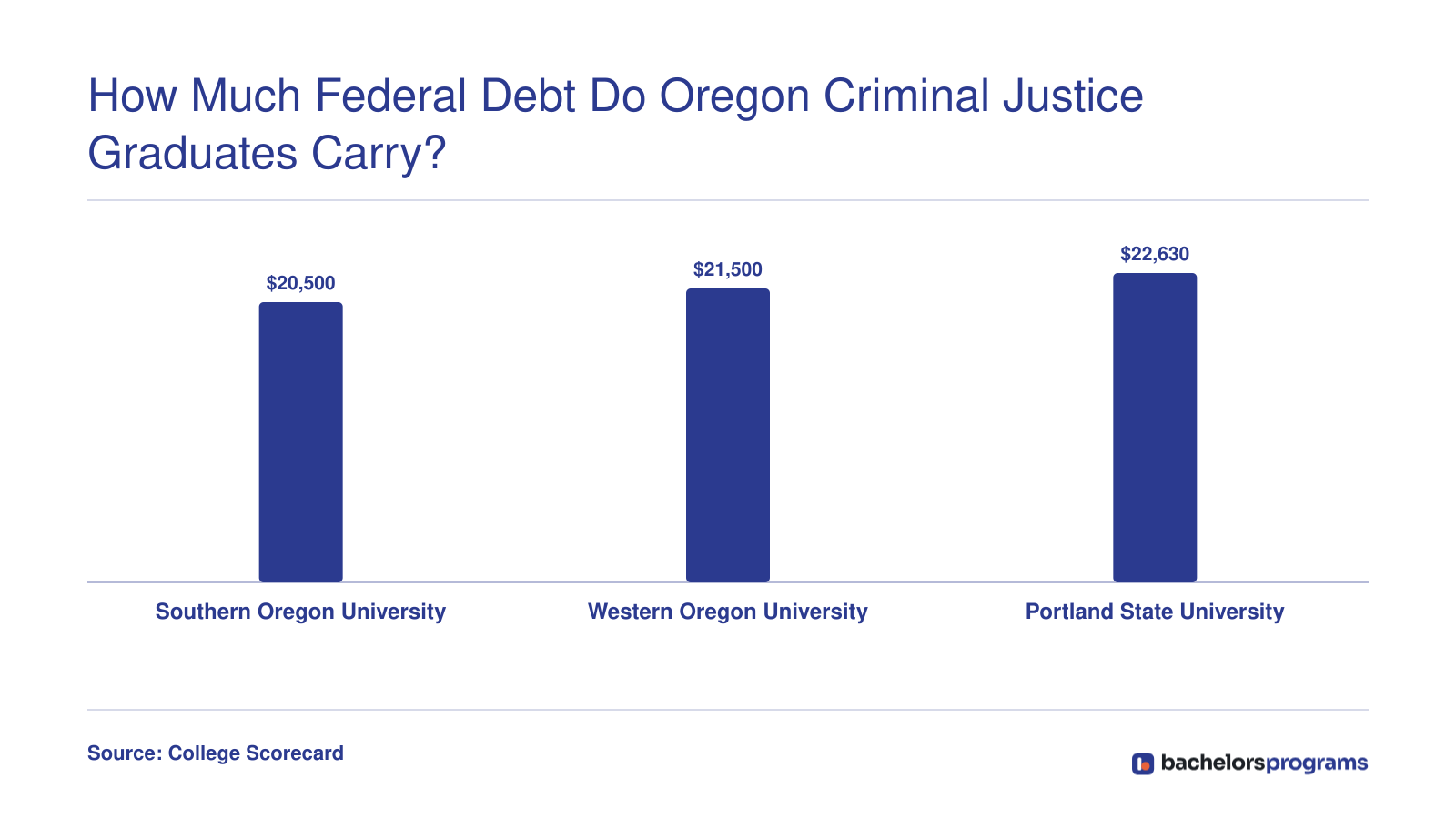
How Much Federal Debt Do Oregon Criminal Justice Graduates Carry?
Median federal loan debt for criminal justice bachelor's completers runs from $20,500 at Southern Oregon University to $22,630 at Portland State University, a gap of about $2,100. Southern Oregon pairs the lowest debt with median earnings of $40,553 one year after graduation, while Portland State's slightly higher debt comes with the strongest first-year earnings here, $45,401. These figures describe students who finished each program, and schools without a published program-level debt figure, including Corban University and Warner Pacific University, are not charted.
Related Articles
What Oregon Criminal Justice Graduates Earn After Finishing
Portland State University posts the strongest early earnings figure among the Oregon programs with federal outcomes data.
Questions to Ask Yourself
Do you want to become a sworn officer or work in probation, courts or victim services?
Will you start at an Oregon community college and transfer, or enroll straight into a four-year program?
Do you need an online or hybrid schedule around shift work, or can you attend in person?
Have you compared what each school will actually cost you after aid?
Compare Criminal Justice programs on the data that matters
Explore more Criminal Justice & Law majors or browse every field of study.
All Criminal Justice & Law programs Browse every field of study