Best Communications Degree Programs in Minnesota
Compare 27 accredited Communications programs in Minnesota at 22 colleges, with net price after aid, graduation rates, earnings and debt from IPEDS and the U.S. College Scorecard.

Value is the question that matters most when you compare Minnesota schools for a communications bachelor's degree. The common credential is the Bachelor of Arts (B.A.) in Communications, but sticker prices swing widely between public universities and private colleges, and graduate earnings do not track tuition neatly.
Every school here is ranked and offers a bachelor's program, on campus or online. The ranked top 10 comes first, followed by the cheapest and highest-earning schools, then online options, admissions, cost, and Minnesota careers.
Most communications hiring in the state clusters in the Twin Cities, so location matters as much as the school's name.
Key Points
- University of Minnesota-Crookston has the lowest average net price here.
- University of St Thomas posts the highest program-level median earnings ranked.
- North Star Promise and Minnesota State Grant depend on income, residency.
Best Bachelor's Degree in Communications Programs in Minnesota, Ranked
Ten bachelor's programs in communications anchor this list, from the University of Minnesota's Twin Cities flagship to private colleges in Saint Peter, Collegeville, and Duluth. Each entry pairs the structure of the degree, its credits and concentrations, with what the school does well for undergraduates: research access, internships, or small classes. Tuition, net price, and aid options are covered in the cost sections below.
University of Minnesota-Twin Cities
#1Minneapolis, MN · ~$17,000/yr (est.)
Best for: Research-minded students in the Twin Cities
The flagship campus of the University of Minnesota system, set in Minneapolis and offering the widest course catalog in the state. Communication Studies majors can build double or triple majors, join faculty research projects, and draw on Twin Cities newsrooms, agencies, and corporate communication teams for internships. It posts the highest graduation rate of any program on this list.
- B.A. in Communication Studies with room for double and triple majors
- Coursework in persuasive speaking, critical thinking, and clear writing
- Focus on ethical, theory-informed message creation
- Analyzes messages across media and multicultural contexts
- Undergraduate research with faculty in the department
- Scholarships and awards for communication majors
- Prepares students for journalism, PR, marketing, and HR
Gustavus Adolphus College
#2Saint Peter, MN · $20,000 – $25,000/yr (est.)
Best for: Small-college students wanting liberal arts breadth
A private liberal arts college in Saint Peter, about an hour southwest of the Twin Cities, with small classes and a broad general education core. Communication Studies sits inside a classic liberal arts model, so students pair the major with other disciplines and can count internships, study away, and community-based learning toward the degree. Faculty require a C- or better in every course counted toward the major.
- B.A. requiring at least 40 credits, including prerequisites and cognates
- C- or higher required in every course counted toward the major
- Examines social, political, and cultural functions of communication
- Covers interpersonal, public, mediated, and global settings
- Fieldwork, independent study, and community-based learning options
- Internships and international study can count toward the major
University of Minnesota-Duluth
#3Duluth, MN · $15,000 – $20,000/yr (est.)
Best for: Duluth-area students seeking agency internships
A public campus in Duluth, part of the University of Minnesota system, with a mid-size department and a strong hands-on research culture. Communication majors mix interpersonal, mass media, and rhetoric coursework with faculty-led research teams and internships at employers such as 3M, Boston Scientific, and Walt Disney World. The department also runs a Communication Club and an active alumni network to help students build portfolios.
- B.A. covering interpersonal communication, mass media, and rhetoric
- Theory and research balanced with hands-on practice
- Faculty-led research teams open to undergraduates
- Internships with 3M, Boston Scientific, and Walt Disney World
- Communication Club for portfolio building
- Alumni network active on LinkedIn and Facebook
- Graduates work as communication directors and social media strategists
University of St Thomas
#4Saint Paul, MN · ~$29,000/yr (est.)
A private Catholic university in Saint Paul and the largest private institution in Minnesota. Communication Studies majors complete 36 credits and a capstone, then often pair the degree with business or a second field, and interns have worked with organizations such as the Minnesota Vikings. The department supports a radio station, an honor society, and an undergraduate research conference.
- 36-credit major, easy to pair with a second major or minor
- Capstone course required for graduation
- Core topics include public speaking, persuasion, and communication ethics
- Internships with organizations such as the Minnesota Vikings
- Beta Chi communication honor society
- Student media including The Crest and KUST Radio
- Study abroad and an undergraduate research conference
College of Saint Benedict
#5Saint Joseph, MN · $27,000/yr (est. net price)
A private women's college in Saint Joseph that shares courses, dining, and activities with Saint John's University across the road. Strategic Communication Studies offers two concentrations, public relations, advertising and marketing or public advocacy and leadership, and students choose a self-designed path, one concentration, or both. The college participates in Minnesota's Direct Admissions program for eligible high school students.
- Two concentration options: PR, Advertising and Marketing, or Public Advocacy and Leadership
- Three paths: own design, one concentration, or both concentrations
- Adding a second concentration requires 8 more communication credits
- Coursework in visuals, speech, text, and graphics
- Built around strategic thinking for business-world roles
- Shared curriculum and campus life with Saint John's University
Saint Johns University
#6Collegeville, MN · ~$26,000/yr (est.)
A private men's university in Collegeville that partners with the College of Saint Benedict and shares the same Strategic Communication Studies curriculum. Students can design their own path or add one or both concentrations, with the second concentration requiring 8 additional communication credits. The campus also takes part in Direct Admissions Minnesota for eligible students from participating high schools.
- Same Strategic Communication Studies curriculum as Saint Benedict
- Concentrations in PR/Advertising/Marketing or Public Advocacy and Leadership
- Students may design their own path through the major
- Completing both concentrations adds 8 communication credits
- Emphasis on strategic thinking in an information-heavy landscape
- Shared courses and resources with the College of Saint Benedict
Bethel University
#7Saint Paul, MN · $29,000/yr (est. net price)
A private Christian university in Saint Paul with a structured, credit-heavy Communication Studies major. The 122-credit B.A. pairs a 24-credit communication core with an emphasis in health communication or relational studies, plus an internship and a capstone. Students cannot add the communication studies minor alongside the major.
- 122 total credits, anchored by a 24-credit communication core
- Tracks: Health Communication (23-26 credits) and Relational Studies (24 credits)
- Core includes research methods, media criticism, and communication theory
- Internship and seminar required before the capstone
- Capstone focuses on relational communication
- Communication Studies minor cannot be added with the major
The College of Saint Scholastica
#8Duluth, MN · $28,000/yr (est. net price)
A private Benedictine college in Duluth with small communication classes and a media production bent. Communication and Media Studies blends intercultural communication, media literacy, film studies, and multimedia production, and internships run through radio stations, TV networks, advertising agencies, and sports organizations. Students can add a Film Studies concentration or pair the major with a language such as ASL, German, Ojibwe, or Spanish.
- Interdisciplinary B.A. blending theory with hands-on practice
- Coursework in intercultural communication and media literacy
- Film Studies concentration available
- Multimedia production and film studies coursework
- Internships at radio stations, TV networks, and ad agencies
- Pair the major with ASL, German, Ojibwe, or Spanish
- First-year applicants considered for the Benedictine Scholarship
University of Northwestern-St Paul
#9Saint Paul, MN · ~$28,000/yr (est.)
A private Christian university in Roseville, sitting between Minneapolis and Saint Paul and close to both business districts. Students earn either a B.A. or B.S. in Communication Studies across 125 credits, with coursework in business communication, communication theory, and organizational communication. Internships with Northwestern Media and nearby Twin Cities employers give students portfolio work before graduation.
- B.A. or B.S. option in Communication Studies
- 125-credit program built on a communication core
- Courses include Business Communication and Organizational Communication
- Communication Theory and ethics integrated into coursework
- Internships with Northwestern Media
- Communication Studies minor available
- Campus between the Minneapolis and Saint Paul business districts
Minnesota State University-Mankato
#10Mankato, MN · $10,000 – $19,000/yr (est.)
A public Minnesota State university in Mankato with the largest communication graduating class among these programs and the lowest in-state tuition. The Communication and Media B.S. requires 120 credits and a minor in any subject, and it runs as a fully online degree-completion track for students who already hold an associate degree or the Minnesota Transfer Curriculum. The statewide Communication Studies Transfer Pathway feeds directly into the program.
- 120 credits total, with 36 credits in the major
- 2-credit foundation seminar on research and career paths
- 4-credit advanced seminar built around a faculty-led group project
- 2-credit senior capstone on networking and interviewing
- 28 credits of restricted communication electives
- Minor in any subject required
- Fully online degree-completion track for transfer students
- Internships require 45 on-site hours per credit earned
Cost & outcomes by school
Federal data for the highest-earning Communications programs, independent of the ranking above. Earnings are this field's bachelor's graduates four years after completing where the Scorecard reports them, else the school's undergraduate median.
| School | Net price / yr | Grad rate | Earnings | Debt | Grads/yr | Format |
|---|---|---|---|---|---|---|
| Saint Johns University MN | $25,672 | 75% | $76,786 | $26,899 | 11 | Campus |
| Gustavus Adolphus College MN | $22,900 | 77% | $69,423 | $27,000 | 26 | Campus |
| University of Minnesota-Twin Cities MN | $16,778 | 85% | $69,020 | $19,500 | 18 | Campus |
| The College of Saint Scholastica MN | $27,846 | 71% | $65,934 | $20,000 | 7 | Campus |
| University of St Thomas MN | $29,155 | 76% | $64,917 | $26,125 | 19 | Campus |
| College of Saint Benedict MN | $26,640 | 77% | $64,430 | $27,000 | 19 | Campus |
| Augsburg University MN | $23,873 | 52% | $63,850 | $25,000 | 13 | Campus |
| Metropolitan State University MN | $16,863 | 44% | $61,355 | $20,364 | 28 | Campus |
| University of Minnesota-Duluth MN | $18,743 | 65% | $60,023 | $21,852 | 47 | Campus |
| Concordia University-Saint Paul MN | $18,462 | 46% | $59,871 | $17,832 | 2 | Campus |
| Hamline University MN | $20,744 | 61% | $59,557 | $24,672 | 23 | Campus |
| Saint Cloud State University MN | $13,529 | 40% | $56,388 | $23,250 | 31 | Campus |
Sources: U.S. Department of Education. Net price, graduation rate, earnings and debt: College Scorecard (earnings and debt for this field's bachelor's graduates where reported, else school-wide); graduates: IPEDS. A dash means no figure is reported.
Cost, debt & payoff
Median earnings of this field's bachelor's graduates (4 yrs after completing, else the school's undergraduate median) vs. their median federal loan debt · U.S. College Scorecard
Across these programs the median graduate earns about $59,557 and finishes with roughly $23,200 in debt — a ratio that clears a common rule of thumb (keep debt below first-year salary). Net price and debt vary widely school to school, so check the per-school figures in the table above before you shortlist.
Most Affordable Communications Bachelor's Programs in Minnesota
These public universities in Minnesota have the lowest average net price for a bachelor's degree in communications, based on IPEDS and College Scorecard data from the U.S. Department of Education (2024). University of Minnesota-Crookston has the lowest net price at $12,212 per year, while Metropolitan State University has the lowest in-state sticker price at $9,840. University of Minnesota-Twin Cities, which also appears in our main ranking, costs more than the others but has a far higher graduation rate (85.3%).
| School | City | Program | Format | In-State Tuition and Fees | Average Net Price | Graduation Rate |
|---|---|---|---|---|---|---|
| University of Minnesota-Crookston | Crookston | Communication | Online | $13,288 | $12,212 | 49.8% |
| Saint Cloud State University | Saint Cloud | Communication Studies | Campus or online | $10,245 | $13,529 | 40.3% |
| Bemidji State University | Bemidji | Communication Studies | Campus | $10,237 | $15,261 | 47.9% |
| University of Minnesota-Twin Cities | Minneapolis | Communication Studies | Campus | $17,214 | $16,778 | 85.3% |
| Metropolitan State University | Saint Paul | Communication Specialist Track, Professional Communication BA | Campus | $9,840 | $16,863 | 43.6% |
What Top Program Graduates Earn
University of St Thomas posts the highest program-level median earnings among the communications bachelor's programs ranked here.
Online and Hybrid Bachelor's in Communications at Minnesota Schools
Can you earn a bachelor's degree in communications fully online from a Minnesota school? Yes. Two public universities offer a 100% online path, but they serve different students: one suits students starting fresh, the other students finishing a degree they already began.
Fully Online Options
- University of Minnesota Crookston: The Bachelor of Science in Communication is delivered 100% online and asynchronously, with no required campus visits. You complete coursework on your own schedule within course deadlines. Crookston presents it as a standard bachelor's program, not a degree-completion track.
- Minnesota State University-Mankato: The Bachelor of Science in Communication and Media can be completed 100% online. The program requires 120 total credits, including 36 major credits, a required minor and a capstone covering interviewing and networking.
Hybrid Delivery and Entry Paths
Mankato is the ranked school whose communication program is listed as hybrid. You can take it on campus, fully online or as a mix of the two. The other schools ranked here are campus-based programs.
The entry path matters more than the format. Mankato's online version is a degree-completion program. It is designed for students who already hold an associate degree or have finished the Minnesota Transfer Curriculum, and it has transfer pathways with Minnesota community colleges. If you are a first-time student with no college credits, Crookston's online program is the one built as a full four-year bachelor's.
Online Tuition Compared With Campus Rates
Crookston publishes an online rate of $483.70 per credit, before fees. Mankato lists in-state tuition and fees of $9,572 a year for its campus program. Its online per-credit rate should be confirmed directly with the university's tuition office. Ask both schools which fees apply to online students, because technology and course fees can change the final bill.
Are Online Programs Accredited?
Both degrees come from public universities, and the online credential is awarded by the same institution that runs the campus programs. Confirm institutional accreditation on each school's website before you enroll. That status determines whether you can use federal financial aid and whether your credits transfer.
Related Articles
Admission Requirements for a Bachelor's Degree in Communications in Minnesota
Public universities and private colleges in Minnesota differ less in selectivity than many applicants expect. The most selective school here is a private college, yet most schools on either side admit a clear majority of applicants.
Selectivity: Public vs. Private
Recent admission rates show how open most of these schools are:
- Gustavus Adolphus College: about 61 percent, the most selective school in the ranking
- University of Minnesota-Twin Cities: about 80 percent, the most selective public option
- University of St Thomas: about 85 percent
- Minnesota State University-Mankato and Bethel University: about 88 percent each
- University of Minnesota-Duluth: about 89 percent
- College of Saint Benedict and Saint Johns University: about 92 and 91 percent
- The College of Saint Scholastica and University of Northwestern-St Paul: about 93 percent each
These rates apply to the whole university, not the communications major. Communications programs at these schools generally admit students through the university's standard freshman process rather than a separate application.
GPA and Testing Policies
Minimum GPA expectations and test-optional rules are set at the university level and can change from one admission cycle to the next. Check each school's current admissions page before you decide whether to send ACT or SAT scores. Once you are enrolled, grade standards inside the major also matter. Gustavus, for example, requires a C- or higher in communication major courses.
Tips for Transfer Students
- Look for named pathways: Minnesota State University-Mankato lists transfer pathways with Minnesota community colleges for its Communication and Media (B.S.) program, which also offers a fully online option.
- Complete general education as a package: Minnesota public colleges generally recognize the Minnesota Transfer Curriculum. Finishing it before you transfer can reduce the risk of repeating core courses, but confirm how your target school applies it.
- Compare total credit requirements: Degree totals vary. Minnesota State Mankato's program requires 120 credits, Bethel's requires 122 and Northwestern's requires 125. Before you commit, ask each school for an unofficial transcript evaluation so you can see how many of your credits will count toward the major.
What a Bachelor's in Communications Costs in Minnesota
In Minnesota, the real price of a communications bachelor's degree is sticker tuition minus grant aid, and that gap is wide. Public universities start much lower, while private colleges discount heavily.
Public versus private costs
In-state tuition and fees run $9,572 at Minnesota State University-Mankato, $14,610 at University of Minnesota-Duluth and $17,214 at University of Minnesota-Twin Cities. Net price, what students pay after grants, sometimes including housing and other costs, is $19,139, $18,743 and $16,778 at those three schools.
Private sticker prices look steeper. In our directory, Concordia University-Saint Paul lists $25,600 in tuition and fees, with a net price of $18,462. St Catherine University lists $51,454, with a net price of $19,764. After aid, the private net prices land close to the public ones.
Minnesota State Grant and North Star Promise
The Minnesota State Grant is need-based and has no single fixed maximum. The state builds each award from recognized tuition and fees plus a living allowance set at 106% of the federal poverty guideline, then subtracts the family's expected contribution and Pell eligibility.2 The minimum award is $100.1 Eligibility runs up to 120 grant-eligible credits, generally eight full-time semesters at 15 credits per term, and students who already hold a bachelor's degree are excluded.
North Star Promise works differently. It is a last-dollar scholarship for Minnesota residents with a family adjusted gross income limit of $80,000, and students need only one credit of enrollment to qualify.4 It covers up to 100% of base tuition and mandatory fees left after other gift aid, but not tuition differentials or surcharges. A calculated award under $50 per term is treated as $0. Four-year students get up to eight full-time semesters, though one institutional description cites a 120-credit limit, so confirm with your school. The 2026-27 deadline was June 1, so plan early for the next cycle.3 The add-on NSP+ is set at 0% of Pell for 2026-27, so no such award exists this year.5 The Minnesota Dream Act application counts for both programs.4
Debt after graduation
Median debt among communications bachelor's completers is $22,779 at Minnesota State University-Mankato and $21,852 at University of Minnesota-Duluth, based on federal College Scorecard data for each program's graduates.
The likely real cost
A Minnesota resident at a public campus with a family income under the $80,000 limit may see tuition and fees largely covered once the State Grant and North Star Promise stack. Housing, food and differentials remain, and those drive the debt figures above.
Communications Careers in Minnesota for Bachelor's Graduates
Minnesota DEED's 2018 statewide staffing data counted 5,703 public relations specialists, 3,507 editors, 2,011 public relations and fundraising managers, and 1,348 technical writers working across the state1. Those counts are several years old, so read them as a rough picture of scale rather than a current headcount; still, they show where communications graduates land: marketing and PR roles dominate, with editing and technical writing forming smaller, specialized pockets.
Roles and Pay
Market research analysts and marketing specialists make up the largest group. In the Twin Cities metro, DEED reported roughly 12,230 of these jobs with a median hourly wage of $25.77 and a 90th-percentile wage of $43.62, figures tied to 2018 reporting2. A separate DEED figure puts a Twin Cities annual median at $56,9813, while the national median for the occupation sits near $74,0944. Treat these as reference points, not guarantees; wages move with experience, employer size, and whether you work in the metro or greater Minnesota. Current wage detail by occupation and region is published through DEED's Local Look tool.
Where Graduates Work
The Twin Cities concentration in DEED's data reflects the region's density of corporate headquarters, agencies, health systems, nonprofits, and state and local government offices. Outside the metro, communications graduates more often work in regional healthcare, higher education, tourism, and county or municipal communications offices. Internships matter here: students at Minneapolis and Saint Paul campuses such as the University of Minnesota-Twin Cities, University of St Thomas, and Augsburg University sit inside that employer cluster, while programs at Bemidji State University, Minnesota State University Moorhead, and University of Minnesota-Crookston build regional networks.
Licensure and Credentials
Communications is not a licensed occupation in Minnesota. There is no state board, no exam, and no continuing-education requirement standing between your bachelor's degree and your first job. Voluntary credentials can still help mid-career: the Accredited in Public Relations (APR) credential from the Universal Accreditation Board is the best-known mark in PR, and project management or digital marketing certifications are common additions for communications coordinators moving toward management.
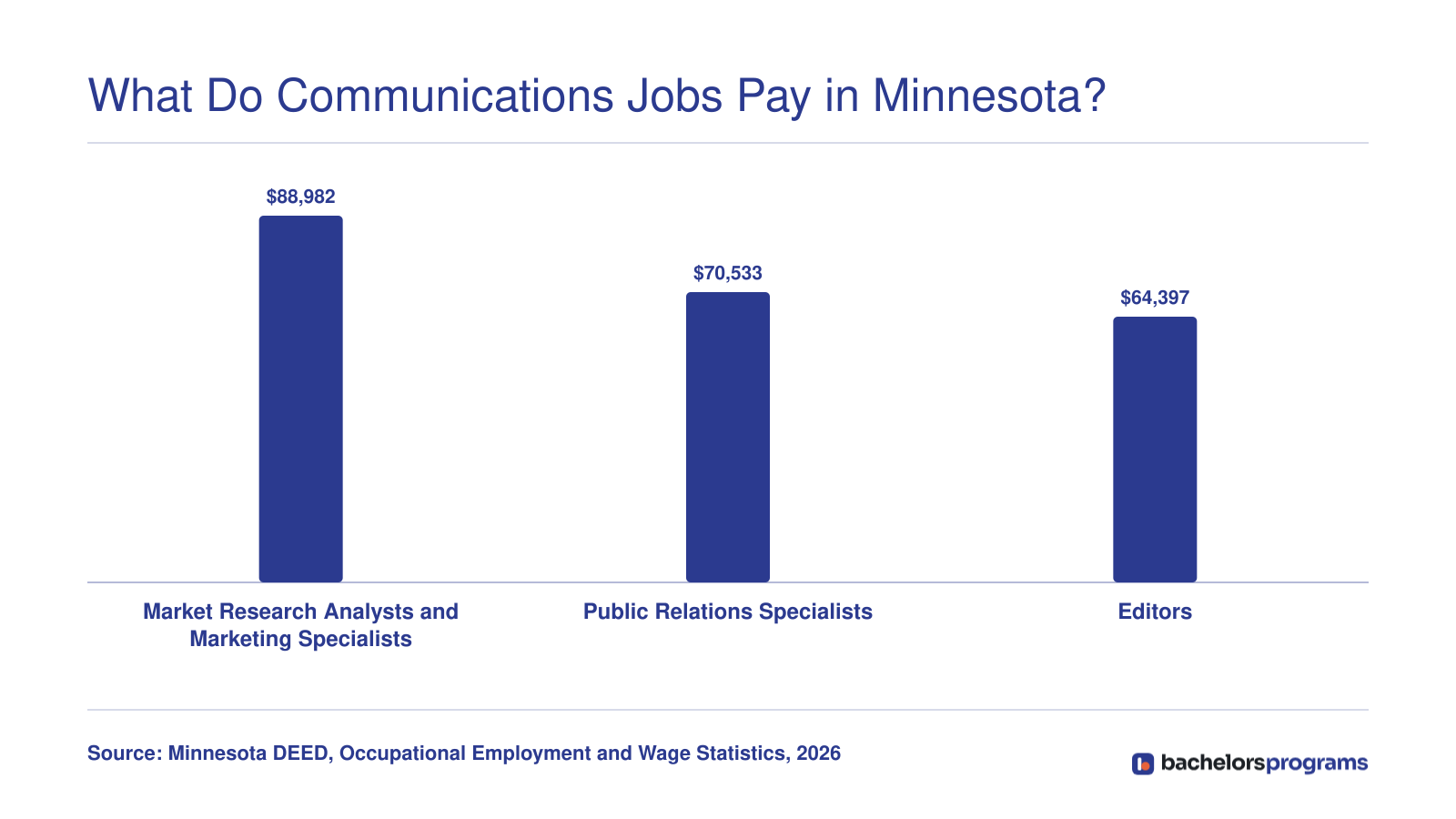
What Do Communications Jobs Pay in Minnesota?
These are Minnesota median wages for everyone working in each occupation, not earnings reported for graduates of the programs ranked on bachelorsprograms.com. Minnesota DEED publishes hourly medians for First Quarter 2026, so the annual figures below are annualized at 2,080 hours per year. Market research analysts and marketing specialists are the largest group, with 21,280 jobs statewide, compared with 8,260 public relations specialists and 1,970 editors.
Compare Communications programs on the data that matters
Explore more Communications & Media majors or browse every field of study.
All Communications & Media programs Browse every field of study