Best Speech Pathology Schools in Michigan
Compare 9 accredited Speech Pathology programs in Michigan, with net price after aid, graduation rates, earnings and debt from IPEDS and the U.S. College Scorecard.
Two routes lead into speech-language pathology: an undergraduate major that feeds directly into graduate study, or a different bachelor's followed by catch-up prerequisites. Most programs award a Bachelor of Science (B.S.), and Michigan's public universities and private colleges all offer the major in some form.
The constraint is the credential ceiling. Licensure as a speech-language pathologist in Michigan requires a master's degree, so the bachelor's is the pre-professional step, not the finish line.
So the choice comes down to three things: which program admits you, which costs less after aid, and which sets you up for graduate admission.
Key Points
- Michigan licenses speech-language pathologists only after they complete a master's degree.
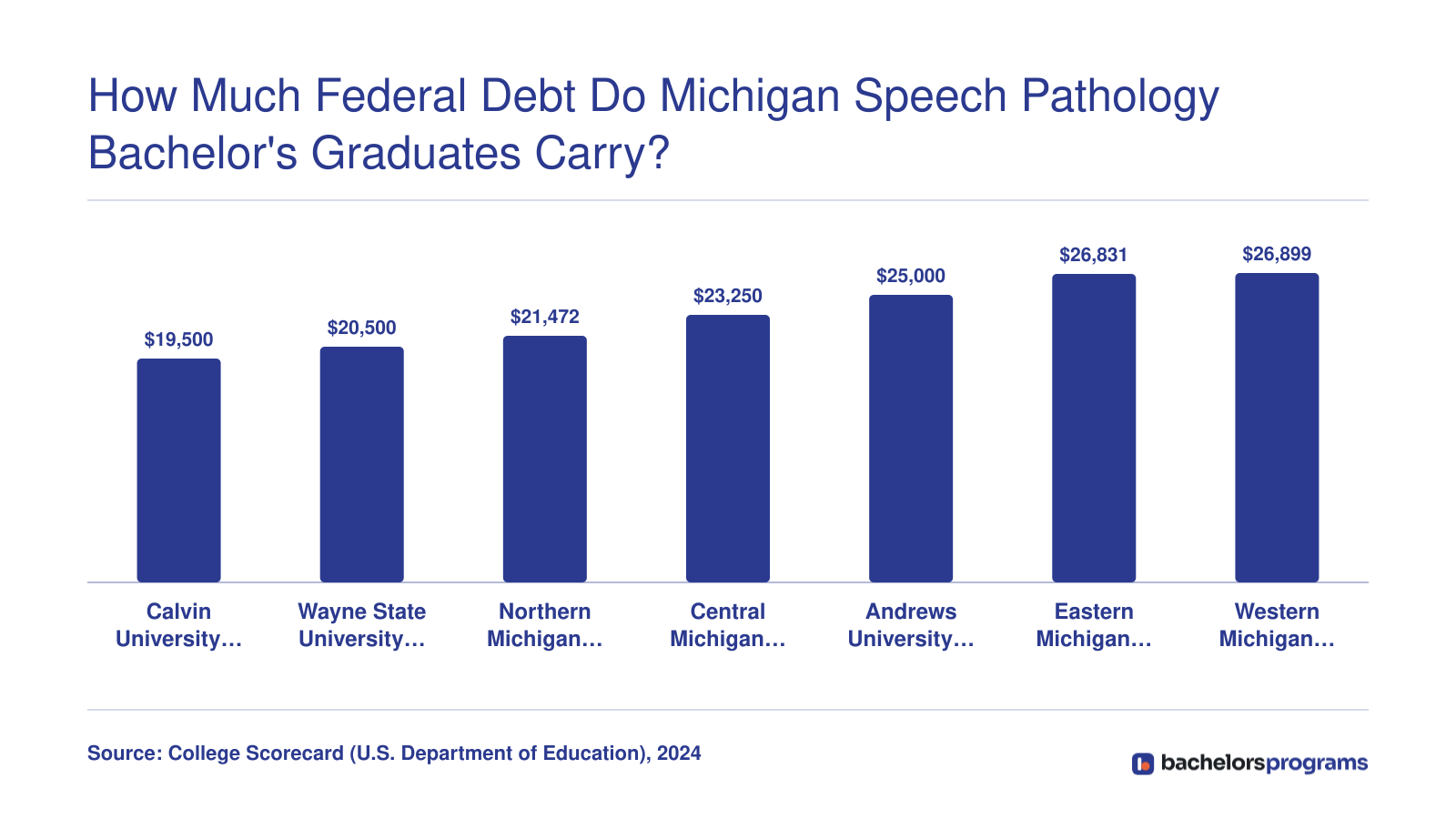
- Median debt runs from $19,500 at Calvin to $26,899 at Western Michigan.
- Central Michigan University requires a 3.00 pre-admission GPA for its major.
Best Bachelor's in Speech Pathology Schools in Michigan
Michigan's undergraduate programs in this field go by several names: Speech Pathology, Speech-Language Pathology, Communication Sciences and Disorders, and Speech, Language and Hearing Sciences. Each label describes the same pre-professional field, and every card below uses the name the school itself uses for the major. All nine are bachelor's degrees that lead to graduate study, since licensure as a speech-language pathologist in Michigan requires a master's degree.
Michigan State University
#1East Lansing, MI · $16,000 – $44,000/yr (est.)
Best for: Students wanting a large research university
Michigan State is the largest public option here, and its Bachelor of Science in communicative sciences and disorders sits in the College of Communication Arts and Sciences. This school's graduation rate is 81%, the highest among the Michigan programs on this list. Students study typical and disordered speech, language, hearing and swallowing, and alumni work in hospitals, nursing homes, K-12 schools, early intervention programs and private clinics.
- Bachelor of Science in communicative sciences and disorders
- Covers speech, language, hearing and swallowing
- Coursework in diagnosis and treatment of communication disorders
- Includes diversity, equity, inclusion and ethical practice
- Housed in the College of Communication Arts and Sciences
- Alumni work in hospitals, nursing homes, schools and early intervention
- Many graduates continue to graduate study in SLP or audiology
Wayne State University
#2Detroit, MI · ~$13,000/yr (est.)
Best for: Detroit-area students seeking clinical exposure
This school's graduation rate is 58%. Undergraduates can join faculty labs working on aphasia, autism and stuttering and observe live therapy sessions at community clinics, an unusually clinical start for a bachelor's program.
- 120 total credit hours
- Blends audiology, phonetics, speech science and clinical methods
- Faculty-led research labs in aphasia, autism and stuttering
- Observe live speech therapy sessions at community clinics
- Meets ASHA coursework requirements for clinical certification
- Scholarships and financial aid available
Calvin University
#3Grand Rapids, MI · $23,000/yr (est. net price)
Best for: Private-college students preparing for grad school
A private university in Grand Rapids, Calvin offers a Bachelor of Arts in speech pathology and audiology built explicitly as preparation for competitive graduate programs. This school's graduation rate is 74%. The department pairs communication sciences coursework with a health sciences emphasis and a service-oriented approach to care, in a smaller campus setting than the state's public options.
- Bachelor of Arts in speech pathology and audiology
- Built as preparation for competitive graduate programs
- Strong academic base in communication sciences
- Coursework grounded in evidence-based, compassionate care
- On-campus program with a holistic health sciences approach
Andrews University
#4Berrien Springs, MI · $10,000 – $15,000/yr (est.)
Andrews, a private university in Berrien Springs, offers the only genuinely dual undergraduate program on this list, combining speech-language pathology and audiology in one Bachelor of Science. This school's graduation rate is 72%. The 124-credit degree builds a science base through human biology, physics, psychology and statistics, then adds preclinical observation and clinical application courses.
- 124 total credit hours across four years
- Dual focus on speech-language pathology and audiology
- Cognates in human biology, physics, psychology and statistics
- Preclinical observation and clinical application courses
- First two years cover general education and prerequisites
- Student chapter of NSSLHA
- Option to add a minor
Grand Valley State University
#5Allendale, MI · $15,000 – $20,000/yr (est.)
Grand Valley State is a public university in Allendale with a 120-credit Bachelor of Science in communication sciences and disorders, taught face to face. This school's graduation rate is 67%. Students apply in the second semester of sophomore year with a 3.0 GPA, then use clinical placements and labs on Grand Rapids' Medical Mile, a practical fit for West Michigan healthcare employers.
- 120 total credit hours
- 3.0 GPA required to apply in sophomore year
- Coursework in audiology, phonetics, fluency and swallowing
- Clinical placements and labs on Grand Rapids Medical Mile
- Meets prerequisites for most graduate programs in the field
- Merit-based scholarships available
- Roughly 25% of students do research with faculty
Western Michigan University
#6Kalamazoo, MI · $15,000 – $20,000/yr (est.)
Western Michigan is a public university in Kalamazoo whose bachelor's degree in speech, language and hearing sciences is a pre-professional step toward audiology and speech-language pathology graduate work. This school's graduation rate is 58%. Students enter as pre-majors and apply separately by February 1, so planning ahead matters more here than at majors that admit everyone at entry.
- Minimum 2.5 cumulative GPA to apply to the major
- February 1 application deadline each year
- Prerequisite grades in writing, biology or anatomy, physics, math and statistics
- Students enter as pre-SLHS majors
- Prepares for graduate study in audiology and speech-language pathology
- Advisor meeting required before applying
- Transfer students should enroll by the first semester of sophomore year
Central Michigan University
#7Mount Pleasant, MI · $18,000/yr (est. net price)
Central Michigan, a public university in Mount Pleasant, offers communication sciences and disorders as a 46-credit major inside either a Bachelor of Applied Arts or a Bachelor of Science. This school's graduation rate is 59%. The on-campus Carls Center for Clinical Care and Education and its summer speech-language clinics give students observation and optional practicum hours without leaving town.
- 46 credit hours in the major
- 3.0 GPA required for admission
- Bachelor of Applied Arts or Bachelor of Science degree options
- Three-semester course sequence after admission
- Clinical observations at the on-campus Carls Center
- Optional practicum and summer speech-language clinics
- Service-learning in dementia care
- ASHA KASA certification coursework available
Northern Michigan University
#8Marquette, MI · $14,000 – $20,000/yr (est.)
This school's graduation rate is 52%. Students move from videotaped and live observation into supervised practicum at the on-campus Speech-Language-Hearing Clinic, with service learning and an NSSLHA chapter alongside.
- Four-year Bachelor of Science program
- Supervised practicum at the on-campus Speech-Language-Hearing Clinic
- Coursework in speech science, fluency and aural rehabilitation
- Videotaped and live observation before practicum
- Student chapter of NSSLHA
- Service learning opportunities
Eastern Michigan University
#9Ypsilanti, MI · $15,000 – $20,000/yr (est.)
Eastern Michigan, a public university in Ypsilanti, takes a different route: a Bachelor of Science that pairs a 35-hour special education major with a 29-hour communication sciences and disorders endorsement, aimed at school-based speech and language work. This school's graduation rate is 46%. It must be paired with a teaching-certification major, so it suits readers heading toward Michigan K-12 endorsement rather than a standalone CSD degree.
- 35-hour major with a 29-hour CSD endorsement
- Must be paired with a teaching-certification major
- Leads toward Michigan endorsement code SB
- Prepares for the MTTC #057 Speech-Language Impairment exam
- C+ required in SPGN 251 and CSD 135L4
- 120 credits and a 2.0 cumulative GPA to graduate
- Offered in person and in a hybrid format
- NSSLHA student chapter
Cost & outcomes by school
Federal data for the highest-earning Speech Pathology programs, independent of the ranking above. Earnings are this field's bachelor's graduates four years after completing where the Scorecard reports them, else the school's undergraduate median.
| School | Net price / yr | Grad rate | Earnings | Debt | Grads/yr | Format |
|---|---|---|---|---|---|---|
| Michigan State University MI | $19,680 | 81% | $67,253 | $23,250 | 49 | Campus |
| Central Michigan University MI | $17,597 | 59% | $62,082 | $23,250 | 47 | Campus |
| Calvin University MI | $22,992 | 74% | $60,986 | $19,500 | 21 | Campus |
| Eastern Michigan University MI | $15,407 | 46% | $60,615 | $26,831 | 22 | Hybrid |
| Andrews University MI | $12,547 | 72% | $58,526 | $25,000 | 19 | Campus |
| Wayne State University MI | $12,766 | 58% | $58,291 | $20,500 | 34 | Campus |
| Western Michigan University MI | $15,273 | 58% | $58,023 | $26,899 | 29 | Campus |
| Northern Michigan University MI | $14,085 | 52% | $57,165 | $21,472 | 14 | Campus |
| Grand Valley State University MI | $16,317 | 67% | $56,118 | $24,500 | 46 | Campus |
Sources: U.S. Department of Education. Net price, graduation rate, earnings and debt: College Scorecard (earnings and debt for this field's bachelor's graduates where reported, else school-wide); graduates: IPEDS. A dash means no figure is reported.
Cost, debt & payoff
Median earnings of this field's bachelor's graduates (4 yrs after completing, else the school's undergraduate median) vs. their median federal loan debt · U.S. College Scorecard
Across these programs the median graduate earns about $58,526 and finishes with roughly $23,250 in debt — a ratio that clears a common rule of thumb (keep debt below first-year salary). Net price and debt vary widely school to school, so check the per-school figures in the table above before you shortlist.
How We Ranked Michigan Speech Pathology Bachelor's Schools
Federal outcome data lets you compare bachelor's programs on cost and results, provided you know what each number measures. The order rests on the measures below.
What We Weighed
- Net price after aid: What students typically pay after grants and scholarships, which is often far below the sticker tuition.
- Graduation rate: The share of students who finish within six years.
- Selectivity: How hard admission is, based on the share of applicants accepted.
- Program completions: How many students finish a bachelor's degree in this field, a rough signal of how established the program is.
- Earnings: Median pay after graduation, when it is available for the program.
Read These Numbers Carefully
Net price and graduation rate are institution-wide averages. They describe the whole university, not the speech pathology major, so a program can sit above or below its school's figure.
Earnings and debt appear only when the College Scorecard publishes them for the specific program. When we show one, we state the time window, such as one or two years after graduation. When the program has no published figure, we leave it out rather than substitute a campus-wide number.
What the Order Does and Doesn't Mean
Only bachelor's-level programs were ranked. Graduate study is outside this page.
This is a data-driven ranking, not a verdict on teaching quality, faculty or clinical training. Two schools that sit close together are effectively comparable on the numbers. Use the order to build your shortlist, then check each school's program page for admission steps, prerequisites and deadlines.
Compare Michigan Speech Pathology Bachelor's Schools Side by Side
This table lines up each ranked school's program name, format and key cost and outcome figures from the U.S. Department of Education's IPEDS and College Scorecard (2024) data, so you can compare options quickly. Watch the gap between sticker price and net price: Andrews University lists $35,056 in tuition and fees but has the lowest average net price here at $12,547. Michigan State University posts the highest graduation rate at 81%, and Northern Michigan University has the lowest in-state tuition and fees at $14,277.
| School | City | Program Name | Format | In-State Tuition and Fees | Average Net Price | Graduation Rate | Acceptance Rate |
|---|---|---|---|---|---|---|---|
| Michigan State University | East Lansing | Communicative Sciences and Disorders | Campus | $16,458 | $19,680 | 81% | 85% |
| Wayne State University | Detroit | Bachelor of Arts in Communication Sciences and Disorders | Campus | $15,190 | $12,766 | 58% | 81% |
| Calvin University | Grand Rapids | Speech Pathology and Audiology | Campus | $39,350 | $22,992 | 74% | 71% |
| Andrews University | Berrien Springs | Bachelor of Science in Speech-Language Pathology and Audiology | Campus | $35,056 | $12,547 | 72% | 82% |
| Grand Valley State University | Allendale | Communication Sciences and Disorders | Campus | $15,140 | $16,317 | 67% | 83% |
| Western Michigan University | Kalamazoo | Speech, Language and Hearing Sciences | Campus | $15,252 | $15,273 | 58% | 85% |
| Central Michigan University | Mount Pleasant | Communication Sciences and Disorders | Campus | $14,760 | $17,597 | 59% | 90% |
| Northern Michigan University | Marquette | Speech, Language and Hearing Sciences | Campus | $14,277 | $14,085 | 52% | 84% |
| Eastern Michigan University | Ypsilanti | Special Education K-12 Communication Sciences and Disorders Endorsement | Hybrid | $16,240 | $15,407 | 46% | 80% |
Online and Hybrid Speech Pathology Bachelor's Options at Michigan Schools
The bachelor's programs at the Michigan schools here are built around campus study. None of the official program pages at Eastern Michigan University, Central Michigan University, Western Michigan University or Michigan State University describes a fully online, hybrid or degree-completion path for this major. Treat that as the baseline, and confirm current formats with each admissions office before you plan around one.
What the Schools Say About Format
- Eastern Michigan University: The Communication Sciences and Disorders degree is listed as in-person.1
- Central Michigan University: The Communication Sciences and Disorders major (B.S. or B.A.A.) is listed as on campus, and ASHA's 2026 listing describes the bachelor's delivery as fully in-person.
- Western Michigan University and Michigan State University: Their program pages describe a Speech, Language and Hearing Sciences degree and a Communicative Sciences and Disorders degree, with no online or hybrid format stated.2
- Calvin University: The Speech Pathology and Audiology program is described as an on-campus program.
- Wayne State University, Andrews University, Grand Valley State University and Northern Michigan University: The programs are campus-based, and we found no online option advertised for any of them.
Why the Hands-On Pieces Stay Local
This field leans on in-person experience, and several schools say so directly. Central Michigan lists on-campus clinics and optional practicum experiences. Northern Michigan requires observation experiences and trains students in its own clinic. Grand Valley State describes clinical placements and lab experiences, and Wayne State lets students observe live speech therapy sessions. None of these are described as remote.
Who Benefits From Each Route
Campus study suits recent high school graduates and anyone who wants steady access to labs, clinics and faculty. Transfer students should pay attention to timing. Western Michigan advises transfers to start in their sophomore year, and Grand Valley State has students apply in sophomore year. Working adults and students in rural Michigan face more friction: no source describes a remote path. If you need flexibility, ask each department about evening sections, part-time enrollment and where observation hours can be completed before you apply.
Admission Requirements: GPA, Test Policy and Transfer Credit
Central Michigan University requires a 3.00 pre-admission GPA, plus a C or better in every pre-admission course, before students can enter its Communication Sciences and Disorders major. That requirement shows how most Michigan programs work: you are admitted to the university first, then you apply separately to the major.
What GPA Do You Need for Speech Pathology in Michigan?
Published GPA floors for entering the major run from 2.5 at Western Michigan University to 3.0 at Central Michigan University and Grand Valley State University. Treat these as minimums, not targets. Western Michigan states plainly that pre-major status does not guarantee admission, and it weighs grades in specific courses alongside the overall GPA. A cushion above the floor puts you in a stronger position.
Major-Entry Requirements by School
- Central Michigan University: Requires a separate departmental application. You must be enrolled in or have completed CSD 230, 278, 330, 331 and 335 and ENG 271, with a 3.00 pre-admission GPA. Deadlines are December 1 for spring and May 1 for fall. The major leads to a B.A.A. or B.S.
- Western Michigan University: Students enter as pre-SLHS. Applying requires 40 semester hours, an advisor meeting and a 2.5 cumulative GPA across all post-high-school coursework. The deadline is February 1. Reviewers also consider your introductory communication-disorders grade, your familiarity with the field, and grades in writing, biology/anatomy, physics, math and statistics.
- Grand Valley State University: Program materials list a 3.0 GPA minimum, with the application filed during sophomore year.
- Eastern Michigan University: Most CSD courses require program admission first. Apply after 56 credit hours, at least 12 of them earned at EMU.1 Program materials list a 2.0 GPA minimum.1
- Michigan State University: The registrar's general academic rules reference a 2.00 GPA in major courses.2 MSU does not frame this as a special entry rule for communicative sciences and disorders.
- Wayne State, Calvin, Andrews and Northern Michigan: Ask the department directly. The materials we reviewed did not list a separate major-entry GPA for these programs.
Test Policy and Transfer Credit
SAT and ACT policies are set at the university level and have changed at many schools in recent years. None of the program pages we reviewed set a test requirement for the major itself, so confirm the current rule on each school's freshman admissions page before you plan around a score.
For transfer students, the Michigan Transfer Agreement (MTA) is the main tool. It requires at least 30 credits with a grade of at least 2.0 in each course and can satisfy general education requirements at participating Michigan universities. Residency rules also apply. Eastern Michigan requires 12 EMU credits before you apply to its program, and Western Michigan advises transfer students to begin by sophomore year so they can finish the prerequisite sequence on time.
Tips for Transfer Students and Lower-GPA Applicants
- Start prerequisites early: Biology, physics, statistics and introductory CSD courses carry real weight in major review. Strong grades there can offset a weaker first semester.
- Meet an advisor before you transfer: Course numbering differs between schools. An advisor can confirm which credits count toward the major, not just toward graduation.
- Show an upward trend: Departments that review full transcripts can see improvement. Retaking a low science grade, where the school allows it, may raise the GPA that counts.
Related Articles
Cost of a Bachelor's Degree in Speech Pathology in Michigan
What a family actually pays after state and institutional aid matters more than the sticker price.
Sticker Price Versus Net Price
Published in-state tuition at the schools ranked here ranges from $14,277 at Northern Michigan University to $39,350 at Calvin University. Central Michigan University comes in at $14,760, Grand Valley State University at $15,140, Wayne State University at $15,190, Western Michigan University at $15,252, Eastern Michigan University at $16,240 and Michigan State University at $16,458. Andrews University, a private school, publishes $35,056. Calvin and Andrews charge the same tuition to in-state and out-of-state students, which is typical of private institutions.
Average net price after aid tells a different story. Andrews reports the lowest average net price at $12,547, followed by Wayne State at $12,766 and Northern Michigan at $14,085. Calvin's average net price is the highest at $22,992, with Michigan State at $19,680 and Central Michigan at $17,597. Treat these as institution-wide approximations, not speech pathology program prices, because they blend all undergraduates and all aid sources.
Pell share offers another signal. Wayne State (68%) and Eastern Michigan (65%) enroll the largest shares of Pell Grant recipients among the schools here, while Calvin (43%) and Michigan State (46%) enroll the smallest.
State Aid That Changes the Math
The Michigan Achievement Scholarship awards up to $5,500 a year and $27,500 total to Michigan residents who graduate high school in 2023 or later, enroll full-time, and have a FAFSA Student Aid Index of $30,000 or less.1 A $1,000 Pell bonus is available to Pell-eligible recipients.1 The $5,500 figure is a maximum, not a promise.
The Tuition Incentive Program targets students whose families received Medicaid for 24 months within a 36-month window between age 9 and high school graduation, and it requires at least half-time enrollment.2 Phase I funds certificate and associate study, not bachelor's coursework directly. At public universities it pays the lower-level resident rate; at participating private colleges the 2026-27 reimbursement rate averages $138 per credit.3 Phase II can apply to four-year credits after 56 transferable semester credits, with a 30-month completion window.4
How to Lower Your Cost
Start with the FAFSA, because both state programs and campus need-based aid depend on it. Compare net price calculators rather than sticker price, and ask each speech pathology department about departmental scholarships and whether advanced placement or transfer credit can shorten your time to graduation. A private school with a high sticker price can still land near a public school's net price after aid, as Andrews shows.
How Much Federal Debt Do Michigan Speech Pathology Bachelor's Graduates Carry?
Median federal loan debt for speech pathology bachelor's completers at these Michigan schools runs from $19,500 at Calvin University to $26,899 at Western Michigan University. That is a gap of about $7,400, which works out to roughly $78 more per month on a standard 10-year repayment plan ($207 vs. $285). Each bar shows program-level debt, with the estimated monthly payment in the label. Michigan State University does not report a program-level debt figure, so it is left out rather than replaced with a campus-wide number.
Careers in Michigan and Michigan Speech-Language Pathology Licensure
A bachelor's degree alone will not qualify you to work as a speech-language pathologist in Michigan. Michigan licenses that role at the graduate level, so the bachelor's is the pre-professional step: it gets you into a qualifying master's program and, eventually, into supervised practice.
What Michigan Licensure Actually Requires
The rules sit in the Michigan Administrative Code (R 338.601 to R 338.649) and are administered by the Department of Licensing and Regulatory Affairs (LARA).1 The education requirement is a master's or doctoral degree in speech-language pathology from a program accredited by the Council on Academic Accreditation.1 On top of the degree:
- Exam: a passing score on the Praxis Speech-Language Pathology test, with Michigan adopting ASHA's recommended passing score2.
- Clinical experience: 9 months and 1,260 hours of supervised postgraduate practice, at least 1,008 of which must be direct clinical contact under a fully licensed SLP with no past or pending disciplinary action3.
- Certification and screening: ASHA certification verification sent directly to LARA2, plus a criminal background check and fingerprint processing.
LARA's educational limited temporary license lets new graduates practice under supervision while they finish the postgraduate hours, so the stretch between commencement and full licensure is not idle time.4
What the Bachelor's Gets You in Michigan
The degree's main job is admission. The programs at the schools on this page build the science coursework and observation hours that graduate programs expect to see, and that is the step that leads to a license. Beyond that:
- Graduate study in speech-language pathology or audiology, the route to the license itself.
- School-based support roles. Eastern Michigan University's program leads to a Special Education K-12 Communication Sciences and Disorders endorsement, a teaching credential rather than an SLP license.
- Assistant and support positions in clinics, hospitals and schools. Duties and employer expectations vary across Michigan settings, so confirm the scope of any role with LARA before you accept it.
Michigan Pay and Employment for the Licensed Profession
The Bureau of Labor Statistics' May 2023 state estimates count 4,420 speech-language pathologists working in Michigan, with a mean hourly wage of $39.54, a median hourly wage of $40.20 and a median annual wage of $83,610.5 Those figures describe licensed SLPs, not the earnings of bachelor's graduates, and should not be read as a starting salary for the degree.
Speech Pathology or Communication Sciences and Disorders?
Same field, two labels. Communication sciences and disorders is the broader academic name, covering normal and disordered communication along with audiology; speech pathology names the clinical side. Schools pick whichever fits their department, which is why Calvin University lists Speech Pathology and Audiology while Michigan State University and Grand Valley State University use Communication Sciences and Disorders. Graduate admissions committees read the two names the same way.
Compare Speech Pathology programs on the data that matters
Explore more Communications & Media majors or browse every field of study.
All Communications & Media programs Browse every field of study