Best Public Health Schools in Michigan
Compare 14 accredited Public Health programs in Michigan, with net price after aid, graduation rates, earnings and debt from IPEDS and the U.S. College Scorecard.

Public health is increasingly taught as an undergraduate major rather than only a graduate specialty. A bachelor's degree in public health, most often a Bachelor of Science (B.S.) in Public Health, now leads to entry-level work in health departments, hospitals, and nonprofits, or serves as a base for graduate study.
University of Michigan gets most of the attention, yet the state's public universities, from Wayne State in Detroit to Western Michigan in Kalamazoo, also run public health bachelor's programs with very different prices, admission rules, and formats. The comparison below covers them statewide, including where online study fits.
The real tension is that the best-known name is also the hardest to get into, and the most affordable option may suit your goals better.
Key Points
- University of Michigan ranks first, with a CEPH-accredited school of public health.
- In-state tuition and fees at the most affordable publics: $12,930 to $15,640.
- Test scores are mostly optional, but some programs enforce GPA minimums after enrollment.
Best Bachelor's in Public Health Schools in Michigan, Ranked
The University of Michigan in Ann Arbor is the best public health school in Michigan for a bachelor's degree, combining a CEPH-accredited school of public health, a science-focused B.S. in Public Health Sciences, and the strongest completion and earnings picture in the group. Wayne State, Oakland, and UM-Dearborn are the next names to weigh, each with an accredited or well-established program and a lower net price after aid. Across the ten schools listed, institution-wide graduation rates run from about 40% to 93%, so ask about advising and completion support on every campus visit.
University of Michigan
#1Ann Arbor, MI · $18,000 – $61,000/yr (est.)
Best for: Pre-health students aiming at medical school
The University of Michigan's School of Public Health in Ann Arbor offers a B.S. in Public Health Sciences with a scientific, clinical bent, aimed at students heading to medical school or to graduate work in epidemiology, environmental health, or data science. The school runs a formal academic health department partnership with the Washtenaw County Health Department and takes part in Michigan research on the Flint water crisis, PFAS and other environmental exposures, cancer prevention, and infectious-disease preparedness. The degree sits inside a dedicated school of public health, which is rare among bachelor's programs in the state, so undergraduates learn alongside graduate students and research faculty.
- CEPH-accredited School of Public Health
- Built for graduate study in epidemiology or environmental health
- Covers infectious and chronic disease surveillance and modeling
- Serves as a pre-health track for medicine, dentistry, and nursing
- Students can complete other pre-health requirements alongside the major
- Coursework in epidemiological investigation and mathematical modeling
University of Michigan-Dearborn
#2Dearborn, MI · ~$9,000/yr (est.)
Best for: Metro Detroit commuters wanting an accelerated path
UM-Dearborn delivers public health as a concentration inside its B.S. in Health and Human Services, which puts health education, community outreach, policy awareness, and service coordination at the center of the degree. Rolling admissions, a locked tuition rate, and a 4+1 pathway to a master's make it practical for students balancing school with work or family. Internship connections run to nonprofits, government agencies, and health care institutions across metro Detroit.
- Public Health is one concentration inside the health and human services major
- Rolling admissions paired with a locked tuition rate
- Accelerated 4+1 option to a master's degree
- Internship connections to nonprofits, hospitals, and government agencies
- Coursework in evidence-based practice and program evaluation
- Prepares for health education, social work, and health services management
Wayne State University
#3Detroit, MI · ~$13,000/yr (est.)
Best for: Health equity advocates rooted in Detroit
Wayne State's CEPH-accredited B.S. in Public Health sits in Detroit and draws on the city's hospital systems and community agencies for practicum placements and research. Students choose among Advocacy and Practice, Research and Evaluation, or Interprofessional concentrations and finish with a capstone or public health practicum. The university is also building out a standalone School of Public Health, a sign of how seriously the institution is investing in the field locally.
- CEPH accredited
- 120 credits total, 39 in the major
- Three concentrations: Advocacy and Practice, Research and Evaluation, Interprofessional
- Capstone course or public health practicum required
- 2.0 GPA minimum for the major
- AGRADE pathway fast-tracks qualifying students into the MPH
- Honors degree available
Calvin University
#4Grand Rapids, MI · $23,000/yr (est. net price)
Calvin University is a Christian liberal arts institution in Grand Rapids where public health is taught as a B.A. within the School of Health, alongside nursing, kinesiology, and speech pathology and audiology. The program is small, so students get a tight cohort inside a broader health-focused school, and a Master of Public Health at the same university lets graduates continue without changing institutions.
- Housed in the School of Health with nursing and kinesiology
- A Master of Public Health is offered at the same university
- Small cohort inside a larger health-sciences school
Oakland University
#5Rochester Hills, MI · $9,000/yr (est. net price)
Oakland University's CEPH-accredited B.S. in Public Health is housed in the Department of Public and Environmental Wellness in Rochester Hills. The curriculum is built around proactive, preventive care and community partnerships, with career paths in environmental health, community health, epidemiology, health policy, and global health. A minor in wellness and health promotion pairs with the major for students who want a broader health promotion profile.
- CEPH accredited
- Offered by the Department of Public and Environmental Wellness
- Career paths span environmental, community, and global health
- Curriculum aligns with national and local health priorities
- Minor in wellness and health promotion pairs with the major
- Community-partner projects built into coursework
Western Michigan University
#6Kalamazoo, MI · $15,000 – $20,000/yr (est.)
Western Michigan University in Kalamazoo offers a broad B.S. in Public Health covering biostatistics, epidemiology, environmental health sciences, and the social and behavioral sciences. The program prepares students for the Certified Health Education Specialist credential and encourages presentations at state and national conferences plus study abroad with faculty. Graduates move into health departments, hospitals, nonprofits, insurers, and corporate wellness roles.
- Coursework in biostatistics, epidemiology, and environmental health
- Prepares students for the Certified Health Education Specialist credential
- Study abroad with public health faculty
- Students present at state and national conferences
- Classroom instruction paired with hands-on practice
Saginaw Valley State University
#7University Center, MI · $10,000 – $15,000/yr (est.)
Saginaw Valley State University in University Center offers a B.S. in Public Health with two tracks, Health Promotion and Health Administration, both built around fieldwork and a culminating project. An accelerated BS/MPH lets students count 12 graduate credits toward the bachelor's, which shortens the road to a master's. The Cardinals for Public Health student organization and study abroad options round out the experience, and military benefits are accepted.
- Two tracks: Health Promotion and Health Administration
- Capstone plus fieldwork placement in a public health agency
- Combined BS/MPH counts 12 graduate credits toward the bachelor's
- Military benefits accepted
- Student organization: Cardinals for Public Health
- Study abroad opportunities
Central Michigan University
#8Mount Pleasant, MI · $18,000/yr (est. net price)
Central Michigan University in Mount Pleasant runs a CEPH-accredited B.S. in Public Health focused on community health education, with 61 credit hours in the major and nineteen electives for tailoring the degree to a career goal. A full-time internship at a community health agency gives students direct practice before graduation. An accelerated master's pathway and an award-winning Eta Sigma Gamma honor society chapter add momentum for students planning graduate study.
- CEPH accredited
- 61 credit hours in the major
- Nineteen elective courses for tailoring the degree
- Full-time internship at a community health agency
- Eta Sigma Gamma honor society chapter
- Accelerated master's in public health pathway
- Rolling admissions
University of Michigan-Flint
#9Flint, MI · $15,000 – $28,000/yr (est.)
UM-Flint's CEPH-accredited B.S. in Public Health pairs epidemiology, bioethics, global health, and health policy coursework with a required internship inside a working public health agency. Undergraduates can join faculty research projects, and a dedicated academic advisor supports students from entry through graduation. A joint BS/MPH track saves up to 17 credits for students who already know they want a master's degree.
- CEPH accredited
- Required internship in a public health agency
- Undergraduate research opportunities with faculty
- Prepares students for the Certified Health Education Specialist exam
- Joint BS/MPH track saves up to 17 credits
- Dedicated academic advisor for the program
Eastern Michigan University
#10Ypsilanti, MI · $15,000 – $20,000/yr (est.)
Eastern Michigan University in Ypsilanti offers a B.S. in Public Health with two tracks, Community Health Education and Health Administration, both requiring an internship. The program emphasizes health equity and cultural competence and prepares graduates for entry-level roles in public health agencies, community organizations, and health care settings. A MiTransfer pathway eases the move for community college transfers, and admission uses a separate application with a 2.5 GPA minimum and rolling acceptance.
- Two tracks: Community Health Education and Health Administration
- 120 total credit hours
- Internship required in both tracks
- MiTransfer pathway for community college transfers
- Separate program application with a 2.5 GPA minimum
- Rolling admissions
- Student groups include Eta Sigma Gamma and a health administration org
Cost & outcomes by school
Federal data for the highest-earning Public Health programs, independent of the ranking above. Earnings are this field's bachelor's graduates four years after completing where the Scorecard reports them, else the school's undergraduate median.
| School | Net price / yr | Grad rate | Earnings | Debt | Grads/yr | Format |
|---|---|---|---|---|---|---|
| Oakland University MI | $9,120 | 58% | $85,266 | $31,000 | 19 | Campus |
| University of Michigan MI | $13,138 | 93% | $78,928 | $16,787 | 111 | Campus |
| University of Michigan-Dearborn MI | $9,492 | 58% | $59,649 | $21,872 | 96 | Campus |
| Albion College MI | $14,301 | 62% | $58,799 | $27,000 | — | Campus |
| Calvin University MI | $22,992 | 74% | $58,375 | $23,250 | 3 | Campus |
| Eastern Michigan University MI | $15,407 | 46% | $58,252 | $27,000 | 12 | Campus |
| Central Michigan University MI | $17,597 | 59% | $55,874 | $27,000 | 17 | Campus |
| Adrian College MI | $25,368 | 48% | $55,504 | $27,000 | 1 | Campus |
| Wayne State University MI | $12,766 | 58% | $55,302 | $18,750 | 217 | Campus |
| Alma College MI | $20,694 | 63% | $54,742 | $27,000 | — | Campus |
| Western Michigan University MI | $15,273 | 58% | $53,562 | $26,188 | 10 | Campus |
| University of Michigan-Flint MI | $7,007 | 40% | $53,230 | $25,000 | 11 | Campus |
Sources: U.S. Department of Education. Net price, graduation rate, earnings and debt: College Scorecard (earnings and debt for this field's bachelor's graduates where reported, else school-wide); graduates: IPEDS. A dash means no figure is reported.
Cost, debt & payoff
Median earnings of this field's bachelor's graduates (4 yrs after completing, else the school's undergraduate median) vs. their median federal loan debt · U.S. College Scorecard
Across these programs the median graduate earns about $55,689 and finishes with roughly $25,594 in debt — a ratio that clears a common rule of thumb (keep debt below first-year salary). Net price and debt vary widely school to school, so check the per-school figures in the table above before you shortlist.
How We Ranked Michigan's Bachelor's Public Health Schools
Two kinds of rankings circulate for public health: reputation surveys that ask deans to rate graduate schools, and data-driven lists built on what undergraduates actually pay and earn. The ranking below uses the second approach.
The Data Behind the List
We start with federal College Scorecard figures for each school: net price after aid, completion rate, median earnings for graduates, and typical debt at graduation. Those numbers describe outcomes for real students rather than perceptions among academics, and anyone can check them against the same public source.
Peer-survey rankings, by contrast, evaluate schools of public health at the graduate level. They do not score bachelor's programs, and they say nothing about what an undergraduate pays or earns. For a student comparing bachelor's degrees in public health, that is the wrong yardstick.
Where the Numbers Fall Short
Two limits are worth knowing up front. Net price is a sector-level estimate for the whole institution, not a public health tuition quote, so your own aid package and program fees may differ. Graduation rate is also institution-wide, not specific to the major.
We use these figures to sort schools into a usable order, not to deliver a verdict. Treat the list as a starting point, then weigh each program's curriculum, credit requirements, and location against your own plans.
Highest-Earning Michigan Schools for a Public Health Bachelor's
Earnings and debt reflect graduates of each school's public health bachelor's program at the window shown, while net price is the school-wide average yearly cost for all undergraduates after aid. University of Michigan posts the strongest four-year earnings in this table, $78,928 four years after finishing, with the lowest median program debt ($16,787). For earnings relative to cost, Oakland University stands out, with $72,819 five years after finishing and the lowest school-wide net price shown ($9,120), and Wayne State University pairs a $12,766 net price with $18,750 in median program debt.
| School | Median earnings, public health bachelor's graduates | Earnings window | Median earnings one year after finishing | Median program debt | School-wide average net price per year (all undergraduates) |
|---|---|---|---|---|---|
| University of Michigan (Ann Arbor) | $78,928 | Four years after finishing | $36,181 | $16,787 | $13,138 |
| Oakland University (Rochester Hills) | $72,819 | Five years after finishing | $59,330 | $31,000 | $9,120 |
| Central Michigan University (Mount Pleasant) | $70,016 | Five years after finishing | N/A | N/A | $17,597 |
| Eastern Michigan University (Ypsilanti) | $58,252 | Four years after finishing | $38,781 | $27,000 | $15,407 |
| Wayne State University (Detroit) | $55,302 | Four years after finishing | $32,584 | $18,750 | $12,766 |
Online and Hybrid Bachelor's in Public Health Options at Michigan Schools
Flexibility is the tradeoff students weigh first: an online degree fits around a job, but public health runs on internships, fieldwork, and face-to-face community work. At Michigan schools, that hands-on requirement tends to win. Every public health bachelor's program on this list is published as a campus-based degree, and none of the schools here documents a fully online version of the major.
What the schools publish
Wayne State University is the clearest on part-time study. Its BS in Public Health requires 120 credits, and the university states that scholarships and financial aid are open to both full-time and part-time majors.1 Eastern Michigan University publishes a MiTransfer pathway for community college transfer students, one of the few explicit degree-completion routes. The University of Michigan accepts external transfer applicants and cross-campus transfers in sophomore year, with 120 credits required, including at least 60 upper-level credits and 45 in the School of Public Health. UM-Flint, Western Michigan, Oakland, Calvin, Central Michigan, Saginaw Valley State, and UM-Dearborn publish no separate part-time track or dedicated degree-completion option for the major. That silence is not a refusal, but it does mean you have to ask admissions directly.
Matching format to student
- Traditional-age students: the campus format supplies the internship and capstone placements employers screen for.
- Working adults near a campus: Wayne State's part-time accommodation is the most promising starting point.
- Community college transfers: Eastern Michigan's MiTransfer pathway, and Michigan's cross-campus transfer process, are worth a call before you apply.
Admission Requirements: GPA, Test Policy, and Transfer Credit
Do you need a test score or a specific GPA to get into a Michigan public health bachelor's program? Test scores are mostly optional, but GPA gates exist, and the most selective school adds a second application after you enroll.
University of Michigan (15.6% admit rate)
- Tests: Test-optional for the 2027 cycle.1 ACT or SAT scores may be submitted, and AP and IB results are considered either way.
- GPA: No first-year minimum is published. Students on the 2026-2027 preferred-admission pathway need a 3.0 cumulative GPA, 48 credits, and prerequisites to move from LSA into the School of Public Health.
- Internal application: Required for both the B.A. in Community and Global Public Health and the B.S. in Public Health Sciences, typically in sophomore year. The Fall 2026 window ran Oct. 1, 2025 to Jan. 15, 2026, and asked for unofficial transcripts plus two essays. Confirm current dates before you plan.
- Transfer credit: The external-transfer page cites 48 transferable credits, while the Fall 2026 checklist says 54. The pages conflict, so verify with admissions. Outside courses need a C or better, though UM-Dearborn and UM-Flint courses transfer regardless of grade. Up to 60 credits count toward the 120-credit degree (62 with a qualifying associate's), and no more than 12 transferred credits can apply to the 45 required public health credits. The Michigan Transfer Agreement is not required.
Other Michigan schools
- Wayne State University (81.2%): The program lists a 2.0 GPA minimum.
- Eastern Michigan University (79.6%): Rolling admissions, a 2.5 GPA minimum, prerequisite courses, and a separate application and admission for the major. A MiTransfer pathway serves community college transfers.
- University of Michigan-Dearborn (55.6%): Rolling admissions. We found no published GPA minimum or test policy for the major.
- Central Michigan University (89.8%): Rolling admissions. We found no published GPA minimum or test policy for the major.
Schools with no published policy found
For Calvin University (70.9%), Oakland University (87.8%), Western Michigan University (84.6%), Saginaw Valley State University (72.1%), and University of Michigan-Flint (70.5%), we found no published GPA minimum, test policy, transfer rule, or internal major application for public health. Treat each as having no stated policy until its admissions office tells you otherwise, and ask directly before applying.
Related Articles
What a Bachelor's Degree in Public Health Costs in Michigan
At the most affordable public universities on this page, a bachelor's degree in public health in Michigan runs about $12,930 to $15,640 a year in published in-state tuition and fees, but the average net price after grants drops to roughly $7,007 to $12,766, based on campus-wide 2024 IPEDS and College Scorecard data from the U.S. Department of Education. Net price is an average across aided students and only an approximation of your own bill, and state aid can lower it further: per Michigan.gov, the Michigan Achievement Scholarship offers full-time students at public universities up to $5,500 a year (up to $27,500 over five years) if they file the FAFSA, are Michigan residents, finished high school in 2023 or later, and have a Student Aid Index of 30,000 or less, with a $1,000 bonus for Pell-eligible students. The Michigan Competitive Scholarship pays up to $1,500 a year toward tuition, though it is closed to students who finished high school in 2023 or later and ends September 30, 2029, while the Tuition Incentive Program is state funded for 2026-27, so confirm its current award rules with the state student aid office before counting on it.
| School | Sector | In-State Tuition and Fees (per year) | Average Net Price After Aid (per year) | Pell Share of Undergraduates |
|---|---|---|---|---|
| University of Michigan-Flint | Public | $14,704 | $7,007 | 65.9% |
| Oakland University | Public | $15,262 | $9,120 | 56.2% |
| University of Michigan-Dearborn | Public | $15,640 | $9,492 | 73.9% |
| Saginaw Valley State University | Public | $12,930 | $10,775 | 54.5% |
| Wayne State University | Public | $15,190 | $12,766 | 68.4% |
Public Health Careers in Michigan and Professional Credentials
Entry-Level Roles and Pay
After graduation, the choice comes down to timing: start working now with a bachelor's degree, or spend a few more years on credentials and graduate training that lead to higher-level roles.
Two common starting points, using the Bureau of Labor Statistics' national figures (Michigan pay can run above or below these):
- Health education specialists: National median of $64,070 in May 2025, with 6% projected growth from 2025 to 2035 and about 6,900 openings a year.1 A bachelor's degree is the typical entry requirement.
- Community health workers: National median of $51,850 in May 2025, with 13% projected growth from 2025 to 2035.2 Many employers hire at the high school level, so a bachelor's can help you compete for coordinator and program roles.
In Michigan, these jobs sit in county and city health departments, hospital systems, community health centers, and nonprofits working on maternal health, chronic disease, and substance use prevention.
Licensure and the CHES Credential
Michigan has no state license for public health bachelor's graduates, so you can start working right after commencement. The voluntary Certified Health Education Specialist (CHES) credential from the National Commission for Health Education Credentialing (NCHEC) is the most recognized way to show competence. Eligibility rests on academics alone: a health education major, or a degree with at least 25 semester credits of health education coursework covering the Nine Areas of Responsibility. You then pass a competency-based exam and keep the credential active through continuing education.3
The Master Certified Health Education Specialist (MCHES) is the advanced tier, adding five years of experience to the academic requirements. CHES holders typically qualify after five continuous active years and at least one completed recertification cycle.5 Applicants without that history need a graduate degree in health education or a related field plus five years of documented work experience.4
Graduate and Medical School
A public health bachelor's also leads into graduate study in public health, epidemiology, or health administration, and into medical, nursing, or physician assistant programs. If clinical school is the goal, confirm early that your electives cover the biology and chemistry prerequisites those programs expect.
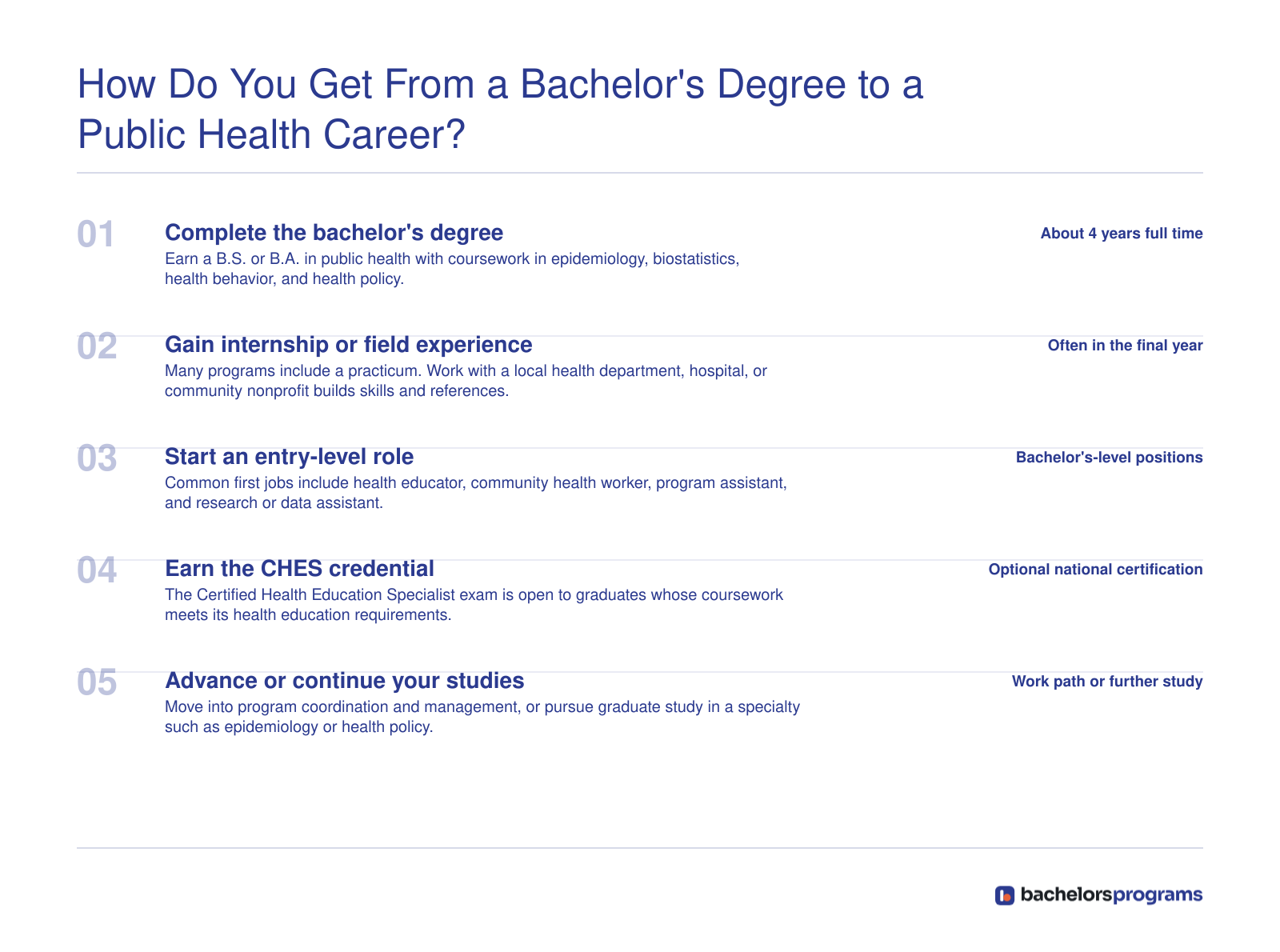
How Do You Get From a Bachelor's Degree to a Public Health Career?
Most public health careers in Michigan follow a predictable path: finish the degree, build hands-on experience, then decide whether a credential or further study fits your goals. The steps below show that typical sequence for graduates of the schools ranked here.
How to Choose the Right Michigan Public Health School
Choosing a Michigan public health school means weighing a specific program's price, schedule, and academic focus against the career you want. Here is where we would start for four common student types.
Match the School to Your Goals
- Budget-focused: Start with University of Michigan-Flint, which posts an average net price of $7,007, followed by Oakland University ($9,120) and University of Michigan-Dearborn ($9,492).
- Working adults and transfers: UM-Dearborn's rolling admissions and locked tuition rate make planning easier, and Eastern Michigan University offers a MiTransfer pathway for community college students. These programs are campus-based, so ask each school which courses run online or in the evening.
- Pre-med: The University of Michigan is the strongest pick. Its Public Health Sciences program includes a pre-health track for medicine, dentistry, and nursing and lets you complete other pre-health requirements.
- Policy and community health: Wayne State University stands out, with an Advocacy and Practice concentration and a required capstone. Eastern Michigan's Community Health Education concentration and Western Michigan's preparation for CHES certification are solid alternatives.
Use CEPH Accreditation as a Check
The Council on Education for Public Health (CEPH) accredits schools of public health, public health programs, and standalone baccalaureate programs, all with full accreditation status.1 Its directory lists the University of Michigan's School of Public Health (accredited since 1946, current term through July 1, 2027) and UM-Flint's Public Health Program (accredited since 2018, with a listed term ending July 1, 2026, so confirm its current status).2 UM-Flint's bachelor's page also describes the program as CEPH accredited. Central Michigan University appears as a "Public Health Program," but the listing does not say whether the bachelor's degree is covered. The directory lists no Michigan school under the standalone baccalaureate category, and UM-Dearborn, Wayne State, Calvin, Oakland, Western Michigan, Saginaw Valley State, and Eastern Michigan do not appear at all.2 Ask each school how accreditation applies to its bachelor's degree.
Three Next Steps
- Compare net price: Run each school's net price calculator, since your aid package may differ from the averages above.
- Check transfer credit: Ask how prior coursework will apply, especially if you are coming from a Michigan community college.
- Request program information: Ask about internships, advising, and accelerated bachelor's-to-MPH options.
Ready to narrow your list? Explore the schools ranked here on bachelorsprograms.com and request information from the programs that fit your budget and goals.
Michigan Public Health Bachelor's Programs: Common Questions
These answers draw on the schools' own program pages and a Michigan employer posting. Requirements and rankings change, so confirm details with each school before you apply.
What is the best public health school in Michigan?
Can you earn a bachelor's degree in public health online from a Michigan school?
What jobs can you get with a bachelor's degree in public health in Michigan?
Can I get into medical school with a public health bachelor's degree?
Compare Public Health programs on the data that matters
Explore more Healthcare majors or browse every field of study.
All Healthcare programs Browse every field of study