Best Speech Pathology Schools in Minnesota
Compare 4 accredited Speech Pathology programs in Minnesota, with net price after aid, graduation rates, earnings and debt from IPEDS and the U.S. College Scorecard.

Which Minnesota bachelor's degree actually leads to a speech-language pathology master's: Speech Pathology, Communication Sciences and Disorders, or something else? Speech Pathology and Communication Sciences and Disorders both appear on Minnesota campuses, usually for the same body of coursework. The standard credential is the Bachelor of Science (B.S.) in Speech Pathology.
These programs are pre-professional by design. Minnesota licenses speech-language pathologists at the master's level, so undergraduate years go to phonetics, speech science, language development and audiology, plus clinical observation and practicum hours.
Formats vary too: campus, hybrid and fully online at Minnesota-based schools. The bottleneck is graduate admission, where major GPA and faculty references outweigh the name on the diploma.
Key Points
- In-state tuition runs about $9,572 to $14,610 a year.
- Most applicants get in; advancing within the major is the harder hurdle.
- Minnesota licenses speech-language pathologists only with a master's or doctoral degree.
Best Bachelor's Degree in Speech Pathology Programs in Minnesota
Four Minnesota public universities award a bachelor's degree in speech pathology or its close equivalent, and each names the major a little differently: Communication Sciences & Disorders, Speech-Language-Hearing Sciences, and Speech Pathology. All four are built as pre-professional preparation for graduate study, with clinical observation or practicum worked into the undergraduate years at most of them. The tuition, net price and graduation rate figures shown on each card are institution-wide or sector-based averages, not program-specific numbers.
University of Minnesota-Duluth
#1Duluth, MN · $15,000 – $20,000/yr (est.)
Best for: Hands-on learners seeking SLPA practicum
The University of Minnesota Duluth runs its Communication Sciences & Disorders major as a cohort, so students move through the required sequence with the same small group of classmates. The department's Robert F. Pierce clinic and an optional speech-language pathology assistant practicum give undergraduates early contact with clients, and an optional audiology practical adds a second clinical thread. Faculty research covers neurogenic communication disorders and the SPEAK OUT! therapy program. It is the most research-active department in this set for students who want lab and clinic exposure before graduate school.
- Cohort-based structure with small class sizes
- Optional SLPA clinical practicum for assistant certification
- Optional audiology clinical practical experience
- Robert F. Pierce Speech-Language-Hearing Clinic on campus
- Research on neurogenic communication disorders and SPEAK OUT! therapy
- Prepares students for graduate study in speech-language pathology and audiology
- Campus career center reports average starting salary above $43K
Minnesota State University-Mankato
#2Mankato, MN · $10,000 – $19,000/yr (est.)
Best for: Students weighing three concentration tracks
Minnesota State Mankato lays out its Communication Sciences and Disorders major as a 120-credit four-year plan, with 46 credits in the major and a choice of speech-language pathology, audiology or general options. A required clinical practicum and the two-course Grand Rounds capstone give the degree a professional finish rather than a purely academic one, and the department has expanded simulation-based learning plus a partnership with Madelia Public Schools for rural, school-based clinical training. The department is direct that a master's is the minimum professional credential and does not recommend bachelor's graduates for practice on their own.
- 120 total credits, 46 of them in the major
- Three options: Speech-Language Pathology, Audiology, General
- Two-course Grand Rounds capstone (CDIS 445 and CDIS 446)
- 2 credits of clinical practicum required
- 3.0 GPA across four core courses required for 400-level work
- American Sign Language offered through Level IV
- Four-year plan available for full-time students
- Department states a master's is the minimum for professional practice
Minnesota State University Moorhead
#3Moorhead, MN · ~$18,000/yr (est.)
Best for: Students needing hybrid course flexibility
Minnesota State Moorhead awards a BS in Speech-Language-Hearing Sciences built on a 43-credit core that runs from a survey of the field to a research applications capstone. Students choose six elective credits with a faculty advisor, and the department offers a pre-audiology emphasis plus electives such as Medical SLP and Childhood Stuttering and Related Disorders. Related coursework in statistics and technical report writing is folded in, and the major has its own designated writing-intensive course. It suits students who want a broad speech, language and hearing sciences foundation before committing to a graduate specialty.
- 43-credit core plus six advisor-approved elective credits
- Pre-audiology emphasis available
- Electives include Medical SLP and Childhood Stuttering
- Related requirements in statistics and technical report writing
- ENGL 387 is the designated writing-intensive course
- Learning outcomes aligned to graduate program entry standards
- Cultural humility and ethical conduct built into the curriculum
- Minor in Speech, Language, Hearing Sciences offered
Saint Cloud State University
#4Saint Cloud, MN · ~$14,000/yr (est.)
St. Cloud State University awards a BS in Communication Sciences and Disorders with pre-professional training in normal communication development and in clinical assessment and intervention. The standout add-on is the Speech-Language Pathology Assistant certificate, which stacks onto the bachelor's and prepares students for the ASHA Assistants Certification Exam and licensed assistant work. The department's on-campus clinic has operated since 1948 and serves more than 75 clients a semester, so undergraduates see supervised clinical work alongside nationally certified speech-language pathologists and audiologists. Graduates move into roles such as speech-language pathology assistant, behavioral therapist, early intervention specialist and special education teacher.
- Speech-Language Pathology Assistant (SLP-A) certificate stackable with the bachelor's
- SLP-A certificate prepares students for the ASHA Assistants Certification Exam
- On-campus clinic operating since 1948, serving 75+ clients a semester
- Students work with nationally certified SLPs and audiologists
- Coursework spans normal development, assessment and intervention
- NSSLHA student organization for undergraduates
- Recorded outcomes include behavioral therapist and early intervention roles
Cost & outcomes by school
Federal data for the highest-earning Speech Pathology programs, independent of the ranking above. Earnings are this field's bachelor's graduates four years after completing where the Scorecard reports them, else the school's undergraduate median.
| School | Net price / yr | Grad rate | Earnings | Debt | Grads/yr | Format |
|---|---|---|---|---|---|---|
| Saint Cloud State University MN | $13,529 | 40% | $58,587 | $15,300 | 7 | Online |
| University of Minnesota-Duluth MN | $18,743 | 65% | $58,362 | $20,500 | 20 | Campus |
| Minnesota State University Moorhead MN | $17,997 | 57% | $57,260 | $20,029 | 33 | Hybrid |
| Minnesota State University-Mankato MN | $19,139 | 54% | $55,396 | $21,000 | 36 | Campus |
Sources: U.S. Department of Education. Net price, graduation rate, earnings and debt: College Scorecard (earnings and debt for this field's bachelor's graduates where reported, else school-wide); graduates: IPEDS. A dash means no figure is reported.
Cost, debt & payoff
Median earnings of this field's bachelor's graduates (4 yrs after completing, else the school's undergraduate median) vs. their median federal loan debt · U.S. College Scorecard
Across these programs the median graduate earns about $57,811 and finishes with roughly $20,265 in debt — a ratio that clears a common rule of thumb (keep debt below first-year salary). Net price and debt vary widely school to school, so check the per-school figures in the table above before you shortlist.
Compare Minnesota's Speech Pathology Schools Side by Side
Individual university pages rarely line up against each other, so this table puts the schools ranked here on the same federal measures from IPEDS and the College Scorecard, with earnings and debt drawn from each school's own speech pathology program. Saint Cloud State University stands out on cost, with the lowest net price ($13,529) and the lowest median program debt ($15,300), while Minnesota State University-Mankato graduates the most students from its program (44 completions) and Minnesota State University Moorhead is the most selective (59% admission rate). University of Minnesota-Duluth posts the highest graduation rate (65%) and the highest program earnings five years after finishing ($62,612), though program earnings four years after finishing sit close together, from $55,396 to $58,587.
| School | Sector | Admission rate | Average net price (per year) | Pell Grant share | Graduation rate | Program completions | Program median earnings, four years after finishing | Program median earnings, five years after finishing | Program median debt |
|---|---|---|---|---|---|---|---|---|---|
| University of Minnesota-Duluth | Public | 89% | $18,743 | 38% | 65% | 26 | $58,362 | $62,612 | $20,500 |
| Minnesota State University-Mankato | Public | 88% | $19,139 | 46% | 54% | 44 | $55,396 | $58,513 | $21,000 |
| Minnesota State University Moorhead | Public | 59% | $17,997 | 46% | 57% | 41 | $57,260 | $55,292 | $20,029 |
| Saint Cloud State University | Public | 95% | $13,529 | 57% | 40% | 19 | $58,587 | $45,495 | $15,300 |
Online and Hybrid Bachelor's Options at Minnesota Schools
Students searching for online speech pathology programs in Minnesota usually want one answer first: can the bachelor's be finished without relocating? Sometimes. Format varies enough by school that each program's own page, not a general description, has to be your guide. Every option below is a Minnesota-based school, not an out-of-state online provider.
Where the online and hybrid options are
- Saint Cloud State University: Program information lists a fully online option for the Communication Sciences and Disorders bachelor's, with coursework in clinical assessment and intervention and an SLPA certificate students can pair with the degree.
- Minnesota State University, Mankato: The Bachelor of Science in Communication Sciences and Disorders is described as hybrid, combining online and in-person instruction.1 Our listing marks it campus-based; plan around the school's hybrid format instead.
- Minnesota State University Moorhead: The Speech, Language, Hearing Sciences bachelor's is face-to-face with some online courses, so expect to be in Moorhead for most of your schedule.
- University of Minnesota Duluth: The Communication Sciences & Disorders program is listed as campus-based.
What to verify before you enroll
Online delivery rarely covers the whole degree in this field.2 Clinical practicum and observation hours have to happen in a real setting, usually a clinic, school or hospital, and programs arrange those placements differently. Ask who finds the site, whether travel to the university's own clinic is expected, how many supervised hours are required, and whether placements near your home are permitted and who supervises them.
Lab work in phonetics, speech science and audiology often needs equipment you cannot replicate at home, and American Sign Language sequences, which some programs build into the major, can be the hardest piece to finish remotely. Formats change from year to year, so confirm the current delivery method with an advisor before you apply.
Admissions: GPA, Test Policy and Transfer Credit
Getting into a Minnesota speech pathology bachelor's program is usually easier than staying in it. Most of the public universities here admit the large majority of applicants, and the real academic gatekeeping happens later, when you apply to advance within the major.
Selectivity at the Minnesota schools
Saint Cloud State University admits roughly 95 percent of applicants, the University of Minnesota-Duluth about 89 percent and Minnesota State University-Mankato about 88 percent. Minnesota State University Moorhead is the most selective of the group at roughly 59 percent, though that still means the majority of applicants are offered a place. For students with a solid high school record, admission to the university itself is rarely the obstacle.
Admission to the college vs. admission to the major
These are two separate decisions, and confusing them is the most common planning mistake. At Minnesota State University-Mankato, the 2026-2027 catalog for the Bachelor of Science in Communication Sciences and Disorders does not set a university-wide minimum GPA for freshman admission; an overall 3.0 is strongly recommended rather than required. Progression is where the requirement tightens: students must complete CDIS 312, 322, 392 and 394 with a 3.0 GPA before the department grants permission to enroll in 400-level coursework. A 3.0 is also recommended for clinical practicum, though an advisor or course instructor may waive it. The degree totals 120 credits, with 46 of those in the major.
The University of Minnesota-Duluth offers a Bachelor of Applied Science in Communication Sciences and Disorders. Its program materials do not publish a minimum GPA, a current standardized test policy or a separate major-admission process1, so check directly with the department before you build a plan around assumptions.
Test policy and transfer credit
Test-optional admission is now the norm across Minnesota's public universities, and Mankato's 2026-2027 CSD catalog does not state a testing requirement for the major. If your scores are strong, submitting them can still help with scholarship consideration.
Transfer students should ask three questions on every campus visit: how many credits will apply toward the 120 required for graduation, how many of the 46 or so major credits must be earned in residence, and whether the department (not just the registrar) approves each major course. Answers vary, and several Minnesota schools do not publish them in one place.
Courses that carry the most weight
The coursework that matters most for later graduate admission is already built into these majors: phonetics and speech science, anatomy and physiology of the speech mechanism, normal language development, audiology, and clinical assessment and intervention. Add the outside prerequisites graduate programs expect, typically statistics plus a biological science, a physical science and a behavioral science, and finish with the GPA to match.
Related Articles
What a Bachelor's in Speech Pathology Costs in Minnesota
In-state tuition at the Minnesota public universities offering a speech pathology bachelor's runs from roughly $9,572 to $14,610 a year, and average net price after aid falls between about $13,529 and $19,139. Which one is cheapest depends on which number you use.
Tuition and Net Price Side by Side
- Minnesota State University-Mankato: lowest published in-state tuition at about $9,572, but the highest average net price at about $19,139.
- Saint Cloud State University: about $10,245 in tuition and the lowest average net price at roughly $13,529.
- Minnesota State University Moorhead: about $10,428 in tuition and an average net price near $17,997.
- University of Minnesota-Duluth: the highest in-state tuition at about $14,610, with an average net price around $18,743.
Net price is an average for aided students at each institution, not a quote for any one family. A high-tuition school can end up cheaper than a low-tuition one once grants and scholarships are counted, so run the net price calculator for each campus before deciding.
Institution-Wide Debt and Pell Figures
Across the four schools, the share of undergraduates receiving Pell grants ranges from about 38 percent at Minnesota Duluth to about 57 percent at Saint Cloud State. Median federal debt for graduates is in a narrow band, from roughly $20,000 at Moorhead to about $22,024 at Duluth. These are whole-institution numbers covering all majors, not figures specific to a speech pathology major, so treat them as context rather than a forecast.
Minnesota Aid That Lowers the Bill
The Minnesota State Grant is the state's need-based grant, administered by the Minnesota Office of Higher Education, which distributes more than $247 million a year.1 You apply by filing the FAFSA or the Minnesota Dream Act application, must be a Minnesota resident enrolled in an eligible program, and must make satisfactory academic progress.2
North Star Promise is the larger award for many families. For 2026-27 it covers up to 100 percent of tuition and mandatory fees for Minnesota residents whose family adjusted gross income is below $80,000, after all other gift aid is applied.3 You must attend a Minnesota public institution, enroll in at least one credit, hold no prior bachelor's degree, meet satisfactory academic progress, and not be in default on a student loan. Awards run up to eight full-time semesters for a four-year degree and can be used in fall, spring or summer. Filing by June 1, 2026 met the priority deadline for 2026-27, and the statutory deadline can extend up to 30 days after the term starts.4
Practical Ways to Cut the Cost
- File early. Submit the FAFSA or Minnesota Dream Act application as soon as it opens, since both state programs depend on it.
- Ask the department. Check with each communication sciences and disorders department about scholarships for majors, which outside awards may not replace under last-dollar aid rules.
- Protect your four years. North Star Promise covers up to eight full-time semesters, so a degree plan that avoids extra terms keeps the aid intact.
Careers in Minnesota and Speech-Language Pathologist Licensure
The Minnesota Department of Health licenses speech-language pathologists, and the degree requirement is unambiguous: a master's or doctoral degree1. The bachelor's degree in speech pathology is the pre-professional step. It builds the foundation in anatomy, phonetics, language development and audiology that a graduate program expects, but it does not qualify you to practice independently as an SLP.
Can You Work as an SLP With Only a Bachelor's?
No. Minnesota law requires the graduate degree before licensure, and the license is what allows you to diagnose and treat communication and swallowing disorders. Graduates either continue to graduate school or move into a related, assistant-level role.
The SLPA License
Minnesota began licensing speech-language pathology assistants in 2025, which gives bachelor's graduates a direct route into the field5. The state lists two routes, and one fits bachelor's graduates: a bachelor's degree in communication sciences and disorders plus an SLPA certificate with specified coursework and at least 100 supervised fieldwork hours3. The other route uses an associate degree from an accredited SLPA program, also with 100 fieldwork hours.
Applicants must be at least 18, pass a background check, and pay the application fee2. The license renews every two years with continuing education, and SLPAs practice under the supervision of a Minnesota-licensed SLP2. Current statute caps the initial and renewal fees at $220 each, so check the Department of Health's fee schedule for the exact amount4.
Praxis and the Graduate Path
Minnesota requires a qualifying examination for SLP licensure, and the Praxis Speech-Language Pathology test is the standard route most applicants take through ASHA certification1. Holders of the Certificate of Clinical Competence can use it in place of separately documenting degree, training and exam requirements1. The state also requires a fingerprint-based background check and a records access waiver. For 2026, the initial SLP application fee is $210.50, renewal is $200, and the background check adds $10.504.
Other Bachelor's-Level Roles
Beyond the SLPA license, graduates take positions as early-intervention aides, classroom and therapy support staff, and patient-service coordinators in clinics and school districts. These roles vary in title and requirement from employer to employer, so confirm expectations before applying.
What Do Speech-Language Pathologists Earn in Minnesota?
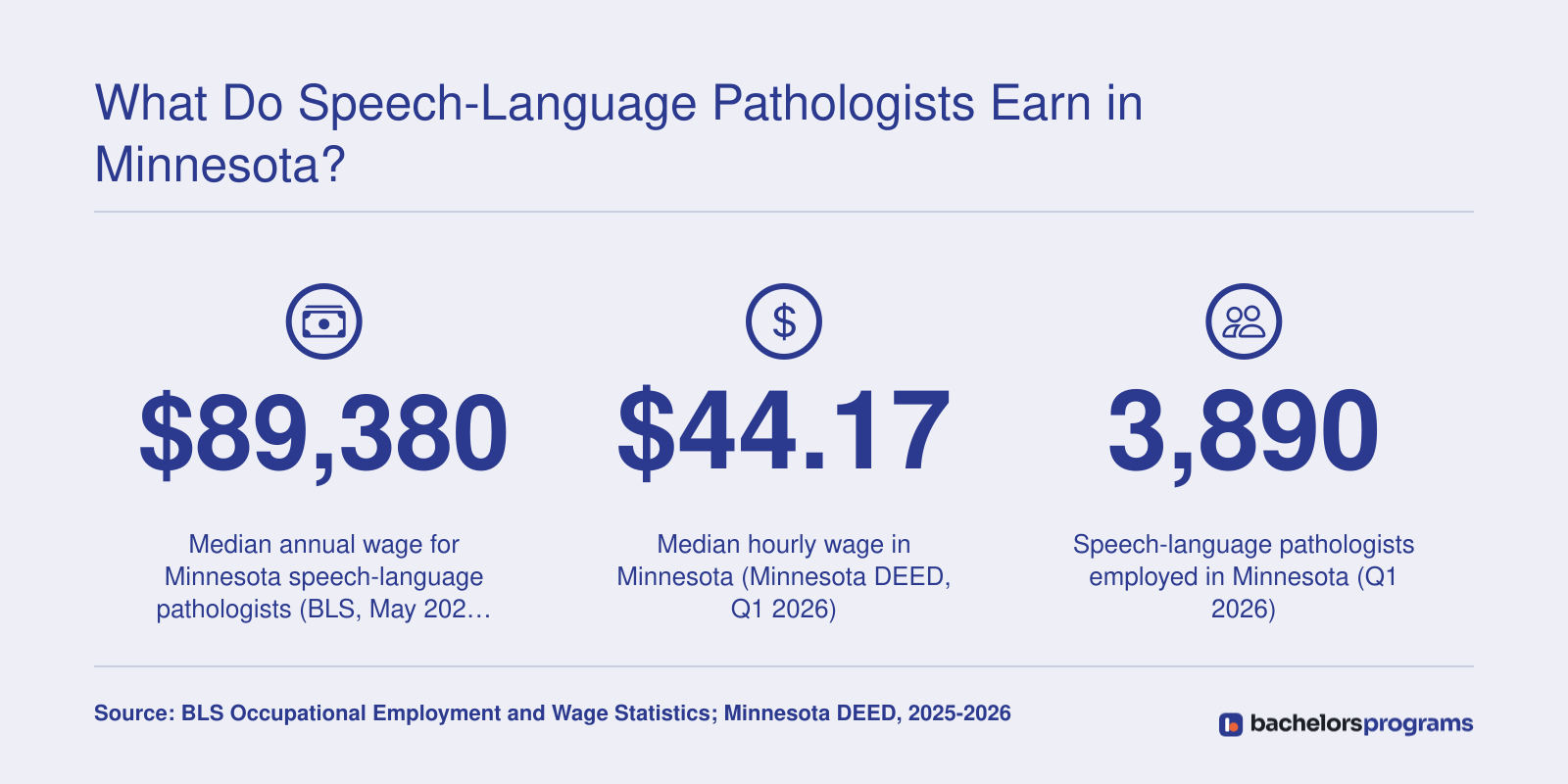
These are occupational wages for working speech-language pathologists, a role that in Minnesota requires a master's degree, so they show where the bachelor's degree in speech pathology can lead rather than what graduates earn right after finishing it. Federal May 2025 data put the typical Minnesota range at $62,390-$107,820 a year. Minnesota DEED's newer First Quarter 2026 hourly median runs slightly higher, though the two sources cover different periods. Neither source publishes a separate Minnesota wage for speech-language pathology assistants. Keep these figures apart from the College Scorecard earnings of program graduates shown earlier, which track bachelor's completers from specific schools, not licensed professionals.
How We Ranked Minnesota Speech Pathology Schools
What We Included
Only Minnesota bachelor's programs appear here, in every format: on campus, hybrid and online. Each school is based in Minnesota and offers a bachelor's degree in speech pathology under its own major name, whether that is Communication Sciences and Disorders or Speech, Language, Hearing Sciences. The order of the schools comes from our internal rankings data.
Where the Numbers Come From
- Federal data: College Scorecard and IPEDS supply the cost, graduation, earnings and debt figures.
- School websites: Admissions requirements and program format come from each school's own pages. Where a school publishes no policy, we say so rather than guess.
Limits to Keep in Mind
Some figures describe the whole institution, not the speech pathology major. Graduation rate, net price and some debt figures are institution-wide, so they show how a school performs overall, not how one program does. Net price is also an average across students who receive aid. Your own cost depends on your family income, residency and aid package, and it may land well above or below that average.
Data Year and Verification
Figures reflect the most recent releases available as of November 2026. Federal earnings and debt data trail the current year, and tuition, aid and admissions rules change from one cycle to the next. Before you apply, confirm costs, deadlines, GPA expectations and format options directly with each school.
Common Questions About Speech Pathology Bachelor's Programs in Minnesota
These answers cover the questions students ask most often before choosing a bachelor's degree in speech pathology in Minnesota. Each one reflects what the schools and the American Speech-Language-Hearing Association (ASHA) publish.
What bachelor's degree do you need for speech pathology in Minnesota?
Can you become a speech-language pathologist with only a bachelor's degree?
Are there online speech pathology programs in Minnesota?
How much do SLPAs make in Minnesota?
Which undergraduate courses help prepare for later study in the field?
Compare Speech Pathology programs on the data that matters
Explore more Communications & Media majors or browse every field of study.
All Communications & Media programs Browse every field of study