Best Speech Pathology Schools in North Carolina
Compare 5 accredited Speech Pathology programs in North Carolina, with net price after aid, graduation rates, earnings and debt from IPEDS and the U.S. College Scorecard.
A bachelor's degree in speech pathology, usually a Bachelor of Science in Communication Sciences and Disorders, is the pre-professional step toward working with speech, language and swallowing disorders. It does not carry a license on its own. Practicing as a speech-language pathologist in North Carolina requires a master's degree, so the undergraduate choice is really about preparation, cost and fit.
Schools label the major differently: Speech Pathology, Speech-Language Pathology or Communication Sciences and Disorders (CSD). The coursework overlaps far more than the names suggest, and the real differences show up in price, admissions standards and whether the program can be finished online.
For students planning graduate school, undergraduate grades matter more than anything else.
Key Points
- Montreat College's 120-credit CSD bachelor's can be completed fully online.
- UNC System campuses set a 2.5 weighted high school GPA minimum.
- Licensure as a North Carolina SLP requires a master's degree or higher.
Best Bachelor's Degree in Speech Pathology Schools in North Carolina
Five North Carolina colleges offer a bachelor's degree in speech pathology, whether the major is labeled speech pathology, speech-language pathology or communication sciences and disorders. Four deliver the degree on campus, and one can be completed fully online. Each entry below is built around the school's own program name, its location, its in-state tuition, an approximate average net price after aid, and the institution-wide graduation rate, so you can compare them on the same terms.
Appalachian State University
#1Boone, NC · $8,000 – $25,000/yr (est.)
Best for: Future SLPs wanting campus clinic observation
Appalachian State University in Boone runs a broad communication sciences and disorders major that moves from typical speech, language and hearing development into disorders in children and adults. A senior capstone puts students into guided clinical observation at the university's Communication Disorders Clinics and partner sites, which gives applicants real observation hours before graduate school. Students also declare an academic interest area or minor, and popular choices such as American Sign Language, psychology and special education line up well with a future SLP career.
- Senior capstone with guided clinical observation
- Observation hours at on-campus Communication Disorders Clinics
- Required academic interest area or minor
- Popular minors include ASL, psychology and special education
- Accelerated bachelor's to master's option in the department
- Departmental honors projects and research labs
- NSSLHA student chapter on campus
East Carolina University
#2Greenville, NC · ~$16,000/yr (est.)
Best for: Aspiring assistants preparing for SLPA certification
East Carolina University in Greenville builds its speech and hearing sciences degree around the normal processes of speech, hearing and language, then adds clinic observations and research participation to connect that foundation to clinical work. The department is explicit that graduates can head toward graduate study, speech-language pathology assistant certification, or roles in schools, nonprofits and service industries. Major courses meet only in fall and spring, advising happens on the main campus, and the department currently offers no undergraduate scholarships of its own.
- Bachelor of Science in Speech and Hearing Sciences
- Clinic observations and research participation available
- Prepares students for speech-language pathology assistant certification
- Major courses offered only in fall and spring
- Study abroad possible in the freshman or sophomore year
- Advising held on the main campus
- No department scholarships for undergraduates at present
University of North Carolina at Greensboro
#3Greensboro, NC · $11,000/yr (est. net price)
Best for: Transfer students navigating departmental admission
Students log guided observation hours alongside ASHA-certified clinicians and can take part in honors clinical experiences that pair them with graduate students. UNCG's Speech and Hearing Center also keeps a regional clinical connection with Cone Health, and the campus NSSLHA chapter has earned Gold Chapter Honors.
- 3.0 GPA minimum for the major
- Separate departmental application after about 55 credit hours
- Fall-only admission with applications due May 15
- Guided observation hours with ASHA-certified clinicians
- Honors clinical experiences alongside graduate students
- NSSLHA chapter with Gold Chapter Honors
- Prepares students for SLP or audiology graduate study
Montreat College
#4Montreat, NC · $25,000 – $30,000/yr (est.)
Montreat College, a small private college in western North Carolina near Asheville, delivers its communication sciences and disorders bachelor's degree fully online in eight-week sessions. Fieldwork mixes in-person hours with Simucase, Master Clinician Network and teletherapy contact, and those hours can count toward ASHA certification. With spring, summer and fall starts and room to transfer up to 90 semester credits, it is the most flexible route on this list for students who cannot relocate.
- Fully online, eight-week course sessions
- Spring, summer and fall start terms
- 120 total credit hours to graduate
- 2.0 GPA minimum for admission
- Transfer up to 90 semester credits
- Up to 66 semester hours from two-year schools
- Fieldwork 1: 25 hours of therapy or diagnostic observation
- Fieldwork 2 uses Simucase, Master Clinician Network and teletherapy
North Carolina A & T State University
#5Greensboro, NC · ~$11,000/yr (est.)
North Carolina A&T State University in Greensboro, a historically Black university, offers a Bachelor of Arts in speech/language pathology and audiology with 55 of its 120 credit hours inside the major. The curriculum runs from phonetics and introduction to audiology through language disorders across the lifespan, then into a clinical phase students enter by junior year and a senior internship. That structure gives graduates supervised practicum experience to list on graduate school applications.
- Bachelor of Arts with 120 total credit hours
- 55 credit hours inside the major
- 3.0 GPA minimum and a C or better in core courses
- Admission to the Clinical Phase required by junior year
- Senior internship included
- Coursework spans phonetics, audiology and language disorders
- Prepares students for graduate study in speech-language pathology
Cost & outcomes by school
Federal data for the highest-earning Speech Pathology programs, independent of the ranking above. Earnings are this field's bachelor's graduates four years after completing where the Scorecard reports them, else the school's undergraduate median.
| School | Net price / yr | Grad rate | Earnings | Debt | Grads/yr | Format |
|---|---|---|---|---|---|---|
| East Carolina University NC | $15,739 | 63% | $68,338 | $22,750 | 49 | Campus |
| University of North Carolina at Greensboro NC | $10,965 | 56% | $61,620 | $20,537 | 43 | Campus |
| Appalachian State University NC | $16,836 | 75% | $53,125 | $17,750 | 56 | Campus |
| Montreat College NC | $27,061 | 50% | $45,151 | $25,813 | 3 | Online |
| North Carolina A & T State University NC | $10,846 | 57% | $44,440 | $27,000 | — | Campus |
Sources: U.S. Department of Education. Net price, graduation rate, earnings and debt: College Scorecard (earnings and debt for this field's bachelor's graduates where reported, else school-wide); graduates: IPEDS. A dash means no figure is reported.
Cost, debt & payoff
Median earnings of this field's bachelor's graduates (4 yrs after completing, else the school's undergraduate median) vs. their median federal loan debt · U.S. College Scorecard
Across these programs the median graduate earns about $53,125 and finishes with roughly $22,750 in debt — a ratio that clears a common rule of thumb (keep debt below first-year salary). Net price and debt vary widely school to school, so check the per-school figures in the table above before you shortlist.
How We Ranked North Carolina Speech Pathology Bachelor's Programs
A useful speech pathology ranking rewards schools that keep costs manageable, graduate their students and prepare them for what comes next. That is the standard this list applies.
What We Looked At
- Cost: In-state tuition and average net price after grants and scholarships, since price drives borrowing more than anything else.
- Graduation: How many students finish their bachelor's degree, a practical sign of advising and academic support.
- Selectivity: Admission rate, which shows how competitive entry is and how prepared incoming classes tend to be.
- Outcomes: Earnings and federal loan debt after graduation.
How to Read the Numbers
Most graduation, earnings and debt figures describe the whole institution, not the speech pathology major alone. A school's overall graduation rate blends nursing, business, education and every other major on campus. Read these figures as a picture of the school, not a guarantee about one department.
Program-level earnings and debt appear only where College Scorecard publishes them for the specific major. Smaller majors often fall below federal reporting thresholds, so many school profiles rely on institution-wide figures instead.
What This List Covers
Every program here is a bachelor's degree, whether the school calls it Speech Pathology, Speech-Language Pathology or Communication Sciences and Disorders. Each one is offered on a North Carolina campus or online through a North Carolina-based school. Graduate programs are not ranked, because this page focuses on the undergraduate step that comes first. Students comparing options should weigh cost and graduation most heavily, then check each school's own program page for course sequences and clinical observation hours.
Compare the Top North Carolina Bachelor's Programs Side by Side
This table lines up the ranked schools on the numbers that matter most when comparing a bachelor's degree in speech pathology: tuition, net price after aid, graduation rate and earnings, drawn from IPEDS and College Scorecard (2024) data. North Carolina A & T State University posts the lowest in-state tuition ($6,813) and the lowest net price ($10,846), while Appalachian State University leads on graduation rate at 74.5%. Montreat College, the private and online option here, charges the same tuition to every student regardless of residency. Graduation rates and earnings cover each school as a whole, not the speech pathology major alone.
| School | Program Name | Location | Format | In-State Tuition and Fees | Out-of-State Tuition and Fees | Average Net Price | Graduation Rate | Median Earnings 10 Years After Entry (All Programs) |
|---|---|---|---|---|---|---|---|---|
| Appalachian State University | Communication Sciences and Disorders | Boone, NC | Campus | $7,579 | $25,212 | $16,836 | 74.5% | $51,836 |
| East Carolina University | Speech and Hearing Sciences | Greenville, NC | Campus | $7,361 | $23,638 | $15,739 | 62.6% | $55,146 |
| University of North Carolina at Greensboro | Speech Pathology and Audiology | Greensboro, NC | Campus | $7,661 | $24,012 | $10,965 | 56.3% | $48,160 |
| Montreat College | Communication Sciences and Disorders | Montreat, NC | Online | $36,450 | $36,450 | $27,061 | 50.3% | $45,151 |
| North Carolina A & T State University | Speech/Language Pathology and Audiology | Greensboro, NC | Campus | $6,813 | $20,673 | $10,846 | 57.2% | $44,440 |
Online and Hybrid Bachelor's Options at North Carolina Schools
Montreat College offers a 120-credit-hour Bachelor of Science in Communication Sciences and Disorders that can be completed fully online, in one to four years depending on how many credits you transfer. Courses run in eight-week sessions, two per semester. Among the schools here, it is the one built for distance learners.
Which Schools Offer Which Format
- Montreat College: Online. Its program page also lists spring, summer and fall starts.
- University of North Carolina at Greensboro: Campus. The Bachelor of Science in Speech Pathology and Audiology expects you on campus three to four days a week for upper-level major courses, with only a few courses online.
- East Carolina University: Campus. The Bachelor of Science in Speech and Hearing Sciences is listed as an on-campus degree.
- Appalachian State University: Campus, in Communication Sciences and Disorders.
- North Carolina A & T State University: Campus, in Speech/Language Pathology and Audiology.
No hybrid or degree-completion bachelor's is documented at the campus-based schools, so verify any such option directly with the department. UNCG's one-year, on-campus prerequisite program for second-degree seekers is separate from its bachelor's, though one audiology course in it, CSD 334, is delivered online and asynchronously.
In-Person Components to Expect
Online does not always mean zero hands-on work. Montreat's program page describes 25 observation hours, completed through teletherapy and Simucase simulations, and says they can count toward ASHA certification. Campus programs lean on in-person observation and clinic work: UNCG includes guided observation hours with speech-language pathologists, ECU lists clinic observations, and N.C. A&T requires admission to a clinical phase and includes an internship. Ask each department whether observation can be done near your home.
How to Confirm Format and State Authorization
Open the school's program page and look for the delivery mode, any residency or on-campus requirement, and the fieldwork description. If you live outside North Carolina, check the school's state authorization or distance-education disclosure page for your state, and ask admissions in writing whether the program is approved there. Format details change, so confirm them before you apply.
Admissions: GPA, Test Policy and Transfer Credit at North Carolina Schools
Entry standards differ more by school type than by program. Four of the schools here belong to the UNC System, which sets a floor of a 2.5 weighted high school GPA for Fall 2026 and beyond.1 Applicants with a weighted GPA from 2.50 to below 2.80 also need at least a 17 ACT or 930 SAT.1 Meeting that floor does not guarantee admission to a campus or a major.
School-by-school requirements
- Appalachian State University: GPA follows the UNC System minimum of 2.5 weighted. Tests follow the system's 17 ACT/930 SAT band. Transfer credit: No policy published.
- East Carolina University: GPA follows the UNC System minimum of 2.5 weighted. Tests follow the system's 17 ACT/930 SAT band. Transfer credit: No policy published.
- University of North Carolina at Greensboro: The department page asks for a 2.5 cumulative GPA across all colleges attended, while the degree page says 3.0, so confirm with the department. You apply in spring of sophomore year with 55 college credits completed by May 15, for fall entry only. Test policy: No policy published for the major. Transfer credit: official transcripts from every college are required, with no equivalency policy published.
- Montreat College: GPA: No policy published. Test policy: No policy published. Transfer credit: No policy published.
- North Carolina A & T State University: Enrolled majors need a 2.5 cumulative GPA. Students entering from Undecided and transfer applicants need 2.7. Published test thresholds are 800 SAT or 16 ACT in-state and 950 SAT or 18 ACT out-of-state. Those figures carry no entering year, so check them against current UNC System rules. Transfer credit: No policy published beyond the 2.7 GPA.
What to check before you apply
UNCG treats the major as a second admission step after you enroll, so a general acceptance does not place you in upper-level courses. Nothing published by the other schools says whether they admit students directly to the major or add department requirements. Ask each admissions office how your existing credits, including dual-enrollment and AP courses, would count toward the degree.
Related Articles
Cost of a Speech Pathology Bachelor's Degree in North Carolina
North Carolina families have more direct control over cost than over any other part of choosing a speech pathology program, and the gap between the cheapest and priciest option here is wide enough to change where a student enrolls.
Sticker Price vs. Net Price
In-state tuition at the public universities on this list runs from $6,813 a year at North Carolina A & T State University to $7,661 at UNC Greensboro, with East Carolina University at $7,361 and Appalachian State University at $7,579. Montreat College, the private option, charges $36,450. Out-of-state students at the public schools pay $20,673 to $25,212, so establishing North Carolina residency before enrolling is worth real money.
Net price, what a typical first-time student pays after grants and scholarships, is the more useful number. Public options land between $10,846 and $16,836, while Montreat's net price comes in at $27,061. Treat those as sector-level averages rather than a personal quote: your actual offer depends on your FAFSA results, residency status, and whether you live on campus.
North Carolina and Federal Aid to Know
- NC Need-Based Scholarship: for North Carolina residents attending qualifying private colleges in the state, enrolled in at least six credits with no prior bachelor's degree and a Student Aid Index at or below $15,000.1 It is awarded automatically after your FAFSA lists the college, but institutional priority deadlines decide who gets funded, and late filers can be turned away.
- Next NC Scholarship: for North Carolina residents at UNC System universities, enrolled at least six credits. For 2025-26, families with adjusted gross income of $80,000 or less and an SAI of $7,500 or less qualified for at least $5,000 a year, built from Pell plus state aid. Check current-year terms with each campus.
- Federal Pell Grant: 2026-27 awards range from $740 to $7,395 depending on need and enrollment intensity.2 Eligibility is federal, not tied to state residency.
Three Ways to Cut the Bill
- File the FAFSA early, every year. Need-based aid is not renewed automatically, and state programs run out.
- Start at a community college. Montreat College accepts up to 90 transfer credits and follows the state's Comprehensive Articulation Agreement, which protects credit for completed courses.
- Compare net price, not tuition. A higher sticker price with strong institutional aid can cost less than a low one without it.
Careers and Licensure in North Carolina: From Bachelor's to Speech-Language Pathologist
A bachelor's degree in speech pathology or communication sciences and disorders starts your career, but it does not lead directly to a license. In North Carolina, licensure as a speech-language pathologist requires a master's degree or higher.1 The bachelor's is the groundwork for graduate admission and supervised clinical training.
The Path to an SLP License
- Bachelor's degree (typically 4 years): Complete the undergraduate major and any graduate-program prerequisites.
- Graduate degree (typically about 2 years): Finish an accredited speech-language pathology program, including required coursework and supervised practicum. Prerequisites, part-time study and clinical placement schedules can stretch this timeline.
- Praxis exam: Pass the Praxis in Speech-Language Pathology, commonly taken near the end of graduate school.1 Scores must be sent directly from ETS.
- Clinical fellowship (CF): Complete at least 36 weeks and 1,260 hours, about nine months full-time.2 The CF may begin only after coursework and practicum are done.
- State license: Apply to the North Carolina Board of Examiners for Speech-Language Pathologists and Audiologists.
On a conventional, uninterrupted schedule, the whole path takes roughly six years and nine months to seven years.4
State License vs. ASHA Certification
The NC Board issues the state license. The American Speech-Language-Hearing Association (ASHA) separately awards the optional Certificate of Clinical Competence (CCC-SLP). It rests on the same building blocks: coursework, practicum, a passing Praxis score and a completed CF. ASHA requires the fellowship to be finished within 48 months of its start date.2
What You Can Do With a Bachelor's Right Away
The most direct entry point is working as a speech-language pathology assistant. North Carolina calls this credential SLP-Assistant registration, and the same Board oversees it. For an applicant holding a bachelor's in Communication Science and Disorders, requirements include:
- Fieldwork: 100 hours of SLP-assisting clinical fieldwork, completed through a college or university or under temporary Board registration.1
- Temporary registration first: Applicants must hold temporary SLP-Assistant registration under a Board-approved supervisor.
- Qualified supervisor: The supervising SLP must have held a full, unrestricted license for at least two years and have supervised a fully registered SLPA for at least one year.
- Fees: The Board's 2026 registration page lists $40, plus a $3 PayPal processing charge.3
SLPAs support licensed clinicians under supervision, which also builds hands-on experience before graduate school. Review the Board's current rules on scope, supervision and renewal before you apply, since those details can change.
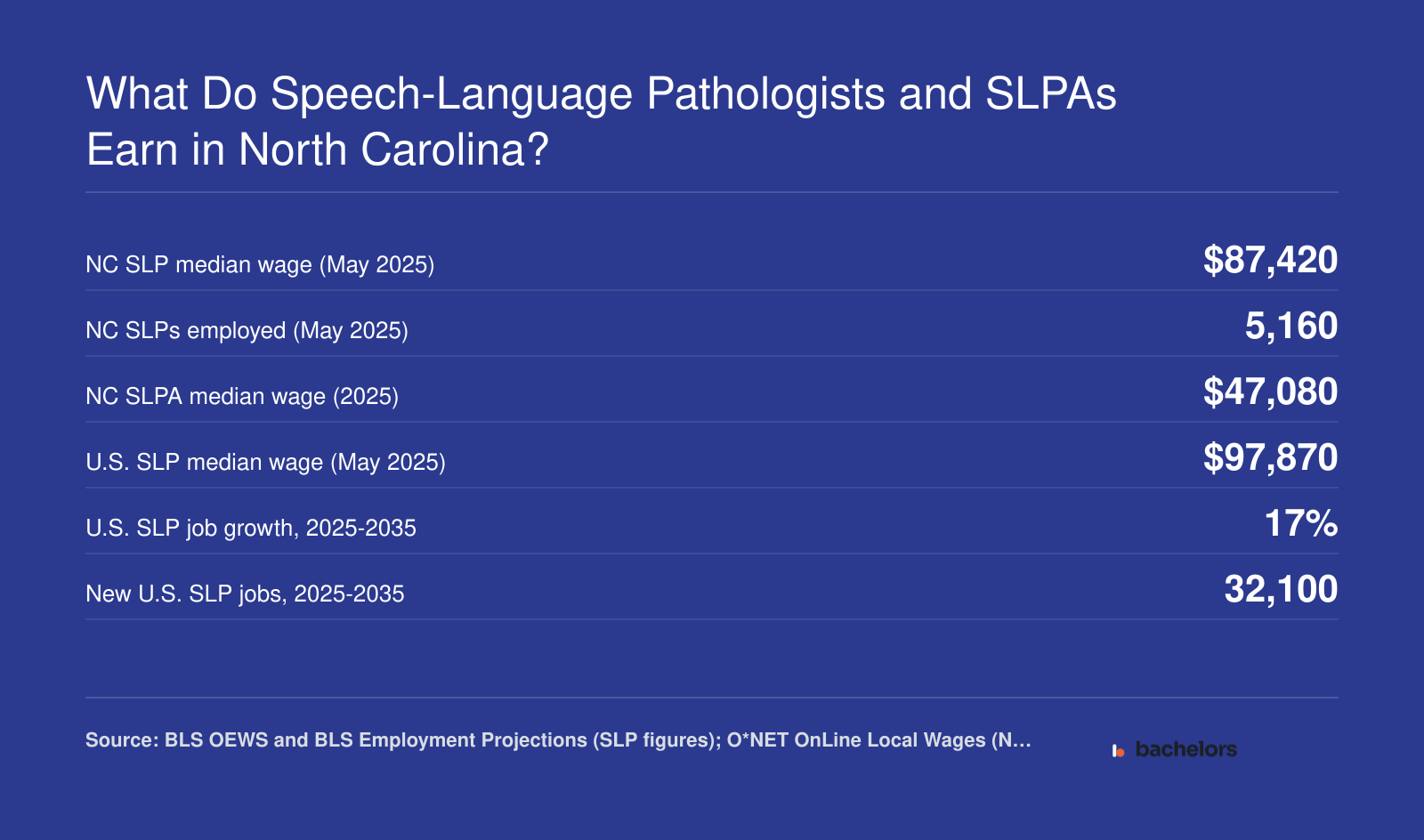
What Do Speech-Language Pathologists and SLPAs Earn in North Carolina?
These are occupational wage and job figures for working professionals from BLS and O*NET, not earnings for recent bachelor's graduates, which appear separately in the program comparisons above. The SLP wages reflect a licensed role that requires a master's degree. The SLPA wage uses O*NET's mapped category for speech-language pathology assistants, since BLS does not track SLPAs as a separate occupation.
Frequently Asked Questions About Speech Pathology Schools in North Carolina
These answers cover the questions students ask most when comparing bachelor's degree options in North Carolina. Program names, formats and requirements change, so confirm details with each school before you apply.
What are the best speech pathology programs in North Carolina?
Can you get a bachelor's degree in speech pathology online in North Carolina?
Which North Carolina schools offer a bachelor's in communication sciences and disorders?
Which speech pathology programs in North Carolina are ASHA accredited?
Are there speech pathology assistant programs in North Carolina?
Compare Speech Pathology programs on the data that matters
Explore more Communications & Media majors or browse every field of study.
All Communications & Media programs Browse every field of study