Best Public Health Schools in North Carolina
Compare 23 accredited Public Health programs in North Carolina, with net price after aid, graduation rates, earnings and debt from IPEDS and the U.S. College Scorecard.

North Carolina runs public health services through 100 county health departments, and a public health bachelor's is the credential most entry-level community health and health education postings ask for. The standard award is the Bachelor of Science (B.S.) in Public Health.
Admission varies from test-optional private colleges to flagships expecting a competitive GPA, and online completion tracks let students with prior credits finish the upper division remotely.
Cost is where the decision usually turns. A private college's net price after aid can undercut a public university's out-of-state sticker, so published tuition says little about what four years will actually cost.
Key Points
- Fayetteville State University has the lowest net price here: $7,892 yearly.
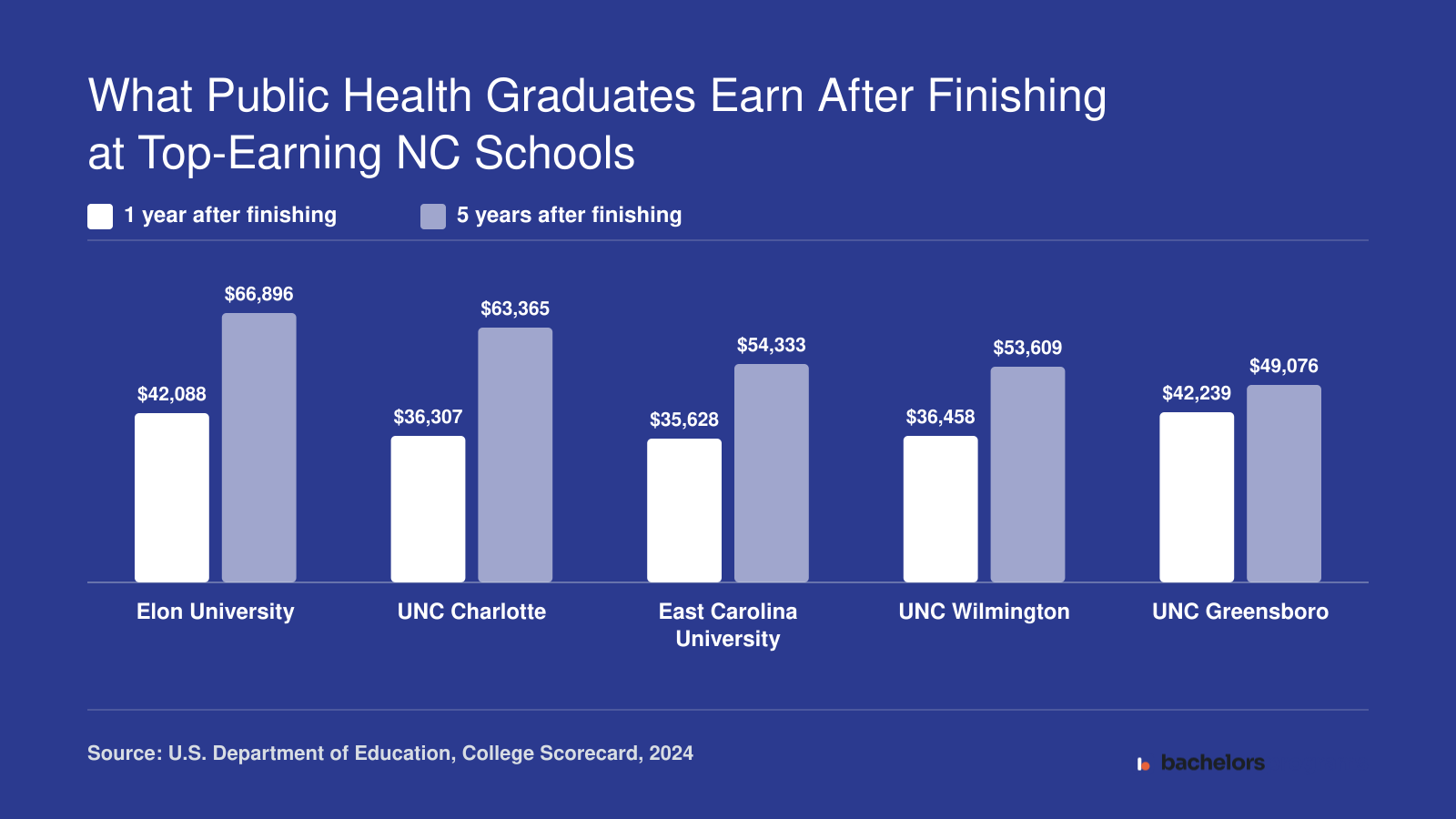
- Elon University graduates earn a $66,896 median five years after finishing.
- Most online public health options are degree-completion programs for transfer students.
Best Bachelor's Degree in Public Health Programs in North Carolina, Ranked
The ten programs below are the strongest bachelor's-level public health options based in North Carolina, spanning large public flagships, a private liberal arts university, two women's colleges, and one fully online completion degree. Each card gives the concentration or focus and the format, plus the approximate average net price after aid and the institution-wide graduation rate, which describes the whole school rather than the public health major alone. Twenty-three bachelor's programs in the field were considered for this list.
University of North Carolina at Chapel Hill
#1Chapel Hill, NC · ~$12,000/yr (est.)
Best for: Students choosing among five public health majors
UNC Chapel Hill is the state's flagship public university and home to the Gillings School of Global Public Health, which offers five separate Bachelor of Science in Public Health majors: biostatistics, community and global public health, environmental health sciences, health policy and management, and nutrition. Students apply to the major during sophomore year and begin public health coursework as juniors, in small, sequenced, in-person classes. Gillings also runs county health department partnerships and statewide workforce initiatives, so undergraduates learn inside a school that is wired into North Carolina public health practice.
- Five majors, from biostatistics to nutrition and health policy
- Apply during sophomore year; coursework begins junior year
- Prerequisite courses and two letters of recommendation required
- Assured Enrollment pathway into the Gillings School
- Small majors; one section per course
- In-person, daytime classes on the Chapel Hill campus
- CEPH accredited
Appalachian State University
#2Boone, NC · $8,000 – $25,000/yr (est.)
Best for: Future health educators wanting hands-on research
Appalachian State University sits in Boone and houses its public health bachelor's in the Beaver College of Health Sciences. The program is practice-focused, with a built-in internship, undergraduate research alongside faculty, and an accelerated route from the bachelor's into a master's. The university carries an R2 research classification and emphasizes high-impact learning, and majors have access to modern research facilities and an active Public Health Club.
- Internship built into the degree
- Accelerated bachelor's to master's pathway
- Coursework in health policy, ethics, and law
- Undergraduate research with faculty, presented at conferences
- R2 high research activity university
- Public Health Club for majors
- Based in the Beaver College of Health Sciences on the Boone campus
- CEPH accredited
University of North Carolina at Charlotte
#3Charlotte, NC · $15,000 – $20,000/yr (est.)
Best for: Charlotte-area students wanting a city practicum
UNC Charlotte is the largest public university in the Charlotte region and offers the Bachelor of Science in Public Health through its Department of Public Health Sciences. The degree is deliberately interdisciplinary, pairing the five public health core areas with a required minor, an internship, and a capstone. Graduates leave prepared for the Certified Health Education Specialist exam and for jobs in health departments, hospitals, community organizations, and corporate wellness programs.
- Covers health behavior, epidemiology, environmental health, biostatistics, administration
- Required minor adds an interdisciplinary focus
- Internship and capstone required
- Prepares students for the Certified Health Education Specialist exam
- Focus on population health rather than individual treatment
- Campus-based in Charlotte
- CEPH accredited
University of North Carolina Wilmington
#4Wilmington, NC · $7,000 – $24,000/yr (est.)
UNC Wilmington offers a public health bachelor's with four concentrations: Community Health Education, Global Health, Gerontology, and Pre-Clinical Health. The Pre-Clinical track is built for students aiming at medicine, dentistry, nursing, or nutrition, while gerontology students can move into a 4+1 master's pathway. The program reports strong placement into employment or continuing education within a year of graduation.
- Four concentrations: Community Health Education, Global Health, Gerontology, Pre-Clinical
- 2.5 GPA minimum for the major
- Community Health Education and Global Health tracks lead to the CHES exam
- 4+1 pathway to a master's in applied gerontology
- Pre-Clinical track prepares for medicine, dentistry, nursing, nutrition
- CEPH accredited
East Carolina University
#5Greenville, NC · ~$16,000/yr (est.)
East Carolina University in Greenville runs a large public health bachelor's program built around a community health concentration inside a 120-credit degree. It is a practice-heavy curriculum: needs assessment, program planning and evaluation, health equity, and a required health education internship plus a capstone. Students with an interest in aging, environmental health, or health promotion can specialize within the major.
- Community Health concentration
- 120 credit hours total
- Required health education internship and capstone
- Declare the major by 75 credit hours
- Specialty coursework in gerontology and environmental health
- Three concentration options
- No credit for life experience
- CEPH accredited
University of North Carolina at Greensboro
#6Greensboro, NC · $11,000/yr (est. net price)
UNC Greensboro offers its public health education bachelor's as a fully online degree completion program aimed at adults who already hold an associate's or bachelor's degree. Students take social and behavioral sciences, epidemiology, public health statistics, and health policy and administration without relocating to campus. The program is designed to feed graduates into government, nonprofit, and community health roles, or into graduate study.
- Fully online degree completion, no campus relocation
- Requires a prior associate's or bachelor's degree
- Health Studies concentration
- Coursework in epidemiology, public health statistics, and health policy
- Prepares for government, nonprofit, and community health roles
- Faculty are research-active
- CEPH accredited
Elon University
#7Elon, NC · ~$42,000/yr (est.)
Elon University is a private liberal arts university whose public health major is a Bachelor of Arts built on a population health framework. Coursework crosses the social, environmental, and biological determinants of health, with a strong thread of health equity at the local, national, and global level. It suits students who want a broad liberal arts base before entering the workforce or moving into graduate study in public health, medicine, or policy.
- Bachelor of Arts built on a population health framework
- Interdisciplinary look at social, environmental, and biological determinants
- Health equity focus at local, national, and global levels
- Prepares for public health careers or graduate study
Meredith College
#8Raleigh, NC · ~$22,000/yr (est.)
Meredith College is a women's college in Raleigh, and its public health major combines a liberal arts core with epidemiology and environmental health coursework. Students work in the Science and Mathematics Building, which holds 13 dedicated research labs, and many complete faculty-mentored undergraduate research on topics such as malaria interventions and prenatal services. The Raleigh location puts internships with Research Triangle employers within reach.
- Concentrations include epidemiology and environmental health
- 13 dedicated research labs in the Science and Mathematics Building
- Faculty-mentored undergraduate research, from malaria to prenatal care
- Internships with Research Triangle employers
- Prepares for epidemiologist, toxicologist, and health director roles
Fayetteville State University
#9Fayetteville, NC · $4,400 – $8,000/yr (est.)
Fayetteville State University is a public historically Black university offering a Bachelor of Science in Public Health with a community health concentration. The degree leans on social and behavioral health theory, community needs assessment, and program planning and evaluation, capped by a 350-hour supervised internship in the final semester. Graduates typically move into community health educator, epidemiology, or worksite health roles in health departments, nonprofits, and extension agencies.
- Community Health concentration
- 350-hour supervised internship in the final semester
- Internships offered in fall and spring
- Coursework in social and behavioral health theory
- Training in needs assessment and program evaluation
- Historically Black university in Fayetteville
Salem College
#10Winston-Salem, NC · $18,000/yr (est. net price)
Salem College is a small women's college in Winston-Salem with an interdisciplinary public health major that looks at how social, environmental, biological, and economic forces shape community health. Students examine population and global health and the effects of race, gender, and identity, with health equity and prevention as the through line. A required internship and preparation for the Certified Health Education Specialist exam round out the degree.
- Interdisciplinary major spanning social, environmental, biological, economic factors
- Required internship
- Prepares students for the Certified Health Education Specialist exam
- Focus on population health, global health, and health equity
- Examines race, gender, and identity in health outcomes
- Pathway to graduate study in public health, nutrition, medicine, social work
Cost & outcomes by school
Federal data for the highest-earning Public Health programs, independent of the ranking above. Earnings are this field's bachelor's graduates four years after completing where the Scorecard reports them, else the school's undergraduate median.
| School | Net price / yr | Grad rate | Earnings | Debt | Grads/yr | Format |
|---|---|---|---|---|---|---|
| Elon University NC | $41,555 | 84% | $81,153 | $20,500 | 36 | Campus |
| University of North Carolina at Chapel Hill NC | $11,655 | 91% | $72,200 | $14,000 | 39 | Campus |
| University of North Carolina at Charlotte NC | $15,435 | 69% | $63,965 | $27,000 | 53 | Campus |
| University of North Carolina Wilmington NC | $20,109 | 71% | $60,722 | $21,458 | 95 | Campus |
| East Carolina University NC | $15,739 | 63% | $59,566 | $25,000 | 211 | Campus |
| University of North Carolina at Greensboro NC | $10,965 | 56% | $53,124 | $24,966 | 92 | Online |
| Wingate University NC | $20,748 | 46% | $52,649 | $25,000 | 10 | Campus |
| Meredith College NC | $22,488 | 70% | $51,539 | $27,000 | 11 | Campus |
| Appalachian State University NC | $16,836 | 75% | $49,039 | $19,000 | 67 | Campus |
| Methodist University NC | $24,704 | 44% | $48,050 | $27,000 | — | Campus |
| Guilford College NC | $22,270 | 46% | $47,590 | $26,000 | 2 | Campus |
| Greensboro College NC | $17,882 | 46% | $46,566 | $25,607 | — | Campus |
Sources: U.S. Department of Education. Net price, graduation rate, earnings and debt: College Scorecard (earnings and debt for this field's bachelor's graduates where reported, else school-wide); graduates: IPEDS. A dash means no figure is reported.
Cost, debt & payoff
Median earnings of this field's bachelor's graduates (4 yrs after completing, else the school's undergraduate median) vs. their median federal loan debt · U.S. College Scorecard
Across these programs the median graduate earns about $46,566 and finishes with roughly $25,813 in debt — a ratio that clears a common rule of thumb (keep debt below first-year salary). Net price and debt vary widely school to school, so check the per-school figures in the table above before you shortlist.
How We Ranked North Carolina Public Health Schools
Prestige in public health is usually measured at the graduate level, which is useful if you are picking a master's program but says little about what four undergraduate years will cost, whether students actually finish, or whether you can complete the degree online while working. This ranking is built around those undergraduate questions instead.
What Goes Into the Ranking
The ranking draws on federal data: College Scorecard earnings and completion figures, plus IPEDS tuition and net price figures. We also record program format, because a campus program, a fully online program and a hybrid one produce very different four-year costs and weekly schedules. Every school ranked here offers a bachelor's-level public health credential, and several offer it fully online.
Two Numbers That Are Not About the Program
Both figures describe the whole institution, not the public health department. Read them as context rather than program results. A strong completion rate and a moderate net price suggest a campus where students persist and costs stay predictable, but the department's own credit load, prerequisites and field placement hours still belong on your checklist.
The Takeaways
- Outcomes over reputation: earnings and completion data describe what happened to real graduates, not how famous the faculty are.
- Costs you can compare: published tuition and net price after aid let you line up schools on the same footing.
- Format is part of the value: an online or hybrid option at a North Carolina school can cut housing and commute costs.
- A starting point, not a verdict: use the ranking to build a shortlist, then ask each program about internships and practicum placements in North Carolina.
Most Affordable Public Health Bachelor's Programs in North Carolina
These public health bachelor's programs are ordered by average annual net price, which is what students actually pay after grants and scholarships. Fayetteville State University has the lowest net price in this table at $7,892 a year, and UNC Chapel Hill pairs a net price under $12,000 with the lowest median graduate debt and the highest graduation rate shown. All figures are institution-wide and come from the U.S. Department of Education's IPEDS and College Scorecard data (2024).
| School | City | Format | In-State Tuition and Fees | Average Net Price After Aid | Graduation Rate | Median Graduate Debt |
|---|---|---|---|---|---|---|
| Fayetteville State University | Fayetteville | Campus | $4,353 | $7,892 | 38% | $22,987 |
| University of North Carolina at Greensboro | Greensboro | Online | $7,661 | $10,965 | 56% | $22,858 |
| University of North Carolina at Chapel Hill | Chapel Hill | Campus | $8,994 | $11,655 | 91% | $14,000 |
| North Carolina Central University | Durham | Campus | $6,699 | $15,359 | 42% | $28,250 |
| University of North Carolina at Charlotte | Charlotte | Campus | $7,239 | $15,435 | 69% | $21,500 |
Cost of a Public Health Bachelor's Degree in North Carolina
Sticker price and net price answer two different questions for a North Carolina public health bachelor's. One is what a school publishes; the other is what families actually pay once grants and scholarships are counted. For most students, only the second number decides whether the degree is affordable.
Public and Private Sticker Prices
Among the public universities ranked here, in-state tuition starts at $4,353 a year at Fayetteville State and reaches $8,994 at UNC Chapel Hill, with Appalachian State, UNC Charlotte, UNCW, ECU and UNCG between roughly $7,200 and $7,700. Out-of-state rates run from $22,492 to $41,203. Private options start higher: Salem lists $33,848, Meredith $45,630 and Elon $46,958.
What Families Actually Pay
Aid narrows that gap considerably. Average net price is $7,892 at Fayetteville State, $10,965 at UNCG and $11,655 at UNC Chapel Hill. Salem's net price falls to $18,277 and Meredith's to $22,488, while Elon's stays near $41,555. Net price is the figure to compare because it already reflects the grant aid most students receive.
North Carolina Aid for In-State Students
- NC Promise: $500 per semester in-state tuition at participating UNC System campuses, including Fayetteville State, and $2,500 out of state.1 It covers tuition only, so add fees and living costs.
- NC Education Lottery Scholarship: up to $3,768, need-based and considered automatically after you file the FAFSA.2 You need NC residency for tuition purposes, at least 6 credit hours, Pell eligibility and satisfactory academic progress.2 Funds run out, so file early.
- NC Need Based Scholarship for Private College Students: for NC residents with financial need enrolled at least half time at an eligible independent nonprofit campus.3
- Forgivable Education Loans for Service: up to $7,000 for a bachelor's, but it is a loan forgiven through service, not a grant.4
Cutting the Bill
- Transfer from a North Carolina community college, and confirm which credits the public health major accepts before enrolling.
- Qualify for in-state residency, which at some campuses separates roughly $7,000 from $24,000 in tuition.
- File the FAFSA when it opens on October 1.2
Online and Hybrid Public Health Bachelor's Degrees at North Carolina Schools
An online or hybrid public health bachelor's in North Carolina is rarely a fully remote four-year degree. More often it is a degree-completion program: students bring general education and prerequisite credits from another school, then finish the upper division of a Bachelor of Science in Public Health from home. That distinction matters when you compare formats, because it decides who can enroll and how much of the degree happens online.
Fully Online Degree-Completion Paths
Fully online options are limited among the schools here, but a few are well established. UNC Greensboro's B.S. in Public Health Education offers a Health Studies Online concentration, with students entering in fall of junior year and finishing in about 24 months full time or on a part-time schedule.1 Appalachian State's online B.S. in Health Promotion is part time and year-round, typically 10 semesters, and requires at least 30 transferable credits plus a 320-hour internship. North Carolina Central University's Online Flight Path is built for working adults 25 and older; it requires 120 semester hours, with the final 30 completed at NCCU.2
Campus-Based Programs
UNC-Chapel Hill's B.S. in Public Health, with five majors and a required practicum, is campus-based; its undergraduate handbook caps online coursework at 24 credits. UNC Wilmington reports that most core and concentration public health courses are face to face.4 UNC Charlotte, East Carolina, Elon, Meredith, Fayetteville State and Salem also deliver their public health majors on campus. Hybrid formats are not a major option among these schools, so most choices come down to a fully online completion year or an in-person degree.
Who Each Format Suits
Online completion works best for working adults and transfer students who already hold credits and need flexibility. Campus study suits students who want labs, faculty research and structured internship placement. Before enrolling online, ask where the required fieldwork happens: Appalachian State's internship runs 320 hours, and ask UNCG and NCCU whether any in-person attendance is expected.
Related Articles
What Public Health Graduates Earn After Finishing at Top-Earning NC Schools
Five years after finishing a bachelor's degree in public health, Elon University graduates report median earnings of $66,896, ahead of UNC Charlotte ($63,365), East Carolina University ($54,333), UNC Wilmington ($53,609) and UNC Greensboro ($49,076). One year after finishing, the band is much tighter, running from $35,628 at East Carolina to $42,239 at UNC Greensboro. Because starting pay at these schools sits in a narrow band, the wider gap at five years likely reflects career moves and further study after the first job as much as the school itself.
Compare Public Health programs on the data that matters
Explore more Healthcare majors or browse every field of study.
All Healthcare programs Browse every field of study