Best Speech Pathology Schools in Ohio
Compare 12 accredited Speech Pathology programs in Ohio, with net price after aid, graduation rates, earnings and debt from IPEDS and the U.S. College Scorecard.
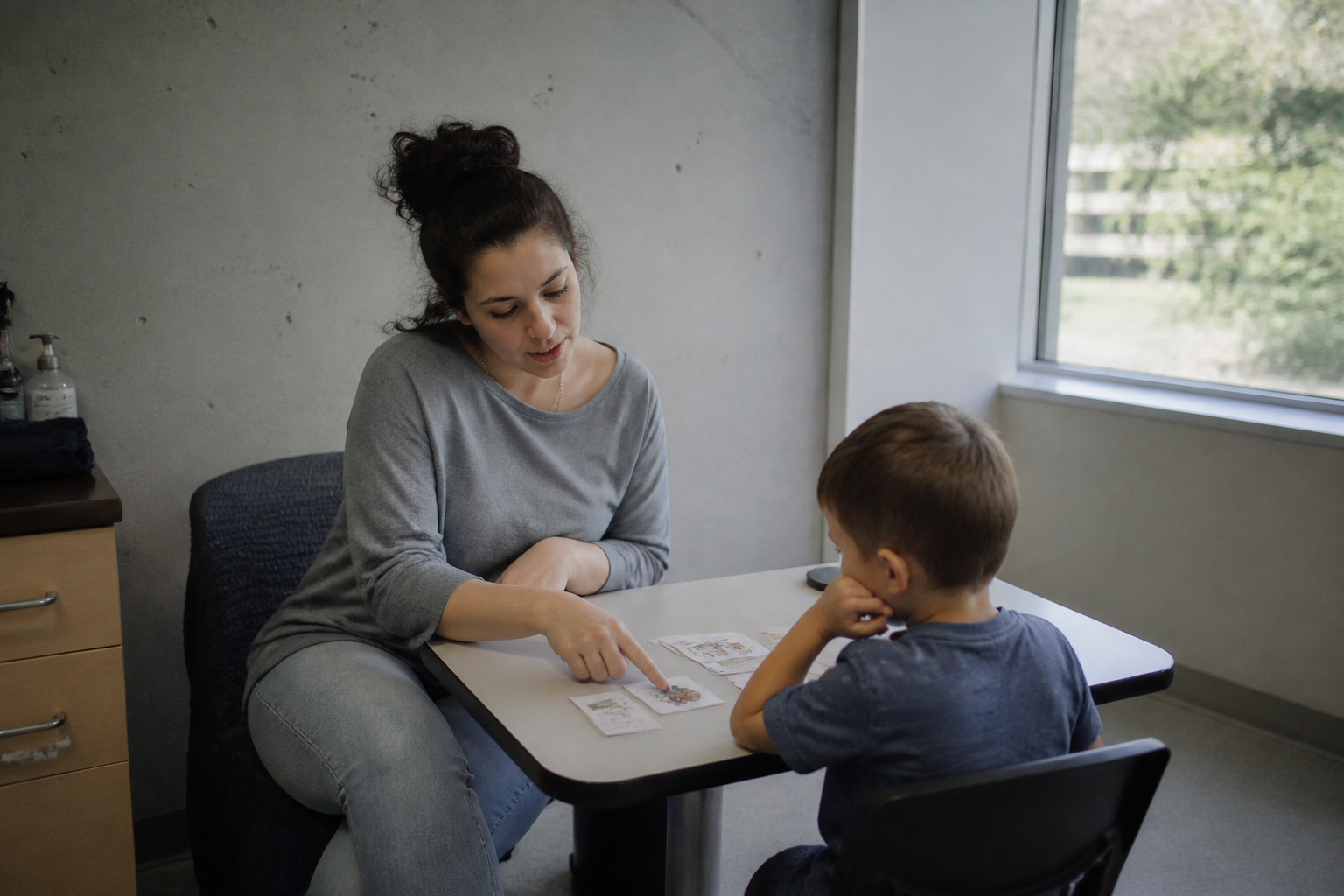
Ohio licenses speech-language pathologists only at the master's level, and the bachelor's degree in speech pathology, usually a Bachelor of Science (B.S.), is the pre-professional step that gets a student there. Depending on the campus, the major is called Speech Pathology, Speech-Language Pathology, or Communication Sciences and Disorders (CSD).
The differences that matter are not in the label. Tuition and fees at Ohio's public universities run from about $12,744 to $18,161 a year; Case Western Reserve publishes $66,608. Cost alone reshapes the shortlist.
Net price after aid narrows some of that gap but not all of it, and the clinical credential itself is only earned in the master's program Ohio licensure requires.
Key Points
- In-state tuition and fees start at $12,744 at ranked public universities.
- Getting into the major often requires meeting a separate GPA threshold.
- Ohio's Speech and Hearing Professionals Board requires a master's for SLP licensure.
Best Bachelor's Degree in Speech Pathology Schools in Ohio
Each card below names the major the way the school itself names it, so you will see speech pathology, speech-language pathology and communication sciences and disorders across the list. Compare the details that shape four years of study: what the core coursework covers, how much clinical or observation time is built in, and where graduates typically go next.
Ohio State University
#1Columbus, OH · $17,000/yr (est. net price)
Best for: Research-minded students near Columbus
Ohio State is the largest public university in Ohio, and its speech and hearing science major sits in the College of Arts and Sciences on the Columbus campus. Majors take nine core courses in speech and hearing science plus two approved 5000-level courses, and the American Sign Language sequence can satisfy the foreign language requirement. The department keeps a student chapter of the national SLP association and offers study abroad and honors thesis options, which gives majors research and professional exposure beyond the classroom.
- Nine core courses in speech and hearing science plus two 5000-level courses
- American Sign Language series can meet the foreign language requirement
- Incoming students should have biology, psychology and math; College Algebra minimum
- Honors thesis option; 10 to 20% of seniors complete one
- Research participation can earn extra credit
- Student chapter of the national SLP association
- Study abroad opportunities available
University of Cincinnati
#2Cincinnati, OH · ~$26,000/yr (est.)
Best for: Students wanting an accelerated three-year route
The University of Cincinnati awards a B.S. in Speech Language Hearing Sciences as a pre-professional program in communication disorders. Students work through Tier 1 and Tier 2 coursework of roughly 15 to 17 credits each, and those who finish Tier 1 of the SLHS track can complete the degree in three years. Listed career paths run from audiology and speech-language pathology to hearing aid specialist, special education teaching and research.
- Tier 1 and Tier 2 coursework, roughly 15 to 17 credits each
- Degree can be finished in three years after completing Tier 1
- Tier 1 includes composition, psychology, introductory biology and a foreign language
- Pre-professional track for audiology or speech-language pathology graduate study
- Career paths include audiology, SLP, hearing aid specialist and special education
Miami University
#3Oxford, OH · $18,000 – $41,000/yr (est.)
Best for: Hands-on learners seeking early clinical experience
Miami University's Oxford campus runs a 64-credit speech pathology and audiology major that combines both sides of the field rather than narrowing to one. A required junior clinical experience and a senior seminar capstone give students hands-on exposure and a chance to reflect on clinical practice before applying to graduate programs. Required supporting work in biology, physics, psychology and statistics supplies the scientific base that graduate admissions committees look for.
- 64-credit major combining speech pathology and audiology
- Required junior clinical experience plus senior seminar capstone
- Coursework in neurology, aural rehabilitation and clinical phonetics
- Required supporting courses in biology, physics, psychology and statistics
- Includes augmentative communication and counseling strategies
Case Western Reserve University
#4Cleveland, OH · ~$41,000/yr (est.)
Case Western Reserve University is a private research university in Cleveland, and its communication sciences major is housed in the Department of Psychological Sciences within the College of Arts and Sciences. The 45-credit major covers communication disorders, phonetics, language development, speech and hearing science, audiology and clinical practice, with room for graduate-level electives taken with permission. Juniors with strong grades can apply to the honors program and complete an independent project, which suits students aiming at research or competitive graduate admission.
- 45-credit B.A. major in communication sciences
- Core courses include phonetics, language development and introduction to audiology
- Introduction to Clinical Practice in Speech-Language Pathology is required
- 400- and 500-level graduate courses open with permission
- Honors program for juniors with a 3.0 overall and 3.25 major GPA
- Coursework covers the ASHA Code of Ethics
Mount Vernon Nazarene University
#5Mount Vernon, OH · ~$22,000/yr (est.)
Mount Vernon Nazarene University is a private Christian university in Mount Vernon with a communication sciences and disorders program built around an on-campus speech and hearing clinic. Students gain assessment and intervention experience with real clients while working through a faith-integrated curriculum, and the program reports a 100% graduate school placement rate. Travel and service mission trips round out a small-cohort experience with heavy faculty mentorship.
- Hands-on clinical practice at the on-campus speech and hearing clinic
- Reports a 100% graduate school placement rate
- Faith-integrated curriculum with travel and service mission trips
- Prepares for SLP, audiology, SLPA and early intervention careers
- Financial aid and scholarships available
- Small cohorts with experienced faculty mentorship
Bowling Green State University
#6Bowling Green, OH · ~$24,000/yr (est.)
Bowling Green State University offers a B.S. in Communication Disorders with a required capstone that includes guided observation hours and practice writing treatment goals, therapy plans and summary notes. Core coursework runs from phonetics and the anatomy of the speech mechanism to acoustics, language assessment and introduction to audiology. Students can join an active NSSLHA chapter, do research alongside faculty and doctoral students, and add a minor in communication sciences and disorders.
- Capstone includes guided observation hours and treatment-plan writing
- Core coursework in phonetics, acoustics and anatomy of the speech mechanism
- Minor in communication sciences and disorders available
- Active NSSLHA chapter; research with faculty and doctoral students
- Living-learning community for health professions students
University of Akron
#7Akron, OH · $10,000 – $15,000/yr (est.)
The University of Akron's speech-language pathology and audiology program is among the more flexible in Ohio, with in-person, hybrid and online courses and an accelerated pathway that lets eligible students begin graduate coursework early. Undergraduates complete 25 supervised observation hours and can join an active NSSLHA chapter. Akron also partners with the University of Cincinnati on a collaborative online master's program for students who continue in the field.
- 25 supervised observation hours required
- In-person, hybrid and online course options
- Accelerated pathway lets eligible students start graduate coursework early
- 2.8 GPA minimum for the major
- Active NSSLHA student chapter
- Scholarships and financial aid available
Cleveland State University
#8Cleveland, OH · $15,000/yr (est. net price)
Cleveland State University's B.A. in Communication Sciences and Disorders mixes biology, psychology, sociology and linguistics with phonetics, audiology, speech and hearing science and aural rehabilitation. Students get clinical exposure in the on-campus Speech and Hearing Clinic under licensed professionals, and honors students choose from research, clinical or cultural competency tracks. A required senior capstone and a cultural diversity course complete the 43-credit major.
- 43-credit major with a required senior capstone
- Clinical practicum in the on-campus Speech and Hearing Clinic
- Honors tracks in research, clinical practice or cultural competency
- Interdisciplinary coursework in biology, psychology and linguistics
- American Sign Language coursework included
- Cultural diversity course required
University of Toledo
#9Toledo, OH · $13,000 – $22,000/yr (est.)
The University of Toledo runs a B.S. in Speech-Language Pathology that stands out for offering undergraduate clinical hours and practicum rather than observation alone. Toledo also gives eligible undergraduates a direct in-state pathway, with automatic admission to its accredited graduate SLP program for students who meet the criteria.
- 124 total credit hours with a 3.0 GPA minimum
- 25 clinical hours plus undergraduate practicum experience
- One of the few Ohio programs offering undergraduate clinical hours
- Average class size of about 30 students
- Eligible students may earn automatic admission to Toledo's graduate SLP program
Kent State University
#10Kent, OH · ~$21,000/yr (est.)
Kent State University's B.S. in Speech Pathology and Audiology covers anatomy and physiology of speech and hearing, phonetics, language development, audiology and clinical procedures, with separate clinical preparation courses in audiology and in speech-language pathology. A combined bachelor's and master's option lets students count up to 9 graduate credits toward the undergraduate degree. Admission to the professional phase is separate from admission to the university and requires a 3.0 GPA.
- 120 total credit hours; 3.0 GPA required for the professional phase
- Combined bachelor's/master's option counts up to 9 graduate credits
- Clinical preparation courses in both audiology and speech-language pathology
- Three application cycles for the professional phase
- NSSLHA student organization available
- In-person delivery on the Kent Campus
Cost & outcomes by school
Federal data for the highest-earning Speech Pathology programs, independent of the ranking above. Earnings are this field's bachelor's graduates four years after completing where the Scorecard reports them, else the school's undergraduate median.
| School | Net price / yr | Grad rate | Earnings | Debt | Grads/yr | Format |
|---|---|---|---|---|---|---|
| Case Western Reserve University OH | $41,190 | 87% | $87,989 | $24,000 | 15 | Campus |
| Miami University OH | $28,384 | 80% | $62,575 | $25,000 | 53 | Campus |
| University of Akron OH | $13,946 | 52% | $58,249 | $21,500 | 20 | Hybrid |
| Ohio State University OH | $17,339 | 88% | $57,797 | $18,425 | 102 | Campus |
| Bowling Green State University OH | $24,022 | 64% | $57,196 | $23,251 | 32 | Campus |
| Kent State University OH | $20,787 | 64% | $56,386 | $21,050 | 42 | Campus |
| Miami University-Hamilton OH | $11,286 | 25% | $55,076 | $23,000 | — | Campus |
| Baldwin Wallace University OH | $27,603 | 67% | $54,122 | $27,000 | 3 | Campus |
| Cleveland State University OH | $14,764 | 51% | $51,540 | $19,500 | 18 | Campus |
| University of Toledo OH | $17,249 | 57% | $50,632 | $22,250 | 35 | Campus |
| Mount Vernon Nazarene University OH | $22,421 | 68% | $49,555 | $25,000 | 6 | Campus |
| Bluffton University OH | $19,943 | 53% | $49,547 | $27,000 | 1 | Campus |
Sources: U.S. Department of Education. Net price, graduation rate, earnings and debt: College Scorecard (earnings and debt for this field's bachelor's graduates where reported, else school-wide); graduates: IPEDS. A dash means no figure is reported.
Cost, debt & payoff
Median earnings of this field's bachelor's graduates (4 yrs after completing, else the school's undergraduate median) vs. their median federal loan debt · U.S. College Scorecard
Across these programs the median graduate earns about $55,731 and finishes with roughly $23,126 in debt — a ratio that clears a common rule of thumb (keep debt below first-year salary). Net price and debt vary widely school to school, so check the per-school figures in the table above before you shortlist.
How We Ranked Ohio Bachelor's Programs in Speech Pathology
What actually separates one Ohio speech pathology bachelor's program from another once you look past the campus tour?
What We Compare
Every program on this list awards a bachelor's degree in speech pathology, most often a B.S., though several schools title the major communication sciences and disorders. All are based at Ohio institutions and appear whether you would study on campus, online or in a hybrid format.
Cost carries real weight: published tuition first, then net price after federal, state and institutional aid, because sticker price rarely matches the bill a family actually pays. We also weigh typical debt at graduation and the earnings of graduates a few years into their careers. Each school's graduation rate and its delivery format round out the picture. The underlying figures come from federal College Scorecard and IPEDS data.
Where the Numbers Stop Short
None of these measures describes the speech pathology major by itself. The graduation rate and the net price are institution-wide averages, and the price is an estimate: your residency, housing choices and aid offer will move it in either direction. Use the ranking as a starting filter, then check each program's own pages for the details that matter to you.
What This List Is Not
A bachelor's degree is the pre-professional step in this field. Licensure as a speech-language pathologist in Ohio requires a master's degree, so this page neither ranks nor recommends graduate programs. Only schools offering the undergraduate credential were considered.
Cheapest Ohio Speech Pathology Bachelor's Programs by Net Price and Debt
These Ohio programs are sorted by average annual net price, which is the cost after grants and scholarships, using IPEDS and College Scorecard data from the U.S. Department of Education. Miami University-Hamilton, a regional campus in our directory, has the lowest net price at $11,286. Among the ranked schools, the University of Akron is lowest at $13,946. Mount St. Joseph University shows how much aid can matter: its $38,150 published tuition drops to a $16,530 average net price.
| School | Program | Format | In-State Tuition and Fees | Average Annual Net Price | Median Debt at Graduation (School-Wide) |
|---|---|---|---|---|---|
| Miami University-Hamilton | Speech Pathology and Audiology B.S. | Campus | $7,491 | $11,286 | $23,000 |
| University of Akron | Speech Language Pathology & Audiology | Hybrid | $13,135 | $13,946 | $23,250 |
| Cleveland State University | Bachelor of Arts in Communication Sciences and Disorders | Campus | $12,988 | $14,764 | $21,797 |
| Mount St. Joseph University | Speech, Language, and Hearing Sciences | Campus | $38,150 | $16,530 | $26,827 |
| University of Toledo | Speech-Language Pathology | Campus | $12,744 | $17,249 | $22,250 |
What a Speech Pathology Bachelor's Degree Costs in Ohio
Tuition is the sticker price a college publishes; net price is what a family actually pays after grants and scholarships are applied. At the public universities ranked here that publish rates, in-state tuition and required fees fall between $12,744 at the University of Toledo and $13,244 at Ohio State University. Out-of-state rates on those campuses run from $18,510 at Cleveland State University to $40,022 at Ohio State. Mount Vernon Nazarene University, a private school, lists $37,158 for students from any state.
After aid, the average net price comes to $13,946 at the University of Akron, $17,339 at Ohio State and $22,421 at Mount Vernon Nazarene. Those are averages for first-year students receiving federal aid, not a quote for your family. Your number depends on household income, residency, merit awards and whether outside scholarships stack on top of institutional aid. Median federal debt among graduates who borrowed is reported at $19,976 for Ohio State, $24,500 for Kent State and $25,000 for Mount Vernon Nazarene.
Sticker Price Versus Net Price
The gap is widest at private universities, where a high published rate often comes with substantial institutional grants. Public universities hold in-state charges down through state funding, so sticker and net price land closer together. Neither number covers everything. Clinical, laboratory or technology fees for a speech pathology major may be billed separately, so ask the department what the full degree costs.
Ohio Aid You Should Apply For
- Ohio College Opportunity Grant: for Ohio residents in a first bachelor's program, with a Student Aid Index of $3,750 or less and household income at or below $96,000. The maximum award is $4,000 at public universities and $5,000 at private nonprofits; not every eligible student receives the maximum.1
- Ohio Tuition Guarantee: participating public universities lock tuition and required fees at the rate set for a student's entering class for four years.
- School scholarships: departmental awards often weigh academic record, talent, residency and intended major.
Practical Ways to Cut the Bill
- Complete general education at a community college, then confirm in writing that credits transfer into the speech pathology major.
- Check the tuition guarantee page before you commit, since rates differ by campus and entry year.
- File the FAFSA early and apply for departmental scholarships, which are often small but renewable.
Related Articles
Admission Requirements for Ohio Speech Pathology Bachelor's Programs
The real decision is less about getting into the university than about getting into, and staying in, the major. At most Ohio schools offering a bachelor's in speech pathology, the first hurdle is general admission. The second is a GPA bar or a prerequisite sequence inside the department, and that gate is where plans can stall.
University Admission vs. Entry to the Major
Several programs publish a major-level grade expectation. The University of Toledo lists a 3.0 GPA minimum for its Speech-Language Pathology program. Kent State University also lists a 3.0 minimum and moves students into a professional phase with three application cycles, so you enter the university first and apply to the upper-division major later. Ohio State University and the University of Akron both note that prerequisite courses are required. Case Western Reserve University opens its Communication Sciences honors program to juniors with a 3.0 GPA.
For the other schools, our data shows no separate major-entry GPA. That does not mean none exists. Treat university admission standards as the baseline and confirm with the department whether you enter the major directly or declare it after your first year.
How Selective These Schools Are
Admission rates span a wide range, from about 37 percent at Case Western Reserve to about 92 percent at the University of Toledo. Cleveland State University (about 91 percent), Kent State (about 86 percent) and the University of Cincinnati (about 85 percent) admit most applicants. Ohio State and Akron sit near 60 percent.
The share of students receiving Pell Grants runs from about 32 percent at Case Western Reserve to about 61 percent at Cleveland State. Most of the public universities fall in the 48 to 60 percent range. Outside Case Western Reserve, admission to the university is achievable for most solid applicants. Keeping the grades the major requires is the harder part.
Test Scores and Transfer Credit
Test policies vary by school and change often. Many Ohio universities now accept applications without SAT or ACT scores, but check each admissions page for the current year rather than assuming.
If you start at a community college, Ohio's statewide transfer framework (Ohio Transfer 36) helps general education courses move between public institutions. Speech pathology departments usually evaluate major coursework, such as phonetics or anatomy of speech and hearing, on a course-by-course basis. Ask the department before you enroll. Where a school's site lists no transfer rule specific to the major, get the answer in writing from an advisor.
What to Prepare
- Transcripts: High school records, plus every college transcript if you are transferring.
- Test scores: Only if the school requires them, or if your scores strengthen the application.
- Major GPA target: Plan to hold at least a 3.0 where programs such as Toledo and Kent State set that bar.
- Prerequisites: Confirm required introductory courses at Ohio State, Akron and any school with a professional-phase application.
- Declaration timeline: Note when and how you formally enter the major, including application deadlines.
Ohio Speech-Language Pathologist Licensure at a Glance
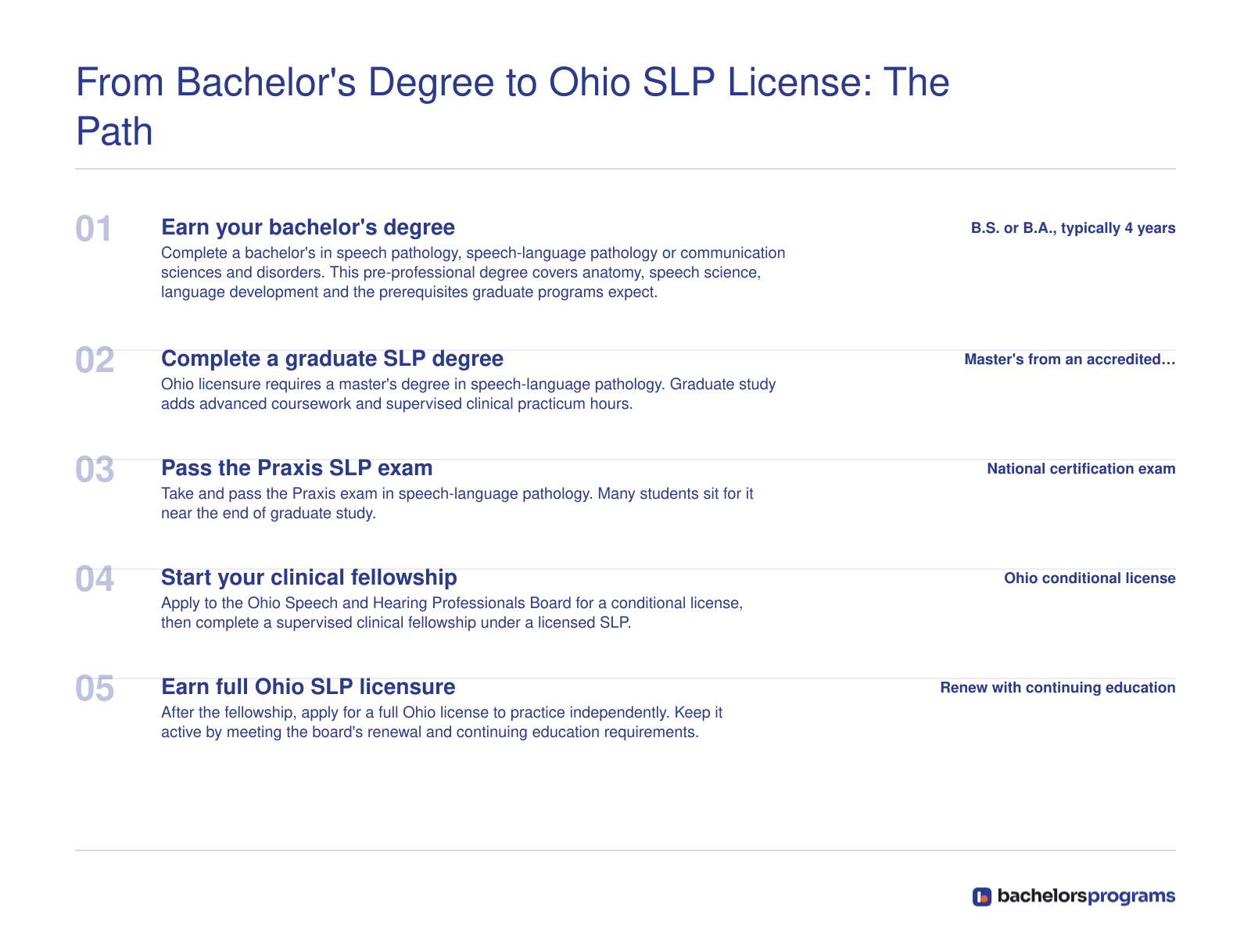
From Bachelor's Degree to Ohio SLP License: The Path
A bachelor's degree in speech pathology or communication sciences and disorders is the first step toward practice, not the finish line. Ohio requires a master's degree, a national exam and supervised professional experience before a speech-language pathologist can practice independently. Here is the order most students follow.
Compare Speech Pathology programs on the data that matters
Explore more Communications & Media majors or browse every field of study.
All Communications & Media programs Browse every field of study