Best Cybersecurity Schools in Ohio
Compare 50 accredited Cybersecurity programs in Ohio at 39 colleges, with net price after aid, graduation rates, earnings and debt from IPEDS and the U.S. College Scorecard.

Ohio offers two routes to the same credential: a large public university with paid co-op terms, or a small private or regional campus with tighter cohorts. The usual credential is a Bachelor of Science (B.S.) in Cybersecurity, though schools here also file it under computer science, information technology, or engineering.
You can finish a cybersecurity bachelor's degree on campus, online, or at a branch campus, and format shapes cost as much as tuition does.
Coursework converges on networks, cryptography, and incident response; what separates programs is price after aid and whether the calendar fits a working student.
Key Points
- University of Cincinnati's ABET-accredited cybersecurity B.S. includes five semesters of paid co-op.
- Akron, Cincinnati, Dayton and Youngstown State hold 2026 CAE-CD designations.
- Ohio University's Eastern, Zanesville and Southern campuses charge residents $6,362 yearly.
Best Cybersecurity Schools in Ohio: 10 Top Bachelor's Programs
The best cybersecurity school in Ohio for a bachelor's degree is the University of Cincinnati, where an ABET-accredited B.S. in Cybersecurity includes five semesters of paid cooperative education and can be completed on campus or online. The ten entries below all award a bachelor's degree in cybersecurity or a closely named equivalent, ranging from large public research universities to regional campuses with lower sticker prices.
University of Cincinnati
#1Cincinnati, OH · ~$26,000/yr (est.)
Best for: Co-op seekers wanting paid security experience
Cincinnati's ABET-accredited B.S. in Cybersecurity pairs digital forensics, threat detection, and risk management with five semesters of paid cooperative education. A companion B.S. in Cybersecurity Engineering adds engineering depth, with concentrations in cyber-attack and defense or network and data security. The university houses the Ohio Cyber Range Institute and graduates about 75% of its students.
- ABET-accredited B.S. in Cybersecurity
- Five semesters of paid cooperative education
- Coursework in digital forensics, incident response, and threat detection
- Risk management and secure systems design in the curriculum
- Offered on campus and online
- 2.75 GPA required for freshmen and transfer applicants
- Freshmen deadline March 1; transfer deadline July 1
- 30 credit hour residency requirement
- Engineering-track B.S. in the College of Engineering
- Concentrations: cyber-attack and defense; network and data security
- Coursework in vulnerability testing and malware reverse engineering
- Undergraduate certificate in cyber operations available
- Integrates engineering and science prerequisites
- Rolling application deadlines; scholarship deadline November 1
Ohio Northern University
#2Ada, OH · $24,000/yr (est. net price)
Best for: Engineering majors adding a security concentration
Ohio Northern runs cybersecurity as a concentration inside its computer science, computer engineering, and electrical engineering degrees, at 128 to 131 credits with a senior capstone and a lab built on Metasploit, Wireshark, and Kali Linux. The university reports 99% of engineering graduates found work in their field within six months, and about 75% of its students finish a degree.
- Concentration inside computer science, computer engineering, or electrical engineering
- 128 to 131 credit hours plus a senior capstone project
- Five required cybersecurity courses and two electives
- Lab uses Metasploit, Wireshark, and Kali Linux
- Hackathons, competitions, internships, and co-ops
- School reports 99% engineering job placement within six months
- Housed in a 105,000-square-foot engineering facility
Youngstown State University
#3Youngstown, OH · ~$13,000/yr (est.)
Best for: Budget-minded students wanting a computer science core
Youngstown State's cybersecurity pathway is a track inside the B.S. in Computer Science, 120 to 124 semester hours with a built-in mathematics minor and coverage of encryption, forensics, information assurance, and secure design. It is among the lower-priced routes to the field on this list, and roughly half of the university's students complete a degree.
- Cybersecurity track inside the B.S. in Computer Science
- 120 to 124 semester hours with an embedded mathematics minor
- Coursework in encryption, forensics, information assurance, and secure design
- Covers software development, networking, and database management
- First-year success seminar and professional ethics course
- Four-year plan of study provided
Ohio University
#4Athens, OH · ~$22,000/yr (est.)
Ohio University awards a B.S. in Cybersecurity Engineering that blends electrical engineering, computer science, and security studies with lab work and a capstone, plus a cybersecurity track inside its information and telecommunication systems degree that carries a business minor. It is an Ohio Cyber Range regional programming center, and about 65% of students graduate.
- Combines electrical engineering, computer science, and security studies
- Covers hardware, software, and network security
- Hands-on labs plus a senior capstone project
- Tuition fixed through the Guarantee+ program
- Listed as an Ohio Cyber Range regional programming center
- Separate admissions paths for freshmen, transfers, and international students
- Cybersecurity track inside the information and telecommunication systems degree
- Business minor included, taught with the College of Business
- Four specialized cybersecurity courses plus three ITS electives
- Courses include encrypted communications and internet engineering
- Coding and scripting automation, statistics, and public speaking required
- Fixed tuition through Guarantee+
University of Akron
#5Akron, OH · $10,000 – $15,000/yr (est.)
Akron offers a cybersecurity option inside its B.S. in Computer Information Systems, with 120 credits and a first-year choice between networking and infrastructure security or software security, alongside a separate B.S. in Cyber Forensics. Both build in an internship or co-op, and about 52% of the university's students finish their degrees.
- 120 credits, including a 48-credit cybersecurity core
- Choose networking and infrastructure security or software security
- Internship or cooperative education work period built in
- Computer Literacy Placement test or CISS 105 with C- or better
- C or better in every major course; 2.0 CISS GPA
- Day and evening classes meet in computer labs
- 80-credit major core plus a forensics internship and capstone
- Includes criminal justice coursework, ethical hacking, and digital evidence
- Windows, file system, wireless, and network forensics courses
- Access to cyber range resources and the Musson ICS Testbed
- 2.0 GPA to declare; C or better in major courses
The University of Findlay
#6Findlay, OH · $25,000 – $30,000/yr (est.)
Findlay folds cybersecurity into a B.S. in Computer Science with an information assurance emphasis, covering network security, cryptography, and risk management alongside project management and analytics. Local employers such as Marathon Petroleum, General Electric, and CentraComm host students, and about 58% of undergraduates graduate.
- 120+ credits in the B.S. in Computer Science
- Emphasis covers network security, cryptography, and risk management
- Core includes project management, software engineering, and analytics
- Information Assurance Certificate also available
- Partners include Marathon Petroleum, General Electric, and CentraComm
- Student chapter of the ACM on campus
Miami University-Hamilton
#7Hamilton, OH · $7,000 – $19,000/yr (est.)
Miami University's Hamilton campus awards a B.S. in Cybersecurity that starts from foundational programming and moves into network, software, and human security, with preparation for Security+ and Certified Ethical Hacker exams. A second route, a B.S. in Information Technology with a cybersecurity and networking major, runs 98 credit hours. About 25% of students at this regional campus graduate.
- 74 to 75 credit hours in the major
- No prior computer experience required to start
- Prepares for Security+ and Certified Ethical Hacker exams
- Software, network, and human security coursework
- Departmental honors and a combined bachelor's/master's option
- 98 total credit hours
- Hands-on instruction in penetration testing and cryptography
- Prepares for CCNA Security, Security+, and Certified Ethical Hacker
- Includes database design, systems analysis, and project management
- Information Technology core plus technical electives
Kent State University at Stark
#8North Canton, OH · $11,000/yr (est. net price)
Kent State's Stark campus offers a cybersecurity concentration inside the computer science program that students can complete entirely at the North Canton location. It suits students who want a Kent State degree without moving to the main campus, and about 37% of students at the campus graduate.
- Cybersecurity concentration within the computer science program
- Can be completed entirely at the Stark campus in North Canton
- Standard undergraduate admissions requirements apply
Kent State University at Tuscarawas
#9New Philadelphia, OH · ~$13,000/yr (est.)
The cybersecurity engineering degree listed here is a 120-credit program accredited by ABET's Engineering Accreditation Commission, covering cryptology, network security with lab, IoT security, wireless mesh security, and forensic analysis, capped by a two-course senior design sequence. Instruction for the engineering program is in person at the Kent Campus, and roughly 38% of students at this regional campus graduate.
- 120 credit hours with a two-course engineering capstone
- Accredited by ABET's Engineering Accreditation Commission
- Coursework in cryptology, network security, IoT security, and forensic analysis
- New students need a 3.0 high school GPA and algebra II with a C
- Transfers need 12 college credits, a 3.000 GPA, and MATH 11022
- Instruction is in person at the Kent Campus
- Graduates work as penetration testers, SOC analysts, and cyber risk analysts
Kent State University at Ashtabula
#10Ashtabula, OH · ~$12,000/yr (est.)
Kent State's cybersecurity engineering degree follows an eight-semester, 120-credit roadmap from cryptology and network security through IoT and wireless mesh security to a two-course capstone, with selective admission at a 3.0 high school GPA for new students. Instruction is in person at the Kent Campus, and about 25% of students at the Ashtabula campus graduate.
- 120-credit, eight-semester plan of study provided
- Selective admission; 3.0 high school GPA for new students
- Covers wireless mesh network security and network instrumentation
- Two-course capstone completed in the same academic year
- 2.5 major GPA required to graduate
- Enrollment reached 57 students in 2026
- Educational partnership agreement with the NSA
Cost & outcomes by school
Federal data for the highest-earning Cybersecurity programs, independent of the ranking above. Earnings are this field's bachelor's graduates four years after completing where the Scorecard reports them, else the school's undergraduate median.
| School | Net price / yr | Grad rate | Earnings | Debt | Grads/yr | Format |
|---|---|---|---|---|---|---|
| Ohio Northern University OH | $24,478 | 76% | $80,928 | $27,000 | 16 | Campus |
| University of Dayton OH | $29,533 | 80% | $75,537 | $23,250 | — | Campus |
| Xavier University OH | $32,997 | 69% | $64,873 | $23,250 | — | Campus |
| Walsh University OH | $20,493 | 59% | $59,764 | $27,000 | — | Online |
| Tiffin University OH | $26,500 | 40% | $57,509 | $27,000 | 28 | Online |
| The University of Findlay OH | $27,221 | 58% | $56,996 | $25,439 | 7 | Campus |
| Cedarville University OH | $24,468 | 73% | $55,443 | $20,937 | 8 | Campus |
| Miami University OH | $28,384 | 80% | $55,076 | $23,000 | — | Campus |
| Miami University-Middletown OH | $10,809 | 32% | $55,076 | $23,000 | — | Campus |
| Miami University-Hamilton OH | $11,286 | 25% | $55,076 | $23,000 | 2 | Campus |
| University of Cincinnati OH | $25,648 | 75% | $54,810 | $21,250 | — | Hybrid |
| University of Mount Union OH | $23,280 | 59% | $53,217 | $27,000 | — | Campus |
Sources: U.S. Department of Education. Net price, graduation rate, earnings and debt: College Scorecard (earnings and debt for this field's bachelor's graduates where reported, else school-wide); graduates: IPEDS. A dash means no figure is reported.
Cost, debt & payoff
Median earnings of this field's bachelor's graduates (4 yrs after completing, else the school's undergraduate median) vs. their median federal loan debt · U.S. College Scorecard
Across these programs the median graduate earns about $52,581 and finishes with roughly $23,250 in debt — a ratio that clears a common rule of thumb (keep debt below first-year salary). Net price and debt vary widely school to school, so check the per-school figures in the table above before you shortlist.
Most Affordable Cybersecurity Schools in Ohio
Ohio University's regional campuses post the lowest average net price for a cybersecurity bachelor's degree in our data, based on 2024 IPEDS and College Scorecard figures. Net price is what students actually paid after grants and scholarships, so it runs well below the published in-state tuition and fees of $6,362 at each campus. Ohio University-Eastern Campus in Saint Clairsville comes in lowest at $3,925. Each option below is a campus-based program.
| School | City | Program | Average Net Price | In-State Tuition and Fees | Format |
|---|---|---|---|---|---|
| Ohio University-Eastern Campus | Saint Clairsville | Cybersecurity Engineering | $3,925 | $6,362 | On campus |
| Ohio University-Lancaster Campus | Lancaster | Cybersecurity Operations Major (B.S.) | $5,650 | $6,362 | On campus |
| Ohio University-Zanesville | Zanesville | Cybersecurity Engineering | $5,746 | $6,362 | On campus |
| Ohio University-Chillicothe Campus | Chillicothe | Cybersecurity Operations Major | $5,755 | $6,362 | On campus |
| Ohio University-Southern Campus | Ironton | Cybersecurity Engineering | $5,993 | $6,362 | On campus |
What Sits Behind the Order: Cost, Outcomes, and Format
The order here answers a practical question: which Ohio cybersecurity bachelor's programs give you the most for what you pay?
Three things drive placement. Cost comes first: net price after aid, which is an estimate averaged across a school's full undergraduate population rather than a quote for a cybersecurity major. Completion comes second, measured by the institution-wide graduation rate, a figure that covers the whole school rather than the major itself. Earnings and debt come third, drawn from federal program-level figures for graduates of each cybersecurity program.
Selectivity and delivery format adjust the picture. A program that admits broadly and offers evening or online coursework ranks differently from a highly selective one with a single on-campus track.
Only bachelor's programs at Ohio-based schools, campus or online, were considered. A program appears here because it awards a bachelor's degree in the field, not a certificate or a graduate credential.
Ohio Cybersecurity Schools With NSA and DHS Cyber Defense Designations
The University of Cincinnati, University of Akron, University of Dayton and Youngstown State University are listed in 2026 as National Centers of Academic Excellence in Cyber Defense (CAE-CD), and each offers a bachelor's-level cybersecurity program. The designation comes through the National Security Agency's CAE program, which reviews a school's curriculum against federal cyber defense standards. A separate research designation (CAE-R) recognizes doctoral-level cyber research. Federal agencies and defense contractors treat CAE status as a sign that graduates have covered core security skills, so it matters most if you are aiming for government or cleared work. Designations are granted for a set term and come up for periodic review, so confirm each school's current status on the NSA CAE list before you apply.
| School | CAE Designation | Bachelor's Cybersecurity Program |
|---|---|---|
| University of Cincinnati | CAE-CD | B.S. in Cybersecurity; B.S. in Cybersecurity Engineering |
| University of Akron | CAE-CD | Computer Information Systems, Cybersecurity, B.S.; Cyber Forensics, B.S. |
| University of Dayton | CAE-CD | B.S. in Computer Science with a Concentration in Cyber Defense |
| Youngstown State University | CAE-CD | B.S. in Computer Science, Cybersecurity Track |
Where Ohio Cybersecurity Graduates Earn the Most
The debt column shows Miami's institution-wide median for bachelor's graduates of all majors, because a program-specific debt and 10-year monthly payment figure is not reported for these programs. With first-year pay close to twice that $23,000 median debt, these programs show a manageable balance of earnings against borrowing.
| School | Program | Program median earnings (1 year after completion) | Program completers in data year | Median debt at graduation (institution-wide, all majors) | Median earnings (institution-wide, all majors, 10 years after entry) |
|---|---|---|---|---|---|
| Miami University-Hamilton | Bachelor of Science in Cybersecurity | $43,918 | 6 | $23,000 | $55,076 |
| Miami University-Middletown | Cybersecurity & Networking, Bachelor of Science in Information Technology | $43,918 | 5 | $23,000 | $55,076 |
Online and Hybrid Cybersecurity Bachelor's Options at Ohio Schools
You can earn a cybersecurity bachelor's degree online from an Ohio school, but online delivery is the exception among the programs ranked here, not the norm.
Where Online Delivery Is Established
- University of Cincinnati: Lists separate onsite and online versions of its B.S. in Cybersecurity. The online curriculum is not a copy of the campus one, and Cincinnati directs students to curriculum maps to see when each course runs. No residency requirement or format-based tuition difference is published.
- Youngstown State University: Its accelerated computer science cybersecurity track is open online to Ohio and out-of-state students. Tuition is $473.80 per credit for Ohio residents and $478.80 for everyone else, with fees included, and no separate online rate is posted.1
Campus-First Programs
The Kent State regional campuses at Stark, Tuscarawas, and Ashtabula teach in person, and the cybersecurity engineering degree at Tuscarawas and Ashtabula is delivered at the Kent Campus. Ohio University's cybersecurity engineering program is on-campus as well. If flexibility matters to you, confirm delivery before you apply rather than assuming it.
Matching Format to Student
Working adults and career changers get the most from the online options: Cincinnati and Youngstown State both let you stay employed while enrolled. Traditional students should weigh what campus adds: Cincinnati builds in five semesters of cooperative education and required lab work, which online formats rarely replicate.
Most program pages leave two questions unanswered: whether online classes meet at set times or run asynchronously, and whether any campus residency is required. Ask admissions about both before you commit.
Related Articles
Getting in: GPA, Test Policy, and Transfer Credit for Ohio Cybersecurity Programs
What GPA and test scores do you actually need to get into an Ohio cybersecurity bachelor's program?
Ohio University: Test-Optional, With Little Published on GPA
Ohio University keeps standardized tests optional for freshman applicants to all programs, cybersecurity included. None of its three cybersecurity paths, Cybersecurity Operations, Cybersecurity Engineering, and the ITS cybersecurity track, publishes a program-specific first-year GPA. Admission to the university is the bar, though Operations may weigh class rank, test scores, and professional activities when seats fill. Cybersecurity Engineering adds preparation rather than a number: four years of college-prep math, a year of chemistry or physics, and one more year of science or engineering science.
Transfers get clearer figures. Operations expects more than 9 semester hours (12 quarter hours) earned after high school at a regionally accredited institution and at least a 2.5 GPA. Engineering admits applicants with fewer than 20 semester hours directly if they meet the math and science preparation; above that, a 2.5 GPA applies, and every engineering transfer needs a C or better in a qualifying math course and a qualifying science course. The ITS track points transfers to university requirements only.
University of Cincinnati: Transfer Thresholds Are the Concrete Part
Cincinnati states a 2.75 GPA and 24 semester hours for transfer applicants. For first-year applicants, the program page lists neither a minimum GPA nor a test policy. Cincinnati admits roughly 85 percent of applicants and Ohio University about the same, so your transcript carries more weight than any single cutoff.
One Check Before You Apply
Ask admissions, in writing, whether test scores are optional for your intended program, and request a transfer credit evaluation showing which courses count before you pay an application fee.
Community College Routes Into an Ohio Cybersecurity Bachelor's Program
Starting at an Ohio community college can lower the cost of a bachelor's degree in cybersecurity if your credits land where you need them. Check each item before you enroll.
- Ohio Transfer 36Complete approved general-education courses totaling 36 to 40 semester hours. Each approved course transfers among Ohio public institutions. It does not guarantee admission to the cybersecurity major, junior standing or credit toward major requirements.
- Transfer Assurance Guides and the IT pathwayTAG courses transfer and apply to the matching major requirement as equivalent coursework. The 2026 Ohio IT transfer pathway guarantees its listed OT36 and TAG courses. A guaranteed transfer pathway can provide junior standing and about half the bachelor's, subject to its conditions.
- School-specific articulation agreementsThese agreements set the course sequence, minimum GPA and admission conditions for an IT or cybersecurity associate degree. Check the current agreement instead of assuming one exists.
- College Credit PlusStudents in grades 7 through 12 earn high school and college credit at the same time. Approved OT36 and TAG courses transfer, but finishing in four years is not guaranteed.
- Confirm with the receiving schoolIn Ohio, accepting credit and applying it to your degree are separate steps. Ask which courses count toward the cybersecurity major, concentration and programming prerequisites, and which count only as electives.
What a Cybersecurity Bachelor's Degree Costs in Ohio
What you actually pay for a cybersecurity degree in Ohio starts with published tuition and fees, minus the grants and scholarships that bring the figure down. Public and private schools land far apart on that scale.
Sticker Price vs. Net Price
Public in-state rates are the lowest. Miami University-Hamilton lists $7,012 in-state against $18,811 out-of-state, and Kent State University at Stark lists $8,211 against $17,969. Ohio University's Athens campus lists $15,018 in tuition and fees for 2026-27, plus $8,954 for a room. Private schools generally charge more, which is why Ohio's grant ceilings run higher for private nonprofit students.
Net price is the average cost after grant aid and is usually well below the sticker price. It also covers more than tuition. Averages run $10,897 at Kent State at Stark, $11,286 at Miami-Hamilton and $12,205 at Kent State at Ashtabula.
Ohio Aid Programs
- Ohio College Opportunity Grant: Need-based, with a FAFSA deadline of October 1. For 2026-27 the Student Aid Index cap is $3,750 and the household income cap is $96,000. Maximum awards are $4,000 at public universities and $5,000 at private nonprofits.1 These are ceilings, not guarantees, and aid is limited to 10 semesters.
- Choose Ohio First: STEM scholarships from $1,500 up to $9,445 per year for degree seekers.1 Cybersecurity is not named in state guidance, so ask whether your school's approved program qualifies. You apply through the college, and recipients complete work-based learning.
- College Credit Plus: Lets high school students earn college credit early. Confirm current rules with your school.
- Tuition guarantees: Ohio University, for example, locks in its rate for 12 semesters.
Veterans
Military-connected students can use federal veterans' education benefits, and OCOG still applies to students who receive them.
How Much More Do Out-of-State Students Pay at Ohio Cybersecurity Schools?
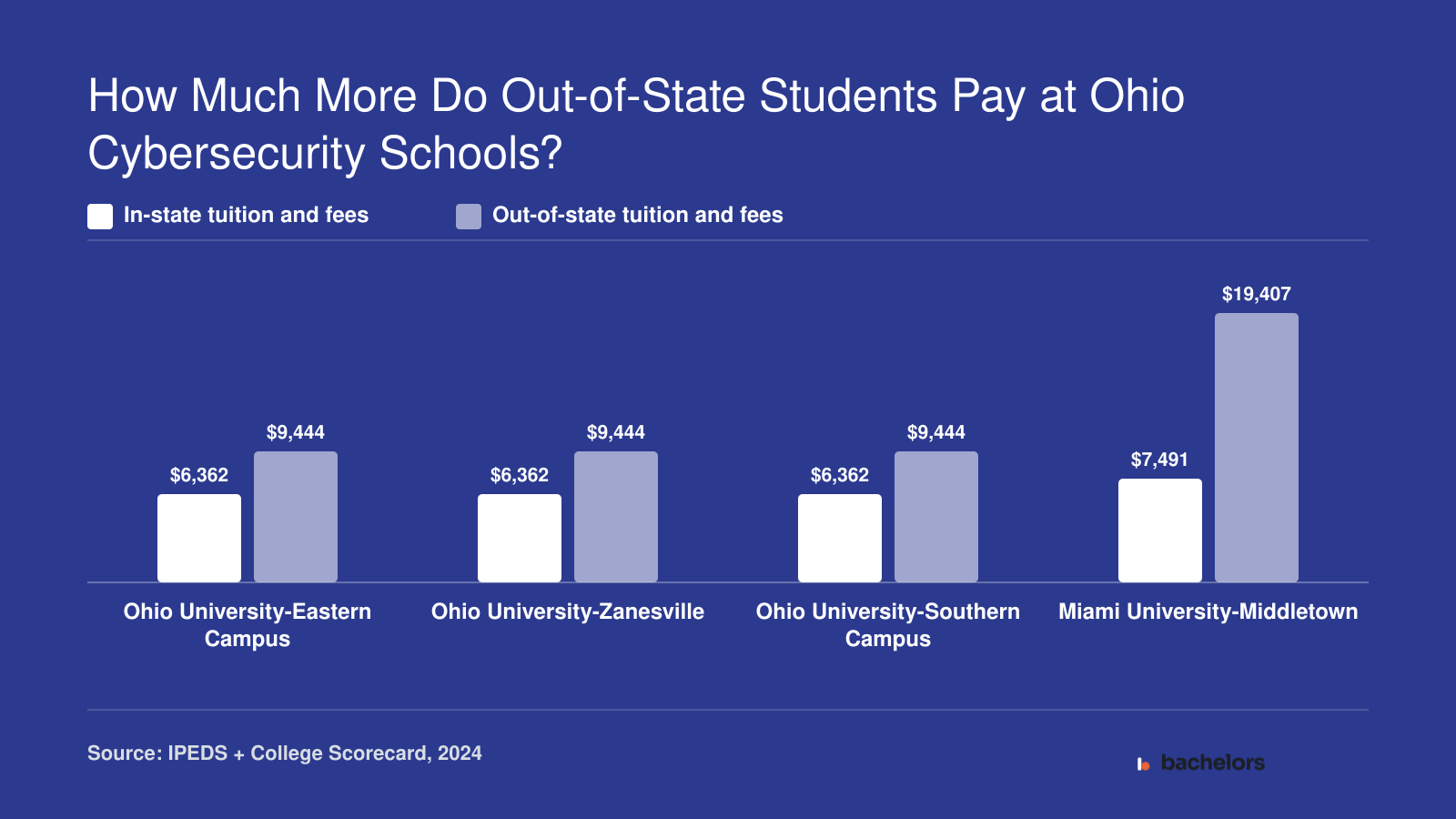
Ohio University's Eastern, Zanesville and Southern campuses each list $6,362 in yearly tuition and fees for Ohio residents and $9,444 for nonresidents, a modest gap. Miami University-Middletown charges $7,491 in state but $19,407 out of state, so residency matters far more there. These are published sticker prices before financial aid. Most students pay less once grants and scholarships apply: average net price at Ohio University-Eastern Campus is $3,925, well under its in-state tuition.
Cybersecurity Careers in Ohio After a Bachelor's Degree
Cybersecurity graduates in Ohio earn salaries well above the state's typical wage, and the work is spread across several large industries.
What the Pay Looks Like
BLS data for May 2025 puts the median annual wage for information security analysts in Ohio at $110,480, or about $53.11 an hour. The 10th percentile is $68,070 and the 90th is $171,450, so experience and specialization move the number a lot. Metro medians run from $103,720 in Toledo to $120,020 in Columbus, with Cincinnati at $114,300 and Dayton-Kettering-Beavercreek at $111,430.
Who Hires and in What Roles
Finance, insurance, healthcare, defense and government all recruit here. Names to watch include JPMorgan Chase, Nationwide, Huntington Bancshares, KeyCorp, Cleveland Clinic and NASA Glenn Research Center, plus the defense community around Wright-Patterson Air Force Base in Dayton. Typical entry-level titles include security analyst, SOC analyst, IT security specialist and digital forensics associate.
Credentials That Help You Get Hired
A B.S. gets you through the door, and a certification shows employers you can do the job. CompTIA Security+ is the usual first credential, and many students sit for it before or soon after graduating. Employers also read a school's NSA/DHS Centers of Academic Excellence (CAE) designation as a sign that the curriculum meets national standards, which is especially useful for federal and defense-related roles.
The Ohio Cyber Range is a statewide hands-on training environment. Ask any program you are considering whether its students use it, and check the range's own pages for current workforce and training offerings.
Licensing
Ohio requires no state license to work in cybersecurity. Employers set their own expectations, and certifications fill that gap.
Compare Cybersecurity programs on the data that matters
Explore more Computers & IT majors or browse every field of study.
All Computers & IT programs Browse every field of study