Best Speech Pathology Schools in Washington
Compare 4 accredited Speech Pathology programs in Washington, with net price after aid, graduation rates, earnings and debt from IPEDS and the U.S. College Scorecard.
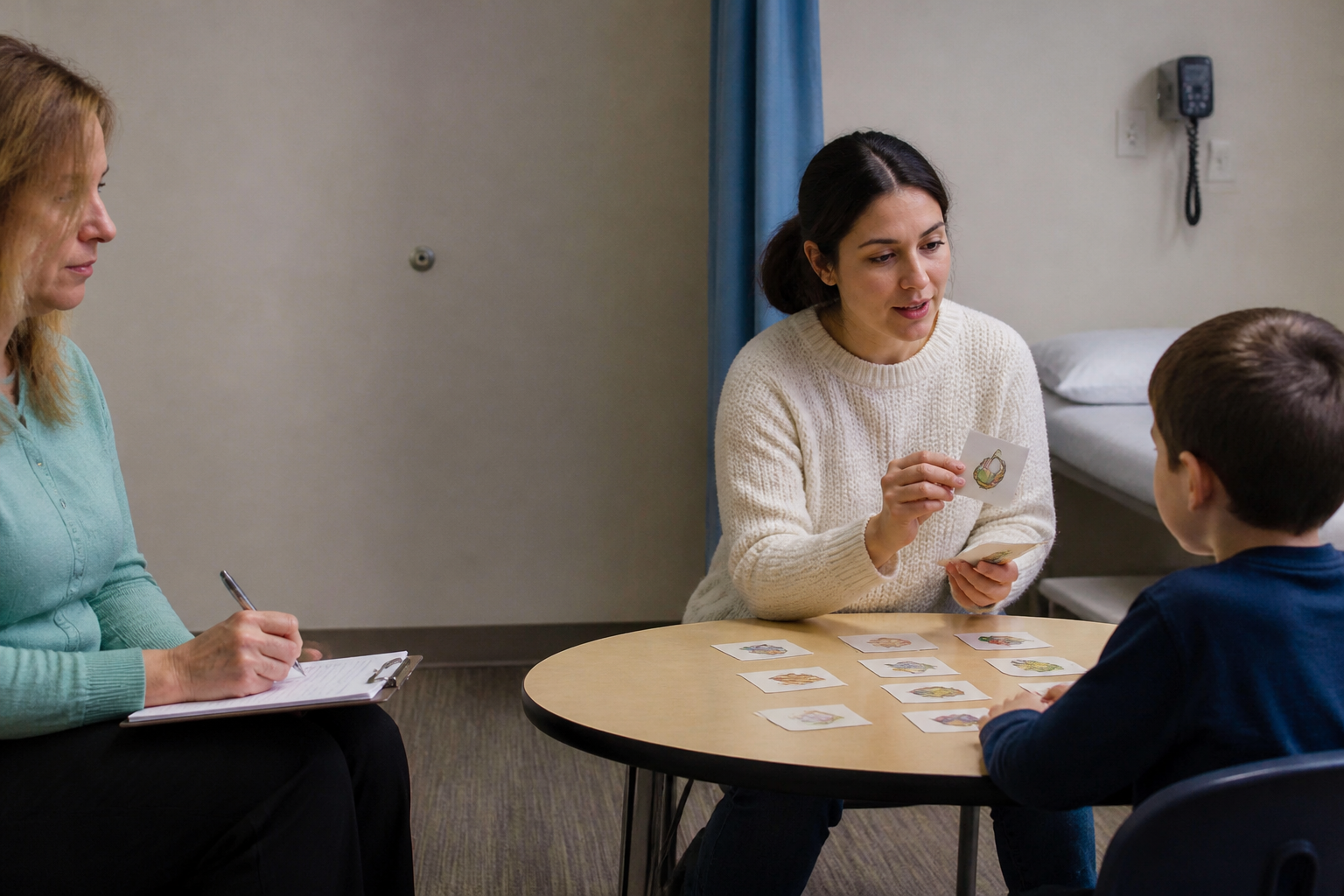
In Washington, a bachelor's degree in speech pathology is pre-professional: it does not license you to practice. The degree title varies by campus, Bachelor of Science at the University of Washington and Bachelor of Arts at Washington State and Eastern Washington, and every pathway to practice runs through a master's program afterward: state licensure as a speech-language pathologist requires a graduate degree, supervised clinical hours, and a passing exam.
The four public universities on this list, the University of Washington-Seattle Campus, Washington State University, Western Washington University, and Eastern Washington University, each name the major differently, from Speech & Hearing Sciences to Communication Sciences and Disorders. Cost separates them sharply, and admission to the major is a gate of its own. Plan the bachelor's as the first four years of a six-year path.
Key Points
- Eastern Washington University lists the lowest in-state tuition here: $8,586 (2024).
- Washington licenses speech-language pathologists only after a master's degree.
- No program here is fully online in 2027; expect campus or hybrid.
Best Bachelor's Degree in Speech Pathology Schools in Washington
Four Washington public universities offer a bachelor's degree in speech pathology, each under its own major name, and all four are built as pre-professional preparation for graduate study. One is a large research program in Seattle, one sits inside a medical school, one is a small cohort major in Bellingham, and one meets in a downtown Spokane health and education hub. Each card below uses the school's own program name, with the approximate average net price after aid and institution-wide graduation rates.
University of Washington-Seattle Campus
#1Seattle, WA · ~$14,000/yr (est.)
Best for: Seattle students seeking research lab experience
The University of Washington's Seattle campus is the state's largest public research university, and its speech and hearing sciences major is a capacity-constrained program with its own departmental application. Undergraduates take prerequisites in statistics, biology or chemistry, and linguistics while working in faculty labs and clinics. A post-baccalaureate route lets people who already hold a bachelor's degree complete the same foundation in three to six quarters. Institution-wide, about 85% of students graduate, and average net price after aid runs near $14,000.
- Four-year, in-person Bachelor of Science in Speech & Hearing Sciences
- Capacity-constrained major with a separate departmental application
- At least 75 completed credits and a 2.5 cumulative GPA to apply
- Autumn-quarter entry only for current UW students
- Transfer applicants apply to UW and the department together (Feb. 15 deadline)
- Post-baccalaureate B.S. option completes in three or six quarters
- Prepares students for graduate study in speech-language pathology
- Financial aid and funding resources listed by the department
Washington State University
#2Pullman, WA · ~$15,000/yr (est.)
Best for: Future clinicians drawn to a medical campus
Washington State University runs its speech and hearing sciences program through the Elson S. Floyd College of Medicine, giving undergraduates an early foothold in a health-sciences setting. Students start on the Pullman campus and finish the degree in Spokane, where community clinics and advocacy groups supply applied experience. Admission to the major is a separate process from admission to the university, and the coursework is taught from a multicultural, global perspective. About 60% of students graduate institution-wide, with average net price after aid near $15,000.
- Starts in Pullman and finishes in Spokane
- Housed in the Elson S. Floyd College of Medicine
- Major admission is separate from WSU admission
- Community clinics and advocacy-group clinical experience
- Undergraduate research guided by faculty
- AP, IB and CLEP credit accepted
- One scholarship application covers 700+ WSU programs
- Coursework spans speech, language, learning and hearing disorders
Western Washington University
#3Bellingham, WA · $10,000 – $29,000/yr (est.)
Best for: Bellingham undergrads wanting a cohort model
Western Washington University in Bellingham runs a small, cohort-based speech, language, and hearing sciences major inside a mid-sized public university known for undergraduate teaching. Students pair a 58 to 63 credit major with a required minor and get practicum and lab time with modern equipment. The degree is designed as preparation for graduate study rather than for immediate clinical practice. Roughly 65% of students graduate institution-wide, and average net price after aid is about $21,000.
- 58-63 credits required, plus a minor of at least 24 credits
- Declare after 75 completed credits, SLHS 251, and a 2.70 GPA
- Cohort-based, lock-step major starting fall quarter of junior year
- Clinical practicum opportunities and labs with modern equipment
- Coursework in speech acoustics, hearing science and language disorders
- Prepares students for graduate study in speech-language pathology or audiology
Eastern Washington University
#4Cheney, WA · ~$14,000/yr (est.)
Eastern Washington University offers its communication sciences and disorders degree at the Catalyst Building in Spokane, on a semester calendar that differs from most of the university's quarter-based programs. Students enter as juniors after finishing general education, which keeps cohorts tight and puts them in a downtown health and education hub. The degree is pre-professional, with clinical practicum reserved for graduate students. About 43% of students graduate institution-wide, and average net price after aid is roughly $14,000.
- Bachelor of Arts in Communication Sciences and Disorders
- Enter as a junior after university proficiencies and breadth core
- Four semesters: fall-spring-fall-spring
- 2.75 GPA minimum, department application and application fee
- Classes meet at the Catalyst Building in Spokane on semesters
- Two years of one world language; ASL accepted
- Senior capstone in speech-language pathology required
- Prerequisites in biology, physics or chemistry, statistics and social science
Cost & outcomes by school
Federal data for the highest-earning Speech Pathology programs, independent of the ranking above. Earnings are this field's bachelor's graduates four years after completing where the Scorecard reports them, else the school's undergraduate median.
| School | Net price / yr | Grad rate | Earnings | Debt | Grads/yr | Format |
|---|---|---|---|---|---|---|
| University of Washington-Seattle Campus WA | $14,091 | 85% | $80,947 | $12,542 | 50 | Campus |
| Eastern Washington University WA | $13,886 | 44% | $65,245 | $19,500 | 11 | Campus |
| Washington State University WA | $14,971 | 61% | $63,052 | $25,000 | 21 | Campus |
| Western Washington University WA | $21,193 | 65% | $61,802 | $14,334 | 34 | Campus |
Sources: U.S. Department of Education. Net price, graduation rate, earnings and debt: College Scorecard (earnings and debt for this field's bachelor's graduates where reported, else school-wide); graduates: IPEDS. A dash means no figure is reported.
Cost, debt & payoff
Median earnings of this field's bachelor's graduates (4 yrs after completing, else the school's undergraduate median) vs. their median federal loan debt · U.S. College Scorecard
Across these programs the median graduate earns about $64,149 and finishes with roughly $16,917 in debt — a ratio that clears a common rule of thumb (keep debt below first-year salary). Net price and debt vary widely school to school, so check the per-school figures in the table above before you shortlist.
How We Ranked Speech Pathology Schools in Washington
Ranking a speech pathology bachelor's program comes down to what a student takes away from it: what the degree costs and what it leads to. We compared the Washington schools on this list using five measures, drawn from federal data and each program's own published figures.
What We Weigh
- Cost after aid: What a typical student really pays per year, not the sticker tuition. Lower out-of-pocket cost leaves more room to save for the master's degree that licensure eventually requires.
- Graduation rate: The share of students who finish. A strong completion rate usually signals advising and course scheduling that keep students moving toward the degree.
- Earnings and debt after graduation: Median pay and typical borrowing for the program's graduates, which show what the degree returns early in a career.
- Completions: How many students the program graduates, a rough proxy for a stable faculty and dependable course rotation.
- Selectivity: How competitive admission is, which shapes the peer cohort and often class size.
What These Numbers Cannot Tell You
Two limits matter here. Graduation rate and net price describe the whole institution, not the speech pathology major alone, and program-level earnings and debt figures are medians, so half of graduates land above them and half below. This ranking also covers bachelor's programs at Washington schools only. Graduate programs are not ranked or recommended here; the master's is a separate decision you make after the bachelor's.
Compare Washington Bachelor's Programs Side by Side
This table lines up the schools ranked here using federal figures from IPEDS and the College Scorecard (2024). Eastern Washington University has the lowest in-state tuition ($8,586) and the lowest average net price ($13,886), while the University of Washington-Seattle Campus posts the highest graduation rate at 85%. Early earnings are modest across the board because most graduates go on to the master's degree that Washington requires for licensure, and early earnings for Eastern Washington's program are not reported.
| School | Major Name | Location | In-State Tuition and Fees | Out-of-State Tuition and Fees | Average Net Price | Admission Rate | Graduation Rate | Median Earnings 1 Year After Graduation (Program) |
|---|---|---|---|---|---|---|---|---|
| University of Washington-Seattle Campus | Speech & Hearing Sciences | Seattle | $12,973 | $43,209 | $14,091 | 39% | 85% | $25,791 |
| Western Washington University | Speech, Language, & Hearing Sciences | Bellingham | $9,582 | $28,707 | $21,193 | 93% | 65% | $19,512 |
| Eastern Washington University | Communication Sciences and Disorders | Cheney | $8,586 | $25,959 | $13,886 | 91% | 43% | N/A |
| Washington State University | Speech and Hearing Sciences | Pullman | $13,391 | $29,950 | $14,971 | 87% | 60% | $27,463 |
Online and Hybrid Speech Pathology Options at Washington Schools
Can you earn a bachelor's degree in speech pathology online in Washington? As of 2026, no public university in the state does. Every bachelor's pathway at the four schools on this list is campus-based or hybrid, and none is fully online.
How each Washington program is delivered
- University of Washington: The B.S. in Speech and Hearing Sciences is campus-based in Seattle. Foundation coursework is listed, but the university does not publish a fully online or formal hybrid bachelor's option.
- Washington State University: The B.A. in Speech and Hearing Sciences is the hybrid option here. Students complete earlier core and prerequisite work, then finish roughly 55 credits of the final two years, including the senior capstone, on the WSU Spokane campus.
- Western Washington University: The Speech Language & Hearing Sciences major is on campus in Bellingham. Major courses run once a year in a prescribed sequence, so there is little room to swap in remote sections.
- Eastern Washington University: The B.A. in Communication Sciences and Disorders meets at the Catalyst Building in Spokane, with lower-division prerequisites on a quarter schedule before the semester-based major begins.1 EWU's all-online Communication Studies degree is a different major and does not lead toward speech-language pathology.
What resists a fully online format
Speech pathology is a clinical field. Students need supervised observation hours, lab work with instrumentation, and hands-on exposure to assessment and treatment. Even where lectures could travel online, those components usually require a campus or clinic setting.
Who should count on online study
Online prerequisites and general education credits can be realistic, and WSU's structure is the closest fit for students who want to start near home and relocate for the final two years. Anyone who needs the entire bachelor's online should plan on a different field or a different state.
Admissions for Washington Speech Pathology Bachelor's Programs
Admissions often happen in two stages: getting into the university, then into the major. Washington's Direct Transfer Agreement (DTA) helps community college credits move with you, but it does not guarantee admission. Confirm every date and minimum on each school's current admissions page before you apply.
- University of Washington-Seattle Campus (Speech & Hearing Sciences)Transfer applicants apply to UW and to the department at the same time, and the major admits for autumn entry only. You need a 2.5 cumulative GPA, a competitive prerequisite GPA of about 3.0, and no prerequisite grade below 2.0 (2.5 is recommended). You also need at least 75 credits to apply and 90 by the time you enter. Prerequisites cover statistics, social science, biology, physics or chemistry, and linguistics. For autumn 2027, the department window opens in February 2027 and closes March 31, 2027. UW Admissions recalculates your transfer GPA, and general transfer deadlines vary by term.
- Washington State University (Speech and Hearing Sciences)WSU does not require or use SAT or ACT scores. First-year applicants should apply by March 31. The fall transfer priority date is August 7, and meeting it also puts you in line for transfer academic awards. The admissions pages we reviewed do not describe a separate major application, so check with the department.
- Western Washington University (Speech, Language, & Hearing Sciences)Fall transfer applicants to the Bellingham campus have a March 1 priority date and a June 1 regular deadline. Priority dates for other terms are September 15 (winter), January 1 (spring) and March 1 (summer). Ask the department whether the major has its own application step or GPA minimum.
- Eastern Washington University (Communication Sciences and Disorders)EWU offers its CSD bachelor's on the Cheney campus. Our research could not confirm its current GPA expectations, test policy, transfer credit rules or deadlines. Get these directly from EWU Admissions and the CSD department.
Related Articles
Cost of a Bachelor's Degree in Speech Pathology in Washington
Tuition vs. Net Price
What a Washington bachelor's in speech pathology costs comes down to two numbers: the tuition a school lists and the net price students actually pay. Net price is the full cost of attending, including housing and food, minus grants and scholarships. Here is how the ranked schools compare for in-state students:
- Eastern Washington University: $8,586 tuition, $13,886 net price
- Western Washington University: $9,582 tuition, $21,193 net price
- University of Washington-Seattle Campus: $12,973 tuition, $14,091 net price
- Washington State University: $13,391 tuition, $14,971 net price
Tuition alone can mislead. Western has one of the lower tuition bills here but the highest net price. UW's aid brings its net price close to Eastern's.
Debt and Monthly Payments
Borrowing for these programs stays moderate. Median debt for speech pathology completers is $12,542 at UW, about $133 a month on a 10-year plan. It is $14,334 at Western ($152 a month) and $25,000 at WSU ($265 a month).
The Washington College Grant
This is the state's main need-based grant. It serves Washington residents earning a first bachelor's who file the FAFSA or WASFA. For 2026-27, a family of four earning up to $83,500 qualifies for the full award, and some aid reaches families earning up to $139,500.1 Maximum 2026-27 awards reach $13,203 at UW, $12,700 at WSU and $8,035 at Eastern,2 with actual amounts set by income and enrollment. Awards shrink below 12 credits a quarter (3 credits minimum).3 Eligibility generally lasts 18 quarters, though UW caps it at 15 full-time quarters.
Scholarships and a Budget Takeaway
Federal data put the Pell Grant share at roughly 53 to 63 percent of undergraduates across these schools, so need-based aid is common. Three school routes stand out:
- UW Husky Promise: Covers tuition and fees for Pell-eligible Washington residents. In 2024-25, 10,234 students (22 percent of UW's Washington undergraduates) qualified.
- Western: First-year students are considered automatically for merit and many donor scholarships, with no separate application.
- Eastern: A need-based grant serves qualified residents for up to 250 attempted credits.4
The takeaway: compare net price, not tuition, and file the FAFSA or WASFA early. A family under the full-award income line can see the state grant cover most or all of tuition at UW, WSU or Eastern.
Speech Pathology Licensure in Washington: From Bachelor's to Practice
What does it take to turn a bachelor's degree in speech pathology into a Washington SLP license?
In Washington, licensure as a speech-language pathologist requires a master's degree.1 The bachelor's is where you build the coursework and observation experience that gets you into graduate school, where the clinical and credentialing path really begins. The sequence runs from a graduate degree to a supervised clinical fellowship, the national Praxis exam, a Washington Department of Health license, and the ASHA Certificate of Clinical Competence, which many employers look for.
Choose a Graduate Program With CAA Accreditation
The Council on Academic Accreditation in Audiology and Speech-Language Pathology (CAA) is the accreditor ASHA recognizes.2 To earn the CCC-SLP, you must graduate from a CAA-accredited program or one with CAA-candidacy status, complete the required coursework and graduate clinical practicum, and then finish the Clinical Fellowship. Before you apply to any graduate program, confirm its current CAA status on the accreditor's site. A program that lacks accreditation or candidacy can complicate your certification path, even if its curriculum looks strong.
Fellowship, Praxis, and the Washington License
After your master's, expect a supervised clinical fellowship of at least 36 weeks full-time (or the part-time equivalent) and 1,260 hours for ASHA.3 The national SLP Praxis exam comes next; the passing score is 162.4 Washington's Department of Health verifies your Praxis score directly with the exam agency and also requires a jurisprudence exam, official transcripts, and verification of every jurisdiction where you have held or sought a credential. A fingerprint-based background check may be required.
ASHA and DOH rely on the same national exam, but pass rates are program-specific. CAA-accredited programs publish student outcome data, including Praxis results, so ask each graduate program for its most recent figures instead of assuming a statewide average. Under ASHA's 2027 standards, the Praxis must be passed no earlier than five years before your certification application and no later than two years after ASHA receives that application; the fellowship does not have to be finished before you apply, but it must be completed for certification.
Use Your Bachelor's Years Deliberately
Complete guided observation hours, finish prerequisite courses in communication sciences and disorders, statistics, and the biological, physical, and social/behavioral sciences, and protect your GPA. Washington graduate programs set their own admission standards, so confirm prerequisites early and build relationships with faculty who can write meaningful letters of recommendation.
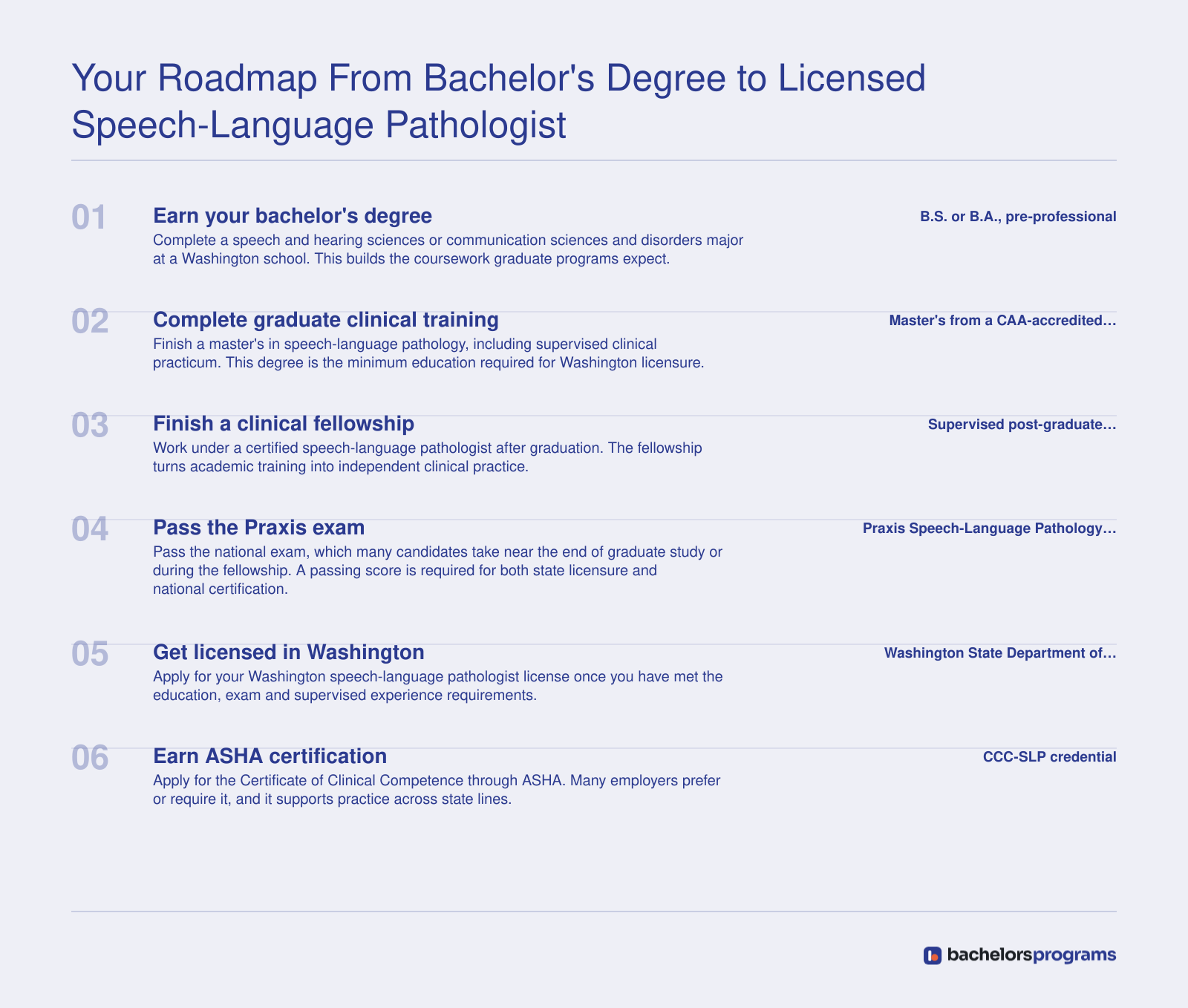
Your Roadmap From Bachelor's Degree to Licensed Speech-Language Pathologist
A bachelor's degree in speech pathology is the pre-professional first step, not the finish line. Licensure as a speech-language pathologist in Washington requires a master's degree, followed by supervised practice, a national exam and a state license.
Speech Pathology Careers and Pay in Washington
Speech-language pathology pay in Washington is not one number. It shifts with the setting (a school district, a hospital, a private clinic, early intervention), the metro area, and whether your contract covers the nine-month school year or a full calendar year. Finding current figures takes some work, because each source updates on its own schedule and none covers everything at once.
Start With the Federal Data
Go to BLS.gov and search the occupation code SOC 29-1127. The Occupational Outlook Handbook gives national context: a May 2025 median annual wage of $97,870 and projected growth of 16.6% for 2025 to 2035, which the Handbook rounds to 17%. For Washington, pull the state and metro tables and search "Seattle-Tacoma-Bellevue, WA" and "Spokane-Spokane Valley, WA" as separate geographies, since BLS splits the Seattle area into overlapping definitions. Two caveats: releases lag by roughly a year, and a metro table may not carry a row for every occupation.
Check State and Local Sources
- School districts: Job postings and published salary schedules show actual entry-level ranges and how extra duty or summer work is paid.
- University career pages: The speech and hearing sciences departments at the University of Washington, Washington State University, Western Washington University, and Eastern Washington University often post alumni and hiring information.
- Associations: ASHA publishes national school-based compensation medians ($79,000 academic-year, $89,000 calendar-year, $60.49 hourly for 2026)1, and the Washington Speech-Language-Hearing Association can speak to rural and school-based openings.
Questions Worth Asking
Ask districts how rural vacancies get filled, whether clinical fellowship supervision is provided, and how their salary schedule compares with neighboring districts. When a specific Washington wage figure is not published for a given area, treat the national benchmark as context rather than a local answer.
Washington Speech Pathology Degree FAQs
These answers cover the questions Washington students ask most about bachelor's degrees in speech pathology, from licensure to cost. Check each school's own pages for current requirements and prices before you apply.
Can you become a speech pathologist with a bachelor's degree in Washington?
What do you need to become a speech-language pathologist in Washington state?
Which Washington universities offer a bachelor's in communication sciences and disorders?
Are there online speech pathology programs in Washington?
How much does a speech pathology degree cost in Washington?
Compare Speech Pathology programs on the data that matters
Explore more Communications & Media majors or browse every field of study.
All Communications & Media programs Browse every field of study