Best Urban Planning Degree Programs
Compare 50+ accredited Urban Planning programs at 40+ colleges, with net price after aid, graduation rates, earnings and debt from IPEDS and the U.S. College Scorecard.

The Bachelor of Science (B.S.) in Urban Planning is the field's standard undergraduate credential, and most programs pair a studio sequence with GIS, land use and a required internship. A bachelor's degree in urban planning trains students to decide where housing, transit and climate-resilience money actually goes.
The choice is rarely about prestige. Net price after aid at these schools runs from roughly $6,500 to $20,000, and the gap between a Planning Accreditation Board program and an unaccredited one surfaces years later, in how much professional experience AICP certification demands.
Key Points
- University of Florida has the lowest net price here, at $6,541.
- Fully online urban planning bachelor's programs remain scarce in 2027.
- A PAB-accredited bachelor's reduces the experience needed for AICP certification.
Best Urban Planning Schools: Our Top 10 Ranked
Ten undergraduate programs anchor this list, and the strongest pair a manageable average net price after aid with planning-specific coursework that employers recognize. Each card notes the credential awarded, the format, and where it is published, program-level earnings and median debt for planning graduates.
University of Florida
#1Gainesville, FL · ~$7,000/yr (est.)
Best for: In-state Florida students eyeing spatial analytics
Florida's flagship public university awards the state's first urban planning bachelor's, built on a 120-credit, eight-semester plan that folds data science, policy analysis and geospatial methods into the study of the built environment. A professional internship is built into the curriculum, and an optional 4+1 path lets students finish the master's degree in five years. A 15-credit minor opens the field to non-majors, while transfer applicants enter in fall or summer with no spring intake.
- 8-semester, 120-credit plan with critical tracking courses
- Professional internship built into the curriculum
- First degree of its kind in Florida
- 4+1 option awards both the bachelor's and the MURP in five years
- Five-course, 15-credit undergraduate minor available
- Coursework spans economics, policy, data science and geospatial analysis
- Transfer entry in fall and summer only, with no spring admission
- Transfer applicants need a 3.0 GPA and 60 college credits
Massachusetts Institute of Technology
#2Cambridge, MA · ~$20,000/yr (est.)
Best for: Aspiring researchers who want a senior thesis
MIT's Cambridge campus awards its planning bachelor's through Course 11 in the Department of Urban Studies and Planning, pairing a compact set of required subjects with a large elective budget that students shape with an advisor. Every major completes a senior thesis or project, and an optional urban field experience subject puts students in contact with live planning practice. The result is a small, research-oriented program for students who want policy, design and spatial analysis taught at a demanding pace.
- Bachelor of Science in Planning awarded through Course 11
- 78 to 81 units of planning electives chosen with an advisor
- Senior thesis or senior project, with a fall thesis seminar
- Two communication-intensive subjects inside the major
- Optional urban field experience subject for declared majors
- Requires 17 General Institute Requirements subjects
- Core courses include Intro to Urban Design and Development
- Swimming test plus four physical education courses required
University of Washington-Seattle Campus
#3Seattle, WA · ~$14,000/yr (est.)
Best for: Transfer students entering a small cohort
At the University of Washington's Seattle campus, planning is taught through an interdisciplinary Community, Environment, and Planning major that blends core seminars, methods courses, a 120- to 150-hour internship and a quarterly governance practicum. The cohort is capped at 38 students, giving students a small-college experience inside a large public research university. Entry requires 90 completed credits and a 2.50 GPA, which makes the major a natural fit for transfers and for students who declare after their first two years.
- 77 to 82 credit major with 30 credits of core seminars
- 120- to 150-hour internship required
- Cohort limited to 38 students, autumn start only
- Admission requires 90 completed credits and a 2.50 GPA
- Capstone senior project worth 2 to 6 credits
- Quarterly governance practicum and leadership retreats
- Department scholarships available to majors
- Applications due February 15 for autumn quarter
Georgia Institute of Technology
#4Atlanta, GA · ~$12,000/yr (est.)
Georgia Tech describes its Atlanta program as the first undergraduate planning major of its kind, and the curriculum leans hard into the analytical side of the field: GIS, data visualization, urban analytics and community engagement. Students build a self-designed focus area from ten concentration options, ranging from transportation and housing to economic development and urban design, then finish with a capstone senior studio. Recent offerings include a community-engaged course on Atlanta's own development history.
- 10 core courses in cities, GIS, and data visualization
- Self-designed focus area drawn from 10 concentration options
- 122 credit hours with a capstone senior studio
- Concentrations include transportation, housing and urban analytics
- Community-engaged course on Atlanta offered in 2026
- Sustainable Cities minor can pair with the major
University of Virginia
#5Charlottesville, VA · $22,000/yr (est. net price)
UVA's School of Architecture houses a Planning Accreditation Board accredited Bachelor of Urban + Environmental Planning that begins with a shared Common First Year across architecture, planning and architectural history. Students then move into community design, transportation strategy, data visualization, land use policy and social planning, with fieldwork woven through the upper years. A 3.4 GPA opens the Distinguished Major and its thesis, and a 15-credit minor serves students majoring in other fields.
- Planning Accreditation Board accredited program
- 122 credits minimum with a 2.0 GPA to graduate
- Shared Common First Year across architecture, planning and architectural history
- Distinguished Major option requires a 3.4 GPA and a thesis
- 15-credit urban planning minor available
- Coursework in land use, transportation, data visualization and social planning
- Planning courses require a C- or better
University of California-Irvine
#6Irvine, CA · $14,000/yr (est. net price)
UC Irvine's social ecology school renamed its urban studies major Urban Studies, Planning, and Policy effective fall 2026 to sharpen its focus on planning practice and policy analysis. The compact 48-unit major pairs lower-division foundations with upper-division electives spanning transportation, housing, community development and environmental sustainability. An optional geographic information systems specialization lets students stack spatial analysis courses that also count toward the degree.
- Twelve courses, 48 units, for the major
- Three lower-division courses plus three upper-division core courses
- Six upper-division electives from UPPP 100 through 190
- Optional GIS specialization courses count toward the major
- Major renamed Urban Studies, Planning, and Policy effective fall 2026
- Prepares students for entry-level roles in transportation and housing
University of Michigan
#7Ann Arbor, MI · $18,000 – $61,000/yr (est.)
Michigan's Taubman College teaches planning through a Bachelor of Science in Urban Technology that puts city systems alongside design and technology skills. The field is STEM-designated, so international graduates can access the 24-month optional practical training extension, and the college runs a dedicated career development team plus a student-run planning journal. Ann Arbor's proximity to Detroit gives students a large, complicated metropolitan region to study.
- STEM-designated degree field eligible for the 24-month OPT extension
- Combines city studies with design and technology skills
- College reports 95% of graduates find jobs in related fields
- Full-time career and professional development team
- Student-run Agora planning journal
- Paths into urban planning, urban design, public service or entrepreneurship
California Polytechnic State University-San Luis Obispo
#8San Luis Obispo, CA · ~$17,000/yr (est.)
Cal Poly's learn-by-doing culture shapes its accredited Bachelor of Science in City and Regional Planning, where students specialize in urban and regional design and work through land use, housing, transportation and open space planning. Graduates go into public agencies and private consulting firms, including the review and regulation of private development.
- Specialization in urban and regional design
- Planning Accreditation Board accredited BSCRP program
- Coursework in land use, housing, transportation and open space
- New 2026 to 2028 catalog and updated curriculum flowchart
- Prepares students for public agency and consulting careers
- Covers budgeting for public projects and regulating private development
Texas A&M University-College Station
#9College Station, TX · ~$21,000/yr (est.)
Texas A&M's College of Architecture runs a structured four-year degree plan in urban and regional planning, moving from foundational city studies into planning law, GIS, economic development and a capstone studio. Six concentration areas let students target health systems, infrastructure, land development, urban analytics, urban design or urban policy. A semester away through internship or study abroad, plus a 3+2 master's option, adds flexibility to a fixed plan.
- Six concentration areas including urban analytics and urban design
- Fixed four-year degree plan ending in a 5-credit capstone
- Semester away via internship, study abroad or approved coursework
- Courses in planning law, GIS and economic development
- 3+2 Master of Urban Planning option
- Association of Student Planners chapter and APA Texas conference attendance
- Urban planning minor available
Ohio State University
#10Columbus, OH · $17,000/yr (est. net price)
Ohio State's Columbus campus offers an accredited city and regional planning bachelor's within the School of Architecture, one of 15 accredited professional bachelor's programs in North America. The upper years center on two client-based studios, a professional portfolio and a professional skills course, with an internship at the Mid-Ohio Regional Planning Commission available the summer after junior year. Admission is direct after university admission, and graduates qualify for AICP certification after three years of professional work.
- Planning Accreditation Board accredited, one of 15 in North America
- Two client-based studio courses and a professional portfolio
- Direct admission after university admission; no portfolio required
- Internship with the Mid-Ohio Regional Planning Commission
- Graduates eligible for AICP certification after three years of work
- Study abroad in China, Chile, Italy, Peru and Taiwan
- New graduates report $38,000 to $50,000; median $52,000 under three years
Cost & outcomes by school
Federal data for the highest-earning Urban Planning programs, independent of the ranking above. Earnings are this field's bachelor's graduates four years after completing where the Scorecard reports them, else the school's undergraduate median.
| School | Net price / yr | Grad rate | Earnings | Debt | Grads/yr | Format |
|---|---|---|---|---|---|---|
| Massachusetts Institute of Technology MA | $20,111 | 96% | $143,372 | $14,768 | 18 | Campus |
| University of Southern California CA | $32,740 | 92% | $106,094 | $18,000 | 1 | Campus |
| Cornell University NY | $28,690 | 95% | $104,043 | $12,952 | 31 | Campus |
| Georgia Institute of Technology GA | $12,116 | 94% | $102,772 | $21,672 | — | Campus |
| University of Virginia VA | $21,565 | 96% | $86,863 | $17,500 | 18 | Campus |
| University of Michigan MI | $13,138 | 93% | $83,648 | $19,500 | — | Campus |
| Virginia Polytechnic Institute and State University VA | $24,953 | 86% | $81,698 | $21,500 | — | Campus |
| University of Illinois Urbana-Champaign IL | $14,355 | 85% | $81,054 | $19,500 | — | Campus |
| California Polytechnic State University-San Luis Obispo CA | $16,665 | 86% | $80,820 | $19,334 | 32 | Campus |
| University of California-Irvine CA | $14,251 | 87% | $80,735 | $15,000 | — | Campus |
| Brigham Young University UT | $15,564 | 81% | $75,790 | $11,069 | 10 | Campus |
| University of Washington-Seattle Campus WA | $14,091 | 85% | $73,413 | $14,615 | 39 | Campus |
Sources: U.S. Department of Education. Net price, graduation rate, earnings and debt: College Scorecard (earnings and debt for this field's bachelor's graduates where reported, else school-wide); graduates: IPEDS. A dash means no figure is reported.
Cost, debt & payoff
Median earnings of this field's bachelor's graduates (4 yrs after completing, else the school's undergraduate median) vs. their median federal loan debt · U.S. College Scorecard
Across these programs the median graduate earns about $64,573 and finishes with roughly $20,896 in debt — a ratio that clears a common rule of thumb (keep debt below first-year salary). Net price and debt vary widely school to school, so check the per-school figures in the table above before you shortlist.
How We Ranked These Bachelor's Programs
A low sticker price can still leave you carrying heavy debt, and a famous university name does not guarantee strong earnings after graduation. Choosing a planning program means weighing cost against payoff, and reputation against fit. This ranking leans on reported outcomes rather than name recognition.
What the List Covers
Only undergraduate urban planning programs appear here. Graduate planning degrees, certificates and adjacent majors in related built-environment fields are not part of it.
The Measures We Use
Federal data supplies the inputs: average net price for the whole institution, earnings after completion for graduates of the program, median federal debt, the number of completions, and delivery format, campus, online or hybrid, drawn from the U.S. Department of Education's College Scorecard and IPEDS.
No single figure decides a placement. A program with modest earnings but a very low net price and little borrowing can offer better value than one with higher earnings and heavy student debt. Reading the numbers side by side is the point.
School-Wide Numbers, Not Department Numbers
Graduation rate and admission rate describe the whole institution. They show how the university performs overall, not how the planning department teaches or advises, so treat them as context rather than a verdict.
One Limitation Worth Knowing
Small programs may not publish earnings for their graduates, because too few students are counted to report a figure. For those, cost and completion data carry more weight, and the comparison is less complete than it is for a large department.
The aim is transparency: you can see what each judgment rests on and decide whether you would weigh the same factors.
What a Bachelor's Degree in Urban Planning Involves
What do you actually study in a bachelor's degree in urban planning?
A bachelor's degree in urban planning teaches how cities decide what goes where: which land becomes housing, which corridors carry buses and freight, where parks and schools sit, and who gets a say in those calls. A Bachelor of Science (B.S.) in Urban Planning is the usual credential, a policy degree with design and data skills attached. Graduates land in city planning departments, transit agencies, consulting firms and community nonprofits.
The Core Coursework
Expect general education and introductory social science courses early, then a heavier run of planning classes, often capped by a senior studio or thesis. Most programs build the same skeleton:
- Planning history and theory: how cities grew, and the ideas behind zoning, comprehensive plans and reform.
- GIS and spatial analysis: mapping, data visualization and quantitative work applied to real places.
- Planning law and policy: the rules and political process that decide what can be built.
- Studio projects: team work for an actual client, usually a city or neighborhood group, ending in a plan and a public presentation.
- Internship: a supervised placement in a planning office, agency or consulting firm.
Where Programs Diverge
Many let you concentrate. California Polytechnic State University-San Luis Obispo offers an Urban and Regional Design track, and Texas A&M University lists Policy and Urban Design concentrations. Transportation, housing, environmental sustainability and community development are other common options. Ask how early you declare, whether the concentration appears on the transcript, and how much elective room you keep.
What Employers Look For
The studio and internship carry the most weight in hiring. A portfolio of real client work plus a semester inside an agency tells an employer more than a transcript does. Ask each program who its studio clients are, whether internships are arranged for you or found on your own, and how many credits the placement counts for.
Urban Planning Degree Cost, Net Price and Debt Compared
Net price is what students pay on average after grants and scholarships, not the sticker tuition. On that measure, the University of Florida ($6,541), California State University-Fresno ($7,000) and Florida Atlantic University ($8,752) are the most affordable options here, and all are public universities with median graduate debt between $14,505 and $17,236, according to 2024 IPEDS and College Scorecard data from the U.S. Department of Education. For Florida Atlantic urban planning graduates, a median program debt of $21,114 works out to about $224 a month on a standard 10-year plan, and because out-of-state tuition at these schools runs $17,324 to $28,659 versus $4,879 to $7,350 for residents, attending a public university in your home state is often the biggest lever on cost.
| School | Location | Net Price (Avg. After Grants) | In-State Tuition and Fees | Out-of-State Tuition and Fees | Pell Grant Share | Median Debt (All Graduates) | Median Monthly Payment, 10-Year Plan (Program Graduates) |
|---|---|---|---|---|---|---|---|
| University of Florida | Gainesville, FL | $6,541 | $6,381 | $28,659 | 66.7% | $15,000 | N/A |
| California State University-Fresno | Fresno, CA | $7,000 | $7,350 | $19,950 | 86.3% | $14,505 | N/A |
| Florida Atlantic University | Boca Raton, FL | $8,752 | $4,879 | $17,324 | 72.2% | $17,236 | $224 |
Can You Earn an Urban Planning Bachelor's Online?
An online urban planning bachelor's is a four-year degree that delivers most coursework, planning theory, GIS, land use, over the internet rather than on a campus. Fully online options are scarce. Every program ranked here is listed as campus-based, and none is flagged as online or a mix of both. Online study in this field mostly sits outside the top-ranked list.
Online and Hybrid Options Worth Checking
Two programs are clearly offered online in the research we reviewed. This is not a complete national list, so confirm details with each school.
- Arizona State University: The online Bachelor of Science in Planning has an urban planning concentration. The page we reviewed listed a next start of January 11, 2027.1
- University of Arizona: The online Bachelor of Science in Urban and Regional Development is 120 credits at $525 per credit, and it includes an internship and capstone component.2
- Westfield State University: Its Urban and Regional Planning B.S. offers both in-person and online classes, but the research does not show the full degree can be finished online.3
How Studio and Fieldwork Are Handled
Campus programs lean on studios and local placements. UMKC is studio-based with a 240-hour internship4, and the University of Washington requires a 120- to 150-hour internship plus a capstone.5 Ohio State builds in two studio courses with real clients.
Online programs have to substitute. Common approaches include virtual studios, projects tied to your own community and internships arranged near where you live. For Arizona, the sources do not say whether GIS and field labs run fully online or on campus, and internships may need to be done in person. ASU's page does not clarify whether studio or fieldwork is required. Ask both schools directly.
The Takeaway
Online study fits working adults and transfer students who need flexibility. What it rarely replicates is in-person studio critique and a local agency internship, which is where many planners make their first professional contacts. If you can attend campus, the programs ranked above give you more of both.
Related Articles
What Urban and Regional Planners Earn Nationally
A bachelor's degree in urban planning is the usual entry point to planning work, and the national pay benchmark reflects a solid return for the field.
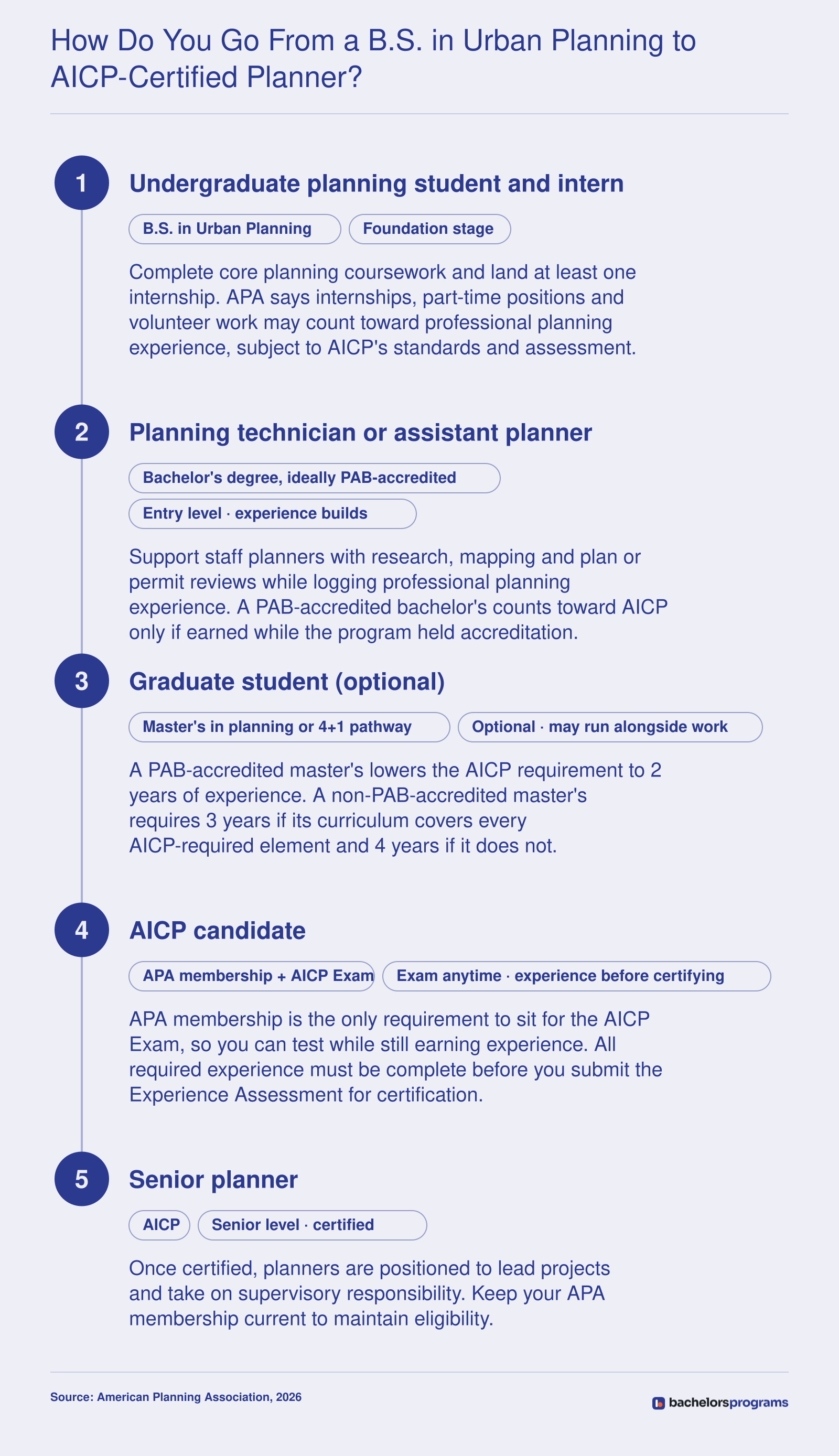
How Do You Go From a B.S. in Urban Planning to AICP-Certified Planner?
The American Institute of Certified Planners (AICP) credential rewards a mix of education and professional planning experience, and the degree you hold sets how much experience you need. A bachelor's from a program accredited by the Planning Accreditation Board (PAB) cuts the requirement to 3 years, compared with 4 years for other degrees and 8 years with no degree.
Questions to Ask Yourself
Do you want to work for the city, county or regional agencies near campus?
Do you need to transfer community college credits or keep working while you study?
Which specialty pulls you most: transportation, housing, environmental or community development?
Do you plan to add a master's later, and would a 4+1 pathway save you a year of tuition?
Urban Planning programs by state
Urban Planning Degree FAQs
These answers cover the questions prospective undergraduates ask most often about a bachelor's degree in urban planning. Requirements vary by school, state, and employer, so confirm details with each program before you apply.
Is a bachelor's degree enough to become an urban planner?
Can you get a bachelor's degree in urban planning online?
Do I need GIS or advanced math experience before starting an urban planning bachelor's?
Can community college credits transfer into a B.S. in Urban Planning?
Compare Urban Planning programs on the data that matters
Explore more Science & Engineering majors or browse every field of study.
All Science & Engineering programs Browse every field of study