Best Information Technology Schools in Massachusetts
Compare 16 accredited Information Technology programs in Massachusetts, with net price after aid, graduation rates, earnings and debt from IPEDS and the U.S. College Scorecard.

Employers in Massachusetts now hire IT staff as much for security and cloud administration as for help-desk work. Around Boston and along Route 128, hospitals, banks, insurers and software firms compete for the same graduates, and a bachelor's degree in information technology, most often a Bachelor of Science (B.S.), is the usual entry credential.
The tension is cost against fit. Published tuition at private schools in the state runs far above the public campuses, and programs vary in how much they emphasize networking, security or business systems. Every school listed here is Massachusetts-based and teaches its IT program on campus, online or both.
Anyone weighing offers should expect the strongest local employers to care about hands-on skills and internships at least as much as the school's name.
Key Points
- Salem State University's average net price is just $15,996 per year.
- UMass Lowell, Clark and Fisher offer fully online IT bachelor's paths.
- Public tuition runs $11,900 to $17,000; private schools charge up to $58,900.
Best Bachelor's in Information Technology Schools in Massachusetts
The ten schools below award bachelor's degrees in information technology in Massachusetts, delivered on campus, fully online or in a mix of both. Each card carries the city, the format, in-state tuition, the average net price after aid and the share of students who graduate. Tuition and net price are institution-wide figures rather than a quote for one major, so treat them as a starting comparison rather than a final bill.
University of Massachusetts-Lowell
#1Lowell, MA · ~$17,000/yr (est.)
Best for: Community college transfers maximizing prior credit
UMass Lowell delivers its online Bachelor of Science in Information Technology through the Richard A. Miner School of Computer and Information Sciences, and the program is built for students arriving with credit already in hand. Learners can transfer up to 90 credits, study part-time or full-time, and stack an IT certificate in Java development, networking and security, or web design on top of the major. The university also maintains articulation agreements with Massachusetts community colleges, including Benjamin Franklin Cummings Institute of Technology and Northern Essex Community College.
- 120 credits across 40 courses, including 14 to 15 IT courses
- Transfer up to 90 credits; part-time or full-time enrollment
- Finish in 12 to 36 months; three concentration options
- $385 per credit, the same rate for in-state and out-of-state students
- IT certificate in Java, networking and security, or web design
- Test optional with rolling admissions and no application deadlines
- 2.0 GPA required to graduate
- Six free electives and a 120-credit, 40-course structure
Clark University
#2Worcester, MA · ~$29,000/yr (est.)
Best for: Working adults finishing a started degree
Clark University's School of Professional Studies awards a Bachelor of General Studies with an Information Technology track, structured as a degree completion path for students who already hold college credit. The 32-course-unit program pairs 10 core major courses with four track courses, 11 distribution units and a capstone project. Students can build a custom track with an advisor or add a six-course Management Minor through the AACSB-accredited School of Business, and credit is accepted from prior college work and military training.
- 128 semester hours across 32 course units
- 10 core major courses plus four courses in the chosen track
- 11-unit liberal arts distribution requirement
- Capstone project demonstrating professional competencies
- Custom track buildable with an advisor
- Management minor through the AACSB-accredited business school
- Credit accepted from prior college work and military training
Simmons University
#3Boston, MA · $25,000 – $30,000/yr (est.)
Best for: Cybersecurity-focused students preferring campus labs
Simmons University offers an on-campus major in Information Technology and Cybersecurity in Boston, and the National Security Agency and Department of Homeland Security have named it a Center for Academic Excellence in Cybersecurity Education. The 44-credit, 11-course major runs through databases, networks, computing systems, web programming, cybersecurity, systems analysis and project management, with a faculty advisor shaping the sequence. A 3+1 accelerated option lets students pair the major with a Master of Library and Information Science.
- 44 credits across 11 courses, taught on campus in Boston
- Named a Center for Academic Excellence in Cybersecurity by NSA and DHS
- Coursework in databases, networks, cybersecurity and systems design
- 3+1 accelerated path to a Master of Library and Information Science
- Faculty advisor tailors the program to your goals
- Prepares for security analyst, systems analyst and ethical hacker roles
Framingham State University
#4Framingham, MA · ~$16,000/yr (est.)
Framingham State University delivers its Business and Information Technology bachelor's on campus through a joint arrangement between the College of Business and the Computer Science department in the College of Science, Technology, Engineering and Mathematics. Students satisfy 11 general education courses outside the major department, with the analysis, modeling and problem solving requirement folded into major coursework. Graduates move into systems analysis, technical training, quality assurance and information systems management roles.
- Jointly run by the College of Business and the Computer Science department
- 11 general education courses required outside the major department
- Analysis, modeling and problem solving requirement met through the major
- Prepares for systems analyst, QA analyst and technical trainer roles
- Coursework supports cybersecurity and project management paths
- Alumni have moved into information systems management roles
Massachusetts College of Liberal Arts
#5North Adams, MA · $15,000 – $20,000/yr (est.)
Massachusetts College of Liberal Arts, in North Adams, awards a Bachelor of Science in Computer Science with a dedicated Information Technology concentration. That concentration covers security, networking, databases, hardware and programming, and points toward information security, network and database administration, and business application development work. A parallel software development concentration serves students aiming at developer roles or graduate study, and detailed requirement checklists are published as PDFs.
- B.S. in Computer Science with an Information Technology concentration
- Concentration covers security, networking, databases, hardware and programming
- Second concentration available in software development
- Prepares for information security, network and database administration roles
- Business application development focus within the IT track
- Requirement checklists published as PDFs
University of Massachusetts-Boston
#6Boston, MA · $18,000/yr (est. net price)
UMass Boston's Bachelor of Science in Information Technology offers four industry-ready tracks and close to 100 electives, ranging from system administration to computer forensics. Students work on projects with industry partners, and the program reports a 96% employment placement rate for graduates. Format varies by college: College of Management students can take some courses online, while College of Science and Mathematics students take most courses in person.
- Four tracks, from IT generalist to computer forensics
- Nearly 100 electives available across the tracks
- Projects completed with industry partners
- Some courses online through the College of Management; most in person
- Program reports a 96% employment placement rate
- Roles include IT consultant, business intelligence analyst and cloud architect
Salem State University
#7Salem, MA · $15,000 – $20,000/yr (est.)
Salem State University's Bachelor of Science in Information Technology is organized around four pillars: computer networks, information security, web systems and information management systems. Students complete foundation courses, advance through those areas, and must add a minor outside IT. Classes are small with individual advising, the program uses newly furnished labs, and graduates move into system administration, web and database development, network engineering and technical support.
- Built on four pillars: networks, security, web systems and databases
- Foundation courses followed by advanced coursework in each pillar
- Requires a minor outside IT
- Small classes with individual advising
- Newly furnished, well-equipped labs
- Prepares for network engineer, database developer and systems analyst roles
Northeastern University
#8Boston, MA
Northeastern University's Bachelor of Science in Information Technology is a STEM-designated degree taught through the College of Professional Studies, with concentrations in analytics, applications development, computer science, and systems administration and cybersecurity. Applicants pay no application fee and submit no SAT or ACT scores, and there are three start dates a year. Industry certifications such as A+, Network+ or PMP can count toward course credit, and the PlusOne option applies up to 16 semester hours toward a master's.
- Concentrations include analytics, applications development, computer science and cybersecurity
- STEM-designated; no application fee and no SAT or ACT
- Three start dates a year: fall, spring and summer
- Certifications such as A+, Network+ or PMP may count toward course credit
- PlusOne option applies up to 16 semester hours toward a master's
- Military rate available for active servicemembers and spouses
- Covers programming, systems and network administration, security and project management
Fisher College
#9Boston, MA · ~$27,000/yr (est.)
Fisher College awards a Bachelor of Science in Information Technology on its Boston campus and fully online, with concentrations in applied artificial intelligence, cybersecurity, game development and software engineering. The 120-credit degree puts 54 credits into program courses such as Programming I and II, Database Design and Management, Network Fundamentals and Information Security and Privacy. As a CompTIA educational partner, Fisher maps coursework to A+, Network+, Linux+, Security+ and PenTest+ certifications, and online terms run eight weeks.
- 120 credits, 54 of them in program courses including Programming I and II
- Concentrations in applied AI, cybersecurity, game development and software engineering
- On campus in Boston or fully online in 8-week terms
- CompTIA educational partner; courses map to A+, Network+, Linux+, Security+ and PenTest+
- Online track finishes in about 3 years and 4 months at two courses per term
- Degree completion option for students with 45 or more credits
- Windows 11 Pro laptop required; Chromebooks and MacBooks not allowed
Boston College
#10Chestnut Hill, MA · ~$42,000/yr (est.)
Boston College's Woods College of Advancing Studies awards a Bachelor of Arts in Information Technology built on 10 required courses and four electives, alongside the university's liberal arts core. Required coursework spans operating systems, database management, Python, computer security, project management and systems architecture, with electives such as cybersecurity fundamentals, computer networks and data visualization. Applications are reviewed on a rolling basis with fall, spring and summer entry points.
- 10 required courses including operating systems, databases, Python and computer security
- Four IT electives such as cybersecurity fundamentals, networks and data visualization
- Liberal arts core curriculum runs alongside the major
- Rolling admissions with fall, spring and summer starts
- $45 application fee; two recommendation letters and a 500 to 750 word essay
- Coursework prepares students for CompTIA A+, Network+ and Security+
Cost & outcomes by school
Federal data for the highest-earning Information Technology programs, independent of the ranking above. Earnings are this field's bachelor's graduates four years after completing where the Scorecard reports them, else the school's undergraduate median.
| School | Net price / yr | Grad rate | Earnings | Debt | Grads/yr | Format |
|---|---|---|---|---|---|---|
| Northeastern University MA | $30,915 | 91% | $163,708 | $22,583 | 748 | Online or campus |
| Northeastern University MA | — | — | $163,708 | $22,583 | 46 | Campus |
| Boston College MA | $41,704 | 91% | $103,937 | $19,000 | — | Online or campus |
| Salem State University MA | $15,996 | 50% | $92,380 | $26,250 | 37 | Campus |
| Massachusetts College of Liberal Arts MA | $16,068 | 56% | $87,671 | $22,375 | 12 | Campus |
| University of Massachusetts-Boston MA | $17,707 | 49% | $83,405 | $21,585 | 125 | Hybrid |
| Wentworth Institute of Technology MA | $34,170 | 68% | $82,721 | $25,028 | — | Campus |
| Framingham State University MA | $16,114 | 48% | $82,590 | $25,000 | 31 | Campus |
| Stonehill College MA | $33,016 | 76% | $77,745 | $25,000 | — | Campus |
| Merrimack College MA | $37,927 | 70% | $75,584 | $27,000 | — | Campus |
| Western New England University MA | $27,290 | 64% | $73,157 | $25,500 | — | Campus |
| University of Massachusetts-Lowell MA | $17,163 | 65% | $64,874 | $23,704 | — | Online |
Sources: U.S. Department of Education. Net price, graduation rate, earnings and debt: College Scorecard (earnings and debt for this field's bachelor's graduates where reported, else school-wide); graduates: IPEDS. A dash means no figure is reported.
Cost, debt & payoff
Median earnings of this field's bachelor's graduates (4 yrs after completing, else the school's undergraduate median) vs. their median federal loan debt · U.S. College Scorecard
Across these programs the median graduate earns about $80,168 and finishes with roughly $25,000 in debt — a ratio that clears a common rule of thumb (keep debt below first-year salary). Net price and debt vary widely school to school, so check the per-school figures in the table above before you shortlist.
Cheapest Massachusetts Schools for a Bachelor's Degree in Information Technology
Among the lowest-cost options for an IT bachelor's in Massachusetts, the spread in average net price is narrow: Salem State University comes in at $15,996 per year and College of Our Lady of the Elms at $17,545, a gap of about $1,550. Net price is an average across aided students, based on U.S. Department of Education IPEDS and College Scorecard data, so your own cost may land above or below it. Sector matters too. The public universities here pair in-state tuition of roughly $12,000 to $17,000 with similar net prices, while private Elms lists $43,325 in tuition and fees but drops to a comparable net price once aid is applied.
| School | City | Sector | Program | Average Net Price per Year | In-State Tuition and Fees | Median Federal Debt for IT Graduates |
|---|---|---|---|---|---|---|
| Salem State University | Salem | Public | Information Technology | $15,996 | $12,338 | $26,250 |
| Massachusetts College of Liberal Arts | North Adams | Public | Computer Science (Information Technology concentration) | $16,068 | $12,436 | $22,375 |
| Framingham State University | Framingham | Public | Business & Information Technology | $16,114 | $11,920 | $25,000 |
| University of Massachusetts-Lowell | Lowell | Public | Information Technology, B.S. (online) | $17,163 | $16,966 | N/A |
| College of Our Lady of the Elms | Chicopee | Private nonprofit | Computer Information Technology and Security | $17,545 | $43,325 | N/A |
Accreditation and Certification: What Counts for an IT Bachelor's in Massachusetts
Accreditation is an outside review that confirms a college, or a specific degree, meets quality standards, and it decides whether your credits transfer and whether you can receive federal financial aid. In Massachusetts, the baseline is institutional accreditation from the New England Commission of Higher Education (NECHE), the regional accreditor for the state's colleges.1 Any bachelor's degree in information technology you consider should come from a NECHE-accredited school.
ABET Is Optional and Rare for IT
ABET is programmatic accreditation. It applies to individual computing degrees, not to a whole campus. Few IT programs hold it, and it is not required to get hired. Northeastern appears in ABET's computing category, but that does not show its Bachelor of Science in Information Technology is itself accredited. The program pages for the other ranked schools in our data do not list ABET accreditation, so treat that as unconfirmed rather than assumed.
Certifications Tied to Coursework
Some schools state how classes connect to industry credentials:
- Fisher College: a CompTIA educational partner, with courses that map to CompTIA certifications.
- Boston College: lists CompTIA A+, Network+ and Security+ pathways.
- Northeastern University: says certifications may count toward course credit.
- Simmons University: its IT and cybersecurity program notes a Center for Academic Excellence in Cybersecurity designation.
None of the program pages reviewed mention Cisco alignment, so ask admissions directly if that matters to you.
No State License Required
Massachusetts does not license IT professionals. Certifications such as CompTIA Security+ are optional résumé boosters, useful for help desk, networking and security roles, but no employer needs a license to hire you.
Verify Before You Apply
- Search the school's name in the NECHE directory and confirm its status is current.
- Look up the exact degree title in ABET's accredited program search if ABET matters to you.
- Ask admissions for the written certification mapping, since a marketing claim is not a curriculum document.
Questions to Ask Yourself
Do you want co-op or paid work experience built in, or flexibility to keep a job while studying?
Is a commute to Boston-area campuses realistic, or do you need an online program from a Massachusetts-based school?
Would you rather specialize in networking, cybersecurity or systems administration, or keep a broad IT foundation?
Are you starting fresh or bringing community college credits that could transfer?
Online and Hybrid Bachelor's in IT Options at Massachusetts Schools
Can you earn a bachelor's degree in information technology online from a Massachusetts-based school? Yes. UMass Lowell, Clark University and Fisher College all offer a fully online path. UMass Boston, Northeastern University and Boston College blend online and in-person study. Simmons University, Framingham State University, Massachusetts College of Liberal Arts and Salem State University deliver their IT-related bachelor's programs on campus.
Fully Online Options
- UMass Lowell: The B.S. in Information Technology runs fully online, requires 120 credits and typically takes 12 to 36 months, depending on transfer credit and pace. Tuition is listed at $385 per credit for Spring 2027, and the rate is the same for in-state and out-of-state students. Some non-IT electives are also offered on campus.
- Fisher College: Fisher's fully online option uses 8-week terms and requires 120 credits. The school publishes a completion time of 20 terms, or about three years and four months.
- Clark University: The Bachelor of General Studies with an information technology concentration is an online degree-completion program that requires 128 credits.
Hybrid Formats
Northeastern's Boston B.S. in Information Technology combines online coursework with on-campus sessions. The program page does not say how often you need to attend in person. It lists $580 per credit based on 2025-2026 rates, which excludes fees, and it supports both full-time and part-time enrollment. UMass Boston delivers most courses in person, with some available online through its College of Management. Boston College offers its IT program in both online and on-campus formats.
Paths for Transfers and Working Adults
If you already have college credit, several programs here are built to accept it:
- UMass Lowell accepts up to 90 transfer credits.
- Northeastern accepts up to 60 credits from regionally accredited institutions, including community colleges. It also offers pathways for Year Up and Merit America participants.
- Fisher runs a Degree Completion Program for students with 45 or more credits.
- Clark grants credit for military service and prior college work.
Per-credit rates change from year to year, and fees are usually billed separately. Before you apply, confirm current tuition, transfer credit evaluation and any on-campus requirements directly with the school.
Related Articles
Admissions Requirements: GPA, Test Policy and Transfer Credit
Massachusetts runs two admissions models side by side: public universities admit most applicants and publish a clear test and transfer-credit policy, while private schools admit a smaller share and publish less.1 Which model you are applying under tells you how much to prepare in advance.
Selectivity at a Glance
Scorecard admission rates show the spread. Salem State (96%), MCLA (90%), Framingham State (84%), UMass Boston (84%) and UMass Lowell (83%) admit the large majority of first-year applicants. Fisher (71%) and Simmons (70%) are moderately selective, Clark (40%) is selective, and Boston College (16%) is the most selective of the schools with a published rate.
What Each School Publishes
- UMass Lowell: the IT program page states no minimum GPA. SAT or ACT scores are optional, though the school may request them from applicants who left high school less than three years earlier. Transfers can bring up to 90 credits, with no more than 75 from a community college.2
- UMass Boston: expects a 3.2 GPA and is test-optional for every program except nursing.1 No numeric transfer cap is published; credit is reviewed course by course.
- Framingham State: sets no minimum GPA and encourages 2.5 or higher. Testing is optional except for College of STEM majors, and it is not stated whether the business and IT program falls under that exception. At least 30 credits must be earned there.
- Clark, Simmons, MCLA, Salem State, Northeastern, Fisher and Boston College: no minimum GPA or transfer-credit ceiling appears on the admissions pages reviewed, so confirm directly with an admissions counselor before you apply.
Three Practical Tips
- Finish the associate degree first. MassTransfer pathways let Massachusetts community college graduates carry a block of general education credit into participating public universities, which is usually cleaner than transferring course by course.2
- Get the credit decision in writing. Ask for a preliminary evaluation before you enroll, and find out how many credits land in the major rather than in electives.
- Ask about alternatives when a score is requested. If a school wants SAT or ACT results from a recent high school graduate, ask what it accepts in place of scores.
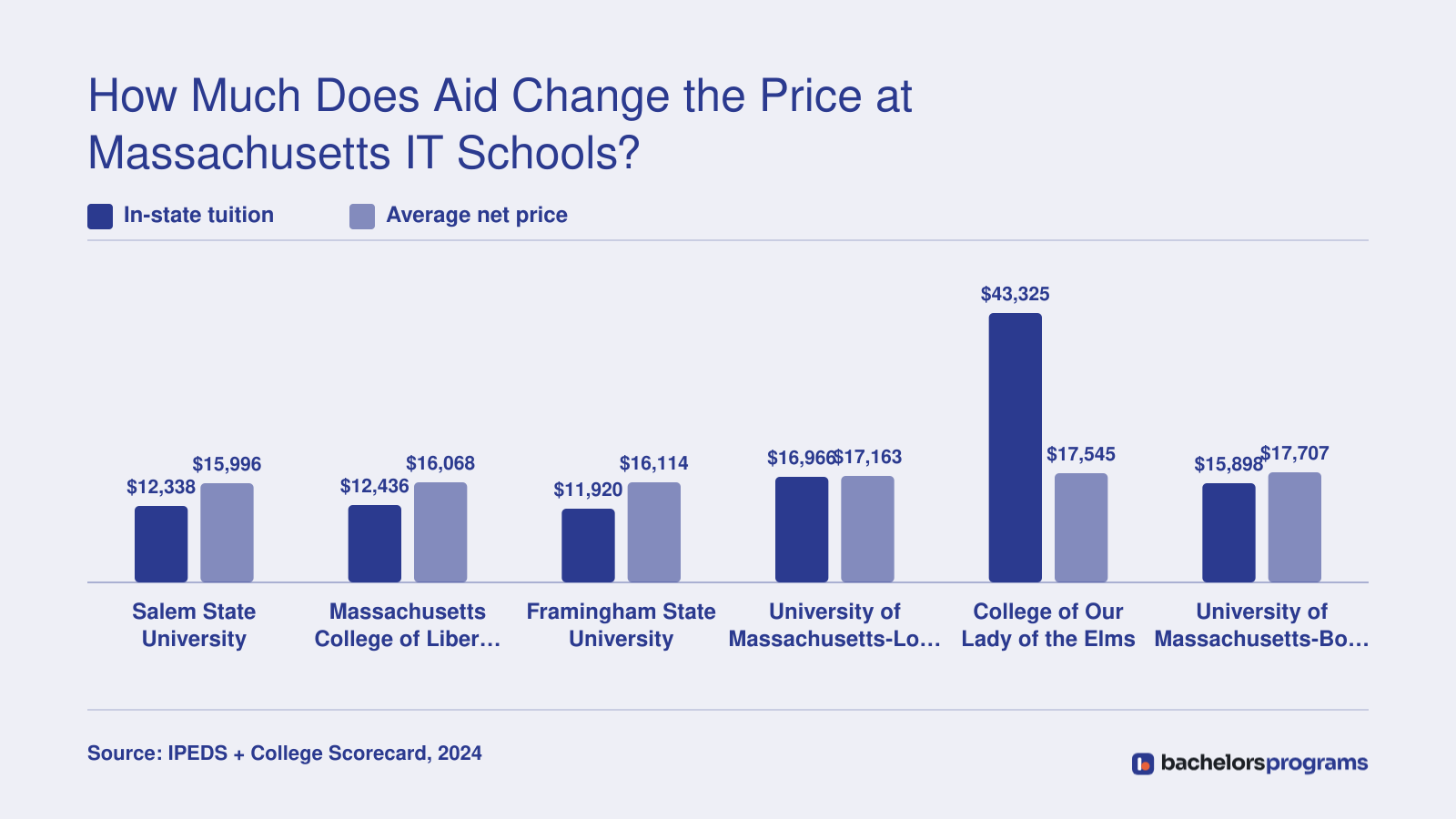
How Much Does Aid Change the Price at Massachusetts IT Schools?
In-state tuition is the published price for tuition and fees. Average net price is what undergraduates on federal aid actually paid in a year after grants and scholarships, and it also includes housing, food and books. At the public universities below, net price runs above tuition because living costs outweigh aid, while at College of Our Lady of the Elms aid cuts a $43,325 sticker price to $17,545, a drop of $25,780. Net price is a school-wide average across all undergraduates, not a figure specific to IT majors, so treat it as a benchmark and run each school's net price calculator for your own estimate.
Cost of a Bachelor's Degree in Information Technology in Massachusetts
Expect a wide cost gap between public and private IT bachelor's programs in Massachusetts. At the public campuses ranked here, published in-state tuition runs from about $11,900 to $17,000 for the year. The private universities on the list publish $35,700 to $58,900. Those are sticker prices, and most students do not pay them.
Sticker Price vs. Net Price
Net price is what a year actually costs after federal, state and institutional grants, and it bundles in fees, housing and food. At the public campuses here it lands between roughly $16,000 and $17,700. At the private ones it drops to about $25,300 to $28,700, a much narrower gap than tuition alone suggests. Loans and work-study are not subtracted, so net price is still a before-borrowing figure.
Massachusetts Aid That Cuts the Bill
- MASSGrant: Need-based aid for Massachusetts residents.1 File the FAFSA, or the MASFA if you are not FAFSA-eligible, by June 30, 2026, enroll full time at 12 or more credits and hold no prior bachelor's degree.1 Awards vary with need and school type and can continue for up to eight semesters.2
- MassTransfer Tuition Waiver: Earn an associate degree at a Massachusetts public community college with at least a 3.0 GPA, transfer to a state university or UMass campus within a year, and resident tuition is covered for two years.3 Fees, housing and books are not included.3
- Commonwealth Commitment: A state pathway for community college students who transfer to a public four-year campus. Current discount terms are set by the state and change, so confirm them with the Massachusetts financial aid office before you count on the savings.
Three Ways to Pay Less
Start at a community college and transfer under MassTransfer, which removes two years of four-year tuition. File the aid forms by the June 30 state deadline every year, not just freshman year. And favor programs with paid internships or co-op terms, which put earnings against tuition while you study.
Careers and Salaries for IT Graduates in Massachusetts
National averages and Massachusetts paychecks are two different numbers. Check both before you commit to a bachelor's program.
Step 1: Pick a Target Role and Check National Benchmarks
Start by naming the job you want after graduation. The Bureau of Labor Statistics reports these national medians for May 2025, with 2025-2035 projections:
- Information security analysts: $129,180 median and 21% projected growth, from 192,900 jobs to 233,400, with about 40,600 openings projected1
- Computer systems analysts: $105,850 median and 8% projected growth2
- Network and computer systems administrators: $99,130 median and a projected 4% decline3
- Computer user support specialists: $61,860 median, while the broader computer support group is projected to decline 3%4
For state context, Massachusetts computer and mathematical occupations posted a mean annual wage of $126,150 in May 2023, and $103,840 in the state's nonmetropolitan areas.5 Those are group averages, not medians for one job, so use them as a backdrop.
Step 2: Pull Massachusetts Data From BLS.gov
On BLS.gov, open the Occupational Employment and Wage Statistics section, choose state estimates and select Massachusetts. Search your occupation title to see the state median, wage percentiles and employment level. Check the metro-area tables as well, because pay around Boston can differ from Springfield or North Adams. For outlook, pair the national Occupational Outlook Handbook page with the long-term projections published by the state's labor market office.
Step 3: Cross-Check School and Association Resources
Look for graduate outcomes, internship or co-op listings, employer partners and career services contacts on program pages at schools such as University of Massachusetts-Lowell, Northeastern University and Salem State University. If a page is light on outcomes, email the career office and ask where recent IT graduates were hired.
Professional groups add another layer:
- MassTLC: Massachusetts tech events, networking and employer connections
- ISACA: salary surveys and certification paths for audit, risk and security roles
- CompTIA: workforce reports, job resources and entry-level certifications
- Local user groups: meetups for cloud, networking and security practitioners
Step 4: Confirm With Employers
Before you sign loan paperwork, ask a few Massachusetts hiring managers or campus recruiters what starting pay looks like for your target role. Their current answers will be more precise than any published figure.
How We Ranked Massachusetts IT Schools
The ranking draws on federal College Scorecard and IPEDS data and counts bachelor's programs only, so certificates, associate degrees and graduate study play no part in the results. Some figures describe the whole school rather than the IT program, so read them as context, not as program-level guarantees. Details on admissions, format and accreditation come from each school's own pages, and we note when a school does not publish a policy.
| Factor | Data Source | What It Tells You |
|---|---|---|
| Bachelor's program offered | IPEDS completions data and each school's program page | Confirms the school awards a bachelor's degree in information technology or a closely related field, such as IT and cybersecurity or business and IT. |
| Graduation rate | IPEDS | The share of students who finish within six years. This rate covers the whole institution, not IT majors alone, so a program's own completion rate may differ. |
| Net price | College Scorecard and IPEDS | The average yearly cost after grants and scholarships for aided students. It is an average, so your price depends on your income, residency and aid package. |
| Tuition and fees | IPEDS | The published sticker price before aid, including in-state rates at public universities. This figure feeds the cheapest-schools list. |
| Earnings after graduation | College Scorecard field-of-study data | Typical pay for bachelor's graduates in the field where federal data reports it. This figure drives the highest-earnings list. |
| Admissions policies | Each school's admissions pages | GPA expectations, test policy and transfer credit rules, recorded as published or noted as not published. |
| Online and hybrid format | Each school's program pages | Whether the bachelor's can be completed on campus, online or in a hybrid format, as stated by the school. |
| Accreditation | Each school's website | Institutional accreditation and any program-level recognition the school lists, noted as published or not. |
Compare Information Technology programs on the data that matters
Explore more Computers & IT majors or browse every field of study.
All Computers & IT programs Browse every field of study