Best Information Technology Schools in Tennessee
Compare 14 accredited Information Technology programs in Tennessee, with net price after aid, graduation rates, earnings and debt from IPEDS and the U.S. College Scorecard.

Cost, format, and program structure vary more across Tennessee than the shared "information technology" label suggests. A campus program in Nashville or Cookeville and a fully online degree can both lead to a Bachelor of Science (B.S.) in Information Technology, yet they differ in price, internship requirements, and how many transfer credits they accept.
This ranking covers a bachelor's degree in information technology at Tennessee schools, on campus and online, with cheapest and highest-earning picks flagged along the way.
Several of these degrees carry other names, such as Professional Studies, Computing, or Computer Information Technology, so the title on the diploma matters less than the curriculum and the accreditation behind it.
Key Points
- Le Moyne-Owen College posts the lowest average net price here: $7,099.
- SACSCOC institutional accreditation is required for a school to disburse federal aid.
- University of Memphis, MTSU and Tennessee Tech offer professional studies IT degrees.
Best Information Technology Schools in Tennessee: Our Top 10
Tennessee has no shortage of places to earn a bachelor's degree in information technology, and they differ sharply in format, cost, and structure. Some are traditional campus programs with required internships and capstone projects, while others are fully online degrees built for adults already working in the field. The ten schools below span both approaches, from a large public research university in Memphis to a small private college in Nashville.
Lipscomb University
#1Nashville, TN · ~$25,000/yr (est.)
Best for: Nashville campus learners seeking internships
A private university in Nashville, Lipscomb teaches information technology inside its School of Computing, with a 126-credit bachelor's that requires both an internship and a senior project. The program reports a 97% job placement rate for graduates and points to Middle Tennessee's IT employers as a hiring base. Class sizes stay small, and an information technology minor is available for students majoring in another field.
- 126 total credit hours, delivered in person
- Internship and senior capstone project both required
- Program cites a 97% job placement rate for graduates
- Information Technology minor offered alongside the major
- Career paths include IT management, support, and systems analysis
- Small class sizes
Middle Tennessee State University
#2Murfreesboro, TN · ~$13,000/yr (est.)
Best for: Working adults needing a fully online path
A large public university in Murfreesboro, MTSU delivers its IT concentration through a Bachelor of Science in Professional Studies that can be finished on campus or entirely online. The degree is built for working adults, and the Prior Learning Assessment program can convert workforce knowledge into college credit. Alumni of the concentration work as cloud architects, data modelers, software engineers, and web developers, at employers such as Bridgestone, Xerox, and United Healthcare.
- On-ground or fully online delivery
- Built for working adults finishing a bachelor's degree
- Prior Learning Assessment turns work experience into credit
- Covers information systems, application development, data analytics
- Foundation courses can be completed fully online
- Alumni employers include Bridgestone, Xerox, and United Healthcare
University of Memphis
#3Memphis, TN · $10,000 – $15,000/yr (est.)
Best for: Transfer students with military or work credit
The University of Memphis is a public research university that awards its information technology bachelor's through UofM Global. Online students earn the same degree as students who take coursework on campus, and the program accepts transfer, military service, and experiential learning credit. Three start dates a year, 24/7 tutoring, career advising, and a required senior project round out the structure.
- 120 total credit hours, including 15 to 22 in the concentration
- Fully online through UofM Global, with the same degree as on campus
- Fall, spring, and summer start dates
- Senior project in the final semester serves as the capstone
- Transfer, military service, and experiential learning credit accepted
- 24/7 tutoring and career advising available
East Tennessee State University
#4Johnson City, TN · ~$16,000/yr (est.)
East Tennessee State University in Johnson City houses its IT concentration inside a Bachelor of Science in Computing, with 124 credits split across a general education core, a 36-credit computing core, and 25 concentration credits. Students take web development, database, systems administration, and human-computer interaction coursework. A senior computing exam stands between students and graduation, and major courses require a 2.5 GPA.
- 124 credit hours, including a 25-credit IT concentration
- Concentration covers web development, databases, and system administration
- 2.5 GPA required in major courses
- Senior Computing Exam required before graduation
- CSCI courses may be attempted a maximum of three times
- Nine advisor-approved elective credits; no minor required
Trevecca Nazarene University
#5Nashville, TN · $17,000/yr (est. net price)
A private university in Nashville, Trevecca Nazarene offers a campus-based information technology bachelor's with three tracks: software engineering, cybersecurity and digital forensics, and data analytics. Students assemble a professional portfolio and present four to five projects in a senior portfolio course reviewed by industry developers. Internships connect students to the Nashville job market, and hardware coursework supports preparation for A+ certification.
- Three tracks: software engineering, cybersecurity and digital forensics, data analytics
- Internship course awards 1 to 3 credits at 55 hours per credit
- Professional portfolio reviewed by industry developers
- Hardware coursework prepares students for A+ certification
- Covers cloud computing, virtualization, networking, UX/UI, and ITIL, Agile, Six Sigma
- Roles include security analyst, web developer, database administrator, network architect
Austin Peay State University
#6Clarksville, TN · ~$10,000/yr (est.)
Austin Peay State University in Clarksville awards a Bachelor of Science in Computer Information Technology, offers every concentration on campus, and makes a 100% online path available. The department enrolls more than 670 majors and produces roughly 100 graduates a year. Students specialize in web and database work or in computer networking, and the university has joined the Tennessee Technology Advancement Consortium, a statewide technology transfer and industry collaboration effort.
- 100% online option, with every concentration also offered on campus
- Two concentrations: Web and Database, and Computer Networking
- Web and Database covers database design, administration, and web programming
- Computer Networking covers enterprise network deployment and security
- Department enrolls more than 670 majors and graduates about 100 a year
Southern Adventist University
#7Collegedale, TN · $20,000 – $25,000/yr (est.)
Southern Adventist University in Collegedale teaches its information technology bachelor's through the School of Computing. The curriculum pairs programming and mathematics with business courses, aimed at students who want to run or support LAN, WAN, and Internet systems. A published four-year course sequence lays out the full path, and graduates typically move into webmaster and network administrator roles.
- Coursework in programming, mathematics, and business
- Focus on supporting LAN, WAN, and Internet systems
- Prepares students for webmaster and network administrator roles
- Sample four-year course sequence published
South College
#8Knoxville, TN · $18,000/yr (est. net price)
South College is a private institution based in Knoxville that runs its information technology bachelor's online and in a hybrid format. Coursework covers database applications, computer architecture, networking, operating systems, and cybersecurity, then walks through the full project life cycle, from requirements and timelines to risk. Students prepare for IT certifications in several areas, and the college accepts military benefits through the Yellow Ribbon program.
- Online or hybrid format, based in Knoxville
- Covers networking, operating systems, cybersecurity, and computer architecture
- Walks through the project life cycle: requirements, timelines, planning, risk
- Prepares students for IT certifications in multiple areas
- SACSCOC-accredited institution
- Yellow Ribbon program participant with the Department of Veterans Affairs
Le Moyne-Owen College
#9Memphis, TN · $7,000/yr (est. net price)
Le Moyne-Owen College is a small historically Black college in Memphis that offers an information technology bachelor's with two concentrations: Network Administration and Security, and Web and Database Development. The program is built on Cisco networking equipment and Oracle Academy database coursework, and the college holds an NSA/DHS cybersecurity center designation. Students must pass two prerequisite math courses before declaring the major.
- 33 credit hours of IT courses plus a 12-credit concentration
- Concentrations: Network Administration and Security, and Web and Database Development
- Requires IT Project and IT Capstone courses
- NSA/DHS cybersecurity center designation
- Cisco networking curriculum and equipment; Oracle Academy database design
- Two prerequisite math courses required before declaring the major
Tennessee Tech
#10Cookeville, TN · $10,000 – $15,000/yr (est.)
Tennessee Tech in Cookeville delivers its information technology concentration through an online Bachelor of Science in Professional Studies, run by the School of Professional Studies. The concentration builds skills in software, operating systems, and network management for people already working in IT who want to move into leadership. Because it is fully online, it fits around a full-time job.
- Delivered fully online through the School of Professional Studies
- Concentration covers software, systems, and network management
- Designed for working IT professionals moving into management
Cost & outcomes by school
Federal data for the highest-earning Information Technology programs, independent of the ranking above. Earnings are this field's bachelor's graduates four years after completing where the Scorecard reports them, else the school's undergraduate median.
| School | Net price / yr | Grad rate | Earnings | Debt | Grads/yr | Format |
|---|---|---|---|---|---|---|
| Strayer University-Tennessee TN | $11,645 | — | $82,304 | $37,500 | 17 | Online or campus |
| East Tennessee State University TN | $15,983 | 53% | $82,073 | $23,370 | 92 | Campus |
| Austin Peay State University TN | $9,735 | 40% | $77,125 | $22,246 | 24 | Online or campus |
| Lipscomb University TN | $24,739 | 72% | $55,541 | $19,500 | 9 | Campus |
| Southern Adventist University TN | $24,345 | 49% | $53,723 | $24,500 | 2 | Campus |
| The University of Tennessee-Chattanooga TN | $14,265 | 50% | $51,151 | $19,500 | — | Hybrid |
| Trevecca Nazarene University TN | $16,813 | 53% | $49,378 | $18,750 | 15 | Campus |
| Middle Tennessee State University TN | $13,359 | 54% | $48,541 | $20,000 | — | Online or campus |
| Tennessee Tech TN | $14,246 | 58% | $48,501 | $15,650 | — | Online |
| University of Memphis TN | $12,397 | 51% | $48,458 | $23,300 | — | Online or campus |
| Tusculum University TN | $21,131 | 26% | $44,367 | $23,250 | — | Campus |
| South College TN | $17,858 | 42% | $36,642 | $18,668 | 4 | Online or campus |
Sources: U.S. Department of Education. Net price, graduation rate, earnings and debt: College Scorecard (earnings and debt for this field's bachelor's graduates where reported, else school-wide); graduates: IPEDS. A dash means no figure is reported.
Cost, debt & payoff
Median earnings of this field's bachelor's graduates (4 yrs after completing, else the school's undergraduate median) vs. their median federal loan debt · U.S. College Scorecard
Across these programs the median graduate earns about $48,960 and finishes with roughly $21,123 in debt — a ratio that clears a common rule of thumb (keep debt below first-year salary). Net price and debt vary widely school to school, so check the per-school figures in the table above before you shortlist.
Are These Tennessee IT Programs Accredited? SACSCOC and ABET Status
Two kinds of accreditation matter here, and they answer different questions. SACSCOC, the Southern Association of Colleges and Schools Commission on Colleges, accredits the institution as a whole; without institutional accreditation a school cannot disburse federal financial aid, and its credits are far harder to transfer. ABET's Computing Accreditation Commission accredits a specific degree program, reviewing curriculum, faculty and facilities against standards the computing field itself sets.
Institutional Status: SACSCOC
Institutional accreditation is the first thing to confirm. East Tennessee State University's SACSCOC status is confirmed,1 and South College states its SACSCOC accreditation on its information technology program page. Before you apply anywhere, pull up that school's entry in the SACSCOC directory. That record is what governs federal aid eligibility and whether your credits will travel if you later transfer within Tennessee.
Programmatic Status: ABET
Among the IT programs on this list, ETSU's is the one with confirmed ABET accreditation: its B.S. in Computing with a concentration in Information Technology is accredited by the ABET Computing Accreditation Commission.2 Tennessee Tech appears in ABET's program search with accredited computing offerings,3 but its online Bachelor of Science in Professional Studies with an IT concentration is not listed as an ABET-accredited information technology program. Lipscomb, Middle Tennessee State, Memphis, Trevecca Nazarene, Austin Peay, Southern Adventist, South College and Le Moyne-Owen do not carry ABET IT accreditation based on our review, and that is not a red flag. ABET review is voluntary for IT, and many employers screen on certifications, internships and portfolio work rather than the seal.
How to Verify It Yourself
Both accreditors publish searchable directories. Look up the institution by name in the SACSCOC directory, then search ABET's accredited program database by institution and by the exact program title you are considering. If a degree does not appear there, ask the department whether the program is accredited and by whom, and get the answer in writing.
Most Affordable Tennessee Schools for a Bachelor's in Information Technology
Le Moyne-Owen College posts the lowest average net price here at $7,099, even though its published tuition is higher than that at Austin Peay State University, Middle Tennessee State University or the University of Memphis. Among the ranked schools in this table, net price runs from $7,099 to $13,359. Strayer University-Tennessee appears in our directory rather than the ranking. Figures come from the U.S. Department of Education's IPEDS and College Scorecard data (2024). Net price is an institution-wide average across all undergraduates, not a program-specific cost, and what you actually pay depends on your family income and the aid you receive.
| School | City | In-State Tuition and Fees | Average Net Price After Aid | Format | Graduation Rate |
|---|---|---|---|---|---|
| Le Moyne-Owen College | Memphis | $12,076 | $7,099 | Campus | 27% |
| Austin Peay State University | Clarksville | $9,006 | $9,735 | Campus and online | 40% |
| Strayer University-Tennessee | Nashville | $13,920 | $11,645 | Campus and online | N/A |
| University of Memphis | Memphis | $10,728 | $12,397 | Campus and online | 51% |
| Middle Tennessee State University | Murfreesboro | $10,266 | $13,359 | Campus and online | 54% |
Online and Hybrid Bachelor's in Information Technology Options at Tennessee Schools
Tennessee's public universities have moved much of their IT degree completion online, mostly to serve working adults who already hold credits or job experience. Delivery format now matters as much as the program name when you compare schools.
Sorting the schools by delivery
- Fully online: Tennessee Tech's Bachelor of Science in Professional Studies with an information technology concentration is built as an online degree aimed at working IT staff moving toward management, covering software, systems, and network management.
- Both online and on campus: Middle Tennessee State University, the University of Memphis, Austin Peay State University, and South College each publish a fully online option alongside classroom study. MTSU's professional studies concentration is explicitly designed for adults finishing a bachelor's, with foundation courses available entirely online. Memphis offers the same degree online as on campus, with three start dates a year.
- Campus-based: Lipscomb University lists its B.S. in Information Technology as in person, and East Tennessee State University, Trevecca Nazarene University, Southern Adventist University, and Le Moyne-Owen College run their IT degrees on campus.
Tuition, credit, and format details
Online study at a public university does not automatically erase the out-of-state premium. At Austin Peay, published in-state tuition and fees run about $9,006 against $14,766 for non-residents; at MTSU the gap is wider, roughly $10,266 versus $31,574. Memphis and Tennessee Tech sit closer together. Private schools including Lipscomb, Trevecca, Southern Adventist, and South College charge one rate regardless of where you live. MTSU also awards credit through prior learning assessment, and Memphis accepts transfer, military service, and experiential learning credit, which shortens the path for adults returning to finish.
Certifications, internships, and who fits where
Certification preparation is uneven, so read program pages closely. Trevecca's coursework prepares students for A+ certification and requires a 165-hour internship worth three credits. Le Moyne-Owen's curriculum uses Cisco networking equipment, Oracle Academy database coursework, Microsoft software and cloud resources, and EC-Council certification paths, and the college holds an NSA/DHS cybersecurity center designation. South College states that its program prepares students for IT certifications. Lipscomb requires both an internship and a capstone.
A simple rule of thumb: if you are already working in IT, hold transfer credit, or need evening flexibility, the online professional studies routes at Tennessee Tech, MTSU, Memphis, Austin Peay, or South College fit best. If you are starting from scratch and want lab access, faculty contact, and a structured internship, the campus programs serve you better.
Admission Requirements for a Bachelor's Degree in Information Technology in Tennessee
Admission to a Tennessee information technology bachelor's program is rarely the hardest step. Most of the schools ranked here admit a clear majority of applicants, so your GPA, test scores and transfer credits shape where you land more than whether you get in.
How Selective Each School Is
Admission rates split the schools into three rough tiers:
- More selective: Southern Adventist University (65.5%), Lipscomb University (67.7%), Middle Tennessee State University (69.1%) and Trevecca Nazarene University (69.4%).
- Moderate: University of Memphis (72.0%), Tennessee Tech (76.1%) and East Tennessee State University (86.2%).
- Most open: Austin Peay State University (96.4%) and Le Moyne-Owen College (99.2%).
No admission rate is reported for South College.
Published GPA, Test and Transfer Rules
Three schools spell out clear thresholds:
- East Tennessee State University: Applicants with fewer than 12 attempted college credits need a high school diploma or equivalency, a 2.3 high school GPA or an ACT of 19 (or equivalent SAT), and the required high school courses. Applicants with more credits are judged on college GPA thresholds that rise with credits earned. The Computing major itself lists a 2.5 GPA minimum.
- Tennessee Tech: You count as a transfer student once you hold 24 transferable college credits.2 Transfers need a 2.00 GPA in their last full-time semester (or last 12 hours if part-time) and a 2.00 overall, excluding developmental courses. Below 24 credits, freshman rules apply, including ACT or SAT scores.2
- Le Moyne-Owen College: The IT program requires SAT or ACT scores, a 2.0 GPA minimum, prerequisite courses and a $25 application fee.
For Lipscomb, Middle Tennessee State, Memphis, Trevecca, Austin Peay, Southern Adventist and South College, we could not confirm a published IT-specific GPA or test policy, so contact each admissions office directly. Two of these schools do advertise flexible credit: Memphis accepts transfer, military service and experiential learning credit, and Middle Tennessee State uses Prior Learning Assessment to turn work experience into credit.
Transferring Through the Tennessee Transfer Pathway
Community college students have a structured route. The Tennessee Transfer Pathway, overseen by the Tennessee Higher Education Commission, is a 60-credit-hour associate curriculum: 41 hours of general education plus 19 hours of pre-major electives.1 All public universities and community colleges in the state participate, and each pathway is reviewed every five years.1
Finish an approved associate degree and you enter a participating public university with junior standing, with general education considered complete. East Tennessee State, for example, guarantees acceptance of pathway courses and counts non-matching courses as general electives.
Two cautions apply. The pathway guarantees credit transfer, not a seat: admission to a specific program remains competitive. And not every program titled "information technology" has its own pathway, so confirm the major with both your community college and your target university before you register for classes.
Related Articles
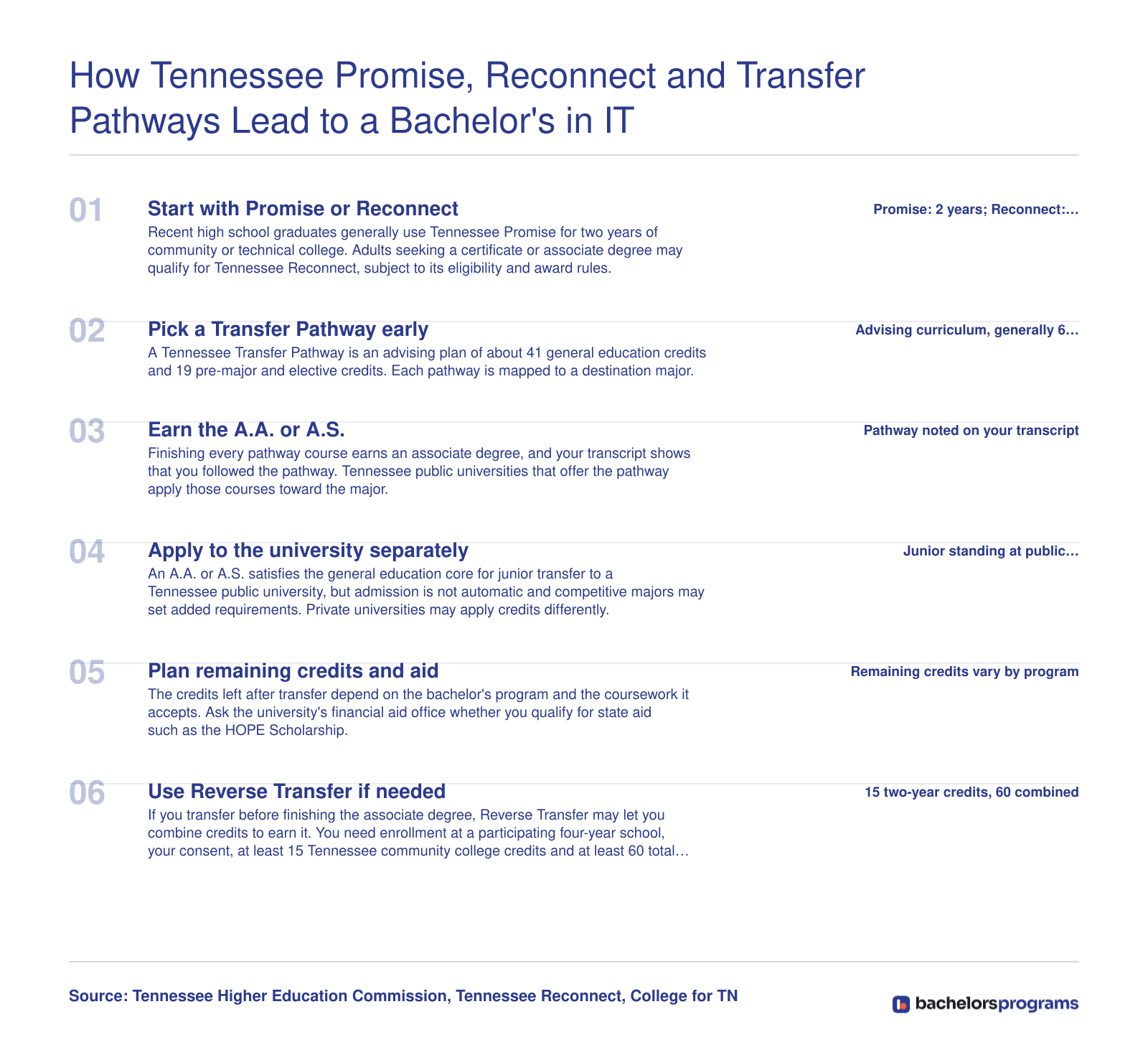
How Tennessee Promise, Reconnect and Transfer Pathways Lead to a Bachelor's in IT
Starting at a two-year college can lower the cost of a bachelor's degree in information technology, but the order of steps matters. The sequence below follows state transfer rules. Confirm current award, renewal and deadline details with each program, because the rules can change.
Information Technology Careers and Salaries in Tennessee
A quick salary figure is easy to find, but a reliable one for Tennessee takes a few more steps. Wages and job counts shift with every data release, and statewide averages can hide big differences between Nashville, Memphis, Knoxville, Chattanooga, and smaller markets. Pulling current numbers yourself takes a few steps for each of three common paths for bachelor's degree graduates: computer user support specialists, network and computer systems administrators, and information security analysts.
Start With the Bureau of Labor Statistics
The Bureau of Labor Statistics (BLS.gov) is the best first stop. Use two of its tools together:
- Occupational Employment and Wage Statistics (OEWS): Open the state data, select Tennessee, then search each occupation by name. Record the employment count, the median annual wage, and the 10th and 90th percentile wages.
- Occupational Outlook Handbook: Look up the same three occupations for typical duties, education requirements, and the national outlook based on the current 2025-2035 projections.
Compare the median against the 10th and 90th percentiles rather than relying on a single average.1 The low end shows where entry-level pay tends to start, and the high end shows what experience and certifications can earn. Note the reference year on every figure so you compare like with like.
Add Tennessee-Specific Sources
National data only goes so far. The Tennessee Department of Labor and Workforce Development publishes labor market information covering state and local job outlook, which helps you judge demand in the region where you want to work.
Then go to the schools. Check each program page and career-services office for:
- Which local employers recruit graduates
- Hiring trends in the area
- Graduate outcomes, such as job placement and typical first roles
Ask directly if the information is not posted. Career-services staff usually know which employers keep coming back.
Check Industry Groups
Professional associations show how the market values specific skills. CompTIA, ISC2, and ISACA publish certification information and often salary surveys, and those credentials can matter for support, systems, and security roles. Local Tennessee tech councils and user groups are useful for networking and for hearing what employers are hiring for now.
Verify Before You Decide
Treat every figure as provisional until you confirm it at the source. Compare at least two or three sources, such as BLS, the state labor department, and a professional association. Then contact schools or employers for a current read on local demand. That gives you a realistic salary picture for the Tennessee market you plan to enter.
Compare Information Technology programs on the data that matters
Explore more Computers & IT majors or browse every field of study.
All Computers & IT programs Browse every field of study