Best Online Cybersecurity Degree Programs
Compare 270+ accredited online Cybersecurity programs, with net price after aid, graduation rates, earnings and debt from IPEDS and the U.S. College Scorecard.
Average yearly net price for a bachelor's degree in cybersecurity runs from $4,904 to $25,648 across the schools ranked here, a fivefold gap for a degree that typically totals 120 credits. Programs typically award the Bachelor of Science (B.S.) in Cybersecurity.
The coverage is undergraduate only. Every program here is delivered fully online, with no hybrid meetings or on-campus requirements, and graduate tracks are left out.
Price is only one variable. Transfer credit and accreditation can change the real bill, and the diploma's value, as much as the sticker price does.
Key Points
- Every ranked program is 100% online: no campus labs or residencies.
- Students transferring an associate degree typically finish in about two years.
- ABET now recognizes cybersecurity as its own distinct program category.
Best Fully Online Bachelor's Degree in Cybersecurity Programs for 2027
Every program below is a fully online bachelor's degree in cybersecurity with no required in-person component; hybrid programs were left out. The order reflects a mixed quality composite of student outcomes, cost and completion rather than any single measure. Each card carries net price after aid, the school's graduation rate, and program-level earnings and debt where the federal data reports them for that specific degree.
Florida International University
#1Miami, FL · ~$9,000/yr (est.)
Best for: Florida residents seeking flexible online study
Florida International University runs its cybersecurity bachelor's degree through Cybersecurity@FIU, a dedicated cybersecurity hub that also hosts certificates, fellowships and graduate study. Undergraduates choose from multiple concentrations while completing the degree remotely, and the school's graduation rate is about 74 percent. Miami's large finance, logistics and healthcare employer base gives students a deep local market for internships and first jobs.
- Bachelor of Science in Cybersecurity offered through Cybersecurity@FIU
- Tracks: multiple cybersecurity concentrations
- Programs page also lists certificates, fellowships and graduate study
- Core cybersecurity coursework plus required courses and electives
- Typical completion in four years of full-time study
American Public University System
#2Charles Town, WV · $5,000 – $10,000/yr (est.)
Best for: Military-connected adults with transfer credits
American Public University System built its cybersecurity bachelor's degree for working adults: 120 credit hours, monthly course starts, no entrance exams and up to 90 transfer credits accepted. Five concentrations range from digital forensics to critical infrastructure and industrial control systems security. Median earnings for graduates of this degree run about $49,600 one year after finishing and $57,200 four years out, median program debt is near $32,300, and the school's graduation rate is about 57 percent.
- 120 credit hours with a required senior capstone seminar
- Tracks: Critical Infrastructure and Digital Forensics among five options
- Other concentrations include General, Privacy and Surveillance, Wireless and Mobile Security
- Critical Infrastructure coursework covers ICS/SCADA and industrial control systems
- Digital Forensics coursework covers evidence collection and incident response
- Monthly course starts, no entrance exams, up to 90 transfer credits
Charter Oak State College
#3New Britain, CT · $15,000 – $20,000/yr (est.)
Best for: Adult completers needing frequent start dates
Charter Oak State College is Connecticut's public online college, and its cyber security bachelor's degree is organized around a 45-credit major with six start dates a year. Prior learning assessment and credit for industry credentials let working adults shorten the runway, and the school's graduation rate is about 67 percent. Students can add an internship or a capstone and finish without ever traveling to New Britain.
- 45-credit major inside the bachelor's degree
- Six start dates each year
- Credit for prior learning and industry credentials can accelerate completion
- Coursework covers fundamentals, network security, forensics and incident response
- Capstone course included, with an internship option
Eastern New Mexico University
#4Portales, NM · ~$4,900/yr (est.)
Eastern New Mexico University delivers its cyber security concentration through the Bachelor of Applied Arts and Sciences, a transfer-friendly degree built for students who already hold an associate degree or roughly 30 technical credits. The concentration pairs security coursework with business, criminal justice and project management courses, and the school's graduation rate is about 45 percent. Online students can study fully online or mix in recorded and live-lecture formats.
- 120 credit hours with a primary and a secondary concentration
- Cyber Security is the secondary concentration, paired with a primary field
- Admission requires an AAS from a CHEA-recognized institution
- Or at least 30 credit hours in a career-technical discipline
- Courses run fully online through Canvas or as recorded and live lectures
- Daniels Fund Boundless Opportunity Scholarship supports adults returning to college
University of Kansas
#5Lawrence, KS · $12,000 – $30,000/yr (est.)
The University of Kansas offers a Bachelor of Applied Science in Applied Cybersecurity through its School of Professional Studies, designed specifically for students arriving with an associate degree or equivalent credit. The 118 to 120 credit degree stacks a general education core beneath applied cybersecurity coursework and a capstone, and the school's graduation rate is about 69 percent. Upper-level courses are delivered online, with an advisor building an individual completion plan.
- 118 to 120 credit hours, including 45 junior and senior hours
- Designed for students entering with an associate degree or equivalent credit
- College Algebra with a C or better required for admission
- Applied cybersecurity core plus electives and a 3 to 6 credit capstone
- Upper-level courses delivered online through the School of Professional Studies
- 2.0 KU GPA required to graduate
Thomas Edison State University
#6Trenton, NJ · $5,000 – $10,000/yr (est.)
Thomas Edison State University is New Jersey's public online institution for adults, and its cybersecurity bachelor's degree requires 120 credits with specializations in digital forensics and cyber investigation, cloud security and homeland security. Generous credit transfer, multiple start dates and credit for military and work experience are central to the design, and coursework includes ethical hacking, firewalls and Windows server configuration. The curriculum is built to line up with industry certifications.
- 120 credits required for the degree
- Tracks: Digital Forensics and Cyber Investigation, Cloud Security, Homeland Security
- Coursework includes ethical hacking, firewalls and perimeter security
- Also covers Windows Server configuration and computer programming
- Generous credit transfer for prior college, military and work experience
- Multiple start dates throughout the year
- Curriculum aligned with industry certifications
George Mason University
#7Fairfax, VA · $15,000 – $20,000/yr (est.)
George Mason University offers an applied science bachelor's with a cybersecurity concentration as a degree completion path for graduates of an associate degree in cyber security. The 120 to 126 credit program is taught with the Volgenau School of Engineering and aligned to NIST and NSA frameworks, which suits students aiming at federal and contractor roles in the Washington metro. Median earnings are about $42,100 one year after finishing and $63,200 four years out, median program debt is near $25,700, and the school's graduation rate is about 68 percent.
- 120 to 126 credits, delivered fully online
- Designed for graduates of an AAS in Cyber Security
- Taught in partnership with the Volgenau School of Engineering
- Curriculum aligned with NIST and NSA standards
- Prepares for cybersecurity analyst and information security analyst roles
- Geared to federal government and contractor careers in the Washington metro
- $60 application fee
Kennesaw State University
#8Kennesaw, GA · ~$15,000/yr (est.)
Kennesaw State University's cybersecurity bachelor's degree is a 120-credit program with tracks in systems security, network security and cyber crime, and it holds a National Center of Academic Excellence in Cyber Defense Education designation. The degree sits in the Coles College of Business and blends upper-division technical and security cores with risk assessment and security management. The school's graduation rate is about 52 percent.
- 120 credit hours, offered fully online
- Tracks: Systems Security, Network Security, Cyber Crime
- Upper division technical core, security core and a capstone
- National Center of Academic Excellence in Cyber Defense Education
- Housed in the Coles College of Business
- Major electives and free electives built into the degree
Fayetteville State University
#9Fayetteville, NC · $4,400 – $8,000/yr (est.)
Fayetteville State University offers a cyber security bachelor's degree with a fully online option and was the first online program in the UNC system. Coursework covers network security, penetration testing and digital forensics, and the NC Promise tuition model keeps in-state costs flat per semester. The school's graduation rate is about 38 percent.
- 100% online option available
- First online program in the UNC system
- Coursework covers network security, penetration testing and digital forensics
- Also covers information, computer, web and software security
- NC Promise holds in-state tuition at a flat per-semester rate
- Prepares for security analyst, penetration tester and forensic examiner roles
University of Cincinnati
#10Cincinnati, OH · ~$26,000/yr (est.)
The University of Cincinnati's cybersecurity bachelor's degree is ABET accredited and pairs applied coursework in digital forensics, incident response and threat detection with five semesters of paid cooperative education, so graduates arrive with more than a year of work experience. The program sits in the School of Information Technology, which also houses the Ohio Cyber Range Institute. Admission requires a 2.75 GPA, and the school's graduation rate is about 75 percent.
- ABET accredited program
- Five semesters of paid cooperative education
- Coursework spans digital forensics, incident response, threat detection and risk management
- Hands-on lab experience required
- 2.75 GPA required for freshman and transfer admission
- Ohio Cyber Range Institute housed in the same school
- Senior design project and 30 credit hour residency requirement
Cost & outcomes by school
Federal data for the highest-earning Cybersecurity programs, independent of the ranking above. Earnings are this field's bachelor's graduates four years after completing where the Scorecard reports them, else the school's undergraduate median.
| School | Net price / yr | Grad rate | Earnings | Debt | Grads/yr | Format |
|---|---|---|---|---|---|---|
| Boston College MA | $41,704 | 91% | $103,937 | $19,000 | — | Hybrid |
| Georgetown University DC | $40,815 | 95% | $103,494 | $15,500 | — | Online |
| Northeastern University MA | $30,915 | 91% | $92,538 | $24,250 | — | Hybrid |
| George Washington University DC | $36,586 | 84% | $90,873 | $20,449 | — | Online |
| Robert Morris University PA | $23,003 | 66% | $90,206 | $26,948 | 54 | Hybrid |
| Drexel University PA | $38,509 | 78% | $84,648 | $25,325 | — | Online |
| Virginia Polytechnic Institute and State University VA | $24,953 | 86% | $81,698 | $21,500 | — | Hybrid |
| California State University-San Marcos CA | $10,229 | 55% | $62,908 | $17,350 | — | Online |
| Florida International University FL | $9,288 | 74% | $60,249 | $16,500 | 68 | Online |
| The University of Tennessee-Knoxville TN | $18,976 | 74% | $60,249 | $20,500 | — | Online or campus |
Sources: U.S. Department of Education. Net price, graduation rate, earnings and debt: College Scorecard (earnings and debt for this field's bachelor's graduates where reported, else school-wide); graduates: IPEDS. A dash means no figure is reported.
Cost, debt & payoff
Median earnings of this field's bachelor's graduates (4 yrs after completing, else the school's undergraduate median) vs. their median federal loan debt · U.S. College Scorecard
Across these programs the median graduate earns about $52,574 and finishes with roughly $22,985 in debt — a ratio that clears a common rule of thumb (keep debt below first-year salary). Net price and debt vary widely school to school, so check the per-school figures in the table above before you shortlist.
Our Scoring Method for Fully Online Cybersecurity Schools
Every school below had to clear one gate before anything else was measured: you can earn the degree without ever setting foot on campus. Programs that require on-site labs, residencies or hybrid class meetings were set aside, even when the coursework is otherwise strong.
What Shapes the Order
Schools that passed the online-only filter are ordered by a composite that blends several quality signals instead of leaning on one number:
- Earnings: what graduates of each cybersecurity program earn after school, from the U.S. Department of Education's College Scorecard.
- Debt: the median amount program graduates borrowed.
- Graduation rate: the share of students who finish at the institution.
- Net price: what students pay on average once grants and scholarships are counted.
- Completions: how many students the program graduates, a sign of an established track.
Two Caveats Worth Knowing
The graduation rate covers the whole school, not the cybersecurity program alone, so it reflects the institution's overall student support. The net price shown is an average after aid, not a quote for any one student. Your own bill depends on your income, residency and transfer credits.
Every school here appears in federal College Scorecard data, which includes institutions eligible for federal student aid. That eligibility is a baseline, not an endorsement of the program itself. Accreditation is covered later on this page.
Inside a B.S. in Cybersecurity: Credits, Courses and How Online Classes Run
A bachelor's degree in cybersecurity is a four-year undergraduate program, typically 120 credits, that pairs general education with a security core and a final capstone project.
What the 120 Credits Actually Contain
About half the degree is general education plus foundational computing courses. The security core usually covers network defense, cryptography, ethical hacking, digital forensics, and governance, risk and compliance. A capstone pulls those threads into one project.
Standalone Degree vs. a Concentration
A standalone B.S. in Cybersecurity suits students who want security coursework from the first term and plan to move into analyst, SOC, or compliance roles. An IT or computer science degree with a cybersecurity concentration leaves more room for programming, systems administration and networking, a better fit if you want a broader technical base or expect to move into adjacent work later.
How Online Classes Run
Formats differ more than the brochures suggest. CSU Global and UMPI YourPace run 8-week asynchronous courses with no set login times; UMPI offers six starts a year with self-paced progress. AMU runs 8- to 16-week courses without set login times. Excelsior's fully online track is asynchronous through a 24/7 portal.2 Avila uses 8-week terms with several starts each year. Shorter terms mean faster completion and a heavier weekly reading load; 16-week terms spread the same material out.
Proctoring varies by course and school. Where remote proctoring is used, services such as ProctorU publish baseline specs: Windows 10 or macOS 11, 8 GB of RAM, a 4-core 2.4 GHz processor, 3 Mbps up and down, and a webcam.1
Labs Without a Campus Visit
Hands-on work runs in virtual environments: simulated labs at CSU Global, immersive labs at UMPI YourPace, and a dedicated cyber range at AMU where students work in tools like Kali Linux and Metasploit.
Online Cybersecurity Degree Cost: Net Price, Per-Credit Tuition and Total Bill
The schools below post the lowest average net price among the online cybersecurity bachelor's programs we track. Net price is the average yearly cost after grants and scholarships for students who receive aid, not a personal quote, so run each school's net price calculator for your own figure. Sticker prices run much higher: Forbes Advisor's 2026 review found online cybersecurity tuition ranging from $190 to $924 per credit, so a 120-credit degree at Kennesaw State's $190 rate comes to about $22,800 in tuition alone before any fees. Utica University estimates $57,000 in tuition for its 120-credit B.S. ($475 per credit, plus a $70 distance-learning fee per online course), and University of Phoenix lists $58,320 for 40 courses at $426 per credit, including a $180 per-course resource fee, for students enrolling on or after Nov. 2, 2026. In the table, Pell Grant shares above 80 percent and median graduate debt of $16,500 to $22,987 signal that these schools serve many lower-income students without heavy borrowing. You can push any bill lower with transfer credits, employer tuition assistance, or military tuition assistance; University of Maryland Global Campus, for example, charges service members $250 per credit, compared with $337 in-state and $499 out-of-state.
| School | Location | Average Net Price (per year) | Annual In-State Tuition and Fees | Annual Out-of-State Tuition and Fees | Students Receiving Pell Grants | Graduation Rate | Median Graduate Debt |
|---|---|---|---|---|---|---|---|
| Eastern New Mexico University | Portales, NM | $4,904 | $7,194 | $9,174 | 81% | 45% | $16,500 |
| Fayetteville State University | Fayetteville, NC | $7,892 | $4,353 | $8,353 | 82% | 38% | $22,987 |
| Florida International University | Miami, FL | $9,288 | $6,565 | $18,964 | 81% | 74% | $16,500 |
Related Articles
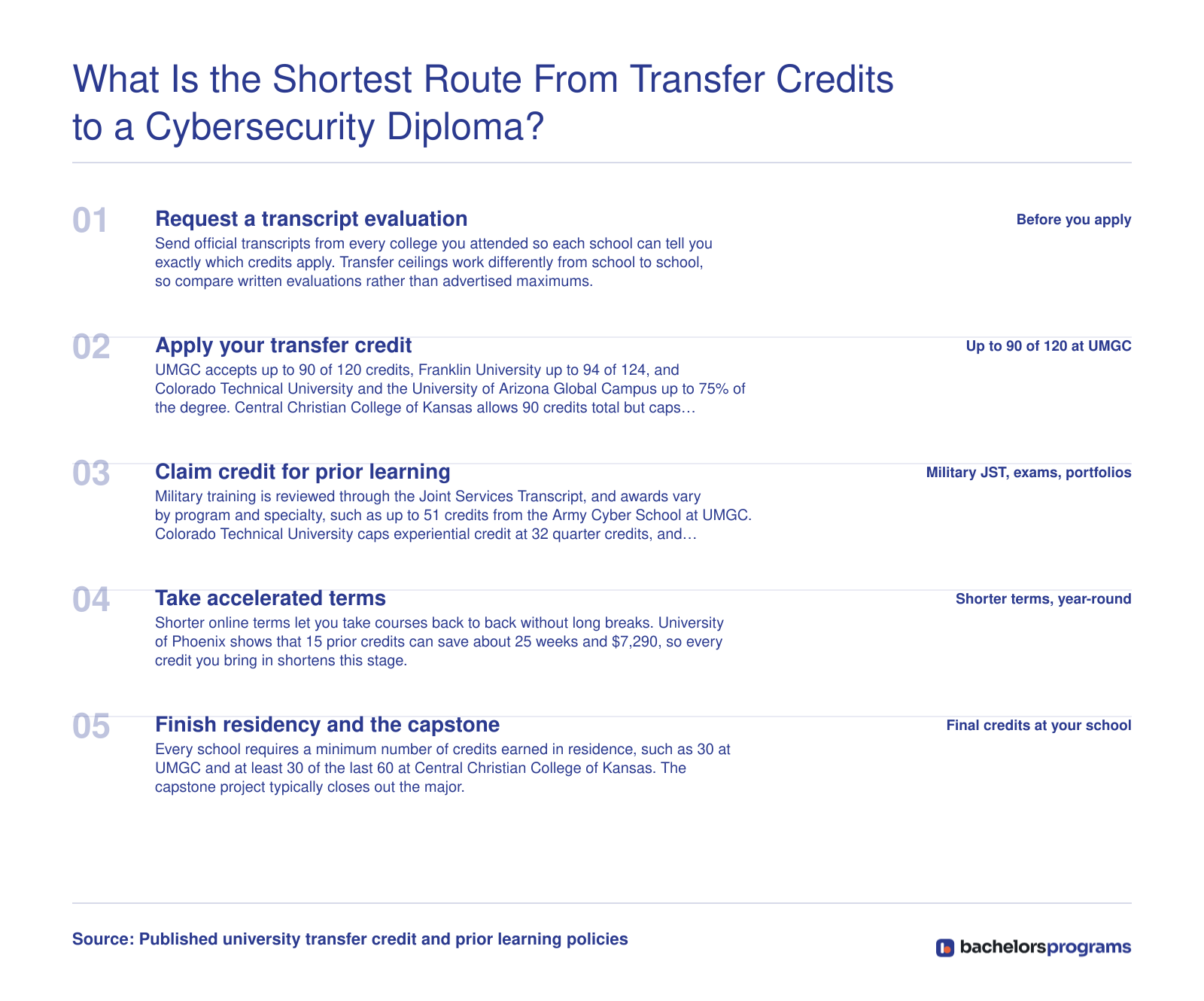
What Is the Shortest Route From Transfer Credits to a Cybersecurity Diploma?
Transfer credit, military training and prior learning can shorten a 120-credit bachelor's degree in cybersecurity, but each school counts them differently. A student with an associate degree typically finishes in about two years of full-time study, while a student starting with no college credit should plan on about four years.
Regional Accreditation vs. ABET vs. NSA CAE: What Each Seal Means
Cybersecurity is now a recognized program category at ABET1, which makes the seals on an online degree page worth reading closely, provided you know which seal you are looking at. ABET reports more than 40 accredited cybersecurity programs at the two- and four-year levels3, and its 2025-2026 criteria require bachelor's programs in this category to include at least 45 semester credit hours of computing and cybersecurity coursework.2
Start With the Institution
Regional (institutional) accreditation covers the whole school and is what typically matters for federal financial aid and credit transfer. Confirm it through the U.S. Department of Education's DAPIP database or CHEA, then check the regional accreditor's own site. This seal says nothing specific about the cybersecurity curriculum.
Then Verify the Program Seals
ABET accredits programs, not institutions.4 Search ABET's accredited program database for the school and the exact program name, then ask admissions two questions: what is the current accreditation term, and is cybersecurity the accredited program or only a concentration inside a broader computing degree? ABET notes that online delivery details can change often1, so confirm the fully online version is the one covered.
NSA CAE-CD (Cyber Defense) and CAE-CO (Cyber Operations) designations work differently. Find the school and its specific designation on the NSA CAE institution list, then read the cybersecurity department's page to see which degrees are covered and through what validation period. A school-level designation does not automatically extend to every online bachelor's program.
Quick Checklist
- Outlook: Read the BLS Occupational Outlook Handbook entry for information security analysts to see typical entry credentials.
- Career claims: Ask career services to name employer partners and explain how online students reach them.
- Certifications: Check ISC2, ISACA and CompTIA guidance on which credentials employers commonly request, then ask whether courses prepare you for them.
What Information Security Analysts Earn Nationally
A bachelor's degree in cybersecurity is a common entry point into information security analyst roles, an occupation with a strong national pay benchmark.
Questions to Ask Yourself
Do you already hold Security+ or an associate degree in IT?
Are you aiming at federal or defense work rather than private-sector security roles?
Can you sustain back-to-back 8-week terms while working full time?
Do you want a standalone cybersecurity bachelor's degree, or an IT degree with a security concentration?
Cybersecurity programs by state
Quick Answers Before You Compare Programs
These short answers cover the questions readers ask most about a bachelor's degree in cybersecurity earned online. Each one points to the section below that goes deeper.
Which fully online cybersecurity bachelor's program ranks highest this year?
What does a cybersecurity bachelor's cost when you earn it online?
Does an online cybersecurity degree pay off financially?
Are 100% online cybersecurity degrees properly accredited?
How many years does an online B.S. in Cybersecurity usually take?
Do online cybersecurity programs require webcam-proctored exams?
Can military training or IT certifications count toward a cybersecurity bachelor's?
Is a standalone cybersecurity degree better than an IT degree with a security concentration?
Compare Cybersecurity programs on the data that matters
Explore more Computers & IT majors or browse every field of study.
All Computers & IT programs Browse every field of study