Best Online Innovation Degree Programs
Compare 140+ accredited online Innovation programs, with net price after aid, graduation rates, earnings and debt from IPEDS and the U.S. College Scorecard.

In-state tuition runs from roughly $3,050 a year at Palm Beach State College to $16,966 at the University of Massachusetts-Lowell, yet the core coursework looks similar across programs: design thinking, venture financing, and applied problem-solving that transfers across industries.
Every program listed here can be completed fully online. No hybrid formats, and no graduate study. The harder problem is naming: entrepreneurship, innovation leadership, innovation and entrepreneurship, food innovation. Employers read the transcript and the capstone, not the label on the diploma.
Key Points
- Every ranked program can be finished online with no campus residency.
- Judge cost by average net price after aid, not published tuition.
- Grand Valley State's Professional Innovation graduates post the top median earnings here.
Best Fully Online Schools for a Bachelor's Degree in Innovation
Every school below can be finished online, and the online route does not build in a campus residency or in-person weekend. Each card names the concentration or track, the school's location, and an approximate average net price after aid. Graduation rates describe the whole institution, not a single major.
Oregon State University
#1Corvallis, OR · $15,000 – $20,000/yr (est.)
Best for: Venture-minded transfer students
Oregon State runs its Innovation & Entrepreneurship major through Ecampus, so the same 180-credit degree taught in Corvallis is available online. The curriculum pairs a full business core with ideation, innovation management and new product development, and no startup idea is required to enroll. Average net price after aid runs about $19,604, and the school's graduation rate is 70%.
- 180 credits, with 34 in the innovation and entrepreneurship curriculum
- Available online through Oregon State Ecampus
- No startup idea required to enter the major
- 2 experiential learning credits from an internship, thesis, project or practicum
- Options in Dean's Academy and International Business
- Accepts second- and third-year transfer students
- At least 45 of the final 75 credits must be completed at Oregon State
Florida International University
#2Miami, FL · ~$9,000/yr (est.)
Best for: Food and hospitality innovation hopefuls
Florida International University is a large public research university in Miami whose Chaplin School of Hospitality & Tourism Management houses this program. The Food Innovation and Entrepreneurship concentration sits alongside hotel, events, cruise and restaurant tracks, giving students a food and hospitality lens on new venture work. Average net price after aid is roughly $9,288, and the school's graduation rate is 74%.
- Food Innovation and Entrepreneurship concentration
- Chaplin School of Hospitality & Tourism Management
- Sibling tracks in hotel, events, cruise and restaurant management
- Course requirements listed in the FIU catalog
American Public University System
#3Charles Town, WV · $5,000 – $10,000/yr (est.)
Best for: Military-connected adults balancing work and study
American Public University System is an online institution based in Charles Town, West Virginia, built around eight-week sessions and frequent start dates. Its entrepreneurship bachelor's degree is ACBSP-accredited and has students build a business plan across the whole program rather than in a single capstone. Average net price after aid is about $9,597.
- 120 semester hours, with 54 in the major
- ACBSP-accredited business program
- Concentrations in General, Digital Marketing Tools or Leadership Strategies
- Business plan built across the full program
- Choice of Innovation Design and Prototyping or Service Innovation and Delivery
- Eight-week sessions with multiple enrollment dates
- Senior seminar in business administration
University of Mississippi
#4University, MS · $10,000 – $15,000/yr (est.)
The University of Mississippi, in Oxford, offers its entrepreneurship bachelor's degree on campus and online. Students can launch a real venture with a mentor entrepreneur, enter startup competitions worth more than $50,000, and take courses such as Corporate Innovation and Venture Finance. Average net price after aid is roughly $13,314, and the school's graduation rate is 72%.
- 120 credits over four years
- Online option available
- Startup competitions with more than $50,000 in prizes
- Launch a business under the guidance of a mentor entrepreneur
- Courses include Business Venturing, Corporate Innovation and Venture Finance
- Optional internship of at least 180 hours
- Center of Innovation and Entrepreneurship
Palm Beach State College
#5Lake Worth, FL · $3,100 – $11,000/yr (est.)
Palm Beach State College is a public college in Lake Worth, Florida, and its business programs hold ACBSP accreditation. The Supervision and Management degree takes an associate degree plus a 2.0 GPA as its entry point, then adds an entrepreneurship concentration for students heading toward management or business ownership. Average net price after aid is about $9,182.
- Entrepreneurship concentration code BAS-T704
- 120 credits, about two years of full-time study
- Admission requires an associate degree and a 2.0 GPA
- 100% online completion route available
- ACBSP-accredited business programs
- Three start terms per year
University of Nevada-Las Vegas
#6Las Vegas, NV · ~$10,000/yr (est.)
The University of Nevada, Las Vegas lists its business administration entrepreneurship degree as available online. The program sits in the Management and Entrepreneurship unit, and the university also offers an entrepreneurship minor for students in other majors. Average net price after aid is roughly $10,359, and the school's graduation rate is 51%.
- Listed as available online
- Housed in the Management and Entrepreneurship unit
- Entrepreneurship minor offered separately
Seminole State College of Florida
#7Sanford, FL · ~$9,000/yr (est.)
Seminole State College of Florida, in Sanford, builds its business and information management degree around a 12-credit specialization chosen from five options. The entrepreneurship track covers commercializing new technologies, new business development and entrepreneurial finance, and finishes with a capstone. Average net price after aid is about $8,970.
- 120 credits, 36 of them in general education
- 12 elective credits in the chosen specialization
- Coursework in commercializing new technologies and entrepreneurial finance
- Capstone project required
- Admission requires an associate or bachelor's degree and a 2.0 GPA
- Trains founders and intrapreneurs inside existing companies
University of Massachusetts-Lowell
#8Lowell, MA · ~$17,000/yr (est.)
UMass Lowell's Manning School of Business runs the entrepreneurship concentration inside its business administration degree, with courses in starting a new venture, corporate entrepreneurship and managing innovation. The Venture Lab supplies hands-on project work, and the capstone produces a new venture business plan. Average net price after aid is roughly $17,163, and the school's graduation rate is 65%.
- 122 credits, with 36 to 54 in the major
- Four required courses including Managing Innovation
- Capstone builds a new venture business plan
- Venture Lab experiential learning
- Degree plans updated for students entering fall 2026
- Career Connected Experience requirement
Western Carolina University
#9Cullowhee, NC · ~$13,000/yr (est.)
Western Carolina University, in Cullowhee, North Carolina, offers a Bachelor of Science in Business Administration with a major in Innovation Leadership and Entrepreneurship. Students can complete it through a 100% online distance option if they bring prior credits, and the program adds internships, consulting projects and competitions to the business core. Average net price after aid is about $13,315, and the school's graduation rate is 60%.
- 120 credits: 42 liberal studies, 36 business core, 24 major
- 100% online distance option for students with prior credits
- Internships of 200+ hours can earn elective credit
- Consulting projects, competitions and clubs
- Sigma Nu Tau entrepreneurship honor society
Weber State University
#10Ogden, UT · ~$10,000/yr (est.)
Weber State University, in Ogden, Utah, runs its entrepreneurship degree through the Hall Global Entrepreneurship Center. The entrepreneurship courses are self-paced and fully online, and students can pitch an idea for seed funding or apply to the Wildcat MicroFund. Average net price after aid is roughly $10,258, and the school's graduation rate is 46%.
- Entrepreneurship courses are self-paced and 100% online
- Run through the Hall Global Entrepreneurship Center
- Wildcat MicroFund offers startup money
- Students pitch business ideas to judges for seed funding
- Also offers a 15-credit minor and a 10-credit certificate
Cost & outcomes by school
Federal data for the highest-earning Innovation programs, independent of the ranking above. Earnings are this field's bachelor's graduates four years after completing where the Scorecard reports them, else the school's undergraduate median.
| School | Net price / yr | Grad rate | Earnings | Debt | Grads/yr | Format |
|---|---|---|---|---|---|---|
| George Mason University VA | $17,915 | 68% | $76,343 | $19,500 | — | Online |
| Charter Oak State College CT | $15,815 | 67% | $64,209 | $18,683 | — | Online |
| CUNY Brooklyn College NY | $3,103 | 54% | $60,752 | $11,000 | — | Online or campus |
| Florida International University FL | $9,288 | 74% | $60,249 | $16,500 | — | Online |
| University of South Florida FL | $9,812 | 77% | $57,743 | $17,988 | 38 | Hybrid |
| Florida Atlantic University FL | $8,752 | 63% | $56,746 | $17,236 | — | Online or campus |
Sources: U.S. Department of Education. Net price, graduation rate, earnings and debt: College Scorecard (earnings and debt for this field's bachelor's graduates where reported, else school-wide); graduates: IPEDS. A dash means no figure is reported.
Cost, debt & payoff
Median earnings of this field's bachelor's graduates (4 yrs after completing, else the school's undergraduate median) vs. their median federal loan debt · U.S. College Scorecard
Across these programs the median graduate earns about $54,665 and finishes with roughly $23,250 in debt — a ratio that clears a common rule of thumb (keep debt below first-year salary). Net price and debt vary widely school to school, so check the per-school figures in the table above before you shortlist.
Online Innovation Degree Tuition, Net Price, and Total Cost Compared
Published tuition is the sticker price, while average net price reflects what students actually paid after grants and scholarships, and it is an institution-wide average rather than a figure for the innovation program alone (U.S. Department of Education, IPEDS and College Scorecard, 2024). Public schools such as University of Michigan-Flint ($14,704 in-state vs. $28,320 out-of-state) typically charge nonresidents more, so confirm whether that rate applies to online students, while private American Public University System lists the same $8,400 for everyone. To estimate total cost, multiply the annual figure by the years you have left after transfer credits are applied: two remaining years at a $9,000 net price works out to roughly $18,000.
| School | State | Sector | In-State Tuition | Out-of-State Tuition | Average Net Price |
|---|---|---|---|---|---|
| Lake Washington Institute of Technology | WA | Public | $5,997 | $12,062 | $6,817 |
| University of Michigan-Flint | MI | Public | $14,704 | $28,320 | $7,007 |
| University of Hawaii Maui College | HI | Public | $3,284 | $8,420 | $8,061 |
| Seminole State College of Florida | FL | Public | $3,122 | $11,447 | $8,970 |
| Palm Beach State College | FL | Public | $3,050 | $10,910 | $9,182 |
| Peninsula College | WA | Public | $4,718 | $5,270 | $9,246 |
| Florida International University | FL | Public | $6,565 | $18,964 | $9,288 |
| Lamar University | TX | Public | $8,905 | $18,745 | $9,366 |
| American Public University System | WV | Private for-profit | $8,400 | $8,400 | $9,597 |
| University of North Georgia | GA | Public | $5,285 | $16,503 | $9,823 |
Accredited Online Innovation Degree Programs: What to Verify Before You Enroll
A state license is not accreditation, and the difference decides whether your degree and your federal aid survive four years of tuition bills. Institutional accreditation, granted to the whole college or university by a Department of Education-recognized body, is the non-negotiable baseline.2 It governs federal student aid eligibility, credit transfer between schools, and how employers read your degree. The major institutional accreditors include the Higher Learning Commission, MSCHE, NECHE, SACSCOC, NWCCU, WSCUC, and DEAC for distance education institutions.
Most innovation programs have no dedicated programmatic accreditor.1 Business accreditation matters when the degree sits inside a business school: AACSB, ACBSP, and IACBE review a business college, department, or named program, not every degree a university offers.3 If a school claims business accreditation, check whether the innovation major falls inside that accredited unit.
How to Verify
Check institutional status in the Department of Education's DAPIP database, and search both institutions and programs through CHEA's directories.4 Confirm that status is current and active, get the accreditor's name, and check that online delivery and the degree level are covered.
Red Flags
- Residency requirements: a "fully online" program with a required on-campus weekend or summer institute.
- Proctored in-person exams: testing centers or site visits buried in the syllabus.
- Vague claims: "accredited" with no accreditor named, or a programmatic seal that covers a different department.
Related Articles
What Is an Innovation Degree Good for? Careers and Earnings
An innovation degree prepares you for roles that turn ideas into products, processes, or ventures. Four common paths show the range, using Bureau of Labor Statistics figures for each occupation.
- Management analysts: Median pay was $101,860 in May 2025, with 10% projected growth from 2025 to 2035.1
- Market research analysts: Median pay was $78,760, with 7% projected growth over the same period.2
- Project management specialists: Median pay was $102,320, with 7% projected growth.3
- Top executives: Median pay was $108,780, a route that usually follows years of experience or founding your own company.4
These are national wages for everyone in each occupation, not what graduates of a particular program earn. Treat them as a benchmark for planning, not a promise. Graduate earnings from a ranked program appear separately below.
The degree tends to pay off most when you pair it with a technical or industry specialty, such as data analytics, healthcare, engineering, or supply chain. Innovation skills show employers how you work. A specialty shows them where you can apply it.
Top Graduate Earnings From a Ranked Innovation Program
Among the schools ranked here, Grand Valley State University's Professional Innovation graduates post the highest program-level median earnings.
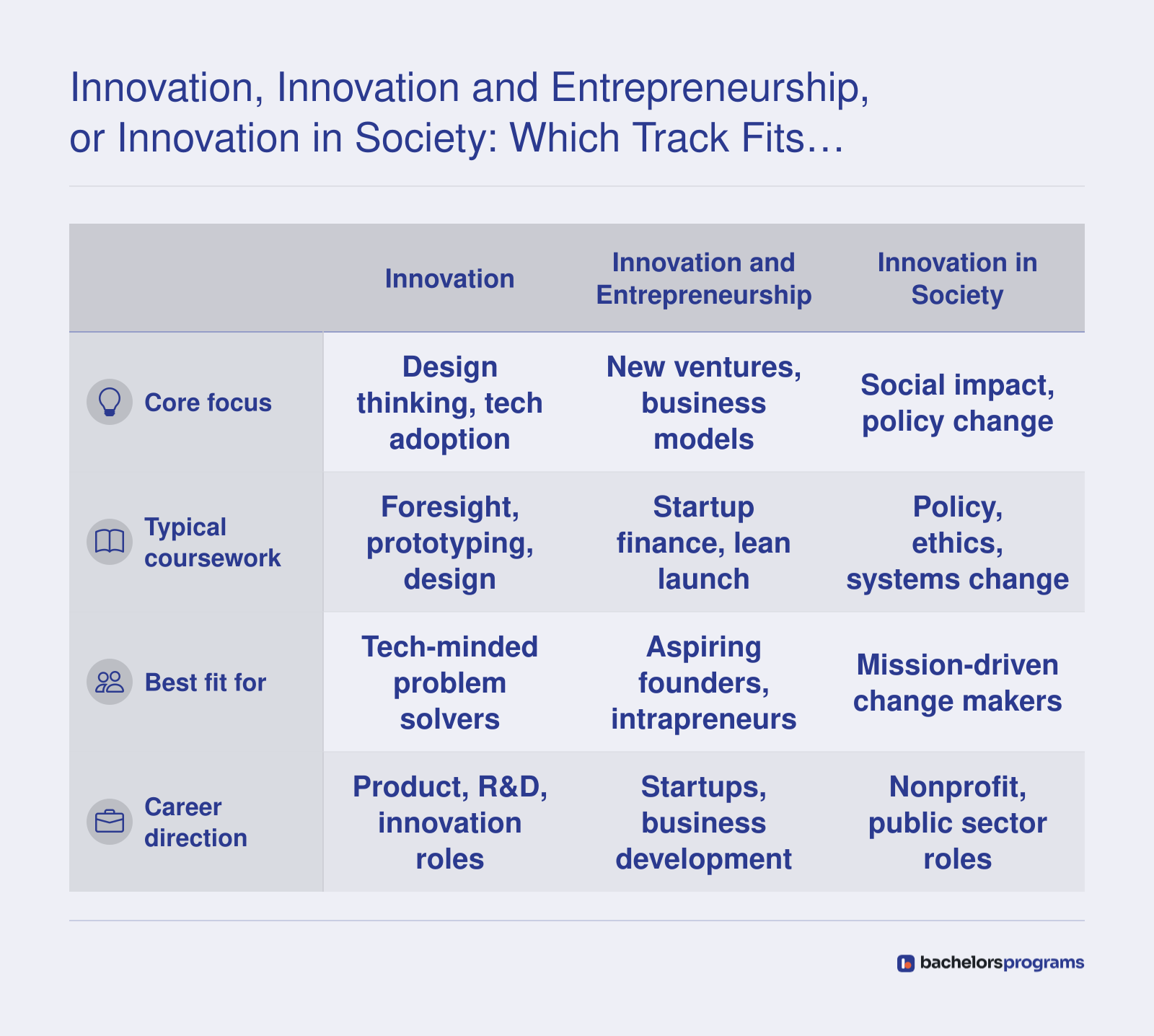
Innovation, Innovation and Entrepreneurship, or Innovation in Society: Which Track Fits You?
All three bachelor's tracks build creative problem-solving skills, but each points toward different work. Compare the focus, coursework, and fit of each before you shortlist programs. If you want a defined path into accounting, finance, or a portfolio-driven design career, a traditional business or design major is likely the better choice.
Choosing the Right Fully Online Innovation Program for You
Which online innovation program fits a career changer, a working parent, or a founder with an idea already in motion? The answer depends on how you will actually use the degree.
- Career changers: Look for applied capstones and project-based coursework you can point to in an interview.
- Working adults: Prioritize asynchronous classes and shorter terms. Arizona State Online runs 7.5-week courses, Old Dominion uses 8-week accelerated courses, and Johnson & Wales offers 7- or 15-week options.4
- Aspiring founders: Seek venture, incubator, or new-venture coursework and access to startup coaching.
Credits, Transfer Caps, and Pacing
Most bachelor's degrees here require about 120 credits, though Oregon State's quarter-credit structure totals 180. Transfer caps vary widely: Old Dominion accepts up to 90 prior credits1 and Unity up to 60, which can cut years off completion.2 Multiple start dates per year (Lynn has three)3 and part-time loads keep the pace flexible.
Your Next Step
Shortlist two or three ranked programs, request a transfer credit evaluation, and compare net price before you commit.
Innovation programs by state
Frequently Asked Questions About Online Innovation Degrees
These answers cover the questions prospective students ask most about timelines, accreditation, and prerequisites. Always confirm details with each school's admissions office, since requirements and credit rules vary.
How long does it take to earn an online innovation bachelor's degree?
Are online innovation degrees accredited and worth it?
Do I need a business or tech background to start a bachelor's degree in innovation?
Compare Innovation programs on the data that matters
Explore more Computers & IT majors or browse every field of study.
All Computers & IT programs Browse every field of study