Best Online Corrections Degree Programs
Compare 50+ accredited online Corrections programs, with net price after aid, graduation rates, earnings and debt from IPEDS and the U.S. College Scorecard.

Correctional officer jobs often require only a high school diploma, yet probation officers and treatment specialists typically need a bachelor's degree, and shift workers can't easily step away to earn one. A bachelor's degree in corrections is an undergraduate degree, often a criminal justice degree with a corrections concentration, covering institutional corrections, community supervision, and offender rehabilitation.
Every program here is fully online. Hybrid options were excluded, so working adults and current staff keep their shifts.
For most working officers, schedule fit decides which program they choose.
Key Points
- Texas A&M University-Central Texas has the lowest average net price: $1,300.
- BLS median pay for probation officers hit $66,270 in May 2025.
- Most online corrections degrees are criminal justice majors with corrections concentrations.
Best Fully Online Schools for a Bachelor's Degree in Corrections
Every school below offers a fully online route to a bachelor's degree in corrections or in criminal justice with a corrections concentration, with no requirement to attend campus classes or join a hybrid cohort. Coursework, advising, and exams happen at a distance, and where a degree also carries a field placement or internship we say so in the card. Each entry covers the corrections credential first, then the cost and completion figures that help you compare schools.
Eastern Kentucky University
#1Richmond, KY · $11,000/yr (est. net price)
Best for: Working corrections officers finishing a degree
Eastern Kentucky University awards a bachelor's degree named specifically for corrections and juvenile justice, delivered through its School of Justice Studies. The 120-credit program runs fully online at $472 per credit with six start dates a year and no campus visits, and it accepts up to 90 transfer credits, including nine credits for Kentucky DOCJT training. EKU reports an institution-wide graduation rate around 50% and an average net price near $11,000 after aid.
- 120 credit hours, fully online
- $472 per credit online tuition rate
- Up to 90 transfer credits; 30 must be earned at EKU
- Six start dates per year; no campus visits required
- Nine credits granted for Kentucky DOCJT training
- Coursework in community corrections and juvenile justice
- $0 application fee
Florida Atlantic University
#2Boca Raton, FL · $4,900 – $17,000/yr (est.)
Best for: Florida transfer students entering public safety
Florida Atlantic University awards a Bachelor of Public Safety Administration through its College of Arts and Letters, with a Law Enforcement and Corrections track built for people moving into criminal justice and corrections administration. The program is 100% online and admits new students in fall, spring, and summer across three 12-week terms. FAU reports an institution-wide graduation rate of about 63% and an average net price near $8,750 after aid.
- 100% online Bachelor of Public Safety Administration
- Concentration in Law Enforcement and Corrections
- Second concentration option in Disaster Management
- Three 12-week terms; fall, spring, and summer admission
- Ranked 53rd for online bachelor's degrees by U.S. News
- Ranked 4th for online criminal justice and law enforcement
Thomas Edison State University
#3Trenton, NJ · $5,000 – $10,000/yr (est.)
Best for: Adults transferring military or work credit
Thomas Edison State University is built for adults returning to school, and its fully online Bachelor of Science in Criminal Justice follows curriculum criteria set by the Academy of Criminal Justice Sciences. Corrections is one of the areas of study, alongside administration of justice, criminological theory, law adjudication, and law enforcement. The degree requires 120 credits, accepts transfer credit, awards credit for military service and industry training, and offers multiple start dates each year.
- 120-credit BS in Criminal Justice, fully online
- Curriculum aligned with Academy of Criminal Justice Sciences criteria
- Corrections among the named areas of study
- Transfer credit accepted, plus credit for military and industry training
- Multiple start dates each year
- General education core in the liberal arts
University of Mississippi
#4University, MS · $10,000 – $15,000/yr (est.)
The University of Mississippi offers a Bachelor of Science in Criminal Justice with a dedicated corrections emphasis covering prisoner management, parole and probation, juvenile supervision, courts, prisons, and rehabilitation. The major runs 42 credit hours across eight semesters and is available online as well as at several Mississippi locations. Ole Miss posts an institution-wide graduation rate of roughly 72% and an average net price of about $13,300 after aid.
- Corrections emphasis within the criminal justice bachelor's
- 42 credit hours in the major across 8 semesters
- Covers parole, probation, and juvenile supervision
- Online plus Oxford, Tupelo, Grenada, Booneville, and DeSoto sites
- Internship program for majors
- Accelerated master's option for current B.S.C.J. students
Florida Gulf Coast University
#5Fort Myers, FL · ~$13,000/yr (est.)
Florida Gulf Coast University's criminal justice bachelor's offers six specializations, and the corrections track covers probation and parole alongside institutional practice. Students who hold an AA or articulated AS from a Florida public community college can finish the 60 upper-division credits online, a structure the university designed around shift work and family obligations. Institution-wide, FGCU graduates about 57% of students and reports an average net price near $12,600 after aid.
- Corrections is one of six specializations
- 60 upper-division credits available online
- AA or articulated AS from a Florida public college accepted
- Curriculum covers probation, parole, and juvenile justice
- Built for students working shifts
- Internship combines theory and practice
Texas A&M University-Central Texas
#6Killeen, TX · under $5,000/yr (est.)
Texas A&M University-Central Texas delivers a 120-hour Bachelor of Science in Criminal Justice on campus and online, with study areas spanning community and institutional corrections, policing, courts, and forensic investigations. The corrections focus prepares graduates for state, local, and federal agency work, and students can join the Criminal Justice Association or the Omega Lambda chapter of Alpha Phi Sigma. The online format suits working adults who need flexibility around a full-time job.
- 120 total credit hours
- Available on campus and online
- Corrections focus covers community and institutional settings
- 10 areas of study including homeland security and forensic investigations
- Student chapter of Alpha Phi Sigma (Omega Lambda)
University of Alabama at Birmingham
#7Birmingham, AL · $19,000/yr (est. net price)
The University of Alabama at Birmingham houses its criminal justice bachelor's in the J. Frank Barefield, Jr. Department of Criminal Justice, where coursework covers corrections, criminology, juvenile justice, law, and computer forensics. Seniors can complete an internship with agencies such as the FBI, NCIS, or the DEA, and the degree can be taken entirely online. UAB reports an institution-wide graduation rate near 64% and an average net price of about $18,750 after aid.
- Corrections concentration within the criminal justice BS
- Can be completed entirely online
- Senior internship with agencies such as the FBI, NCIS, and DEA
- Coursework includes criminology, juvenile justice, and computer forensics
- Affiliated with the UAB Institute for Human Rights and Center for Cyber Security
University of Massachusetts-Lowell
#8Lowell, MA · ~$17,000/yr (est.)
UMass Lowell's School of Criminology and Justice Studies offers six options inside its criminal justice bachelor's, and the Corrections Option draws electives on community and institutional corrections in both theory and practice. The degree requires 120 credit hours, and juniors with a 3.0 GPA can apply to the BS/MA path and finish both degrees in five years. Institution-wide, UMass Lowell graduates about 65% of students at an average net price near $17,150 after aid.
- Corrections Option within the 120-credit criminal justice BS
- Electives cover community and institutional corrections
- Concentrations optional; General Option is the default
- BS/MA path finishes both degrees in five years
- 3.000 GPA required for the accelerated BS/MA
- Students declare an option before their third criminal justice elective
Ball State University
#9Muncie, IN · $10,000 – $15,000/yr (est.)
Ball State University pairs criminal justice with psychology in its Corrections and Human Behavior concentration, a 48- to 51-credit combination of 27 criminal justice credits, 12 psychological science credits, and 9 to 12 directed electives. Coursework digs into the psychology of offending, deviant behavior, and best practices for changing offender behavior. Ball State reports an institution-wide graduation rate near 62% and an average net price of about $14,900 after aid.
- Corrections and Human Behavior concentration
- 48 to 51 total credits, including internship hours
- 27 credits in criminal justice and criminology
- 12 credits in psychological science
- 9 to 12 directed electives across both departments
- Awarded as a Bachelor of Arts or Bachelor of Science
University of Cincinnati
#10Cincinnati, OH · ~$26,000/yr (est.)
The University of Cincinnati's School of Criminal Justice offers four concentrations inside its criminal justice bachelor's, including a Corrections track that covers how courts, policing, and corrections respond to crime. Students complete a final-year field placement with a criminal justice agency, and the school points to top-15 criminal justice rankings from U.S. News & World Report and College Factual. Cincinnati reports an institution-wide graduation rate near 75% and an average net price of about $25,650 after aid.
- Corrections is one of four concentrations
- Four-year degree; SAT and ACT scores optional
- Final-year field placement with a criminal justice agency
- Coursework on the causes and consequences of crime
- Student chapter of the American Correctional Association
- Optional 10-day Criminal Justice in Scotland program
Cost & outcomes by school
Federal data for the highest-earning Corrections programs, independent of the ranking above. Earnings are this field's bachelor's graduates four years after completing where the Scorecard reports them, else the school's undergraduate median.
| School | Net price / yr | Grad rate | Earnings | Debt | Grads/yr | Format |
|---|---|---|---|---|---|---|
| Franklin Pierce University NH | $27,154 | 54% | $70,125 | $27,000 | 23 | Online or campus |
| Thomas Edison State University NJ | — | — | $69,331 | $12,500 | 21 | Online |
| University of Massachusetts-Lowell MA | $17,163 | 65% | $66,258 | $21,502 | 160 | Online or campus |
| Liberty University VA | $29,357 | 65% | $61,715 | $25,000 | 602 | Online |
| Southern New Hampshire University NH | $36,708 | 43% | $61,027 | $22,000 | 1,160 | Online |
| Ferris State University MI | $8,624 | 47% | $60,325 | $18,750 | 135 | Online or campus |
| University of Wisconsin-Platteville WI | $16,032 | 56% | $59,533 | $24,783 | 71 | Online or campus |
| Bemidji State University MN | $15,261 | 48% | $58,519 | $16,375 | 32 | Online or campus |
| University of Minnesota-Crookston MN | $12,212 | 50% | $58,056 | $20,500 | 11 | Online or campus |
| University of Akron OH | $13,946 | 52% | $57,319 | $25,000 | 49 | Online or campus |
| Georgian Court University NJ | $19,285 | 54% | $56,472 | $26,000 | 9 | Hybrid |
| Fort Hays State University KS | $12,569 | 48% | $55,790 | $23,362 | 51 | Online |
Sources: U.S. Department of Education. Net price, graduation rate, earnings and debt: College Scorecard (earnings and debt for this field's bachelor's graduates where reported, else school-wide); graduates: IPEDS. A dash means no figure is reported.
Cost, debt & payoff
Median earnings of this field's bachelor's graduates (4 yrs after completing, else the school's undergraduate median) vs. their median federal loan debt · U.S. College Scorecard
Across these programs the median graduate earns about $53,916 and finishes with roughly $24,213 in debt — a ratio that clears a common rule of thumb (keep debt below first-year salary). Net price and debt vary widely school to school, so check the per-school figures in the table above before you shortlist.
How We Ranked Online Corrections Programs
Only programs delivered fully online qualified. Hybrid programs that require recurring campus visits were excluded, so every school here lets you finish a bachelor's degree without relocating or commuting.
Each card shows four inputs that feed the composite ranking:
- Net price: the average cost after grants and scholarships, not the sticker tuition.
- Graduation rate: the share of students who finish at the institution overall.
- Program earnings: what graduates of the program earn, as reported in College Scorecard.
- Median debt: the typical loan balance students carry out the door.
Two caveats matter. The graduation figure covers everyone at the institution, not the corrections program. Net price is averaged across students rather than quoted for you, so your bill depends on your aid package and transfer credits. Treat both as a starting point, then ask any school you like for an individual estimate.
The figures come from College Scorecard and IPEDS, two federal sources that competing lists rarely disclose.
Most Affordable Online Corrections Degrees: Net Price and Transfer Credit
The three lowest-cost corrections options here are all public universities, with average net prices after aid ranging from $1,300 at Texas A&M University-Central Texas to $8,624 at Ferris State University, and median graduate debt between $17,750 and $23,000. Private online schools list per-credit published tuition instead of a comparable net price (for example, $342 at Champlain College Online for 2026-2027 and $360 at American Military University), and several, including Concordia University, St. Paul, American Military University, Champlain, and Liberty, charge military students $250 per credit. Working officers with prior credits should compare transfer caps: Concordia, Norwich, American Military University, Champlain, and Colorado State University Global accept up to 90 credits, and LSU Online awards credit for past military and law-enforcement training or certifications.
| School | Program | Sector | Average Net Price After Aid | In-State Tuition and Fees (Published) | Median Debt at Graduation |
|---|---|---|---|---|---|
| Texas A&M University-Central Texas (Killeen, TX) | Bachelor of Science in Criminal Justice, Corrections concentration | Public | $1,300 | $7,363 | $17,750 |
| Western New Mexico University (Silver City, NM) | Bachelor of Science in Criminal Justice, Corrections | Public | $8,522 | $7,856 | $23,000 |
| Ferris State University (Big Rapids, MI) | Criminal Justice, Corrections Option | Public | $8,624 | $14,778 | $21,000 |
What Corrections Program Graduates Earn
Among the ranked schools, UMass Lowell posts the highest program-level median pay for corrections-focused bachelor's graduates.
Related Articles
Corrections Degree vs. Criminal Justice Degree
Most online "corrections degrees" are criminal justice majors with a corrections concentration, so the two overlap heavily. The difference is mainly in focus and in which jobs ask for a bachelor's degree at all.
| Factor | Corrections degree or concentration | Criminal justice degree |
|---|---|---|
| How it is offered | Usually a concentration inside a criminal justice major; standalone corrections majors are less common | The broader major that most corrections concentrations sit within |
| Focus areas | Institutional corrections, community supervision, and rehabilitation | A survey of policing, courts, and corrections |
| State and local correctional officer | Typically a high school diploma or equivalent; requirements vary by state and agency | Same entry standard; no bachelor's degree is stated for typical entry |
| Federal Bureau of Prisons officer (GL-05) | A bachelor's degree is one qualifying route; three years of general work experience is an alternative | The degree may be in any field, so criminal justice is not required |
| Probation officers and correctional treatment specialists | A bachelor's degree is typically required; requirements vary by jurisdiction | Criminal justice is a common field, alongside social science and psychology |
| Rule of thumb | Pick this if you want supervision or treatment roles | Pick this if you want to keep policing or court paths open |
Corrections Degree Jobs and Salary: What Each Role Pays
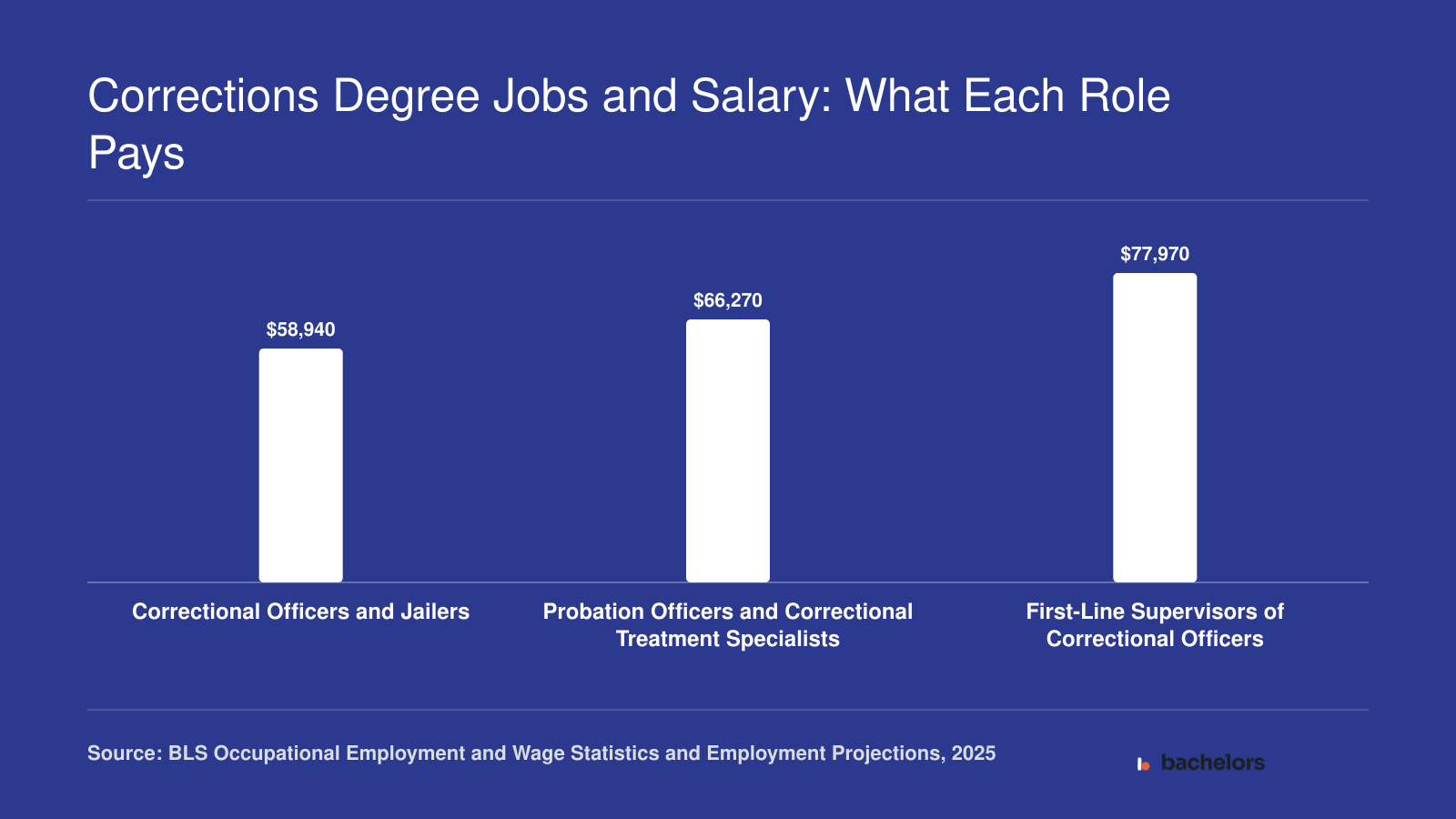
These are national BLS median wages for every worker in each occupation as of May 2025. They are separate from the program graduate earnings shown earlier. Probation officers and correctional treatment specialists typically need a bachelor's degree, earn a $66,270 median, and are projected to grow 3.0% from 2025-2035. First-line supervisors earn $77,970, and a bachelor's degree can help speed promotion into that role, though BLS projects a 2.5% decline (rounded to 3% on its occupation page). Correctional officers and jailers earn $58,940, with a projected 7.4% decline (BLS labels it 7%), so a degree adds the most value as a path toward supervision or community corrections.
What to Look for in an Online Corrections Program
Two programs with the same name can fit your life very differently, depending on whether they were built for working officers or for full-time campus students. Four checks separate the two before you commit.
Accreditation comes first
Confirm the school holds institutional accreditation, and verify it yourself through the school or the U.S. Department of Education database. Regionally accredited institutions protect your ability to transfer credits and to qualify for federal jobs and aid later. Programmatic recognition, such as the Academy of Criminal Justice Sciences for Ball State, adds value but does not replace institutional accreditation.1
Format and schedule fit
Asynchronous courses suit officers on rotating shifts. Ask directly about any live sessions, set login times, or on-site practicum hours, since "online" does not always mean "no visits." The University of Oklahoma, CSU Global, and APU Global all run asynchronous eight-week terms2, and accelerated terms shorten the calendar considerably.
Time to degree
Most bachelor's degrees in corrections run about 120 credits, or roughly four years of full-time study. Transfer credit and eight-week terms are the usual routes to finishing sooner.
Working while enrolled
Most students in these programs already hold jobs, so ask about employer tuition assistance and whether the department promotes from within.
Corrections programs by state
Compare Corrections programs on the data that matters
Explore more Criminal Justice & Law majors or browse every field of study.
All Criminal Justice & Law programs Browse every field of study