Best Criminal Justice Schools in South Carolina
Compare 25 accredited Criminal Justice programs in South Carolina at 21 colleges, with net price after aid, graduation rates, earnings and debt from IPEDS and the U.S. College Scorecard.
South Carolina hires police on certification, not a diploma: a criminal justice graduate still needs the state's law enforcement certification through the South Carolina Criminal Justice Academy before swearing in.
That split frames the choice. A bachelor's degree in criminal justice at a South Carolina school, campus or online, buys promotion eligibility and range, not the badge itself. Most schools on this list award the Bachelor of Science in Criminal Justice; several award a B.A. instead.
Public in-state tuition and fees run near $11,600, and the gap to private schools narrows sharply once need-based aid lands.
Key Points
- Our 2027 top pick is the University of South Carolina in Columbia.
- Allen University posts the lowest average net price here, $10,972 a year.
- Bob Jones University graduates earn a median $58,864 five years out.
Best Criminal Justice Schools in South Carolina: Our Top 10
The best criminal justice school in South Carolina for most students is the University of South Carolina in Columbia, which runs the largest criminal justice program in the state and posts one of its strongest completion rates. Every school below offers a bachelor's degree in criminal justice, and the list covers both campus and online programs at institutions based in South Carolina.
University of South Carolina
#1Columbia, SC · ~$23,000/yr (est.)
Best for: Students seeking the largest in-state network
The state's flagship campus in Columbia runs the largest criminal justice degree program in South Carolina, with a for-credit internship and a study abroad option that compares U.S. justice practice with other countries. Qualified students can begin graduate coursework early through a senior privilege option. Schools offering this program graduate about 79% of students.
- Largest criminal justice degree program in South Carolina
- For-credit internship with an agency, organization or law office
- Study abroad compares U.S. justice practice with other nations
- Coursework in data analysis, writing and problem solving
- Graduates work as police officers, probation officers and special agents
Citadel Military College of South Carolina
#2Charleston, SC · $13,000 – $39,000/yr (est.)
Best for: Cadets wanting a structured military setting
Charleston's military college pairs the criminal justice major with a cadet structure that suits students who want discipline built into the day. The department also offers minors in criminal justice and international criminal justice. Schools offering this program graduate 75% of students, and alumni move into federal agencies such as the FBI, DEA and CIA, as well as courts and corrections.
- Studies law enforcement, courts and corrections as one system
- Applies data analysis to criminal justice policy and practice
- Alumni enter the FBI, DEA, CIA and Homeland Security
- Minors in Criminal Justice and International Criminal Justice
Bob Jones University
#3Greenville, SC · ~$17,000/yr (est.)
Best for: Faith-driven students eyeing federal internships
This Greenville university builds criminal justice study on a constitutional foundation and adds Bible courses and daily chapel through its core curriculum. Faculty hold FBI National Academy credentials and South Carolina law enforcement certification, and seniors intern with agencies including the ATF, the U.S. Postal Inspection Service and SLED. Schools offering this program graduate about 65% of students.
- Senior internship with ATF, U.S. Postal Inspection Service, SLED and local police
- Faculty hold FBI National Academy credentials and SC law enforcement certification
- Core adds Bible courses and daily chapel alongside major coursework
- Starts with the Constitution and court interpretation, ends with critical issues
- Student jobs available in the Department of Public Safety
Anderson University
#4Anderson, SC · ~$24,000/yr (est.)
A 122-credit, four-year criminal justice degree on a traditional residential campus in the upstate, with rolling admission and start dates in August and January. Coursework covers arrest, search and seizure, juvenile delinquency, drug policy and correctional systems. Schools offering this program graduate about 66% of students, and graduates move into local, state and federal law enforcement, probation, parole and victim advocacy.
- 122 credit hours completed over four years, or eight semesters
- Start dates in August and January
- Coursework in arrest, search and seizure, juvenile delinquency and drug policy
- Rolling admission, with December 1 best for scholarship consideration
- Classes meet on the main campus in Anderson
University of South Carolina-Upstate
#5Spartanburg, SC · ~$14,000/yr (est.)
Spartanburg's public university pairs the criminal justice degree with a crime analysis focus and a regional crime analysis center that connects students to agency training and a cold-case team working with local police and sheriff's offices. Students can study entirely online or in hybrid classes at the Greenville campus. Schools offering this program graduate about 43% of students.
- 120 credit hours, with a fully online option
- Hybrid classes blend Greenville campus meetings with online work
- Tracks: Crime Analysis
- Crime Analysis track blends data science, statistics and crime mapping
- Internships with the SC Department of Juvenile Justice and Project R.E.S.T.
- 2.5 GPA target for admission
North Greenville University
#6Tigerville, SC · ~$21,000/yr (est.)
A Christian university in Tigerville that runs its criminal justice degree fully online, at the student's own pace, alongside an on-campus criminal justice and legal studies option. The online core includes forensic analysis, criminal profiling and terrorism coursework plus an internship. Schools offering this program graduate about 55% of students.
- Fully online and completed at the student's own pace
- Core includes forensic analysis, criminal profiling and terrorism
- Two seminars plus a criminal justice internship
- 7+ electives, including law and the media and domestic relations
- Christ-centered perspective in every course
- Named #36 in Best Value Schools by U.S. News for 2026
Voorhees University
#7Denmark, SC · $10,000 – $15,000/yr (est.)
A historically Black university in Denmark with a 120-credit criminal justice degree built on 37 hours of major core courses and 24 hours of social science. The program feeds both direct employment and advanced study in law, public administration or sociology. Schools offering this program graduate about 43% of students.
- 120 semester credit hours, including 37 in the criminal justice core
- 24 hours of social science core plus 9 hours of restricted electives
- 6 free elective hours
- Built for direct entry or advanced study in law and public administration
Coastal Carolina University
#8Conway, SC · $10,000 – $15,000/yr (est.)
Conway's coastal campus lets criminal justice majors add specialized training in legal studies, law enforcement or data analysis, backed by matching certificates. Students need a university-approved minor or certificate and a grade of C or better in every major course. Schools offering this program graduate about 48% of students.
- Specialized training in legal studies, law enforcement or data analysis
- Certificates in Law Enforcement, Legal Studies and Foundations of Data Analysis
- Requires a university-approved minor or certificate
- Grade of C or better in each course counted for the major
- Research, service learning and internship opportunities
- Criminal justice majors cannot also earn the criminal justice minor
Claflin University
#9Orangeburg, SC · ~$18,000/yr (est.)
An Orangeburg HBCU with a test-optional admission path, a free application and mentored undergraduate research starting in the first year. The 120-credit criminal justice degree splits into 48 hours of major requirements and 33 hours of restricted electives, with internships at justice agencies. Schools offering this program graduate about 52% of students.
- 120 credit hours: 48 in the major, 39 general education, 33 electives
- Test optional, with a $0 application fee
- Mentored undergraduate research starting in the first year
- Internships with justice agencies
- Study abroad through the Office of Global Programs
- Fall priority deadline November 1, spring November 15
Newberry College
#10Newberry, SC · ~$22,000/yr (est.)
A small liberal arts college where criminal justice majors take 27 hours in the field and 27 in the social sciences, plus six credits of a single foreign language. Hands-on work includes mock crime scene exercises, field trips and a chair-approved internship or capstone. Schools offering this program graduate about 45% of students.
- 54 credit hours: 27 in criminal justice and 27 in social sciences
- At least 6 credit hours of a single foreign language
- Mock crime scene exercises, field trips and guest speakers
- Internship or capstone approved by the program chair
- Independent research presented at regional and national conferences
Cost & outcomes by school
Federal data for the highest-earning Criminal Justice programs, independent of the ranking above. Earnings are this field's bachelor's graduates four years after completing where the Scorecard reports them, else the school's undergraduate median.
| School | Net price / yr | Grad rate | Earnings | Debt | Grads/yr | Format |
|---|---|---|---|---|---|---|
| Citadel Military College of South Carolina SC | $20,723 | 75% | $65,574 | $24,189 | 38 | Online or campus |
| Columbia College SC | $18,408 | 37% | $59,371 | $19,261 | 48 | Online or campus |
| Strayer University-South Carolina SC | $17,979 | 17% | $53,916 | $41,562 | 27 | Online or campus |
| Charleston Southern University SC | $21,666 | 47% | $53,162 | $27,000 | 20 | Online or campus |
| North Greenville University SC | $21,063 | 55% | $51,418 | $23,082 | 13 | Online |
| University of South Carolina SC | $22,811 | 79% | $50,847 | $20,500 | 240 | Campus |
| Anderson University SC | $23,544 | 66% | $49,825 | $27,000 | 21 | Campus |
| University of South Carolina-Upstate SC | $13,557 | 43% | $48,209 | $23,655 | 58 | Online or campus |
| Newberry College SC | $21,656 | 45% | $48,040 | $26,805 | 12 | Online or campus |
| Southern Wesleyan University SC | $15,464 | 52% | $47,756 | $26,000 | — | Online or campus |
| Coastal Carolina University SC | $13,966 | 49% | $47,258 | $23,750 | 28 | Campus |
| Winthrop University SC | $15,343 | 57% | $47,185 | $26,975 | — | Campus |
Sources: U.S. Department of Education. Net price, graduation rate, earnings and debt: College Scorecard (earnings and debt for this field's bachelor's graduates where reported, else school-wide); graduates: IPEDS. A dash means no figure is reported.
Cost, debt & payoff
Median earnings of this field's bachelor's graduates (4 yrs after completing, else the school's undergraduate median) vs. their median federal loan debt · U.S. College Scorecard
Across these programs the median graduate earns about $48,040 and finishes with roughly $26,700 in debt — a ratio that clears a common rule of thumb (keep debt below first-year salary). Net price and debt vary widely school to school, so check the per-school figures in the table above before you shortlist.
Most Affordable Bachelor's in Criminal Justice Programs in South Carolina
Allen University in Columbia, a private school in our directory, posts the lowest average net price in this group at $10,972 a year. Coastal Carolina University, a public university, sits at the high end at $13,966, a spread of just under $3,000. Sector shapes the gap: public schools like Francis Marion, USC Upstate and Coastal Carolina charge South Carolina residents far less than out-of-state students, while private Allen and Voorhees charge one rate to everyone and lower the cost through grant aid. Net price is an institution-wide average after grants and scholarships, drawn from 2024 IPEDS and College Scorecard data from the U.S. Department of Education. Your own cost will depend on your family income and the aid you receive.
| School | City | Sector | Average Net Price (per year) | In-State Tuition and Fees | Out-of-State Tuition and Fees | Median Graduate Debt (institution-wide) | Program Format |
|---|---|---|---|---|---|---|---|
| Allen University | Columbia | Private nonprofit | $10,972 | $14,304 | $14,304 | $34,290 | Campus and online |
| Francis Marion University | Florence | Public | $11,386 | $11,160 | $21,544 | $27,000 | Campus |
| Voorhees University | Denmark | Private nonprofit | $13,335 | $12,630 | $12,630 | $26,700 | Campus |
| University of South Carolina-Upstate | Spartanburg | Public | $13,557 | $11,588 | $23,090 | $22,310 | Campus and online |
| Coastal Carolina University | Conway | Public | $13,966 | $11,640 | $29,628 | $23,750 | Campus |
Criminal Justice Bachelor's Graduates With the Highest Earnings in South Carolina
The Citadel shows the highest earnings among these schools at $67,591 five years after completion, against a median debt of $24,189 and a typical monthly payment of $256, so its graduates earn nearly three times what they borrow. Strayer University-South Carolina graduates carry the heaviest median debt in the table, $41,562 or about $441 a month, against five-year earnings of $54,929, so weigh borrowing alongside salary when you compare programs.
| School | City | Median Earnings | Earnings Window | Median Debt | Typical Monthly Payment | Average Net Price (per year) |
|---|---|---|---|---|---|---|
| Citadel Military College of South Carolina | Charleston | $67,591 | 5 years after completion | $24,189 | $256 | $20,723 |
| Columbia College | Columbia | $60,613 | 5 years after completion | $19,261 | $204 | $18,408 |
| Bob Jones University | Greenville | $58,864 | 5 years after completion | $18,298 | $194 | $16,641 |
| Strayer University-South Carolina | Greenville | $54,929 | 5 years after completion | $41,562 | $441 | $17,979 |
| North Greenville University | Tigerville | $51,418 | 4 years after completion | Not reported | Not reported | $21,063 |
Online and Hybrid Bachelor's in Criminal Justice Options at South Carolina Schools
Flexibility and campus access pull in opposite directions here, and the right format depends on how much of each you need. Several South Carolina schools offer the criminal justice bachelor's online, but not all of the schools here do.
Which Schools Offer What
- Online: North Greenville University lists a fully online criminal justice program, with a note that you can complete it at your own pace. The University of South Carolina-Upstate offers a fully online option as a degree-completion program.
- Hybrid or mixed formats: Upstate also holds hybrid classes at its Greenville campus. Citadel Military College of South Carolina and Newberry College are listed with both campus and online formats, so confirm with each school which courses and tracks run online.
- Campus-based: The University of South Carolina, Bob Jones University, Anderson University, Voorhees University, Coastal Carolina University, and Claflin University list their criminal justice programs as on campus.
Completion Time and Accelerated Options
A bachelor's degree typically takes about four years of full-time study. The Upstate degree-completion route is built for students who arrive with credits, and it can take two years or less. The actual pace depends on how many credits transfer, how many courses you take each semester, and how well you can fit coursework around work and family. Upstate's program page asks for 30 credit hours from a regionally accredited institution before you start. The program pages describe no formal accelerated sequence or shortened terms, so the pace comes from transfer credit and course load rather than a fast-track design. Upstate also offers a related online degree-completion program in crime analysis.
Accreditation to Check
Upstate is regionally accredited by the Southern Association of Colleges and Schools Commission on Colleges (SACSCOC). That matters for transfer credit, financial aid, and how employers and other schools view the degree. Its criminal justice and crime analysis pages do not identify a separate programmatic accreditation, which is common in this field, so regional accreditation is the credential to verify. For North Greenville, check the school's own accreditation statement before you enroll.
Who Online Suits Best
Online study works best for working adults, transfer students who already hold college credits, and aspiring officers on shift schedules who cannot commit to fixed class times. If you are coming straight from high school and want internships, campus life, and in-person faculty contact, a campus program is likely the better fit.
Related Articles
Admissions: GPA, Test Policy, and Transfer Credit for South Carolina Criminal Justice Programs
Admission to a South Carolina criminal justice program usually comes down to three things: your GPA, whether you must submit SAT or ACT scores, and how many transfer credits the school will accept. Published details vary a lot from one school to the next, so treat the notes below as a starting point and confirm them on each school's admissions page.
GPA and Test Policy
- University of South Carolina-Upstate: Its criminal justice program lists a 2.0 GPA minimum.
- Claflin University: Test optional, with rolling admissions and no application fee.
- Anderson University: Rolling admissions through the Common App, with official high school or GED transcripts required.
For the University of South Carolina, Citadel Military College of South Carolina, Bob Jones University, North Greenville University, Voorhees University, Coastal Carolina University, and Newberry College, the program details we reviewed give no minimum GPA or test requirement. Do not assume one. Check the admissions office directly, and ask whether test scores are optional, required, or only used for scholarships.
How Selective Are These Schools?
Federal Scorecard admission rates give a rough sense of competition. The Citadel is the most selective at about 23 percent. Anderson admits roughly 55 percent of applicants, the University of South Carolina about 60 percent, and Claflin about 65 percent. North Greenville and USC Upstate are both near 67 percent, Coastal Carolina is about 75 percent, and Newberry College is near 90 percent. Bob Jones and Voorhees report no rate in this data. The latest Scorecard figure for the University of South Carolina is about 60 percent, though programs and campuses can differ.
Transfer Credit
The program details we reviewed do not state a transfer credit policy for any of these schools. Ask each admissions office for a written transfer equivalency guide, and ask how many credits can apply to the criminal justice major rather than just to electives.
One practical tip: if cost or grades are a concern, start at a South Carolina technical or community college and complete the general education courses (English, math, social science) before you transfer. Confirm with your target school before you enroll that those specific courses will count. Most bachelor's programs here run 120 credit hours, so every course that transfers cleanly shortens your time and your bill.
Cost of a Criminal Justice Degree in South Carolina: Tuition, Net Price, and State Aid
Public and private criminal justice schools in South Carolina look far apart on sticker price, but the gap narrows once aid is applied.
Sticker Price vs. Net Price
At public universities, in-state tuition and fees run close to $11,600 a year: $11,588 at University of South Carolina-Upstate and $11,640 at Coastal Carolina University. Their net prices are $13,557 and $13,966. Net price is the average yearly cost after grants, including housing and other expenses, which is why it can exceed tuition. Private schools post higher sticker prices, such as $24,470 at Bob Jones University and $29,800 at Southern Wesleyan University. After aid, their net prices drop to $16,641 and $15,464. Allen University and Voorhees University post net prices of $10,972 and $13,335. When you build a shortlist, compare net price rather than tuition.
South Carolina Scholarship and Grant Programs
State awards generally require South Carolina residency, U.S. citizenship or permanent residency, degree-seeking enrollment at an eligible in-state school, no felony conviction, and no student loan default.1
- Palmetto Fellows: Up to $6,700 in year one and $7,500 in years two through four.2 Benchmarks include a 3.5 GPA, an SAT of 1200 or ACT of 25, and a top 6 percent class rank.1 The early deadline is May 1, and the late deadline is July 15.
- LIFE Scholarship: Up to $5,000 a year for up to eight semesters. Benchmarks include a 3.0 GPA, an SAT of 1100 or ACT of 22, and a top 30 percent class rank.1
- HOPE Scholarship: Up to $2,800 for the freshman year only. It serves students with at least a 3.0 GPA who don't qualify for LIFE or Palmetto Fellows.1
- Lottery Tuition Assistance: A per-credit-hour award ($75 to $80, depending on the state source) for students taking at least six credit hours.3 It can't be combined with HOPE, LIFE, or Palmetto Fellows.
- SC WINS: This program is also on the state's aid roster. Confirm its current award and eligibility rules with the Commission on Higher Education.
How Aid Lowers the Bill
Consider a South Carolina resident at USC Upstate who qualifies for LIFE. The full $5,000 award would cut $11,588 in tuition and fees to about $6,588, before any federal grants. A Palmetto Fellow at Coastal Carolina would see $6,700 come off $11,640 in the first year, which leaves roughly $4,940.
File Early and Track Renewal Rules
Submit the FAFSA every year.1 Federal grants and the SC Need-Based Grant are applied first when your school calculates Lottery Tuition Assistance. Write down each program's deadline. Your financial aid office confirms eligibility and award amounts; ask about the GPA and credit-hour rules for renewal. Lottery Tuition Assistance, for example, requires a 2.0 GPA after 24 attempted hours.
Careers and Licensure for Criminal Justice Graduates in South Carolina
A bachelor's degree in criminal justice and a law enforcement certification are separate credentials in South Carolina. The degree is earned at a college. The certification comes through a hiring agency and the South Carolina Criminal Justice Academy (SCCJA).
Main Career Paths
Graduates generally move into four areas:
- Law enforcement: municipal police, sheriff's deputies, and state agencies such as the Highway Patrol.
- Corrections: detention centers, state correctional facilities, and juvenile justice.
- Probation and parole: supervising and supporting people serving community sentences.
- Victim services: advocacy and support roles in agencies and nonprofits.
The SCCJA Certification Path
Candidates cannot enroll on their own. A South Carolina law enforcement agency or detention facility must hire and sponsor you first, and SCCJA does not allow self-sponsorship.1 Basic requirements include:
- A minimum age of 21 for most roles, though Basic Detention allows 18. Department of Juvenile Justice applicants must be 21.1
- A high school diploma or GED and U.S. citizenship.
- A satisfactory background check and a medical exam.
- A valid driver's license. SCCJA's own pages are not consistent on whether an out-of-state license is acceptable, so confirm with your agency.1
Driving-record problems such as a DUI, reckless homicide, involuntary manslaughter, or leaving the scene of an accident can disqualify a candidate.1 SCCJA does not set a single look-back period.
Basic Law Enforcement runs 12 weeks and leads to Class 1 Law Enforcement Officer certification, which must be completed within the first 12 months of employment.2 Detention officers pursue Class 2 Detention Officer Certification through Basic Detention.3 A shorter Special Basic Training route exists: two weeks with the hiring agency plus one testing day covering firearms, driving, and a cumulative exam.3 Anyone who fails it must complete the full 12-week Academy course.
What the Degree Adds
The degree is generally not a license, and many entry-level officer and detention jobs do not require it. It can still help with hiring, promotion, probation and parole positions, and federal roles, where a bachelor's degree is often expected.
Job Outlook
Hiring in South Carolina happens agency by agency, so demand depends on local departments, county detention centers, and state agencies. Check current openings in the region where you want to work.
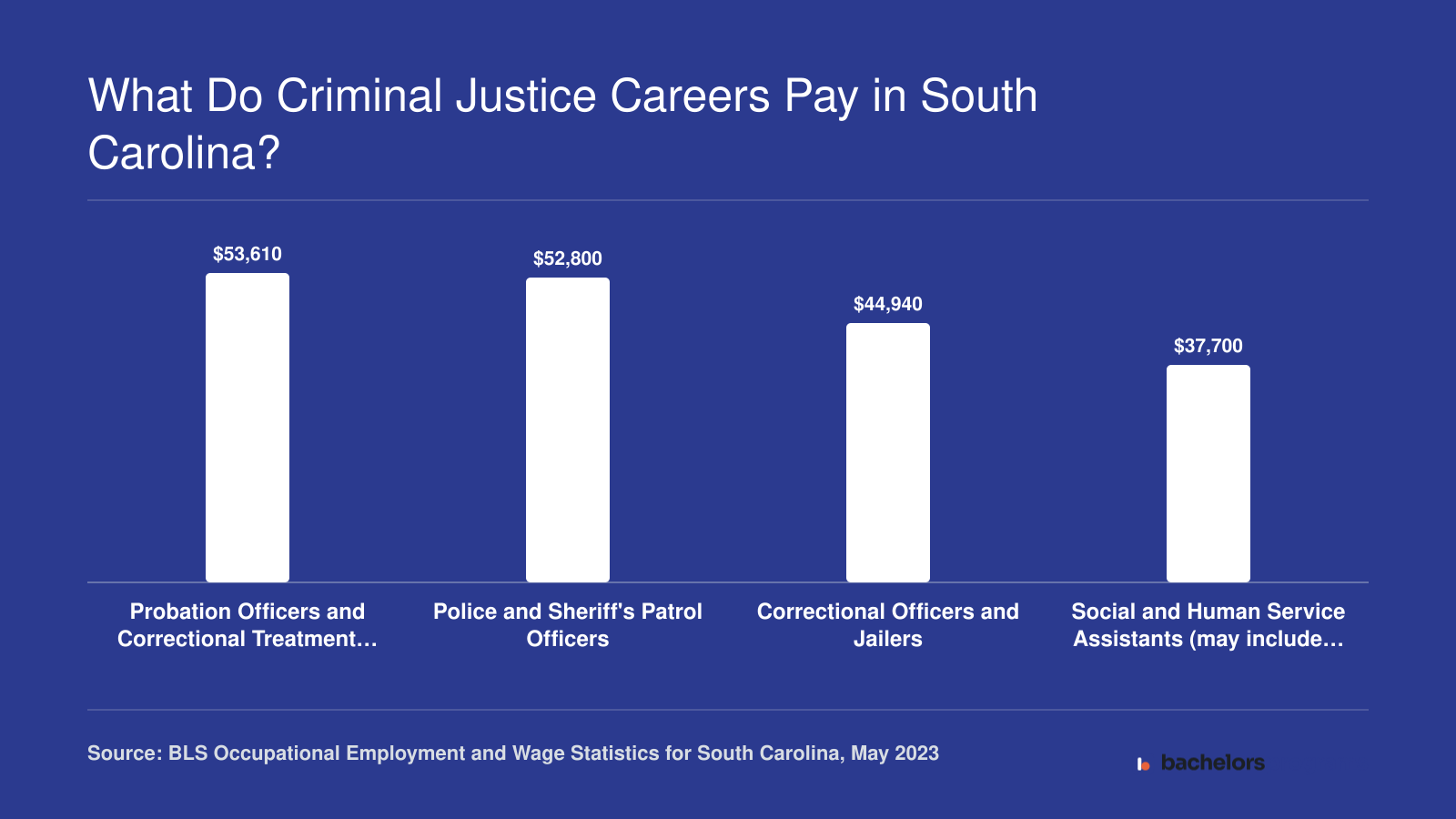
What Do Criminal Justice Careers Pay in South Carolina?
These are statewide median annual wages for common criminal justice jobs in South Carolina, based on federal May 2023 estimates. They describe what workers in each occupation earn, not what graduates of the programs ranked on this page earn after finishing a bachelor's degree. Probation officers and police officers sit near the top of this group, while correctional officers and social and human service assistants, a category that may include some victim advocacy jobs, earn less.
How to Choose a Bachelor's Degree in Criminal Justice in South Carolina
The cheapest program and the most convenient online schedule are rarely the same one, so start with the job you want after graduation and work backward to accreditation, format, and cost.
Start With Accreditation
Institutional accreditation is the first filter. A regionally accredited school keeps federal student aid available and makes credits easier to move if you change majors or finish somewhere else. If a program advertises programmatic accreditation, confirm that it covers the bachelor's track you would actually enter.
Match the Program to the Job
Policing, corrections, victim services, and legal support work call for different coursework. North Greenville's legal studies track and Benedict's criminal justice administration degree signal different emphases than a general criminal justice major. Ask about internships and agency partnerships in the region where you intend to work, including any field placement or academy arrangements.
Plan the Timeline
Plan on four years of full-time study. Transfer credit from a community college or an associate degree can shorten that, and year-round or accelerated terms can move it along faster. Ask each school how many credits it will accept and what residency requirement remains.
Weigh Cost and Format
Compare net price after grants and scholarships rather than published tuition, then check graduation rates and whether online or hybrid delivery fits your work schedule.
Your Next Step
Shortlist three schools, then request admissions requirements and a financial aid estimate from each before you commit.
Compare Criminal Justice programs on the data that matters
Explore more Criminal Justice & Law majors or browse every field of study.
All Criminal Justice & Law programs Browse every field of study