Best Online Criminology Degree Programs
Compare 110+ accredited online Criminology programs, with net price after aid, graduation rates, earnings and debt from IPEDS and the U.S. College Scorecard.

Criminology departments are rearguing an old question: whether a degree built around the causes of crime prepares graduates better than one built around the system that responds to it. Schools confer it as a Bachelor of Science (B.S.) or a Bachelor of Arts (B.A.), and the degree is now delivered fully online, with average net prices from about $4,815 to $22,420 a year.
That spread matters more than the diploma's name. Cost after aid, transfer credit and time to finish separate the programs ranked here more than the title does.
Agencies screen on eligibility, not prestige, so the credential has to clear the employer's requirements before salary enters the conversation.
Key Points
- University of Florida has the lowest average net price, about $4,815 yearly.
- Expect roughly 120 credits, earned as a B.S. or B.A. in Criminology.
- Rankings weigh net price after aid, completion rates and graduate earnings.
Best Fully Online Criminology Bachelor's Programs for 2027
Each entry below is a bachelor's degree in criminology delivered fully online, awarded as a B.S. or a B.A. depending on the school; hybrid and campus-based formats were excluded. We could not confirm required live sessions, proctored exams or campus residencies for most of these programs from published sources, and where a program does document an internship, practicum or campus component, it is noted in the entry.
University of Florida
#1Gainesville, FL · ~$4,800/yr (est.)
Best for: Florida residents wanting an in-state online rate
The University of Florida runs its Bachelor of Arts in Criminology through UF Online, and online students take no campus courses at all, so the degree can be finished without relocating to Gainesville. The 120-credit major pairs 34 credits of criminology with a statistics course and 18 elective credits, and everyone passes an online department exit exam on crime, law and society plus criminological theory before graduating. Faculty who teach on campus also teach and advise the online cohort. This school's graduation rate is 85%, and graduates reported median earnings of about $57,950 four years after finishing, with median debt for borrowers around $19,500.
- 120 total credit hours
- 34 credits of criminology coursework plus a statistics course
- At least 22 of the 34 major credits must be taken at UF
- Up to 12 transfer credits accepted in the major
- 18 credits of major electives, up to 9 interdisciplinary
- Online department exit exam required to graduate
- Online students may not enroll in campus courses
- Grades of C required in major courses
University of South Florida
#2Tampa, FL · ~$10,000/yr (est.)
Best for: Students seeking internship credit with partner agencies
The University of South Florida's Bachelor of Arts in Criminology covers theory, research methods and the full justice system, from policing and courts to juvenile justice and community-based responses. Internships with close to 100 partner agencies can earn up to 9 elective credits, and the department runs four research labs along with a Criminology Club and an Alpha Phi Sigma chapter. Two-year and four-year plans let students set their own pace. This school's graduation rate is 77%, and graduates reported median earnings of about $53,900 four years after finishing, with median debt for borrowers around $20,300.
- Internships worth up to 9 elective credits
- Close to 100 partner internship agencies
- Two-year and four-year plans of study
- Research labs include CJRP, C.I.B.R., TIP and CREATE
- Alpha Phi Sigma honor society chapter
- Criminal Justice Career Fair
- Coursework covers law enforcement, courts and corrections
University of Utah
#3Salt Lake City, UT · $10,000 – $31,000/yr (est.)
Utah awards its criminology major as either a B.A. or a B.S., with three concentration options and a curriculum built on crime theory, research methods and the institutions that process juvenile and adult offenders. Coursework pulls from social deviance, ethics, abnormal psychology, adolescent development and corrections administration, and the major is designed to overlap with other fields of study. The program charges no separate program fee. This school's graduation rate is 65%.
- B.A. and B.S. degree options
- Three concentration options
- Coursework in social deviance, ethics and corrections administration
- Covers tools and methods to study and prevent crime
- Major can overlap with other program areas
- No program fee
- Criminology certificate also offered
Arizona State University
#4Tempe, AZ · ~$15,000/yr (est.)
Arizona State's BS in Criminology and Criminal Justice is a 120-credit degree in the Watts College of Public Service and Community Solutions, covering sociological, psychological and economic explanations for crime alongside the three pillars of policing, courts and corrections. Online students take the same core, can intern with more than 200 agencies, and can apply to an accelerated bachelor's plus master's track that finishes in as little as five years. Change-of-major applicants need a 2.0 cumulative GPA. This school's graduation rate is 68%.
- 120 total credit hours
- 2.0 GPA minimum for change-of-major applicants
- Policing, courts and corrections as core pillars
- Internships with more than 200 agencies
- Accelerated bachelor's plus master's in as little as five years
- More than 300 Global Education programs
- Sample courses include Courts and Sentencing and Introduction to Policing
- Foundation for a prelaw track
California State University-San Marcos
#5San Marcos, CA · $10,000/yr (est. net price)
Cal State San Marcos offers its Bachelor of Arts in Criminology and Justice Studies as a degree-completion program that runs 16 months in an asynchronous online format. Applicants need 60 transferable units and the prerequisite courses, and the senior experience is either a 100-hour supervised internship with a weekly seminar or a capstone seminar built around a work placement. Credit for prior learning is accepted. This school's graduation rate is 55%, and graduates reported median earnings of about $55,400 four years after finishing, with median debt for borrowers around $14,800.
- 16-month degree-completion program
- Asynchronous online classes
- Requires 60 transferable units and prerequisite courses
- Senior experience: 100-hour supervised internship or capstone
- Credit for prior learning accepted
- Rolling admissions with priority application deadlines
- Covers criminal law, family violence and justice system analysis
University of North Carolina at Charlotte
#6Charlotte, NC · $15,000 – $20,000/yr (est.)
UNC Charlotte's online Bachelor of Arts in Criminal Justice and Criminology is a degree-completion program for students who already hold college credits, pairing the study of crime and delinquency with the agencies that respond to it. Students request a change of major and declare after completing 24 credit hours with a 2.0 GPA and a C or better in the introductory criminal justice course. Graduates move into policing, courts, corrections and rehabilitation services. This school's graduation rate is 69%.
- 100% online degree-completion format
- Requires 24 credit hours and a 2.0 GPA to declare
- C or better in the introductory criminal justice course
- Covers crime causes and theory plus justice system response
- Prepares for policing, courts, corrections and rehabilitation
The University of Alabama
#7Tuscaloosa, AL · ~$22,000/yr (est.)
Alabama's Bachelor of Arts in Criminology and Criminal Justice fits 33 semester hours of major coursework into a 120-hour degree, opening with principles of criminology and survey of criminal theories and closing with 400-level electives. Students need a minor, a 2.0 GPA in the major and a C-minus or better in every criminal justice course, and the program lists 12 upper-level hours to be earned on campus, a detail worth confirming before you commit to an online route. Up to 6 internship credit hours can count as electives. This school's graduation rate is 73%.
- 120 total credit hours
- 33 semester hours of major coursework
- A minor is required
- 12 upper-level hours must be earned on campus
- C-minus or better in every criminal justice course
- Up to 6 internship credit hours
- Declare the major by the fourth semester
University of North Carolina Wilmington
#8Wilmington, NC · $7,000 – $24,000/yr (est.)
UNC Wilmington awards its criminology B.A. with three concentrations (Criminology, Criminal Justice and Public Criminology) and lets online students learn from the same faculty who teach on campus. Juniors and seniors can take a practicum in a police or sheriff's department, the district attorney's office, probation and parole, juvenile services or the State Bureau of Investigation. The program reports that 95% of graduates are employed or enrolled in graduate school within six months. This school's graduation rate is 71%, and graduates reported median earnings of about $50,500 four years after finishing, with median debt for borrowers around $22,900.
- Three concentrations: Criminology, Criminal Justice and Public Criminology
- Online students share faculty with the main campus
- Practicum placements with police, district attorney, probation and the SBI
- Electives include Victimology and White Collar Crime
- Core includes criminological theory and a senior seminar
- 95% employed or in graduate school within six months
University of Michigan-Dearborn
#9Dearborn, MI · ~$9,000/yr (est.)
Michigan-Dearborn's Bachelor of Arts in Criminology and Criminal Justice approaches crime and justice through class, race and gender, with more than four dozen interdisciplinary electives running from corrections and restorative justice to white collar and environmental crime. All majors complete an applied practicum or internship with at least 149 hours on site, which is the piece to plan around if you are studying at a distance. The program also runs an Inside-Out Prison Exchange with incarcerated students and an accelerated bachelor's plus master's option. This school's graduation rate is 58%.
- Applied practicum or internship with at least 149 hours on site
- Four required foundation courses plus a methods course
- More than four dozen interdisciplinary electives
- Inside-Out Prison Exchange with incarcerated students
- Accelerated bachelor's and master's option
- Rolling admissions throughout the year
- Go Blue Guarantee covers tuition for qualifying in-state students
Washington State University
#10Pullman, WA · ~$15,000/yr (est.)
Washington State's criminal justice and criminology degree dates to 1943 and runs fully online through the Global Campus, drawing on a policy-based curriculum rooted in the social sciences. Students examine the institutions and people working in the justice system, the causes and patterns of criminal behavior, and the role of law in prevention and response. Undergraduates can join faculty-guided research, the WSU Police Intern program and Alpha Phi Sigma, the honor society founded on that campus. This school's graduation rate is 61%.
- Fully online through the WSU Global Campus
- Founded in 1943, the oldest continuous criminal justice program
- Policy-based curriculum drawn from the social sciences
- WSU Police Intern program
- Alpha Phi Sigma honor society founded at WSU
- Transfer credit from AP, IB, CLEP and Running Start
- More than 700 university scholarship programs
Cost & outcomes by school
Federal data for the highest-earning Criminology programs, independent of the ranking above. Earnings are this field's bachelor's graduates four years after completing where the Scorecard reports them, else the school's undergraduate median.
| School | Net price / yr | Grad rate | Earnings | Debt | Grads/yr | Format |
|---|---|---|---|---|---|---|
| George Mason University VA | $17,915 | 68% | $76,343 | $19,500 | — | Online or campus |
| Washington State University WA | $14,971 | 61% | $68,905 | $19,500 | 136 | Online or campus |
| University of Utah UT | $16,200 | 65% | $67,170 | $19,000 | 162 | Online or campus |
| California State University-Long Beach CA | $10,440 | 69% | $64,403 | $14,289 | — | Online |
| Arizona State University AZ | $14,967 | 68% | $62,668 | $19,500 | — | Online or campus |
| Florida State University FL | $11,297 | 86% | $61,675 | $18,000 | — | Online |
| The University of Alabama AL | $22,420 | 73% | $59,221 | $22,750 | 367 | Online or campus |
| University of Central Florida FL | $10,411 | 78% | $58,308 | $18,190 | — | Online |
| University of Florida FL | $6,541 | 91% | $57,953 | $15,224 | 192 | Online or campus |
| University of Florida FL | $4,815 | 85% | $57,953 | $15,224 | 42 | Online or campus |
| University of South Florida FL | $9,812 | 77% | $53,883 | $17,464 | 386 | Online or campus |
Sources: U.S. Department of Education. Net price, graduation rate, earnings and debt: College Scorecard (earnings and debt for this field's bachelor's graduates where reported, else school-wide); graduates: IPEDS. A dash means no figure is reported.
Cost, debt & payoff
Median earnings of this field's bachelor's graduates (4 yrs after completing, else the school's undergraduate median) vs. their median federal loan debt · U.S. College Scorecard
Across these programs the median graduate earns about $56,201 and finishes with roughly $23,000 in debt — a ratio that clears a common rule of thumb (keep debt below first-year salary). Net price and debt vary widely school to school, so check the per-school figures in the table above before you shortlist.
How We Ranked Fully Online Criminology Programs
A list sorted by sticker price alone is easy to build and nearly useless to a prospective student. A ranking that weighs what a program costs after aid, whether students finish, and what graduates earn tells you something you can act on. Four measures decide the order below.
The Online-Only Filter
Only fully online programs qualified. Hybrid formats, evening cohorts that require regular campus visits, and degrees that expect students to attend labs or field placements in person were excluded. That distinction matters in criminology, where some departments fold a few online courses into a mostly residential degree and market it as an online option.
What Goes Into the Score
Each program is judged on a composite of inputs:
- Net price after aid: the average a student actually pays, not the published tuition sticker.
- Graduation rate: the institution-wide share of students who finish their degrees.
- Earnings and debt: program-level outcomes drawn from federal data where a program reports them.
- Retention and completion signals: whether students return after their first year and progress on schedule.
Data Sources
Figures come from IPEDS and the U.S. Department of Education College Scorecard, and reflect the latest snapshot available at the time of publication.
Know the Limits
Graduation rates are school-wide, not specific to the criminology major. Ten-year earnings describe an institution's graduates broadly rather than one department. Because net price averages across students, financial aid, residency, and transfer credit will move your own cost. Not every program publishes earnings for its own graduates, which means a few entries rest on institution-level figures instead. Treat the ranking as a starting point and confirm the details with each admissions office before you apply.
What a Bachelor's Degree in Criminology Covers: B.S. vs. B.A.
Criminology is the social-science study of why crime happens, how society responds to it, and how crime affects victims and communities. A criminology bachelor's degree runs roughly 120 credits, usually split between general education, a criminology core, electives and sometimes a minor or concentration.
The Core Curriculum
Most programs start with theories of crime, then add research methods and statistics, juvenile delinquency, victimology, corrections, and courses on race, inequality and justice. You will read competing explanations for criminal behavior, learn how to evaluate crime data, and examine how courts, police and corrections agencies fit together. The goal is analysis, not tactical training: graduates learn to ask what the evidence says and why a policy might fail.
B.S. vs. B.A.
The two versions share a core but differ in emphasis. A Bachelor of Science usually requires more statistics, research methods and data analysis, which suits students eyeing graduate study, policy analysis or crime analytics. A Bachelor of Arts leans toward sociology, psychology, writing and sometimes a foreign language, a fit for law school, social services or community advocacy. Schools do not use the labels consistently, so check the actual course list rather than assuming from the degree name.
Where the Degree Lives
Many online criminology programs sit inside sociology or criminal justice departments, and some are degree-completion tracks designed for students who already hold an associate degree or have accumulated college credit. That departmental home shapes the electives you can take.
Concentrations add another layer. The University of Utah and UNC Wilmington each list three concentration options, while Arizona State University frames its criminology and criminal justice major around policing, courts and corrections. Those structures let you tilt the degree toward an interest without changing the core.
Criminology vs. Criminal Justice Degrees: Which Should You Choose?
The two degrees overlap, so the label on a diploma tells you less than the curriculum and the career you are aiming for. Work through the steps below, starting with federal occupation data, then individual school pages, then employer sources. Verify every salary, outlook and outcome figure yourself rather than relying on a general claim.
| Step | Criminology | Criminal Justice |
|---|---|---|
| 1. Check careers in the BLS Occupational Outlook Handbook | Look up sociologists and probation officers and correctional treatment specialists. Note the typical entry education, median pay and job outlook for each. | Look up police and detectives and probation officers. Note the same three items so the roles compare on equal terms. |
| 2. Confirm how the field is classified | Federal education data lists it as Criminology (CIP 45.0401). | Federal education data lists it under Criminal Justice and Corrections (CIP 43.01), including Criminal Justice/Safety Studies (43.0104). |
| 3. Compare the curriculum on each program page | Crime theory, psychological and social bases of criminal behavior, punishment, penology, rehabilitation and recidivism, and policy. | Criminology, correctional science, forensic science, law enforcement, psychology and ethics. |
| 4. Note which department houses the program | Check whether it sits in sociology, an interdisciplinary unit or a criminal justice department, since that shapes faculty and coursework. | Check whether it is a stand-alone criminal justice department or part of a larger social science unit. |
| 5. Review fieldwork, faculty and outcomes | Ask about internship or fieldwork requirements, faculty credentials and any graduate employment disclosures. | Ask the same questions, and ask whether internships place students with local agencies. |
| 6. Verify accreditation and state requirements | Confirm the school's institutional accreditor. Research is a common path, so check graduate-study expectations if relevant. | Confirm the accreditor, then check your state's peace officer (POST) or certification rules for the roles you want. |
| 7. Read employer and association sources | Browse the American Society of Criminology and the Academy of Criminal Justice Sciences for field expectations. | Review IACP resources and state or local agency job postings for required and preferred qualifications. |
| 8. Talk to people and combine the data | Ask admissions and career services for alumni outcomes, then interview 2 to 3 professionals in target roles. | Do the same, then pair BLS pay and outlook with each school's cost and completion data to judge fit. |
Online Criminology Degree Cost, Transfer Credits and Time to Finish
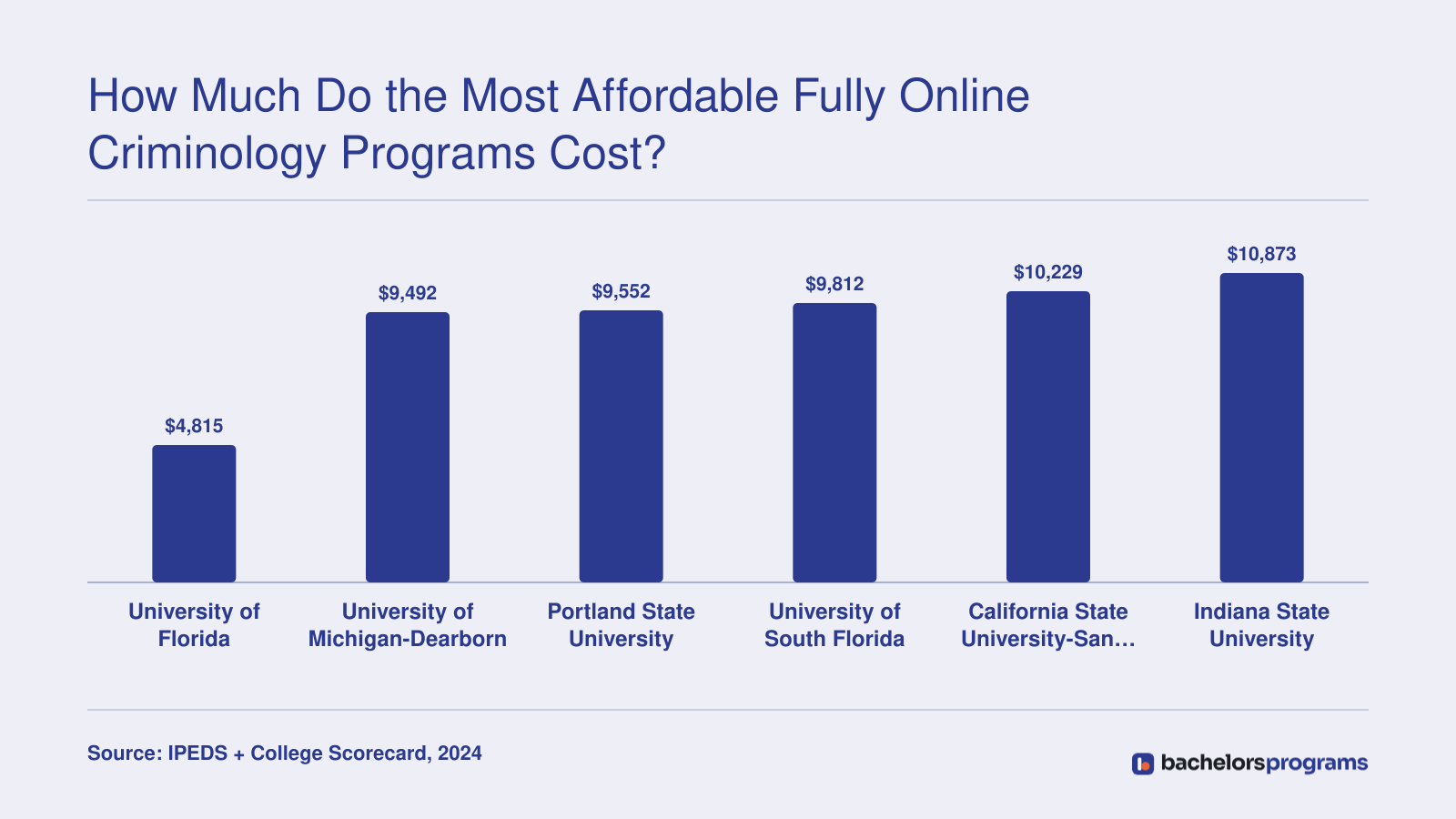
What is the cheapest online criminology degree? The University of Florida has the lowest net price after aid among the schools here: about $4,815 a year. The University of Michigan-Dearborn (about $9,492) and Portland State University (about $9,552) follow. These are averages across students who receive aid, not quotes; your own cost shifts with residency, income and the aid you qualify for.
What Actually Drives the Bill
Per-credit rates vary widely. Arkansas State University lists $302 per credit with all fees included.2 Norwich University ranges from $250 to $415 per credit. Benedictine University charges $450 plus a $40 per-credit student-services fee, or $490 per credit before books. Always ask what fees sit on top of tuition.
Median debt for graduates of these programs also differs. Typical borrowing runs about $15,224 at the University of Florida (roughly $161 a month over 10 years) and $14,810 at California State University-San Marcos (about $157). It is closer to $23,250 at Arkansas State (about $246) and $25,304 at the University of West Georgia (about $268). Debt figures are not reported for every school, so treat them as rough comparisons.
Transfer and Prior-Learning Credit
Transfer policies can cut cost more than any discount:
- Up to 90 credits: Avila University, Arkansas State, Southern Illinois University, Norwich and Southern New Hampshire University (SNHU) all allow it. SNHU requires at least 30 credits taken there.3
- Military and ACE credit: Norwich accepts ACE-reviewed military and professional training toward that 90-credit limit.
- Prior learning: Avila offers prior learning assessment.1 Benedictine caps portfolio credit at 12 hours.
- Entry requirements: Cal State San Marcos is a degree-completion program that requires 60 transferable units.
How Long It Takes
Starting from scratch, a 120-credit bachelor's degree takes about four years of full-time study. With an associate degree or 60 or more transferable credits, many students finish in roughly 18 to 24 months, depending on how many courses they take at once. Cal State San Marcos lists a 16-month program for transfer students. Accelerated formats help too: SNHU uses 8-week terms, often with two classes per term, so you can move through requirements faster than a traditional semester allows.3 Confirm exact credit counts with an admissions advisor before you enroll.
How Much Do the Most Affordable Fully Online Criminology Programs Cost?
University of Florida stands apart at an average net price of $4,815 a year, about half the cost of the next option. University of Michigan-Dearborn, Portland State University, University of South Florida and California State University-San Marcos fall between $9,492 and $10,229, and Indiana State University comes in at $10,873. Net price is the institution-wide average after grants and scholarships, not a program-specific price, so what you pay will depend on your family income, aid eligibility and how many transfer credits you bring.
Related Articles
Median Pay for Probation Officers and Correctional Treatment Specialists
Probation and correctional treatment work is one of the most direct career paths for criminology graduates.
Questions to Ask Yourself
Do you want to study why crime happens, or how the justice system runs?
Can your work schedule absorb required live class sessions, or do you need fully asynchronous courses?
How many of your existing credits will actually transfer, including military or police academy training?
Will your target job require an in-person internship you have to arrange locally?
Criminology programs by state
Online Criminology Degree FAQs
These answers cover the questions prospective students ask most about earning a bachelor's degree in criminology online. Costs and timelines vary by school and by student, so confirm details with each program.
Can you get a criminology degree online?
How long does it take to earn an online criminology bachelor's degree?
What is the cheapest online criminal justice or criminology degree?
Can an online criminology degree help me become a police officer or federal agent?
Will employers know my criminology degree was earned online?
Compare Criminology programs on the data that matters
Explore more Criminal Justice & Law majors or browse every field of study.
All Criminal Justice & Law programs Browse every field of study