Best Criminal Justice Schools in Washington
Compare 5 accredited Criminal Justice programs in Washington, with net price after aid, graduation rates, earnings and debt from IPEDS and the U.S. College Scorecard.
A bachelor's degree in criminal justice in Washington costs anywhere from $13,168 a year in tuition and fees at University of Washington-Tacoma to $56,721 at Seattle University, yet the degree alone does not make anyone a police officer.
Washington schools award either a Bachelor of Arts or a Bachelor of Science in criminal justice. The ranking weighs outcomes and cost above prestige and covers Washington programs on campus and online.
Agencies hire first and then send recruits to the state Criminal Justice Training Commission academy, so the degree works as a competitive edge, not a gate.
Key Points
- UW Tacoma lists $13,168 in-state tuition and a $10,163 net price.
- Graduates of UW Tacoma's criminal justice program report earnings of $63,311.
- Washington's CJTC academy, not your degree, trains newly hired police officers.
Best Bachelor's in Criminal Justice Schools in Washington, Ranked
Five Washington schools award a bachelor's degree in criminal justice, and they differ sharply in price, format and career pipeline. The list runs from a large public campus with a fully online option to a small private university built around working law enforcement officers. Each card gives the format, any concentration, in-state tuition, average net price and graduation rate so you can compare like for like.
University of Washington-Tacoma Campus
#1Tacoma, WA · $13,000 – $43,000/yr (est.)
Best for: Online learners in the South Sound
The University of Washington's Tacoma campus runs a Bachelor of Arts in Criminal Justice that students can complete on campus or entirely online, and it is the only public university on this list. In-state tuition runs about $13,168 a year, and the average net price after aid is about $10,163, the lowest here. The degree takes a multidisciplinary, ecological systems view of crime rather than a narrow law enforcement track, with coursework on the scientific method, restorative justice and the unequal impact of crime across communities. Schools offering this program have a graduation rate of about 63%.
- Fully online option available alongside on-campus study
- Multidisciplinary look at crime within broader social processes
- Ecological systems approach to the justice system
- Scientific method applied to criminal justice coursework
- Rehabilitative and restorative justice approaches covered
- Emphasis on community partnerships and systems thinking
- Prepares students for courts, community organizations and government agencies
Seattle University
#2Seattle, WA · ~$35,000/yr (est.)
Best for: Seattle students wanting crime-lab internships
Seattle University's BA in Criminal Justice and Criminology is an in-person, four-year, 120-credit degree taught on the First Hill campus, with a specialization chosen alongside a faculty advisor. Students intern in prisons, jails, law firms, court services, medical examiner offices and crime labs, and can extend into a BA and MA in five years or a BA and JD in six. It is the most expensive school here, at roughly $56,721 in tuition and $34,662 in average net price after aid, and schools offering this program have a graduation rate of about 76%.
- Four-year program, 120 semester credits
- Internships in prisons, jails, courts and crime labs
- Police ride-alongs, prison tours and courtroom observations
- Specialization area chosen with a faculty advisor
- BA and MA completed in five years
- BA and JD 3+3 completed in six years
- Low student-to-faculty ratio of about 10 to 1
Heritage University
#3Toppenish, WA · $15,000/yr (est. net price)
Best for: Budget-focused students in the Yakima Valley
Heritage University in Toppenish awards a BA in Criminal Justice through its Social Sciences Department, with coursework on public policy, justice, security and public safety and an emphasis on applying skills ethically to real situations. It is the lowest-priced private option here, at about $20,928 in tuition and $14,598 in average net price after aid, and schools offering this program have a graduation rate of about 54%. The department also offers a criminal justice minor and publishes a downloadable course guide for the major.
- Coursework in public policy, justice, security and public safety
- Stated outcomes in critical thinking, leadership and communication
- Emphasis on ethical application of skills to practical situations
- Career paths listed include detective, federal agent and probation officer
- Also lists corporate security, loss prevention and private investigator
- Criminal justice minor offered alongside the major
- Downloadable course guide and program flyer available
Saint Martin's University
#4Lacey, WA · ~$28,000/yr (est.)
Saint Martin's University in Lacey offers a BA in Criminology and Criminal Justice with four concentrations: corrections; law enforcement and investigation; legal studies; and victim services. Every major completes a senior capstone, and internships run with agencies such as the Washington State Department of Corrections and the Lacey Police Department. Tuition is about $45,510 with an average net price near $28,119, and schools offering this program have a graduation rate of about 52%. Classes meet on the Lacey campus and at the university's Joint Base Lewis-McChord location.
- Four concentrations: corrections, law enforcement, legal studies, victim services
- Core sequence in criminal justice systems, social science and processing
- Twelve elective credits plus a required senior capstone
- Internships with the Washington State Department of Corrections
- Internships with the Lacey Police Department
- Student-to-faculty ratio of about 11 to 1
- Senior thesis publication option
- Classes in Lacey and at the Joint Base Lewis-McChord site
City University of Seattle
#5Seattle, WA
City University of Seattle builds its Bachelor of Science in Criminal Justice around working officers, with classes fully online or in weekend and evening sessions in Seattle and Renton. Washington Basic Law Enforcement Academy training waives 15 lower-division criminal justice credits, up to 36 lower-division quarter credits can be applied, and students can finish in as little as four quarters. A First Responders Tuition Scholarship cuts tuition 25%, with a 10% reduction for dependents, and enrollment runs year-round. The school does not report an average net price after aid for this program.
- Academy training waives 15 lower-division criminal justice credits
- Up to 36 lower-division quarter credits accepted
- Degree completable in as little as four quarters
- Fully online option plus weekend and evening classes in Seattle or Renton
- First Responders Tuition Scholarship cuts tuition 25 percent
- 10 percent tuition reduction for dependents
- Year-round enrollment with start dates throughout the year
- Course challenge available for prior learning or experience
Cost & outcomes by school
Federal data for the highest-earning Criminal Justice programs, independent of the ranking above. Earnings are this field's bachelor's graduates four years after completing where the Scorecard reports them, else the school's undergraduate median.
| School | Net price / yr | Grad rate | Earnings | Debt | Grads/yr | Format |
|---|---|---|---|---|---|---|
| Seattle University WA | $34,662 | 76% | $74,018 | $19,702 | 16 | Campus |
| City University of Seattle WA | — | — | $69,460 | $25,000 | 2 | Online or campus |
| University of Washington-Tacoma Campus WA | $10,163 | 63% | $63,311 | $11,628 | 50 | Online or campus |
| Saint Martin's University WA | $28,119 | 52% | $55,951 | $22,500 | 17 | Campus |
| Heritage University WA | $14,598 | 54% | $55,375 | $19,551 | 12 | Campus |
Sources: U.S. Department of Education. Net price, graduation rate, earnings and debt: College Scorecard (earnings and debt for this field's bachelor's graduates where reported, else school-wide); graduates: IPEDS. A dash means no figure is reported.
Cost, debt & payoff
Median earnings of this field's bachelor's graduates (4 yrs after completing, else the school's undergraduate median) vs. their median federal loan debt · U.S. College Scorecard
Across these programs the median graduate earns about $63,311 and finishes with roughly $19,702 in debt — a ratio that clears a common rule of thumb (keep debt below first-year salary). Net price and debt vary widely school to school, so check the per-school figures in the table above before you shortlist.
How We Ranked Washington Criminal Justice Schools
What the ranking weighs
Every school on this list was scored on the same factors a student lives with after enrolling:
- Outcomes: What graduates typically earn in the years after leaving, and how much debt they carry out the door.
- Cost: Published in-state tuition next to the average net price students pay after aid.
- Completions: How many criminal justice degrees a school actually awards, which signals whether the program is a core offering or a thin elective track.
- Selectivity and persistence: Admission standards and the share of students who finish, used as a check on whether a school supports the people it enrolls.
Where the numbers come from
The figures behind these placements come from federal sources: the U.S. Department of Education's College Scorecard and IPEDS. No reputation surveys, no peer-opinion polls, no questionnaires sent to deans. If a school's number is not in the federal record, it does not quietly get credited for it.
Where the data falls short
Be skeptical in the right places. Graduation rate and average net price are reported for the institution as a whole, not for the criminal justice department specifically, so a strong university number does not guarantee a strong departmental experience. Net price is also a sector-level average across all students, meaning your own cost after aid can land meaningfully above or below it. Treat the ranking as a shortlist builder, then verify details with each school directly.
Earnings, Debt and Completions at Washington Criminal Justice Programs
The figures below come from federal College Scorecard data from the U.S. Department of Education and reflect graduates of each school's bachelor's degree in criminal justice, not the university as a whole. University of Washington Tacoma pairs strong earnings ($63,311 four years after completion) with the lowest reported median debt in the table ($11,628, about $123 a month), and Seattle University posts the highest four-year earnings at $74,018 against higher debt of $19,702. Heritage University graduates earn $55,375 at four years with debt similar to Seattle University's.
| School | Program | Median Earnings 1 Year After Completion | Median Earnings 4 Years After Completion | Median Debt at Graduation | Estimated Monthly Payment (10-Year Plan) | Annual Completions |
|---|---|---|---|---|---|---|
| University of Washington-Tacoma Campus | Bachelor of Arts in Criminal Justice | $40,669 | $63,311 | $11,628 | $123 | 101 |
| Seattle University | Criminal Justice and Criminology, BA | $51,100 | $74,018 | $19,702 | $209 | 22 |
| Heritage University | Criminal Justice | $55,375 | $19,551 | $207 | 17 | |
| Saint Martin's University | Criminology and Criminal Justice | $55,951 | 12 |
Online and Hybrid Criminal Justice Bachelor's Programs at Washington Schools
Online degree-completion tracks have become a routine way for working adults to finish a criminal justice bachelor's degree, and two Washington schools here offer one.
Which Schools Offer Which Format
- University of Washington-Tacoma Campus: The Bachelor of Arts in Criminal Justice can be earned on campus or through a fully online option built for degree completion.1 The online route asks for at least 90 transferable college-level quarter credits, versus 45 for on-campus entry.2
- City University of Seattle: The Bachelor of Science in Criminal Justice has a fully online option. Classes also meet on weekday evenings and weekends in Seattle or Renton, which gives students a blended path. Enrollment is year-round.
- Seattle University, Heritage University and Saint Martin's University: These programs are campus-based. Seattle University and Saint Martin's pair coursework with internships in local agencies, so plan on in-person time.
None of the program pages we reviewed describes a formal hybrid degree. City University of Seattle's mix of online and evening classes comes closest.
Who Each Format Suits
Working adults and career changers will find the most flexibility at City University of Seattle and UW Tacoma's online option. City University of Seattle credits law enforcement training toward the degree: 15 criminal justice credits are waived for academy graduates, up to 36 lower-division quarter credits can transfer, and first responders get a 25% tuition reduction. Transfer students with an associate degree or similar credits are the natural fit for UW Tacoma's online completion route, since it requires that 90-credit foundation.
Students coming straight from high school, or those who want internships and faculty contact in person, will do better at the campus programs. Heritage University, in Toppenish, serves students who want to study in the Yakima Valley rather than online.
Accreditation and Planning Details
Regional accreditation for Washington colleges comes through the Northwest Commission on Colleges and Universities (NWCCU). Program pages don't always state a school's status, so check each school in the NWCCU directory before you apply. Federal financial aid and credit transfer both depend on it.
Before choosing an online option, ask whether courses are asynchronous or meet live, and whether any internship, practicum or capstone must be done in person. Those details change how well a program fits around a job or family schedule.
Admission Requirements for a Bachelor's Degree in Criminal Justice in Washington
Washington's criminal justice programs are easier to enter than most applicants assume, but the published requirements are uneven, and only some schools spell them out. Check each admissions page before you apply.
University of Washington Tacoma
UW Tacoma publishes the most detail. You must first be admitted to the university, then to the major.
- Minimum GPA: 2.0 cumulative for the criminal justice major. Current UW students also need 2.0 in all UW coursework and good standing.
- Test policy: No policy published on the criminal justice pages. First-year SAT/ACT rules are not stated there.
- Transfer and Running Start: 2.0 in all transferable coursework. One official page says you should be on track for at least 45 college-level quarter credits before the program begins, while another says at least 60 transferable credits before the major starts. Confirm with an adviser which applies to your route.
- Prerequisites: 5 credits of English composition at 2.0 or higher. Statistics at 2.0 or higher is needed before T CRIM 390, but you may finish it within the curriculum.
Other Ranked Schools
For Seattle University, Heritage University, Saint Martin's University and City University of Seattle, our review did not find a program-specific minimum GPA, test policy or transfer-credit minimum for the criminal justice major. Treat each as No policy published until you confirm it with the school. General university admission rules may still apply even when the major sets no separate bar, so ask the admissions office directly.
Community College Transfer Pathways
Washington's direct transfer agreements let students complete an associate degree at a community college and carry the credits toward a bachelor's. UW Tacoma documents this as adviser-mediated: DTA students should contact their community college adviser about eligibility and degree completion before submitting the major-intent form. No universal DTA credit minimum is established for the criminal justice major. Where other schools here document transfer pathways, those details sit on their transfer pages, so verify before you plan your credits.
Selectivity Varies
Admission rates differ widely among these schools. A large public campus, a private Jesuit university and a smaller regional university can set very different bars for first-year applicants. A 2.0 major threshold does not mean admission to the university itself is automatic, so apply early and have a backup option.
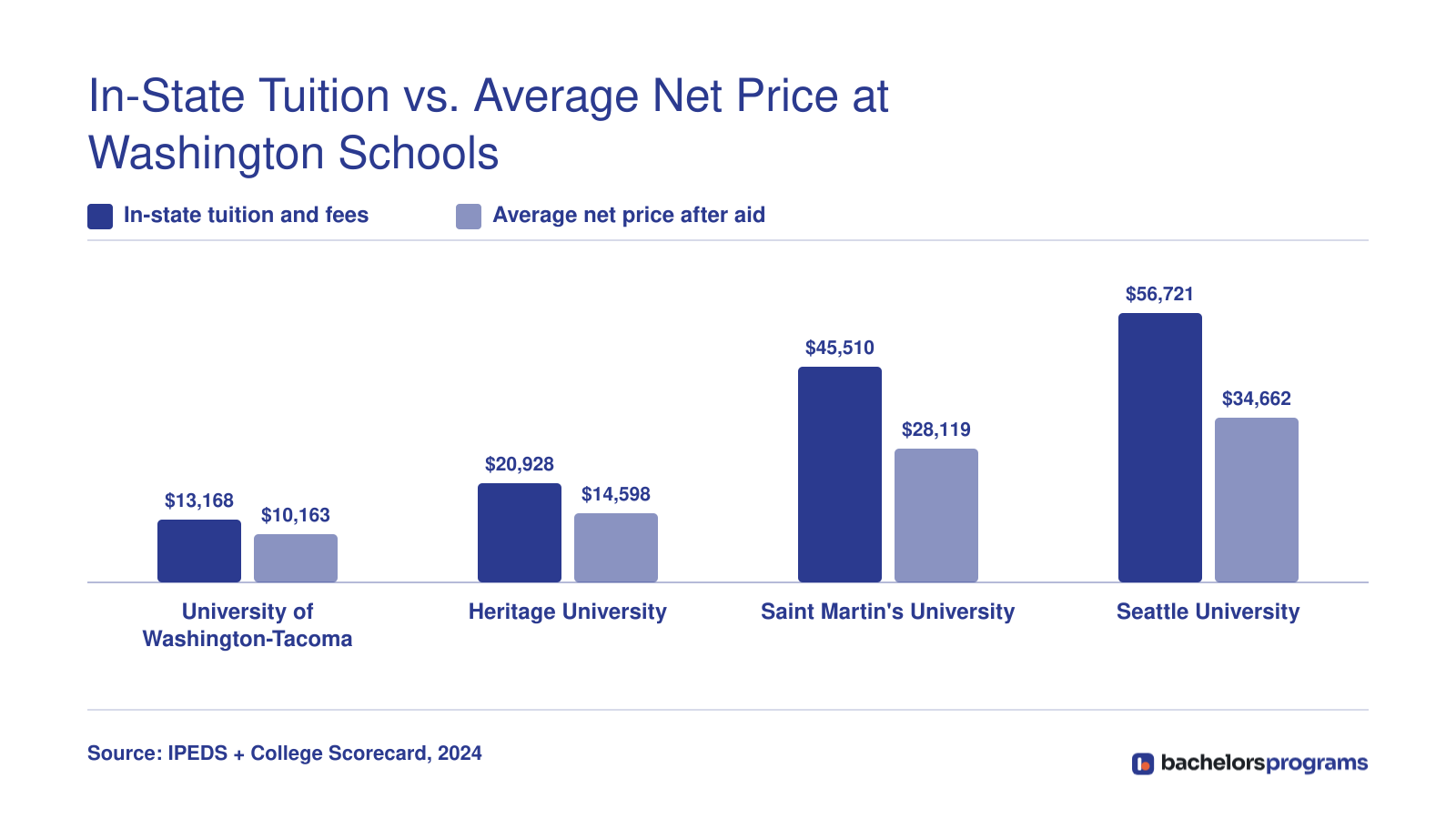
In-State Tuition vs. Average Net Price at Washington Schools
Sticker price and what families actually pay can differ by thousands of dollars, especially at private schools. University of Washington-Tacoma posts the lowest figures here, at $13,168 in tuition and fees and a $10,163 average net price. Seattle University has the highest, with $56,721 in tuition and fees that drops to a $34,662 average net price after grants. Net price is an approximate, sector-based average across all aided undergraduates, so treat it as a planning estimate rather than a quote, and use each school's net price calculator for your own figure.
What a Criminal Justice Bachelor's Costs in Washington and How to Pay for It
Public vs. Private Tuition
The price gap among Washington criminal justice schools is wide. University of Washington-Tacoma, the public option here, lists in-state tuition and fees of $13,168 a year, and its average net price after aid falls to $10,163. The private schools charge one rate regardless of residency:
- Heritage University: $20,928 tuition, $14,598 average net price
- Saint Martin's University: $45,510 tuition, $28,119 average net price
- Seattle University: $56,721 tuition, $34,662 average net price
Residency matters mainly at UW Tacoma, where out-of-state students pay $43,404. That is close to Saint Martin's sticker price, so nonresidents should compare net price before assuming public is cheaper.
The Washington College Grant
The Washington College Grant is the state's main need-based award for undergraduates.1 For 2026-27, you generally qualify if you are a Washington resident (eligible undocumented residents included), hold a high school diploma, GED or equivalent, do not already have a bachelor's degree, and have family income at or below 100% of the state median, adjusted for family size.1
The Washington Student Achievement Council's 2026-27 thresholds pair a full-award level, which covers public college tuition, with a cap for any award:
- Family of three: full award up to $70,000, some award up to $117,000
- Family of four: full award up to $83,500, some award up to $139,500
- Family of five: full award up to $97,000, some award up to $161,500
Above 60% of median income, awards step down to 60%, 50%, 24.5% and then 10% of the maximum as income approaches the cap.2 Part-time students receive a prorated share (75% at three-quarter time, 50% at half time).3
School type also matters. Starting in 2026-27, the maximum at private nonprofit four-year colleges is half the average award at public research universities, and private for-profit colleges no longer qualify.4 In practice, the grant stretches furthest at a public campus like UW Tacoma.
College Bound and the FAFSA or WASFA
The College Bound Scholarship covers tuition, fees and a book allowance at eligible Washington colleges for students from families at or below 65% of median income; students above that line receive the Washington College Grant only.5 There is no separate grant application or deadline. You are considered automatically when you file the FAFSA, or the WASFA if you cannot file the federal form.5
A Practical Way to Cut Cost
Consider completing general education courses at a Washington community college, then transferring to finish your bachelor's degree in criminal justice. Before you enroll, confirm with your target school's admissions office exactly which credits will transfer into the major.
Related Articles
Criminal Justice Careers and Pay in Washington
National pay figures are easy to find, but they rarely match what a Washington agency actually pays, so the smarter move is to pull current state data yourself. Four steps will get you there.
Step 1: Pull Washington Wage Tables From BLS.gov
On BLS.gov, open the Occupational Employment and Wage Statistics tables and select Washington from the state list. Then search each occupation you are considering: police and sheriff's patrol officers, probation officers and correctional treatment specialists, correctional officers and jailers, and detectives and criminal investigators. Compare median wages, mean wages and employment counts across them. BLS lists police officers separately from patrol officers, so confirm you are reading the right row.
As a reference point, the national May 2025 mean annual wage was $79,200 for patrol officers and $99,430 for detectives.1 Measure the Washington rows against those figures.
Step 2: Check the Outlook
Bureau of Labor Statistics national projections for 2025-2035 show probation officers growing 3.0%, detectives growing 0.2%, and correctional officers declining 7.4%, though that last field still averages 28,400 openings a year from turnover.2 For Washington figures, check the Employment Security Department's labor market information pages for state projections and openings.
Step 3: Read the State Agency Pages
The Washington State Criminal Justice Training Commission, the Washington Association of Sheriffs and Police Chiefs, and the Washington State Department of Corrections each explain hiring standards, training pathways and agency context. Use them to learn what an entry-level role requires before you compare salaries.
Step 4: Compare Real Job Postings
Pay varies by city, county and agency, so finish with local sources:
- Program pages: Look at the criminal justice pages at the schools here for career outcomes and employer connections.
- Government HR sites: City and county postings list salary ranges, benefits and step increases.
- Recruitment pages: Sheriff and police department sites show starting pay, experienced pay and any education incentives.
When you compare entry pay with experienced pay, check whether a bachelor's degree affects starting salary or promotion eligibility at the agencies you are targeting.
Washington CJTC Academy and Licensure: How Your Bachelor's Fits In
Washington does not license police officers through a degree. Instead, the Washington State Criminal Justice Training Commission (CJTC) runs the mandated academies that new officers attend after an agency hires them. A bachelor's degree in criminal justice, such as the one offered at City University of Seattle, builds your knowledge and credentials, but it does not certify you to work as a peace officer.
Basic Law Enforcement Academy
The Basic Law Enforcement Academy (BLEA) is the entry academy for peace officers. It runs 20 weeks and 720 hours under the Law Enforcement Training and Community Safety Act. Key points on how it works:
- Sponsorship: Only recruits already hired and sponsored by a recognized Washington agency may attend. You cannot enroll on your own beforehand, and the agency handles registration through the CJTC Acadis portal.
- Timing: Officers must start the academy within six months of hire, unless the Commission waives or extends that window.
- Physical Ability Test: The PAT is required, and the employing agency typically arranges it about two weeks before class.
- Hiring standards: CJTC materials set no single statewide rule for degrees, and age, background checks, citizenship and similar requirements are set by each agency. Check the posting of any department you want to join.
Officers who were previously trained elsewhere may be considered case-by-case for the Basic Law Enforcement Equivalency Academy, which agencies apply for on their behalf.
Corrections Officer Path
Corrections work follows a separate track. The Corrections Officer Academy (COA) runs 400 hours for entry-level jail officers, with the same rules: agency sponsorship, a passed PAT, and attendance within six months of hire. No statewide degree requirement applies. The Corrections Officers Equivalency Academy (80 hours) serves some previously trained officers, and the Juvenile Corrections Officers Academy (80 hours) covers juvenile detention staff, also on an agency-sponsored basis.
What a Bachelor's Adds
Since the state does not require a degree, the return comes in hiring and promotion. A bachelor's from a program such as Saint Martin's University, Seattle University, Heritage University or UW Tacoma can make your application more competitive when agencies compare candidates. It can also help with promotion into supervisory roles, and it satisfies the four-year degree many federal careers treat as a baseline. Confirm each employer's current preferences directly.
Choosing the Right Washington Criminal Justice School for Your Goals
A broad criminal justice degree keeps your options wide, while a narrower criminology or forensic focus suits a specific career. The right pick depends on where you want to end up.
Match the School to Your Goal
- Law enforcement: Look for practical coursework in policing, criminal law and procedure. City University of Seattle's Bachelor of Science in Criminal Justice and Heritage University's Criminal Justice program are built around the broad field.
- Corrections and probation: Choose a program with strong courses in corrections, rehabilitation and community supervision, plus internship options.
- Criminology and research: Seattle University's Criminal Justice and Criminology major and Saint Martin's University's Criminology and Criminal Justice program lean toward theory, research methods and data analysis, which helps if you want to work in research or later pursue further study.
Criminal Justice, Criminology and Forensic Studies
Criminal justice covers how police, courts and corrections operate. Criminology asks why crime happens and how society responds, so it is more research and theory driven. Forensic studies focus on the science of evidence, such as lab analysis and crime scene work, and usually draw on biology and chemistry.
A Short Checklist
- Confirm the school holds regional accreditation.
- Compare net price and expected debt, not just sticker tuition.
- Ask how your existing credits will transfer before you apply.
- Match the format, on campus, online or hybrid, to your work and family schedule.
Your Next Steps
See how each school stacks up in the ranking, then check the admissions table for GPA, test policy and transfer details before you build a shortlist.
Compare Criminal Justice programs on the data that matters
Explore more Criminal Justice & Law majors or browse every field of study.
All Criminal Justice & Law programs Browse every field of study