Best Criminology Schools in Colorado
Compare 7 accredited Criminology programs in Colorado, with net price after aid, graduation rates, earnings and debt from IPEDS and the U.S. College Scorecard.

Criminology has drifted from a narrow pre-law and policing pipeline into a research-driven field, with graduates moving into victim services, probation, analytics and federal work as often as into patrol. Colorado schools reflect that shift, awarding the degree as a Bachelor of Science (B.S.) or a Bachelor of Arts (B.A.), in programs that range from a small private university in Denver to a regional public college in Durango.
The tension is practical: price, format and career payoff rarely line up. Every program here, campus or online, is ranked on cost, outcomes and format. Only peace officer roles carry a state certification requirement, so most graduates are choosing a program on fit rather than licensure.
Key Points
- Colorado State University Pueblo is cheapest, with $9,720 in-state tuition and fees.
- Regis University criminology graduates earned a $63,255 median four years out.
- Colorado peace officers need POST Board certification before appointment.
Best Criminology Schools in Colorado: Our Top-Ranked Bachelor's Programs
Seven Colorado colleges award a bachelor's degree in criminology or a closely related criminal justice field, and they differ sharply in size, price and format. The programs below are ordered by how well each combines a full criminology curriculum, supervised field experience and a track record of getting students to graduation.
Regis University
#1Denver, CO · ~$18,000/yr (est.)
Best for: Working adults in Denver wanting part-time study
Regis University is a private Jesuit university in north Denver whose criminology department blends criminology, sociology and justice studies. The B.A. in Criminology is taught on campus in 16-week semesters and can be pursued full time or part time, with electives in forensic psychology, environmental justice, and the carceral state and abolition. A FastForward option lets strong undergraduates begin graduate coursework, and the department adds related minors in criminal justice, conflict transformation, and peace and justice studies.
- On-campus courses taught in 16-week semesters
- Part-time students pay $1,583 per credit hour
- Full-time tuition is $47,490 for 2026-27
- Electives include forensic psychology and environmental justice
- FastForward option combines the bachelor's with a master's
- Rolling admissions with an Oct. 15 early action priority date
- Minors in criminal justice, conflict transformation and peace studies
- Prior learning credit evaluated for AP and IB coursework
University of Denver
#2Denver, CO · ~$36,000/yr (est.)
Best for: Future law students wanting a research focus
The University of Denver is a private research university south of downtown Denver, and its criminology major sits inside the Department of Sociology and Criminology. The major is compact within a large liberal arts degree: 40 criminology and sociology credits inside a 183-credit bachelor's program, built around a two-quarter research methods sequence and a senior thesis path to distinction. It suits students who plan on law school or doctoral work in criminology, social work or public policy, and up to four internship credits are available to juniors and seniors.
- 40 major credits inside a 183-credit degree
- Required courses include Criminology (SOCI 2250) and a methods sequence
- 20 elective credits, 16 of them from the criminology roster
- Up to 4 internship credits for juniors and seniors with a 3.25 GPA
- Distinction requires a 3.5 major GPA and a defended senior thesis
- Sociology and criminology majors cannot be combined
- Study abroad resident credit available
Colorado State University Pueblo
#3Pueblo, CO · $10,000/yr (est. net price)
Best for: Rural Coloradans needing a fully online degree
Colorado State University Pueblo is a public university in southern Colorado that awards both a B.A. and a B.S. in Criminology through its Department of Sociology, Criminology and Anthropology. The two degrees carry identical criminology requirements, with the B.A. adding foreign language certification, and the 120-credit plan is built to finish in four years at about 15 credits a semester. Criminology can be completed fully online or in a hybrid format, and it is also offered as an external degree through the Division of Extended Studies.
- 120 credit hours, planned at about 15 credits a semester
- B.A. and B.S. share the same criminology requirements
- B.A. adds a foreign language certification
- Fully online and hybrid formats available
- Up to 9 credits of upper-division field experience
- Placements in criminal justice, juvenile justice and victim advocacy
- External degree option through the Division of Extended Studies
- Concentration available in community engagement
Fort Lewis College
#4Durango, CO · ~$17,000/yr (est.)
Fort Lewis College is a public liberal arts college in Durango serving the Four Corners region, and its Criminology & Justice Studies degree examines the social conditions that produce crime. Every major completes a mandatory 15-credit Block internship that ends in a research project, with a faculty mentor guiding the work and placements built around community building and restorative justice. Long-standing partnerships with the Durango Police Department, the La Plata County Sheriff's Office and the Colorado State Patrol keep field work local.
- Mandatory 15-credit Block internship ending in a research project
- Faculty mentor plus Block coordinator approval before the internship
- Placements with Durango Police, La Plata County Sheriff and State Patrol
- Restorative justice and community building focus
- Four Corners region placements, including tribal justice systems
- Prepares for probation, law enforcement, law and crime scene roles
Colorado State University-Fort Collins
#5Fort Collins, CO · ~$21,000/yr (est.)
Colorado State University in Fort Collins houses criminology as a concentration within the sociology major, so students take core sociological theory and research methods alongside crime-focused coursework on law, victimization and sentencing. The concentration runs a faculty and alumni mentoring program, internships with criminal legal agencies and advocacy groups, and a faculty-led summer program in the Czech Republic on comparative criminal justice systems. An Applied Social Research Certificate adds research design, data collection and analysis to the degree.
- Concentration inside the sociology major
- Faculty and alumni mentoring program
- Internships with criminal legal agencies and advocacy groups
- Faculty-led summer study abroad in the Czech Republic
- Applied Social Research Certificate available
- Criminal Justice and Victimization Institute on campus
University of Northern Colorado
#6Greeley, CO · $18,000/yr (est. net price)
The University of Northern Colorado in Greeley offers a B.A. in Criminology & Criminal Justice taught in person, with a 120-credit structure that puts 40 credits in the required major. The program leans practical: workshops in crime scene investigation, forensic photography and bloodstain pattern analysis, ride-alongs with law enforcement officers, and volunteer work with probation offices. Faculty include lawyers, sociologists, criminologists and former detectives, and the student Criminology & Criminal Justice Society is open to all majors.
- 120 credits, with 40 in the required major
- In-person instruction at the Greeley campus
- Workshops in crime scene investigation and forensic photography
- Bloodstain pattern analysis workshop available
- Ride-alongs with law enforcement and probation office volunteering
- Criminology & Criminal Justice Society with two annual awards
- Faculty include lawyers, criminologists and former detectives
Metropolitan State University of Denver
#7Denver, CO · $15,000/yr (est. net price)
Metropolitan State University of Denver is a public university in downtown Denver whose criminal justice and criminology program is one of the state's largest and most transfer-friendly. The B.S. requires 45 credits in the field, a capstone seminar for every major, and a core curriculum aligned with national criminal justice standards. Internships reach Denver probation and parole offices, the public defender and district attorney, and area police and sheriff departments, and articulation agreements smooth the path for Colorado community college transfers.
- 120 credits, including 45 in the major
- Capstone seminar (CJC 4700) required of all majors
- Core curriculum aligned with ACJS national standards
- Internships with Denver probation, public defender, DA and sheriff offices
- Articulation agreements for Colorado community college transfers
- Area electives in policing, courts and law, corrections, justice administration
- Delta Gamma Xi criminal justice honor society chapter
Cost & outcomes by school
Federal data for the highest-earning Criminology programs, independent of the ranking above. Earnings are this field's bachelor's graduates four years after completing where the Scorecard reports them, else the school's undergraduate median.
| School | Net price / yr | Grad rate | Earnings | Debt | Grads/yr | Format |
|---|---|---|---|---|---|---|
| Regis University CO | $18,397 | 61% | $63,255 | $28,332 | 2 | Campus |
| Colorado State University-Fort Collins CO | $21,279 | 67% | $60,543 | $20,000 | — | Online or campus |
| University of Denver CO | $36,131 | 76% | $57,858 | $22,000 | 28 | Campus |
| Colorado State University Pueblo CO | $10,051 | 40% | $55,563 | $21,500 | 38 | Online or campus |
| University of Northern Colorado CO | $17,760 | 51% | $52,231 | $20,470 | — | Campus |
| Metropolitan State University of Denver CO | $15,327 | 32% | $52,093 | $21,500 | — | Online or campus |
| Fort Lewis College CO | $17,296 | 36% | $46,349 | $18,389 | 21 | Campus |
Sources: U.S. Department of Education. Net price, graduation rate, earnings and debt: College Scorecard (earnings and debt for this field's bachelor's graduates where reported, else school-wide); graduates: IPEDS. A dash means no figure is reported.
Cost, debt & payoff
Median earnings of this field's bachelor's graduates (4 yrs after completing, else the school's undergraduate median) vs. their median federal loan debt · U.S. College Scorecard
Across these programs the median graduate earns about $55,563 and finishes with roughly $21,500 in debt — a ratio that clears a common rule of thumb (keep debt below first-year salary). Net price and debt vary widely school to school, so check the per-school figures in the table above before you shortlist.
How We Ranked Colorado Bachelor's in Criminology Programs
A ranking can be built around price or around payoff, and those two orders rarely match. We weighted both, then let flexibility break the ties.
What moved a program up the list
Four things shaped the order you see above:
- Net price after aid: what students actually pay once grants and scholarships are applied, not the published sticker tuition.
- Earnings and debt at the program level: what graduates of criminology and related social science programs report earning, measured against what they borrowed to get there.
- Completions: how many criminology bachelor's degrees a school actually awards each year, which signals a staffed, stable department rather than a thin elective track.
- Delivery format: whether the degree can be finished online, in a hybrid format, or on evenings and weekends, which matters a great deal to working students and transfers.
What the numbers can and cannot tell you
Two figures deserve a caveat. Neither the graduation rate nor the net price describes the criminology major itself. They describe the whole undergraduate population at Regis University or Metropolitan State University of Denver, not the criminology majors specifically. Treat them as context for the school, not a forecast for your degree.
Only schools that award a bachelor's degree in criminology or a closely tied criminology concentration in Colorado, on campus or online, were eligible. Certificates, associate degrees and graduate programs were left out.
So what is the best criminology school in Colorado?
It depends on which of those factors you weight heaviest. If cost drives your decision, the public institutions with the lowest net price belong at the top of your own list. If starting salary and low borrowing matter most, the order shifts. If you need to study around a job, a school with a fully online or evening pathway may outrank both.
Choosing a Bachelor's Degree in Criminology: B.A. vs. B.S. and Criminology vs. Criminal Justice
A bachelor's degree in criminology is a four-year undergraduate program that treats crime as a subject to be studied: why it happens, who commits it, how societies respond, and what the research says about all three. The degree comes as a Bachelor of Science or a Bachelor of Arts, and the difference usually comes down to method versus breadth.
B.A. or B.S.: Method Versus Breadth
The B.S. usually leans on research methods, statistics, and data analysis, which suits students aiming at graduate study in criminology or analytical work inside a justice agency. The B.A. typically spends more credit hours on social science breadth, drawing on sociology, psychology, and political science, with more room for a minor, a language, or free electives. Neither is the better choice for a police career, but the B.S. is the more quantitative route.
Criminology Asks Why. Criminal Justice Asks How.
Criminology studies the causes of crime and the theories and research behind them. Criminal justice studies the system that responds to crime: policing, courts, corrections, and the policy shaping each. The two overlap constantly and are often taught in the same department, which is why the program name and the course list matter more than the department's title.
Reading Colorado Program Names
- Criminology majors: Regis University awards a Bachelor of Arts in Criminology, the University of Denver lists criminology as its major, and Colorado State University Pueblo offers the degree as a B.A. or B.S.
- Combined degrees: University of Northern Colorado lists Criminology & Criminal Justice, and Metropolitan State University of Denver offers a Criminal Justice and Criminology Major, B.S.
- Adjacent programs: Colorado State University-Fort Collins houses criminology and criminal justice as a concentration inside its Sociology major, and Fort Lewis College combines the two fields in Criminology & Justice Studies.
Wherever you apply, ask for the four-year plan and the required course list, then check how much of the degree is criminology and how much is general justice coursework.
Questions to Ask Yourself
Do you want theory and research or hands-on operations, and does the program's name match?
Would a B.S. with a methods focus or a B.A. with broader electives fit your plans better?
Do you need an online or hybrid format, or can you relocate to a Colorado campus?
Are you aiming at a career like policing that requires certification beyond the degree?
Related Articles
Online and Hybrid Criminology Bachelor's Options at Colorado Schools
Yes, you can earn a bachelor's degree in criminology online from a Colorado school, but the fully online route is narrower than the campus one. Among the schools ranked here, Colorado State University Pueblo is the clearest online option; a couple of others list both campus and online formats, and the rest are built around in-person study.
The Online Pathway at CSU Pueblo
CSU Pueblo awards a B.A. or B.S. in Criminology and lists its courses as online or hybrid alongside on-campus instruction, with an external degree pathway through Extended Studies for students who cannot come to campus regularly.1 The program runs 120 credits over about four years, and the 2026-2027 catalog separates the two versions: the B.S. requires CRIM 335 Advanced Methods, while B.A. students may take it as an elective.1 CSU Pueblo does not promise that every course and requirement can be finished with no campus component, so confirm the current online schedule with the department before you enroll.
Hybrid and Campus-First Programs
Colorado State University-Fort Collins, where criminology and criminal justice is a concentration inside the sociology major, and Metropolitan State University of Denver, which offers a B.S. in criminal justice and criminology, both appear as offering campus and online formats. In practice that usually means a mix of delivery modes rather than one fully remote track, so ask each department which courses actually run online in a given term.
The remaining programs are campus-based: Regis University's B.A. in Criminology in Denver, the University of Denver's criminology major, Fort Lewis College's Criminology & Justice Studies in Durango, which includes a required internship block that ties students to local agencies, and the University of Northern Colorado's Criminology & Criminal Justice in Greeley.
Who Thrives in an Online Format
Online criminology coursework suits working adults with full-time jobs, transfer students who need to keep credits moving without relocating, and parents managing childcare at home. The format rewards self-direction, so check whether a program offers asynchronous courses or fixed meeting times before you commit.
Admissions for Colorado Criminology Bachelor's Programs: GPA, Test Policy and Transfer Credit
A first-year applicant with a solid high school transcript and a transfer student arriving with two years of community college credit are read on different terms at Colorado's criminology programs, even when they end up in the same lecture hall. The first-year file is mostly about coursework and completeness. The transfer file is about which credits survive the trip.
What Applicants Typically Submit
Across the schools here, the core requirements are consistent: an online application, a high school diploma or equivalent, and transcripts from every college attended. Regis University also asks for a personal statement. Regis runs rolling admission, with priority dates that include October 15 for fall early action, January 1 for fall first-year applicants, June 1 for fall transfers, November 1 for spring first-year applicants, and December 1 for spring transfers.
GPA and Test Policy: What the Schools Publish
The admissions pages for these programs publish no minimum GPA and no test-optional or test-required policy. The table reflects what is published, not what is assumed.
| School | Minimum GPA | SAT/ACT policy | Transfer credit maximum |
|---|---|---|---|
| Regis University | No policy published | No policy published | No policy published |
| CSU Pueblo | No policy published | No policy published | No policy published |
| MSU Denver | No policy published | No policy published | No policy published |
| University of Northern Colorado | No policy published | No policy published | No policy published |
Treat a blank as unknown rather than as open admission, and get the answer in writing from an admissions counselor before you apply.
Transfer Credit: Ask Before You Apply
MSU Denver designed its B.S. in Criminal Justice and Criminology around students arriving from two-year police science and criminal justice programs, and it holds articulation agreements with Colorado community colleges. Request the agreement for your school and program in writing.
Two other rules matter. CSU Pueblo caps anthropology and sociology electives counted toward the major at 6 credits when a faculty adviser approves them, and major courses require a C or better. UNC also requires a C or better, and a C- will not count. Regis evaluates prior learning, including AP and IB credit, but publishes no overall transfer maximum. As a final step, ask whether your completed courses fall under Colorado's statewide transfer pathways.
Cost of a Criminology Bachelor's Degree in Colorado
Colorado State University Pueblo is the cheapest route to a bachelor's degree in criminology among these schools. In-state tuition and fees run $9,720 a year, and the institution-wide average net price after aid is $10,051. Net price covers the whole university, not just the criminology major, so treat it as a benchmark and not a quote.
Public vs. Private, In-State vs. Out-of-State
Fort Lewis College ($9,958) and Metropolitan State University of Denver ($11,124) are the next most affordable in-state. The University of Northern Colorado ($12,416) and Colorado State University-Fort Collins ($13,373) cost more. Their average net prices are $17,760 and $21,279.
Residency changes the bill sharply at public schools. Out-of-state tuition is $17,944 at CSU Pueblo, $21,526 at Fort Lewis and $34,783 at Colorado State-Fort Collins.
Private schools charge one rate to everyone. Regis University lists $46,340, with an average net price of $18,397 after aid. The University of Denver lists $61,398, with an average net price of $36,131. Institutional aid pulls Regis close to some public options, so compare net price, not sticker price.
Institution-wide, median debt among graduates ranges from $18,389 at Fort Lewis to $25,000 at Regis. Debt figures specific to each criminology program are not available for most of these schools.
Colorado Aid You Can Use
The College Opportunity Fund (COF) stipend lowers in-state tuition for eligible undergraduates at Colorado public universities and participating private institutions.1 The per-credit amount is set annually. Recent published figures at public universities run from $104 to $116 per credit hour, and Colorado State's own guidance cites both.2 You must apply for and authorize the stipend, or you will owe the full tuition. Lifetime eligibility is capped at 145 credit hours, with up to 30 more after a bachelor's degree under certain rules.1
State grants and scholarships, including the Colorado Student Grant and the Colorado Opportunity Scholarship Initiative, also exist. Award amounts and eligibility change each year, so confirm current terms with each school's financial aid office and the Colorado Department of Higher Education.
One Way to Cut the Bill
Start at a Colorado community college and transfer. Metropolitan State University of Denver, for example, has transfer agreements with Colorado community colleges. Two years of lower-division credits at community college rates can trim thousands from the total.
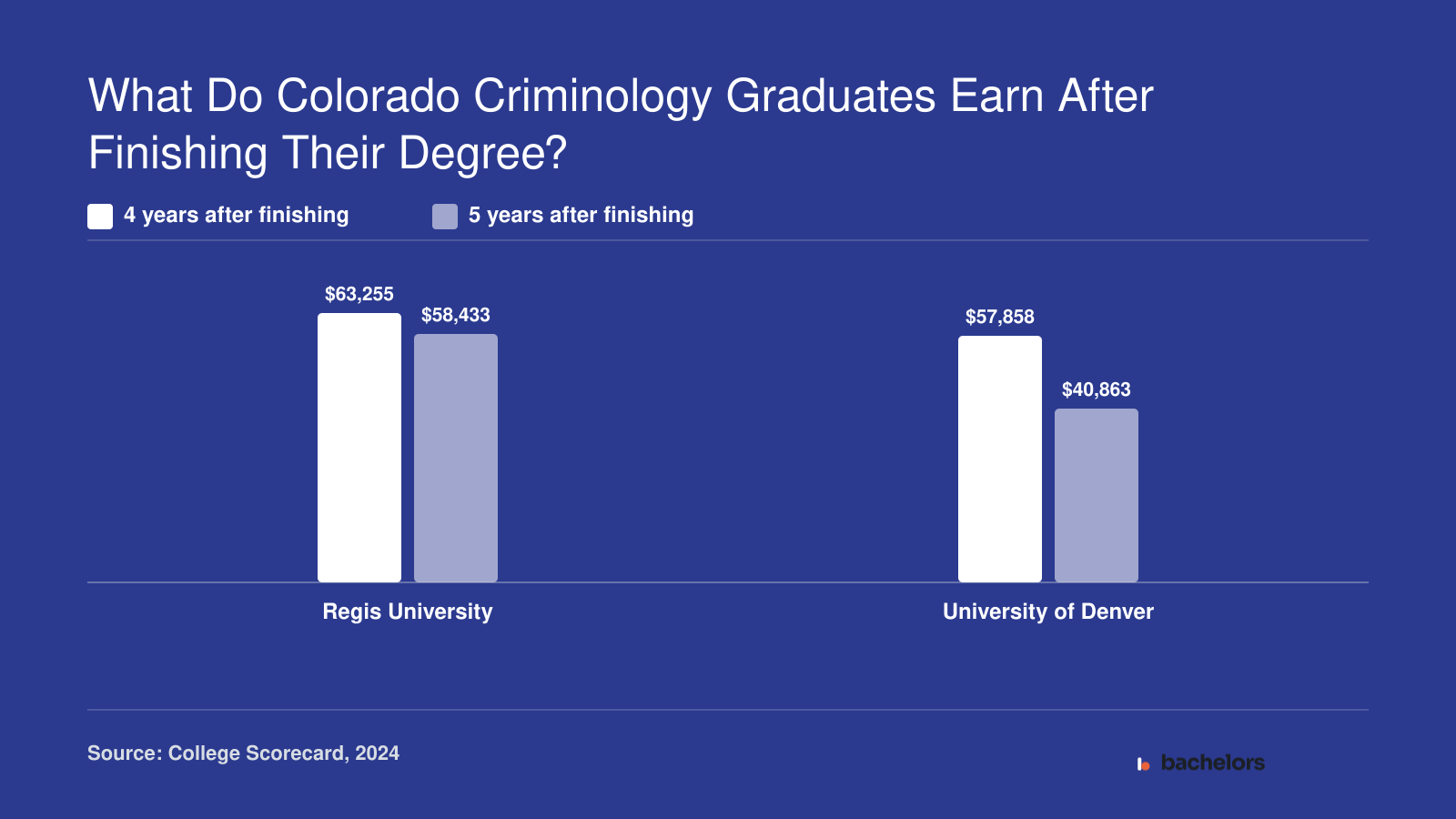
What Do Colorado Criminology Graduates Earn After Finishing Their Degree?
These are College Scorecard program-level medians for bachelor's completers in criminology, measured four and five years after finishing. They are not BLS occupation wages. Regis University completers earned $63,255 at four years and $58,433 at five, while University of Denver completers earned $57,858 at four years and $40,863 at five. The other Colorado schools on this page do not have a published program-level earnings figure, so they are left off the chart.
Colorado POST Certification for Law Enforcement Careers
Frequently Asked Questions About Criminology Schools in Colorado
These answers cover the questions students ask most when comparing Colorado bachelor's degree in criminology programs. Figures come from third-party sources and the schools themselves, so confirm current numbers on each school's official pages before you apply.
What is the best criminology school in Colorado?
What is the cheapest criminology degree in Colorado?
What jobs can you get with a bachelor's degree in criminology?
Is criminology a good major for law school?
Compare Criminology programs on the data that matters
Explore more Criminal Justice & Law majors or browse every field of study.
All Criminal Justice & Law programs Browse every field of study