Best Criminology Schools in Texas
Compare 16 accredited Criminology programs in Texas, with net price after aid, graduation rates, earnings and debt from IPEDS and the U.S. College Scorecard.

A bachelor's degree in criminology studies why crime occurs, how it is measured, and how justice systems respond. In Texas, the degree comes as a Bachelor of Science (B.S.) or a Bachelor of Arts (B.A.) in Criminology, though titles vary: some programs pair it with criminal justice, and a few sit inside sociology departments.
Cost is where the choices diverge. Average net price is $10,836 a year at The University of Texas at San Antonio and $19,359 at University of St Thomas. Median earnings four years after graduation reach $52,087 at University of Houston-Clear Lake.
A program's name says little. Its price, format, and graduate outcomes say more.
Key Points
- University of Houston-Clear Lake graduates earn a $54,539 median five years out.
- Texas A&M University-San Antonio has the lowest ranked net price ($11,196).
- Texas Tech University's Bachelor of Arts in Criminology runs fully online.
Best Criminology Schools in Texas: Our Ranked List of Bachelor's Programs
These ten Texas schools award a bachelor's degree in criminology, and each entry notes whether the program runs on campus, online, or both, so you can weigh format alongside price and completion rates. Every school below enrolls undergraduates directly into a criminology or criminology-adjacent major in Texas.
The University of Texas at Dallas
#1Richardson, TX · $18,000/yr (est. net price)
Best for: Research-minded students near Dallas
UT Dallas is a public research university in Richardson, north of Dallas, and its Bachelor of Arts in Criminology sits in the School of Economic, Political and Policy Sciences. The 120-credit degree builds from preparatory coursework in criminal law and corrections into a senior research seminar, with required distributive justice and international or comparative courses. Faculty research ties run to the Dallas Police Department, Collin County Sheriff's Office, and Tarrant County supervision and corrections, and a prison exchange course pairs students with incarcerated learners.
- 120 total credit hours, including 61 in the major
- Major core of 24 credits: advanced criminology, research methods, policy
- Preparatory block covers criminal law, corrections, court process
- 21 credits of upper-division criminology electives
- One distributive justice course and one international or comparative course required
- Senior research seminar taken after core coursework
- CLEAR certificate in compassionate law enforcement available
- Prepares for federal, state and local justice agencies or graduate study
Texas Tech University
#2Lubbock, TX · $15,000 – $20,000/yr (est.)
Best for: Forensics-focused undergrads in West Texas
Texas Tech is a large public university in Lubbock whose College of Arts and Sciences awards the Bachelor of Arts in Criminology over 120 credits, with 36 hours in the major. Specialized electives draw from anthropology, psychology, and forensics, and a partnership with the Texas Tech Institute for Forensic Science gives students exposure to crime scene investigation and research. All applicants are considered for merit scholarships at admission, and admitted students can search outside awards through Scholarship Universe.
- 4-year, 120-credit bachelor's degree
- 36 major hours in criminology
- Electives drawn from anthropology, psychology and forensics
- Partnership with the Texas Tech Institute for Forensic Science
- Crime scene investigation exposure through the forensic science partnership
- Merit scholarships considered automatically at admission
- External award search available through Scholarship Universe
University of St Thomas
#3Houston, TX · ~$19,000/yr (est.)
Best for: Houston students drawn to social justice
The University of St. Thomas is a private Catholic university in Houston, and its Bachelor of Arts in Criminology, Law, and Society asks for 54 credit hours inside a 120-credit degree, with the final 36 hours taken in residence. Students pick one 9-credit pathway from Human Trafficking, Terrorism and Homeland Security, Social Justice, or Forensic Psychology, and a 15-credit core includes a field internship in criminal justice plus an action research leadership project. Coursework incorporates Catholic social justice principles.
- Major totals 54 credit hours within a 120-credit degree
- Final 36 hours must be completed in residence at UST
- 15-credit core includes a criminal justice field internship
- Action research leadership project required
- Choose one 9-credit pathway: Human Trafficking, Terrorism and Homeland Security, Social Justice, or Forensic Psychology
- Complete four of five sophomore-level courses
- 12 credits of criminology, law and society electives
- Cumulative and major GPA must exceed 2.0; 36 upper-division hours required
University of Houston-Clear Lake
#4Houston, TX · $15,000 – $20,000/yr (est.)
UHCL is a public upper-level and graduate institution in the Houston area, and its Bachelor of Science in Criminology and Criminal Justice runs through the College of Human Sciences and Humanities. Coursework covers ethics, race and justice, terrorism and homeland security, victimology, and the causes and prevention of criminal behavior, and students can complete the degree entirely online through UHCL Online or attend class in Houston or at the Pearland site. Published transfer guides map Texas community college coursework into the major.
- Fully online option available through UHCL Online
- Campus classes in Houston plus a Pearland site for juniors and seniors
- Fall, spring and summer entry terms
- Coursework in ethics, race and justice, terrorism, victimology
- Transfer guides map Texas community college credits into the degree
- Prepares for law enforcement, juvenile justice and victims' services roles
- Also prepares students for graduate study
Texas A&M University-San Antonio
#5San Antonio, TX · $10,000 – $23,000/yr (est.)
Texas A&M-San Antonio is a public university whose Bachelor of Science in Criminology and Criminal Justice requires 120 credit hours with 42 in the major, a required minor, and electives. The curriculum pairs criminological theory with research methods and statistics, and majors choose between a seminar in criminology and an internship. Graduates move into law enforcement, probation and parole, corrections, crime analysis, victim services, and court administration.
- 120 total credit hours
- 42 credit hours in the major plus a required minor
- Covers criminal law, courts, justice policy, policing and corrections
- Research and statistical analysis built into the curriculum
- Advanced criminology electives complement career goals
- Choose between Seminar in Criminology and a Criminology Internship
St. Mary's University
#6San Antonio, TX · $20,000 – $25,000/yr (est.)
St. Mary's University is a private Catholic institution in San Antonio where the Bachelor of Arts in Criminology carries 36 credit hours in the major and 18 in the field, and students can add a minor or an undergraduate combined degree. Course topics include Juvenile Delinquency, Victimology, and Research Methods in Criminal Justice, and the department runs an Alpha Phi Sigma honor society chapter. Graduates head into crime scene and death scene investigation, probation work, and roles at Texas DPS, CPS, APS, and federal agencies.
- 36 credit hours within the major and 18 within the field
- Minor in Criminology and an undergraduate combined degree option
- Coursework in juvenile delinquency, victimology and criminal justice research methods
- Alpha Phi Sigma honor society chapter on campus
- 11-to-1 student-to-faculty ratio
- Prepares for crime scene and death scene investigation roles
- Career paths include probation, Texas DPS, CPS, APS and federal agencies
Texas A&M University-Kingsville
#7Kingsville, TX · ~$12,000/yr (est.)
Texas A&M-Kingsville is a public university in South Texas whose Criminology, B.S. lays out 120 credits across a four-year plan of study, with semester loads of 14 to 16 hours. Upper-division requirements include Psychology of Criminal Behavior, Methods of Social Research, a writing-intensive Criminological Theory course, and Corrections, plus advanced criminology electives and a statistics course. Lower-division work starts with Introduction to Sociology and Introduction to Criminology.
- 120 total credit hours across a four-year plan
- Upper-division core: Psychology of Criminal Behavior, Methods of Social Research, Criminological Theory, Corrections
- Criminological Theory is a writing-intensive course
- Statistics course in psychology or sociology required
- Advanced criminology electives round out the major
- Semester loads run 14 to 16 credit hours
The University of Texas Permian Basin
#8Odessa, TX · ~$13,000/yr (est.)
UT Permian Basin is a public university in Odessa whose Bachelor of Science in Criminology/Criminal Justice Studies takes 120 credits, with 33 semester credit hours in the major (capped at 54) and at least 18 hours in a minor, 12 of them upper-level. Students need a C or better in every major course and a 2.0 cumulative GPA to progress, and 30 of the final credits must be completed at UTPB. Optional certificates include Homeland Security and Corrections, and eligible students can apply to an accelerated master's in Criminal Justice Administration.
- 120 total credit hours, 33 in the major (capped at 54)
- At least 18 credit hours in a minor, 12 upper-level
- 48 upper-level hours and 30 final credits completed at UTPB
- Minimum C grade in all major courses and a 2.0 cumulative GPA
- Optional certificates in Homeland Security and Corrections
- Accelerated master's in Criminal Justice Administration for qualified students
- Course sequence runs from Intro to Criminal Justice through Senior Seminar and Senior Internship
Concordia University Texas
#9Austin, TX · $20,000 – $25,000/yr (est.)
Concordia University Texas is a private Lutheran institution in Austin offering a major in Criminal Justice and Criminology, available fully online or on campus, with two minors as well. Students can mix online, daytime, and evening classes within a single semester, and internships can be completed with a social justice agency. Tuition is locked when students enroll, a textbook rental program is included, and faculty average more than 20 years of fieldwork.
- Major and two minors available fully online or on campus
- Mix online, daytime and evening classes in one semester
- Tuition locked at enrollment
- 2.5 GPA for freshmen; 2.0 cumulative GPA for transfers with 12 or more credits
- Internships can be completed with a social justice agency
- 15-to-1 student-to-faculty ratio; faculty average 20+ years of fieldwork
- Textbook rental program included
McMurry University
#10Abilene, TX · $20,000/yr (est. net price)
McMurry University is a private institution in Abilene whose Bachelor of Science in Criminology sits in the Department of Sociology and Criminology. Students complete at least 120 credit hours with at least 39 at an advanced level and finish with a capstone project that the university positions as an employer-facing credential. Courses include Causes of Crime, Crime and Society, Crimes of the Powerful, Women and Crime, and Wrongfully Convicted, taught in small classes by doctoral faculty.
- 120 total credit hours, at least 39 at an advanced level
- Capstone project required in the major
- Major coursework requires 20 credit hours
- Courses include Causes of Crime, Crimes of the Powerful, Women and Crime, Wrongfully Convicted
- Small classroom setting taught by doctoral professors
- Prepares for roles such as FBI agent, criminal profiler, parole or police officer
Cost & outcomes by school
Federal data for the highest-earning Criminology programs, independent of the ranking above. Earnings are this field's bachelor's graduates four years after completing where the Scorecard reports them, else the school's undergraduate median.
| School | Net price / yr | Grad rate | Earnings | Debt | Grads/yr | Format |
|---|---|---|---|---|---|---|
| Texas A&M University-College Station TX | $21,315 | 84% | $72,097 | $17,804 | — | Campus |
| Texas Christian University TX | $36,660 | 86% | $68,424 | $21,500 | — | Campus |
| The University of Texas at Arlington TX | $13,951 | 54% | $63,199 | $17,527 | — | Campus |
| Texas Tech University TX | $19,070 | 69% | $62,454 | $21,500 | 46 | Online or campus |
| Concordia University Texas TX | $23,131 | 45% | $60,883 | $21,852 | 7 | Online or campus |
| University of St Thomas TX | $19,359 | 69% | $59,224 | $19,928 | 11 | Campus |
| The University of Texas at San Antonio TX | $10,836 | 53% | $57,131 | $20,500 | — | Campus |
| The University of Texas Permian Basin TX | $12,723 | 40% | $56,073 | $17,750 | 29 | Online or campus |
| Texas A&M University-San Antonio TX | $11,196 | 40% | $54,338 | $18,401 | 116 | Campus |
| The University of Texas at Dallas TX | $18,267 | 76% | $52,244 | $19,844 | 79 | Campus |
| University of Houston-Clear Lake TX | $15,563 | 52% | $52,087 | $16,750 | 47 | Online or campus |
| Angelo State University TX | $15,091 | 44% | $50,116 | $20,000 | — | Online or campus |
Sources: U.S. Department of Education. Net price, graduation rate, earnings and debt: College Scorecard (earnings and debt for this field's bachelor's graduates where reported, else school-wide); graduates: IPEDS. A dash means no figure is reported.
Cost, debt & payoff
Median earnings of this field's bachelor's graduates (4 yrs after completing, else the school's undergraduate median) vs. their median federal loan debt · U.S. College Scorecard
Across these programs the median graduate earns about $55,206 and finishes with roughly $20,250 in debt — a ratio that clears a common rule of thumb (keep debt below first-year salary). Net price and debt vary widely school to school, so check the per-school figures in the table above before you shortlist.
Most Affordable Bachelor's Programs in Criminology in Texas
The cheapest criminology degree in Texas by average net price is at The University of Texas at San Antonio ($10,836 a year, in our directory), and among our ranked schools Texas A&M University-San Antonio is lowest at $11,196. The figures below come from 2024 U.S. Department of Education data (IPEDS and College Scorecard): tuition is the published in-state rate, while net price is an average for aided students at public institutions, so treat it as a benchmark rather than a quote of what you will pay. Every school in this table is a public university, and only about $3,100 separates the lowest and highest net prices, so Texas residents can choose among these programs on fit and format without a large cost penalty.
| School | City | Program | In-State Tuition and Fees | Average Net Price After Aid | Page Status |
|---|---|---|---|---|---|
| The University of Texas at San Antonio | San Antonio | Criminology and Criminal Justice | $9,011 | $10,836 | In our directory |
| Texas A&M University-San Antonio | San Antonio | Criminology and Criminal Justice | $9,654 | $11,196 | Ranked |
| Texas A&M University-Kingsville | Kingsville | Criminology, B.S. | $9,892 | $12,090 | Ranked |
| The University of Texas Permian Basin | Odessa | Criminology/Criminal Justice Studies | $9,236 | $12,723 | Ranked |
| The University of Texas at Arlington | Arlington | Bachelor of Arts in Criminology and Criminal Justice | $11,950 | $13,951 | In our directory |
Which Texas Criminology Bachelor's Programs Lead to the Highest Earnings?
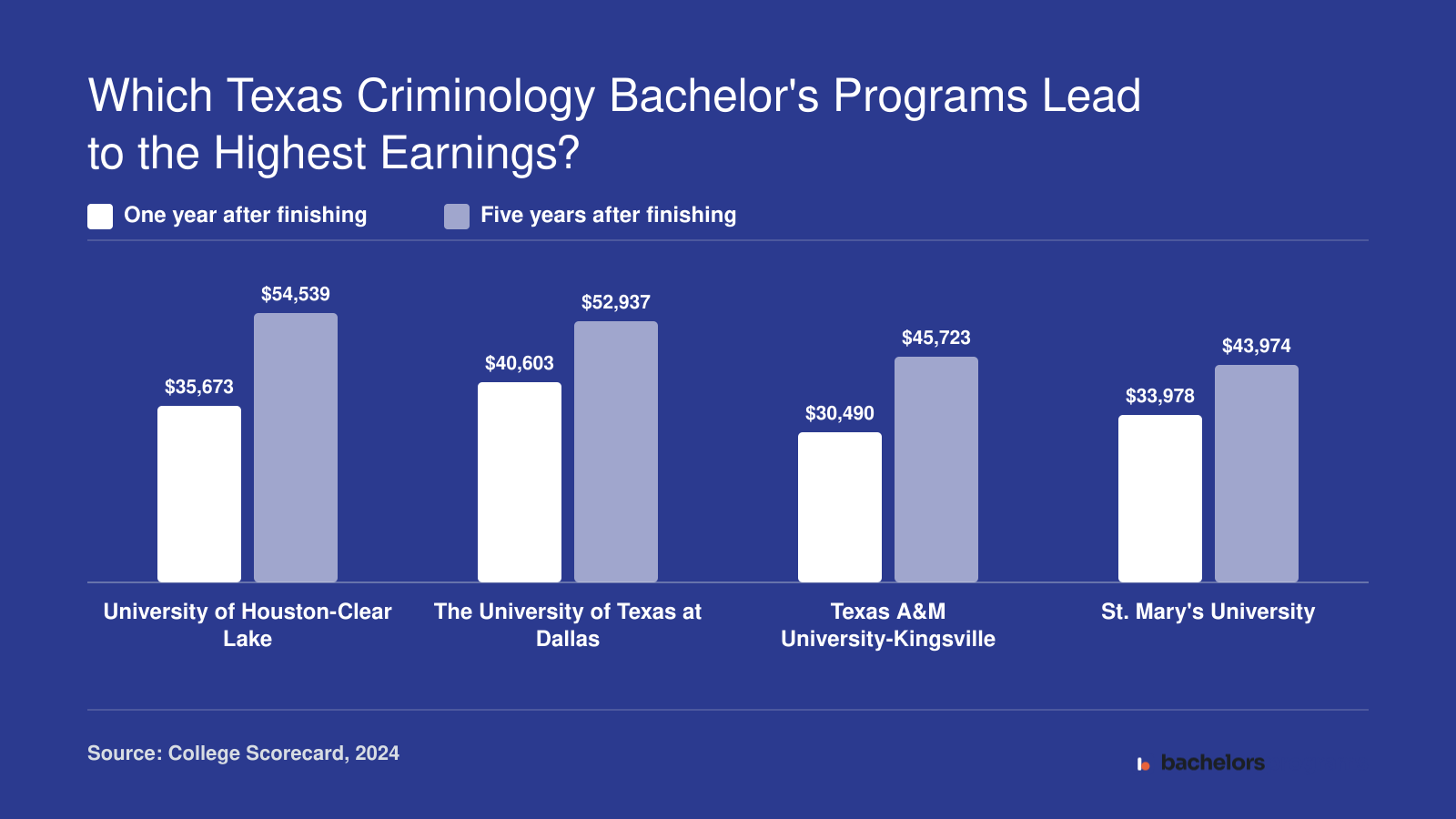
In this comparison, University of Houston-Clear Lake criminology graduates post the highest median earnings five years after finishing ($54,539), with The University of Texas at Dallas close behind ($52,937). St. Mary's University graduates earn $43,974 at the same point, about $10,600 less. That gap is real, but it is narrow enough that cost and program fit still matter. These program-level medians also track local job markets in Houston, Dallas-Fort Worth, South Texas and San Antonio, so your own pay will depend partly on where you work.
How to Choose a Bachelor's Degree in Criminology: B.A. vs. B.S. and Criminology vs. Criminal Justice
St. Mary's University awards a Bachelor of Arts in Criminology, while McMurry University and Texas A&M University-Kingsville award a Bachelor of Science. The letters signal different emphases, not different career ceilings.
B.A. or B.S.?
A B.A. usually leans toward theory, social science and the liberal arts, with room for a foreign language or a broader set of electives. University of St Thomas's Criminology, Law, and Society program, for example, folds in a foreign language option and Catholic social justice principles. A B.S. tends to put more weight on research methods, statistics and science-based coursework. Texas A&M University-Kingsville's B.S. requires statistics for behavioral science and methods of social research. Pick the B.A. if you like writing and policy. Pick the B.S. if you want a data-heavy foundation.
Criminology or Criminal Justice?
Criminology asks why people offend and builds on theory and research. Criminal justice studies the systems that respond: policing, courts and corrections. Texas schools often blend the two. University of Houston-Clear Lake, Texas A&M University-San Antonio, The University of Texas Permian Basin and Concordia University Texas all use combined labels. Since titles vary, read each course catalog rather than relying on the program name.
Forensics and Psychology Paths
If forensics or psychology appeals to you, look at specific coursework and add-ons:
- Texas Tech University: Electives in anthropology, psychology and forensics, plus exposure to crime scene investigation.
- Texas A&M University-Kingsville: A psychology of criminal behavior course in the core.
- University of St Thomas: Four concentration options within the major.
- The University of Texas Permian Basin: Optional certificates in Homeland Security and Corrections.
Confirm current offerings with each department, since electives and concentrations change.
Verify Accreditation
Institutional accreditation affects whether your credits transfer and whether you qualify for federal financial aid. Texas degree-granting colleges are typically accredited by the Southern Association of Colleges and Schools Commission on Colleges (SACSCOC).1 To check, open the SACSCOC Institutions directory, filter the state to TX, search the school's exact name and confirm the record reads "Accredited" rather than candidate or another status.2 Many schools also post this on an accreditation page. Check shortly before you apply, since SACSCOC posts new decisions after its board acts.3
Questions to Ask Yourself
Do you want to study why crime happens, or work inside the justice system?
Would a forensics or psychology concentration serve your goals better than a general degree?
Do you need an online or hybrid format, or can you attend a Texas campus in person?
Online and Hybrid Criminology Bachelor's Options at Texas Schools
Online delivery has moved from an add-on to a core format in Texas criminology and criminal justice education.
Fully online
Texas Tech University's Bachelor of Arts in Criminology runs fully online and asynchronously, so people already working in law enforcement, corrections or a county agency can keep their schedules. University of Houston-Clear Lake publishes a fully online option for its B.S. in Criminology and Criminal Justice, with entry points in fall, spring and summer. Concordia University Texas offers its criminal justice and criminology major online alongside daytime and evening classes.
Hybrid and flexible formats
The University of Texas Permian Basin lets students take classes on campus, online, or in a combination of the two, so a degree can be finished around a full-time job.1 Texas A&M University-Kingsville lists its criminology B.S. as hybrid.
Campus only
The University of Texas at Dallas, the University of St Thomas, St. Mary's University and Texas A&M University-San Antonio list criminology as an on-campus degree. If you need online delivery at one of them, confirm with an advisor before you apply.
Confirm the cost before you commit
These schools do not publish campus and online rates side by side. Texas Tech sets rates by residency and notes that cost varies by program; UT Permian Basin's online rate can carry additional fees.2 Ask for the total cost per term in writing, and check the program page for the current format before the term starts.
Related Articles
Cost of a Criminology Bachelor's Degree in Texas
University of St Thomas in Houston lists tuition and fees of $34,634, yet its average net price after aid is $19,359. That gap is why sticker price is a poor guide when you compare criminology programs.
In-State Tuition vs. Net Price
Public schools sit much lower on sticker price. In-state tuition and fees run $7,770 at University of Houston-Clear Lake, $9,236 at The University of Texas Permian Basin, $9,654 at Texas A&M University-San Antonio, $9,892 at Texas A&M University-Kingsville, $11,852 at Texas Tech University and $14,644 at The University of Texas at Dallas.
Average net price is the better planning number. It is what a typical student pays after grants and scholarships, and it is an average, so your own bill will differ. Net price is $11,196 at Texas A&M University-San Antonio, $12,090 at Texas A&M University-Kingsville, $12,723 at UT Permian Basin, $15,563 at UH-Clear Lake, $19,070 at Texas Tech and $18,267 at UT Dallas.
Pell Grant share shows how many students receive federal need-based aid. It is about 73% at Texas A&M-San Antonio, 75% at Texas A&M-Kingsville, 76% at UH-Clear Lake and 69% at UT Permian Basin, so these schools serve many students who rely on aid.
Texas Aid Programs to Know
Confirm current amounts and eligibility with each program and each school's financial aid office.
- TEXAS Grant: need-based state grant for Texas residents.1
- Texas Public Educational Grants (TPEG): awarded by individual public schools, so availability depends on the campus.
- Texas Tuition Promise: a prepaid tuition plan families can use to lock in future costs.
- Hazlewood: a tuition benefit for eligible Texas veterans and, in some cases, their family members.
Most students apply by filing the FAFSA. Students who cannot file it, for example because of immigration status, can use the Texas Application for State Financial Aid (TASFA). Hazlewood requires separate paperwork through the school's veterans office.2
File Early
Several Texas grants are awarded until funds run out, so submit your FAFSA or TASFA as soon as it opens and meet each school's priority deadline.
Questions to Ask Yourself
Do you want a licensed law enforcement role or an analytical, research or advocacy role?
Would graduate study or a forensic science credential be required for the lab or federal roles you have in mind?
Have you checked your target employer's own hiring requirements before choosing a program?
Frequently Asked Questions About Criminology Schools in Texas
These answers draw on the ranked list, the affordability table and each school's own program pages. Details change, so confirm figures with the school before you apply.
What is the best criminology school in Texas?
What is the cheapest criminology degree in Texas?
Are there online bachelor's degrees in criminology from Texas schools?
Which Texas colleges offer criminology and forensics?
Do I need an accredited school to become a Texas peace officer or apply for aid?
Compare Criminology programs on the data that matters
Explore more Criminal Justice & Law majors or browse every field of study.
All Criminal Justice & Law programs Browse every field of study