Best Criminology Schools in Wisconsin
Compare 6 accredited Criminology programs in Wisconsin, with net price after aid, graduation rates, earnings and debt from IPEDS and the U.S. College Scorecard.

Finding a bachelor's degree in criminology in Wisconsin means weighing a public campus in Whitewater, River Falls, La Crosse or Milwaukee against a private one in Milwaukee or Madison, plus online programs you can finish from anywhere in the state. Schools award it as a Bachelor of Science (B.S.) or a Bachelor of Arts (B.A.) in Criminology, and the label usually signals how much statistics the degree requires.
The differences that matter are practical: in-state tuition against a private rate, a criminology major against criminal justice and criminology, and how close a campus sits to the agencies that hire. Cost and program-level earnings divide these schools more than reputation does.
Key Points
- University of Wisconsin-Whitewater charges the lowest in-state tuition and fees here: $8,616.
- Four years out, Whitewater graduates' median earnings reached $63,365 against $25,283 debt.
- Wisconsin officers need Law Enforcement Standards Board certification and 60 college credits.
Best Bachelor's Degree in Criminology Programs in Wisconsin: Our Ranked List
Six Wisconsin universities award a bachelor's degree in criminology, or a criminal justice and criminology degree close enough to compare directly, and they differ sharply in price, setting and outcomes. The schools on this list have institution-wide graduation rates ranging from 49 to 83 percent, and where program-level earnings are published they run from about $35,650 to $45,113 one year after completion. Below they appear in ranked order with the figures that matter for comparing them.
Marquette University
#1Milwaukee, WI · ~$31,000/yr (est.)
Best for: Milwaukee students pairing crime with law studies
A private Jesuit university in Milwaukee, Marquette runs its criminology major through the Klingler College of Arts and Sciences, where Criminology and Law Studies is a Bachelor of Arts rather than a Bachelor of Science. The university graduates 83 percent of its students, the strongest institutional completion rate on this list. Graduates of the program report median earnings of $35,650 one year after completion and $59,083 four years out.
- 36-37 credit major leading to a Bachelor of Arts
- Five required courses, including methods of criminological research
- Seven electives across four content areas
- Capstone seminar or internship option
- Two social science cognate courses (6 credits)
- 120 total credits and a 2.000 GPA required
- Second-language proficiency at the intermediate level
- AP Statistics score of 4 or 5 accepted
University of Wisconsin-Whitewater
#2Whitewater, WI · $10,000 – $15,000/yr (est.)
Best for: Hands-on learners wanting mock crime scene work
A public regional campus in southeastern Wisconsin, UW-Whitewater offers the only criminology degree program in the UW System, awarding it as either a Bachelor of Arts or a Bachelor of Science. Majors take required theory, statistics and police and courts coursework, carry an approved minor, and intern with law enforcement agencies and corrections facilities. The university graduates about 59 percent of its students, and criminology graduates report median earnings of $40,060 one year after completion and $63,365 four years out.
- Bachelor of Arts or Bachelor of Science in criminology
- Only criminology degree program in the UW System
- Requires an approved minor
- Core includes Criminological Theory and Basic Social Statistics
- Electives such as White Collar Crime and Forensic Documentation
- Internships with law enforcement and corrections facilities
- Mock crime scenes and simulated courts on campus
- 2023-24 survey: 100% of majors employed or in grad school a year out
University of Wisconsin-River Falls
#3River Falls, WI · $10,000 – $15,000/yr (est.)
Best for: Future probation and parole officers
A public campus in western Wisconsin, UW-River Falls houses criminology in its Sociology, Criminology and Anthropology Department and offers it as both an undergraduate major and a minor. Coursework runs from Criminal Behavior and Theories of Crime to Restorative Justice and Women, Crime, and Justice, with steady emphasis on analyzing data and reasoning ethically about agency policy. The university graduates about 57 percent of its students, and criminology graduates report median earnings of $45,113 one year after completion and $51,586 four years out.
- Undergraduate major and minor in the College of Arts and Sciences
- Courses include Criminal Behavior and Theories of Crime
- Electives such as Restorative Justice and White Collar Crime
- Training in calculating, interpreting and analyzing data
- Prepares students for probation, parole and victim advocacy roles
- Many graduates continue to graduate school or law school
- Campus offers 8 living and learning communities
University of Wisconsin-La Crosse
#4La Crosse, WI · $15,000 – $20,000/yr (est.)
A public university in western Wisconsin, UW-La Crosse awards a Bachelor of Science in Criminology through its Sociology and Criminology department. The 36-credit major builds in social research methods and social analysis, requires at least nine credits of criminology electives, and closes with a senior capstone project. Internships, course-embedded research and community-based learning with local partners are part of the program, and the campus graduates about 71 percent of its students.
- Bachelor of Science in Criminology with a 36 credit major
- Core in criminology, social research methods and social analysis
- At least nine credits of criminology electives
- Six credits of sociology electives
- Senior project completed in one of three capstone courses
- Internships and community-engaged learning with local partners
- 120 semester credits and a 2.00 cumulative GPA
- Declare the major before enrolling in SOC 200 and SOC 250
Edgewood University
#5Madison, WI · $25,000 – $30,000/yr (est.)
A private college in Madison, Edgewood awards criminology as a concentration inside its Bachelor of Science in Sociology rather than as a standalone major. Students choose between the criminology track and a human services and social work track, take classes averaging 15 students, complete an original research project, and many intern with the Dane County Sheriff's Department. The campus graduates about 60 percent of its students, and transfer credits are accepted liberally.
- Criminology is a concentration, not a standalone major
- Second concentration option in human services and social work
- 120-credit, on-campus degree in Madison
- Average class size of 15
- Every student completes an original research project
- 85% of students intern or volunteer with community organizations
- Internships with the Dane County Sheriff's Department
- Transfer credits accepted liberally
University of Wisconsin-Milwaukee
#6Milwaukee, WI · $10,000 – $22,000/yr (est.)
A large urban public university in Milwaukee, UW-Milwaukee runs its criminal justice and criminology major inside the Helen Bader School of Social Welfare. Majors complete 48 credits in the field, can specialize in crime analysis, and can earn credit for current justice employment or through field placements at agencies across the city.
- 120-credit Bachelor of Science in the Helen Bader School of Social Welfare
- 48 credits in the major: 30 required and 18 elective
- Crime analysis specialization available
- Field placement elective at eight or more hours a week
- Credit available for current criminal justice employment
- Transfer up to 72 credits from UW System or technical college campuses
- Electives include criminal profiling, victimology and juvenile justice
- Criminal justice capstone seminar required
Cost & outcomes by school
Federal data for the highest-earning Criminology programs, independent of the ranking above. Earnings are this field's bachelor's graduates four years after completing where the Scorecard reports them, else the school's undergraduate median.
| School | Net price / yr | Grad rate | Earnings | Debt | Grads/yr | Format |
|---|---|---|---|---|---|---|
| University of Wisconsin-Whitewater WI | $14,158 | 59% | $63,365 | $25,283 | 38 | Campus |
| University of Wisconsin-La Crosse WI | $16,210 | 71% | $60,378 | $22,500 | — | Campus |
| Edgewood University WI | $26,113 | 60% | $59,728 | $24,424 | — | Campus |
| Marquette University WI | $31,487 | 83% | $59,083 | $25,000 | 75 | Campus |
| University of Wisconsin-Milwaukee WI | $15,014 | 49% | $54,990 | $23,000 | — | Online or campus |
| University of Wisconsin-River Falls WI | $14,054 | 57% | $51,586 | $20,625 | 27 | Campus |
Sources: U.S. Department of Education. Net price, graduation rate, earnings and debt: College Scorecard (earnings and debt for this field's bachelor's graduates where reported, else school-wide); graduates: IPEDS. A dash means no figure is reported.
Cost, debt & payoff
Median earnings of this field's bachelor's graduates (4 yrs after completing, else the school's undergraduate median) vs. their median federal loan debt · U.S. College Scorecard
Across these programs the median graduate earns about $59,406 and finishes with roughly $23,712 in debt — a ratio that clears a common rule of thumb (keep debt below first-year salary). Net price and debt vary widely school to school, so check the per-school figures in the table above before you shortlist.
How We Ranked Wisconsin Bachelor's Degree Programs in Criminology
Federal data now reports graduate earnings by individual program, so criminology majors can be compared on outcomes rather than on a school's overall reputation. This ranking draws on College Scorecard data for cost, completion, earnings and debt, plus program records for delivery format.
What We Measured
- Net price: The average yearly cost once grants and scholarships are applied. A lower net price helps a program rank higher.
- Completion: The percentage of students who finish their degree, a signal of how well a school supports them through graduation.
- Program-level earnings: Median pay for graduates of the specific criminology program, measured over a stated window after completion.
- Debt: Typical federal loan debt at graduation, weighed against earnings so that a low price or a strong salary alone cannot carry a school.
- Delivery format: Whether the bachelor's degree runs on campus, online or hybrid, which matters if you need flexibility.
Which Programs Qualify
The scope is bachelor's programs at Wisconsin-based schools, campus and online. A school appears only if College Scorecard lists its program. Program names vary: Marquette University calls its major Criminology and Law Studies, UW-Milwaukee pairs the two as Criminal Justice and Criminology, and other schools list it simply as Criminology.
Limits Worth Knowing
The graduation rate and the average net price are institution-wide averages. Neither describes the criminology major, and net price is approximate because your actual cost depends on family income and the aid you receive. Earnings are tied to the program and to the time window stated wherever they appear. Any 10-year earnings figure covers all of a school's graduates and serves only as background on the school, not as a measure of criminology outcomes. Treat the ranking as a starting point, then confirm costs and aid with each school directly.
Criminology vs. Criminal Justice: Which Bachelor's Degree Fits You?
Choose criminology if you want to understand why crime happens; choose criminal justice if you want to work inside the system that responds to it. The two fields overlap, but they train different habits of mind.
The One-Sentence Split
Criminology is the study of crime's causes: theory, research methods, poverty, trauma, substance use, and social policy. Criminal justice is the study of the institutions that respond: policing, courts, corrections, and the law. A criminology degree asks you to explain crime; a criminal justice degree asks you to operate within the agencies that manage it.
What Wisconsin Schools Actually Call the Major
Titles are not uniform, so read the catalog entry rather than the brochure. At UW-La Crosse, the catalog lists a standalone Criminology major offered as both a B.A. and a B.S. It requires 36 credits in the major within a 120-credit bachelor's degree, which separately requires at least 40 credits at the 300 and 400 level. UW-Milwaukee takes the combined route with a Criminal Justice and Criminology program, so its course list leans toward agencies and system operations. Marquette uses a third pattern, Criminology and Law Studies. At UW-Whitewater, check the catalog rather than the program page to confirm whether criminology is standalone or paired with criminal justice; the two do not always use identical labels.
Coursework and Who Each Suits
A standalone criminology major typically spends more time on theory, research design, statistics, and electives such as policing or courts. A combined criminal justice and criminology degree usually adds system-focused courses in law enforcement, courts, and corrections. Standalone criminology suits research, graduate school, law school, or policy work. Combined programs suit students who want direct entry into agency careers, though either path can lead to either outcome with the right internships.
Compare Courses, Not Names
Pull the required course lists side by side. Count theory and research methods courses, check the capstone, and look for internships or field placements. The degree title matters less than the transcript you build.
Related Articles
Questions to Ask Yourself
Do you need a fully online or hybrid schedule, or can you attend a campus near an internship site?
Will you start as a first-year student or transfer credits from a technical college or another UW campus?
Are you aiming to work in Wisconsin agencies, or keeping graduate or law school open?
Cost of a Criminology Bachelor's Degree in Wisconsin
Wisconsin's public universities charge in-state tuition and fees from $8,616 at the University of Wisconsin-Whitewater to $10,398 at the University of Wisconsin-Milwaukee. Marquette University and Edgewood University charge every student the same private rate. The net price column is an institution-wide average for all undergraduates after grants, so treat it as an approximation rather than a criminology-only figure. Wisconsin residents who file the FAFSA, the only application, may qualify for state gift aid that does not have to be repaid. For 2026-27, the Wisconsin Grant pays up to $3,700 at UW campuses, and a $1,000 Tier 2 award goes to students with a Student Aid Index of $6,751 to $10,000 when funds allow. The Talent Incentive Program adds $600 to $1,800 for high-need, first-time freshmen from educationally disadvantaged backgrounds, but only if a campus aid office or the Wisconsin Educational Opportunity Program nominates them. Minnesota residents can attend the UW campuses below at reciprocity tuition instead of the out-of-state rate, on a space-available basis. They apply through Minnesota's Office of Higher Education by the last day of classes for the term. On scholarships, UW-Whitewater advertises scholarships for its program, and the state's Academic Excellence Scholarship works through school nominations, with a 2026 nomination window of February 18 to March 13.
| School | In-State Tuition and Fees | Out-of-State Tuition and Fees | Average Net Price After Aid (institution-wide approximation) | Median Debt, All Graduates (institution-wide) | Median Debt, Criminology Bachelor's Completers |
|---|---|---|---|---|---|
| University of Wisconsin-River Falls | $9,008 | $17,470 | $14,054 | $20,500 | $20,625 |
| University of Wisconsin-Whitewater | $8,616 | $18,716 | $14,158 | $23,188 | $25,283 |
| University of Wisconsin-Milwaukee | $10,398 | $22,398 | $15,014 | $23,000 | N/A |
| University of Wisconsin-La Crosse | $10,070 | $19,517 | $16,210 | $22,500 | N/A |
| Edgewood University | $35,860 | $35,860 | $26,113 | $24,424 | N/A |
| Marquette University | $51,170 | $51,170 | $31,487 | $23,940 | $25,000 |
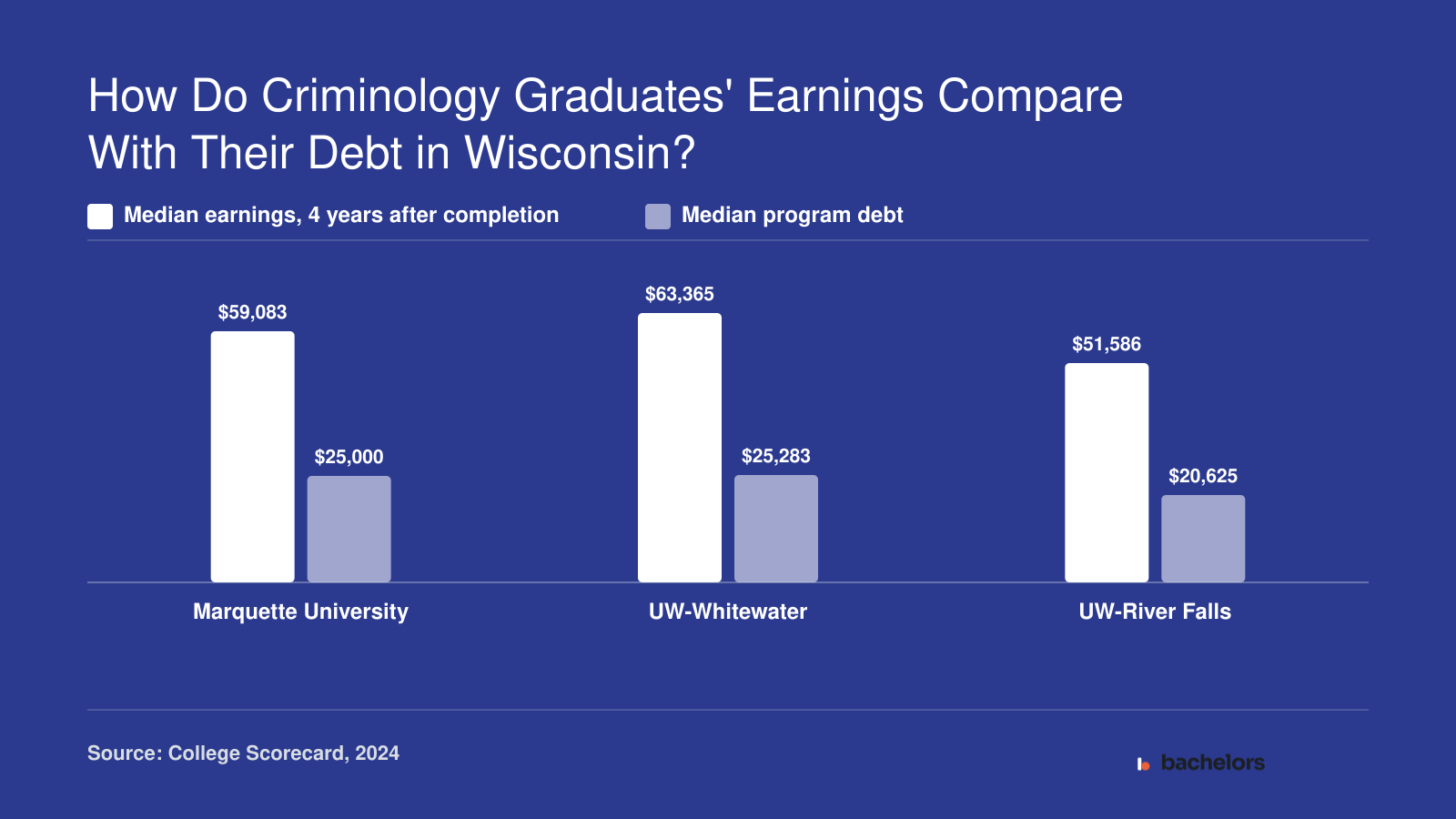
How Do Criminology Graduates' Earnings Compare With Their Debt in Wisconsin?
Four years after finishing, criminology bachelor's graduates from University of Wisconsin-Whitewater reported median earnings of $63,365 against median program debt of $25,283, the widest gap among schools with program-level figures. Marquette University graduates earned $59,083 on $25,000 of debt. University of Wisconsin-River Falls graduates earned $51,586 and carried the lowest median debt, $20,625.
Wisconsin Law Enforcement Certification at a Glance
Compare Criminology programs on the data that matters
Explore more Criminal Justice & Law majors or browse every field of study.
All Criminal Justice & Law programs Browse every field of study