Best Public Health Schools in Wisconsin
Compare 9 accredited Public Health programs in Wisconsin, with net price after aid, graduation rates, earnings and debt from IPEDS and the U.S. College Scorecard.

At the public universities ranked here, in-state tuition for a public health bachelor's degree runs from $8,270 a year at UW-Parkside to $10,398 at UW-Milwaukee. The usual credential is the Bachelor of Science (B.S.) in Public Health, though majors stretch from environmental public health to community health education.
Wisconsin students tend to ask three things: Is the program accredited? What does it cost after grants? Can it be finished on campus or online? The rankings, the cost and highest-earning comparisons, and the admissions and career details that follow answer each in turn.
Price and payoff rarely line up. Private Carroll University posts the highest median earnings here: $66,494 four years after graduation.
Key Points
- Carroll University graduates earn a $66,494 median four years after graduating.
- In-state tuition at public campuses here runs $8,270 to $10,398.
- At several schools, keeping your major GPA matters more than admission.
Best Schools for a Bachelor's Degree in Public Health in Wisconsin
Wisconsin's public health bachelor's programs run from a CEPH-accredited major at a mid-size public university to a 4+1 path that ends with a master's degree. The nine schools below differ widely in price, format and how much supervised field work they require, so the right fit depends on whether you want a large public campus, a small private college, or an online program you can finish while working.
University of Wisconsin-La Crosse
#1La Crosse, WI · $15,000 – $20,000/yr (est.)
Best for: Aspiring health educators seeking field experience
UW-La Crosse has made community health education one of its signature programs, and its Bachelor of Science in Public Health and Community Health Education is the only major of its kind in the Universities of Wisconsin with national CEPH accreditation. Students pair epidemiology, environmental health and policy coursework with a 12-credit preceptorship that places them in hospitals, county health departments and nonprofits. The state health department has also used the campus as a site for community vaccination work, so the link to Wisconsin public health practice is direct.
- CEPH accredited, the only such program in the Universities of Wisconsin
- Accreditation runs through July 2027
- 120 total credit hours with prerequisite courses required
- 12-credit community health education preceptorship
- Capstone required before graduation
- 2.3 GPA minimum for the major
- Coursework in epidemiology, environmental health and health policy
- Prepares for health educator and public health specialist roles
University of Wisconsin-Eau Claire
#2Eau Claire, WI · ~$17,000/yr (est.)
Best for: Liberal arts students pairing a second major
UW-Eau Claire offers public health as both a Bachelor of Arts and a Bachelor of Science, built as a four-year cohort program with small classes and faculty who work closely with majors. The degree draws on epidemiology, geography, sociology, communications and health policy, and every student finishes with a capstone internship, research project or health education campaign. Study abroad, immersion trips and a student public health club round out the experience, and the major pairs easily with a second field such as math or communications.
- Four-year, cohort-based program with small classes
- Capstone internship, research project or health education campaign
- Study abroad and immersion program options
- Pairs well with a second major in math, sociology or communications
- Faculty work closely with students throughout the cohort
- Join the student Public Health Club
- Interdisciplinary coursework in epidemiology, geography and health policy
Carroll University
#3Waukesha, WI · $15,000 – $20,000/yr (est.)
Best for: Private-college students targeting health education certification
Carroll University is a private university in Waukesha with a CEPH-accredited public health major and a curriculum spanning health services administration, biostatistics, epidemiology, behavioral health education and environmental health sciences. Internships with Children's Hospital of Wisconsin and local health departments put students in real settings before graduation, and graduates can sit for the Certified Health Education Specialist exam. A public health minor lets students in other majors add the subject.
- CEPH accredited public health major
- Graduates can sit for the Certified Health Education Specialist exam
- Internships at Children's Hospital of Wisconsin and local health departments
- Coursework in biostatistics, epidemiology and health services administration
- Behavioral health education and environmental health sciences included
- Public Health minor available for other majors
University of Wisconsin-Milwaukee
#4Milwaukee, WI · $10,000 – $22,000/yr (est.)
UW-Milwaukee is home to the Zilber College of Public Health, the only accredited college in Wisconsin dedicated to public health, and its Bachelor of Science in Public Health is grounded in Milwaukee community work. Students take epidemiology, environmental health, health disparities and research methods, then complete 120 hours of field placement with community partners. Faculty research projects, undergraduate research fellowships and an accelerated bachelor's-to-master's track give strong students room to move faster.
- CEPH accredited, taught within the Zilber College of Public Health
- 120 credit hours plus 120 hours of field placement
- Field work with Milwaukee community partners
- Accelerated bachelor's-to-master's track available
- Undergraduate research fellowships and faculty research projects
- Scholarships available for public health majors
- Focus on epidemiology, environmental health and health disparities
University of Wisconsin-Oshkosh
#5Oshkosh, WI · $10,000 – $15,000/yr (est.)
UW-Oshkosh approaches public health through environmental health, offering a Bachelor of Science in Environmental Public Health housed in the biology department. The major requires a substantial science base in biology, chemistry, physics and math, then adds environmental toxicology, public health microbiology and epidemiology along with electives in air quality, GIS, water and wastewater, and vector control. It is the strongest fit on this list for students aiming at sanitarian and environmental health specialist roles.
- At least 55 credits in the major
- Housed in the biology department; Bachelor of Science degree
- Requires biology, chemistry, physics and math coursework
- Courses in epidemiology, environmental toxicology and public health microbiology
- Electives span air quality, GIS, hydrogeology, hazardous waste and vector control
- Prepares for Registered Sanitarian roles
- 2.0 GPA minimum in major courses
Rasmussen University-Wisconsin
#6Green Bay, WI
Rasmussen University-Wisconsin is the online option on this list, offering a Bachelor of Science in Healthcare Management with a Public Health specialization through its Wisconsin campus in Green Bay. The program is built for working adults, with 90 credit hours across 23 courses, eight start dates a year and a pace that can finish in as few as 18 months. Coursework covers advocacy, corporate wellness, epidemiology, health education and population management, and up to five courses can count toward a master's in public health.
- 90 credit hours across 23 courses
- Can be completed in as few as 18 months
- Eight start dates per year, no entrance exam required
- $332 per credit, about $29,880 total program tuition
- Fully online with live sessions and 24/7 tech support
- Up to five courses align with the master's in public health
- Eligible for CAPM and PMP certification exams
- Accredited by the Higher Learning Commission
University of Wisconsin-Parkside
#7Kenosha, WI · ~$12,000/yr (est.)
UW-Parkside offers a Pre Public-Health concentration inside its applied health sciences major, an interdisciplinary track that pulls together biology, communication and sociology. Students take courses such as general genetics, health communication and health psychology, then work through antimicrobial resistance, emerging infectious diseases, bioethics and community health. It is designed for students who intend to continue to a graduate public health degree or enter the field directly after the bachelor's.
- Concentration inside the applied health sciences major
- Combines biology, communication and sociology coursework
- Courses include general genetics, health communication and health psychology
- Covers antimicrobial resistance, emerging infectious diseases and bioethics
- Designed for students heading to a graduate public health degree
- Join the Pre-Health Club or Biology Club
Mount Mary University
#8Milwaukee, WI · ~$20,000/yr (est.)
Mount Mary University runs a 4+1 arrangement with the Medical College of Wisconsin that lets students earn a bachelor's degree and a Master of Public Health in about five years. Undergraduates spend three years on the Milwaukee campus, then take 15 public health core credits in senior year that count toward both degrees, finishing the MPH online. It is the most efficient route here for students who already know they want graduate public health training.
- 4+1 dual degree with the Medical College of Wisconsin
- Bachelor's and MPH completed in about five years
- 15 public health core credits count toward both degrees
- 3.3 GPA, three recommendations and 96 credits needed to apply
- $0 application fee and no transcript fees
- MPH year delivered fully online
- Apply during spring semester of junior year
Alverno College
#9Milwaukee, WI · $20,000 – $25,000/yr (est.)
Alverno College offers a Bachelor of Science in Public Health with a Health Sciences concentration that blends biology and community health. Students study anatomy, microbiology, immunology and pathophysiology alongside epidemiology, global health, environmental health and health policy, learning to interpret biological data for public health decisions. An internship and a senior seminar give the degree applied depth, and graduates move into community, state and federal health agencies.
- 120 total credit hours
- Health Sciences concentration blends biology and community health
- Coursework in anatomy, microbiology, immunology and pathophysiology
- Also covers epidemiology, global health, environmental health and health policy
- Internship plus senior seminar required
- Prepares for roles at community, state and federal health agencies
Cost & outcomes by school
Federal data for the highest-earning Public Health programs, independent of the ranking above. Earnings are this field's bachelor's graduates four years after completing where the Scorecard reports them, else the school's undergraduate median.
| School | Net price / yr | Grad rate | Earnings | Debt | Grads/yr | Format |
|---|---|---|---|---|---|---|
| Carroll University WI | $15,193 | 71% | $66,494 | $27,000 | 11 | Campus |
| University of Wisconsin-Eau Claire WI | $16,550 | 64% | $63,016 | $20,909 | 23 | Campus |
| University of Wisconsin-Oshkosh WI | $14,305 | 46% | $55,548 | $21,500 | 3 | Campus |
| University of Wisconsin-La Crosse WI | $16,210 | 71% | $55,418 | $26,801 | 45 | Campus |
| University of Wisconsin-Milwaukee WI | $15,014 | 49% | $54,990 | $23,000 | 24 | Campus |
| Alverno College WI | $22,540 | 49% | $53,145 | $27,000 | — | Campus |
| University of Wisconsin-Parkside WI | $11,772 | 40% | $51,129 | $20,492 | — | Campus |
| Rasmussen University-Wisconsin WI | — | 57% | $49,032 | $25,607 | — | Online |
| Mount Mary University WI | $20,144 | 43% | $48,745 | $25,288 | — | Hybrid |
Sources: U.S. Department of Education. Net price, graduation rate, earnings and debt: College Scorecard (earnings and debt for this field's bachelor's graduates where reported, else school-wide); graduates: IPEDS. A dash means no figure is reported.
Cost, debt & payoff
Median earnings of this field's bachelor's graduates (4 yrs after completing, else the school's undergraduate median) vs. their median federal loan debt · U.S. College Scorecard
Across these programs the median graduate earns about $54,990 and finishes with roughly $25,288 in debt — a ratio that clears a common rule of thumb (keep debt below first-year salary). Net price and debt vary widely school to school, so check the per-school figures in the table above before you shortlist.
How We Ranked Wisconsin Public Health Schools
A low price and strong outcomes do not always come from the same school, so a fair comparison has to weigh several things at once.
What We Looked At
Five factors shaped the order: cost, earnings, completions, graduation rate, and selectivity. Cost looks at what students typically pay, not just posted tuition. Earnings reflect what graduates in the field make after finishing. Completions show how many students earn the degree each year, a sign of an established program. Graduation rate tells you how many students finish at the school, and selectivity shows how competitive admission is. No single measure decides a school's place, and a program that is strong in one area can sit lower if it lags in another.
Read the Numbers With Care
Graduation rate is institution-wide, not specific to the public health program, so it speaks to the school as a whole. Net price is an approximate sector average, not a quote for your own aid package. Your actual cost will depend on aid, residency, and the program you choose.
Scope
Only bachelor's programs at Wisconsin-based schools were considered, both on campus and online. A few entries are closely related fields, such as environmental public health or healthcare management with a public health concentration, so check each curriculum against your career goals before you apply.
Cheapest Bachelor's in Public Health Programs in Wisconsin
The schools below are ordered by average net price, the amount students typically pay per year after grants and scholarships, based on 2024 IPEDS and College Scorecard data from the U.S. Department of Education. University of Wisconsin-Parkside has the lowest net price here at $11,772. Carroll University's private sticker price of $38,890 drops to an average net price of $15,193, which is close to the University of Wisconsin campuses.
| School | City | Program | Type | In-State Tuition and Fees | Average Net Price | Graduation Rate | Median Debt at Graduation (All Programs) |
|---|---|---|---|---|---|---|---|
| University of Wisconsin-Parkside | Kenosha | Public Health (Pre Public-Health) | Public | $8,270 | $11,772 | 40% | $20,492 |
| University of Wisconsin-Oshkosh | Oshkosh | Environmental Public Health | Public | $8,532 | $14,305 | 46% | $21,500 |
| University of Wisconsin-Milwaukee | Milwaukee | BS in Public Health | Public | $10,398 | $15,014 | 49% | $23,000 |
| Carroll University | Waukesha | Public Health | Private nonprofit | $38,890 | $15,193 | 71% | $27,000 |
| University of Wisconsin-La Crosse | La Crosse | Public Health and Community Health Education Major | Public | $10,070 | $16,210 | 71% | $22,500 |
Highest-Earning Public Health Bachelor's Programs in Wisconsin
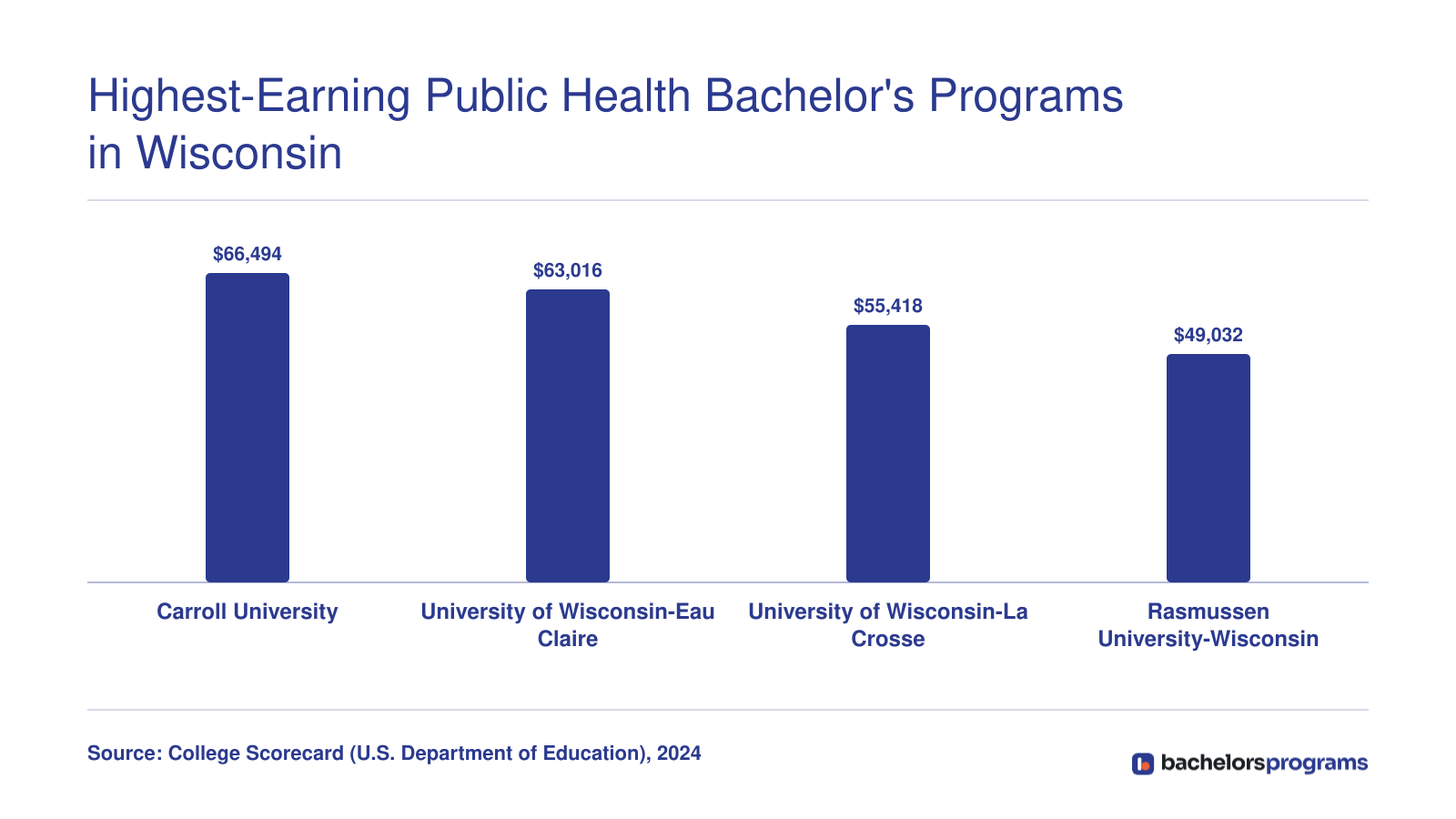
These are program-level median earnings for public health bachelor's graduates, measured four years after finishing, from federal College Scorecard data. Carroll University leads at $66,494, and University of Wisconsin-Eau Claire graduates earn $63,016 four years out, with in-state tuition of $9,642 compared with Carroll's $38,890. Where program debt is reported, earnings clearly outpace it: University of Wisconsin-La Crosse graduates owe a median $26,801 against $55,418 in earnings four years after finishing.
Online and Hybrid Public Health Bachelor's Options at Wisconsin Schools
Format means how and where you actually attend: a traditional campus program, a hybrid mix of in-person and online courses, or a fully online degree you complete from anywhere. For public health, format also decides where your required field hours happen, which matters as much as the coursework itself.
Campus-based programs
Most of the public health majors here are campus programs. UW-Milwaukee's B.S. in Public Health is listed as on campus, and the 120-credit degree includes 54 public health credits plus 120 hours of field placement with community partners, an in-person, community-based requirement. UW-La Crosse, Carroll University, UW-Oshkosh, UW-Parkside and Alverno College also present their public health majors as campus-based. UW-Eau Claire is not fully online either: its 2026-2027 catalog requires at least 30 credits in university residence, plus 12 or 21 upper-division major credits in residence depending on the option, and the major runs as a cohort.
Is there a fully online option?
None of the ranked schools offers a fully online public health major. The fully online bachelor's path that includes public health coursework is Rasmussen University-Wisconsin's Healthcare Management degree with a public health specialization: 90 credits, 23 courses, completion in as few as 18 months, $332 per credit, and eight start dates a year. Mount Mary University lists its public health bachelor's on campus; the 100% online piece there is the master's portion of its five-year dual degree, not the undergraduate program.
What to confirm with admissions
- Whether any course, lab or internship must be completed in person
- How field placements are arranged, and whether you can serve one near your home
- Cohort start dates, and whether the schedule allows you to pause
- How prior college credit transfers, and whether a completion track exists for your credits
Related Articles
Admissions: GPA, Test Policy, and Transfer Credit
Getting In vs. Staying In the Major
At several Wisconsin schools, getting into the university is easier than staying in the public health major, so the GPA that matters most is often the one you hold after your first year. These standards come from program catalogs and handbooks. They mostly govern progression in the major, not freshman admission.
- UW-La Crosse: You need a 2.25 cumulative GPA to be considered for the Public and Community Health Education major.1 Transfer students need at least 2.25 at the point of transfer. Health education courses and listed prerequisites require a C or better.
- UW-Milwaukee: You need a 2.25 cumulative GPA, counting both transferable and UWM credits, plus a 2.5 average across the required public health courses.
- UW-Eau Claire: The catalog sets a 2.00 minimum for total, resident and major GPA.2
- UW-Oshkosh: The Environmental Public Health program lists a 2.0 GPA minimum.
Test Policy and Selectivity
The public health catalogs reviewed here do not spell out an ACT or SAT rule. Confirm testing requirements on each university's general admissions page before you apply. Rasmussen University-Wisconsin states that no entrance exam is required, and it admits students on a rolling basis.
Overall admission rates give a rough sense of competition:
- Most selective: Mount Mary University (62%) and Carroll University (67%) admit the smallest share of applicants among the schools here.
- Least selective: UW-Milwaukee (91%), UW-Oshkosh (87%) and Alverno College (86%) admit the largest share.
These are campus-wide rates, not figures for the public health program itself.
Transfer Credit Rules
UW-Eau Claire accepts up to 72 semester credits from a two-year college.2 It normally limits extension or correspondence credit from outside the UW campuses to one-fourth of the credits needed to graduate.
UW-La Crosse requires 40 upper-division credits within its 120-credit degree.1 Transferred 300- and 400-level courses may count toward that total, though the catalog sets no general transfer cap. UW-Milwaukee also publishes no overall transfer maximum.
If you start at a two-year college or another UW campus, run your courses through the receiving school's course equivalency tool. Then get written confirmation from an advisor on how each course applies to the public health major, not just to general electives. Credits that transfer only as electives can still leave you short of major requirements and add a semester to your bachelor's degree.
Questions to Ask Yourself
Do you need a fully online or hybrid schedule, or can you attend on campus in Wisconsin?
Will your career goals require a CEPH-accredited program?
Do you qualify for in-state tuition or Wisconsin state grants?
Cost of a Bachelor's Degree in Public Health in Wisconsin
At the public universities on this list, in-state tuition and fees run from $8,270 a year at UW-Parkside to $10,398 at UW-Milwaukee; out-of-state charges at the same campuses fall between $16,446 and $22,398. The private options cost more up front: Carroll University, Mount Mary University, and Alverno College each list tuition and fees between $34,086 and $38,890.
Sticker Price Versus Net Price
The published charge is only the starting point. Net price, what is left after grant and scholarship aid, is a sector average rather than a personal quote. Federal data put it near $11,772 at UW-Parkside, about $14,305 at UW-Oshkosh, and roughly $15,014 at UW-Milwaukee. Carroll lands near $15,193, UW-La Crosse near $16,210, and UW-Eau Claire near $16,550, while Mount Mary sits around $20,144 and Alverno around $22,540. Families with greater demonstrated need generally land below those numbers, and higher-income families above them.
Wisconsin Aid Programs
Three state programs can shrink the gap between sticker and net price:
- Wisconsin Higher Education Grant: up to $3,700 for 2026-27, calculated as 40 percent of the difference between $9,250 and your Student Aid Index, with a $1,000 second tier available if funds remain.1 Part-time students receive prorated awards, and eligibility caps at 10 semesters.2
- Talent Incentive Program Grant: $600 to $1,800 for first-year students and $250 to $1,800 for continuing students, but you must be nominated by your school's financial aid office or a WEOP counselor.2
- Wisconsin Tuition Grant: up to $4,000 a year at nonprofit independent Wisconsin colleges, capped at $12,000 total and three academic years of eligibility.3
All three are awarded through the FAFSA.3
What Borrowing Looks Like
Median debt at completion for federal aid recipients gives a clearer picture of total cost than tuition alone. It runs from $20,492 at UW-Parkside and $20,909 at UW-Eau Claire up to $26,801 at UW-La Crosse and $27,000 at Carroll and Alverno, with Mount Mary reporting $25,288 and UW-Milwaukee $23,000.
One Practical Move
File the FAFSA as soon as it opens in the fall instead of waiting until spring. Wisconsin sets no single statewide deadline for these programs, but each campus sets its own priority date for institutional aid, and the Talent Incentive Program nomination has to come through your aid office or counselor, so an early file gives both processes room to work.
Wisconsin Public Health Degree FAQs
These answers cover the questions Wisconsin students ask most about accreditation, cost, online study and UW-Madison. Confirm details with each school's official pages before you apply.
Which public health schools in Wisconsin are accredited?
Does Wisconsin have a CEPH-accredited school of public health?
How much does a public health degree cost in Wisconsin?
Can you get a bachelor's degree in public health online in Wisconsin?
Does UW-Madison have an undergraduate public health major?
Compare Public Health programs on the data that matters
Explore more Healthcare majors or browse every field of study.
All Healthcare programs Browse every field of study