Best Forensic Science Schools in Massachusetts
Compare 9 accredited Forensic Science programs in Massachusetts at 8 colleges, with net price after aid, graduation rates, earnings and debt from IPEDS and the U.S. College Scorecard.
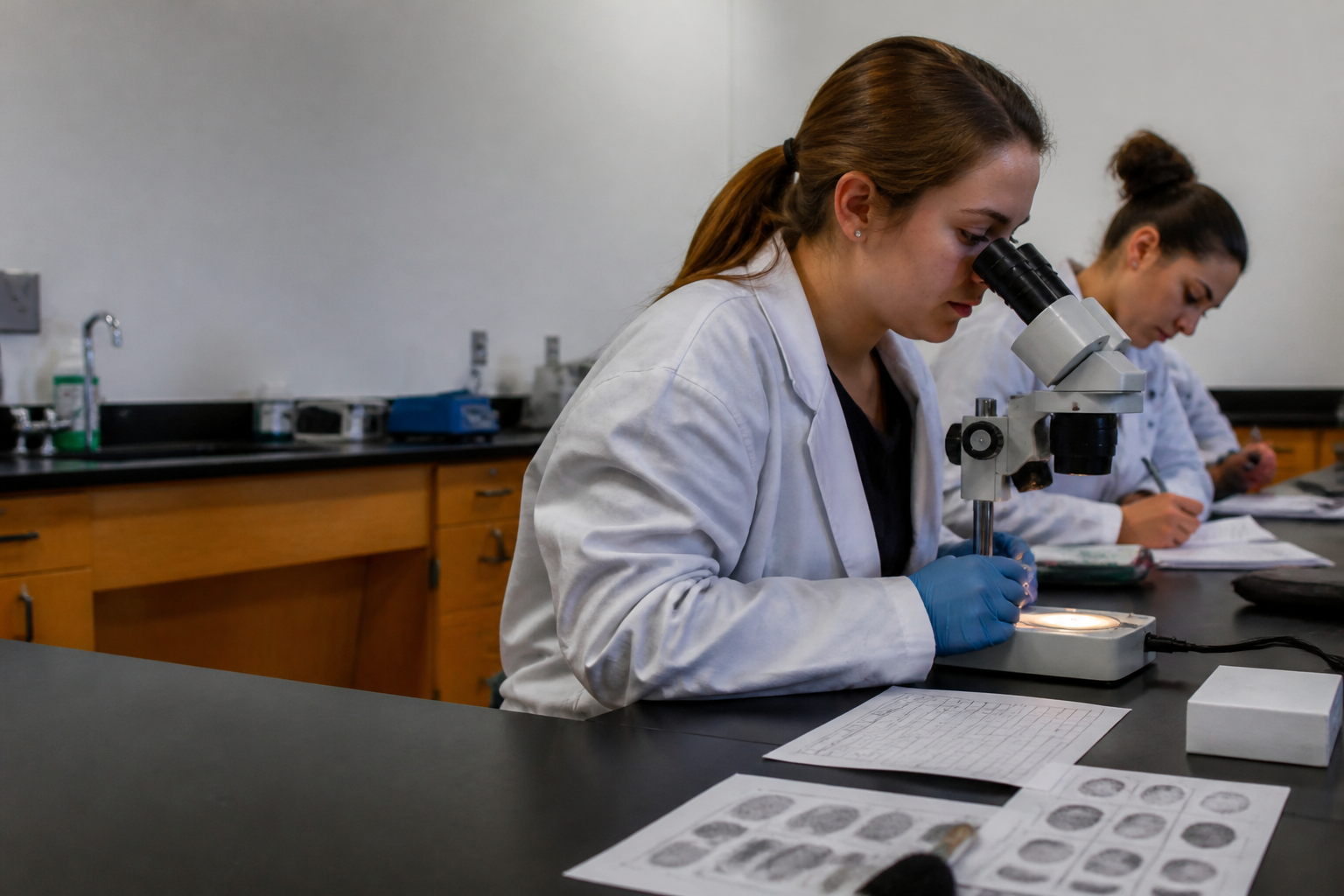
Forensic science employers increasingly screen for solid chemistry and biology coursework. In Massachusetts, a bachelor's degree in forensic science leads to lab or crime-scene work only when the curriculum delivers it.
Schools award a Bachelor of Science (B.S.) or Bachelor of Arts (B.A.) in Forensic Science. Some programs sit inside science departments, such as the chemistry-based option at the University of Massachusetts-Lowell and the forensic chemistry and forensic biology majors at Western New England University.
Average net price after aid runs from $14,271 to $37,927 across the schools on this list, so the right fit depends on science rigor, accreditation, and cost together.
Key Points
- Bay Path University has the lowest average net price, $14,271 yearly.
- FEPAC's official list names Lasell University's B.S. in Forensic Science.
- Strong high school chemistry matters more than any single GPA cutoff.
Best Bachelor's in Forensic Science Schools in Massachusetts: Ranked List
Eight Massachusetts colleges award a bachelor's degree in forensic science, and they differ sharply in flavor: a chemistry-based option at a public university, small liberal arts laboratories, and career-focused tracks with required or guaranteed internships. One is public and one enrolls women exclusively at the undergraduate level. Across these schools, overall graduation rates range from 44% to 73%, and net price after aid runs from roughly $14,000 to about $38,000.
University of Massachusetts-Lowell
#1Lowell, MA · ~$17,000/yr (est.)
Best for: Public-university students wanting chemistry-based forensics
UMass Lowell is the only public university in Massachusetts with a forensic science option, and it takes a chemistry-first approach rather than a standalone criminal justice major. Students complete the general chemistry core and put free electives toward criminal justice and forensic chemistry courses, including Forensic Science I and II and Criminalistics I and II, with access to scanning electron microscopy, mass spectrometry and chromatography instruments. Undergraduate research is available. The school's overall graduation rate is 65%.
- Only forensic science bachelor's option at a Massachusetts public university
- No additional courses beyond the general chemistry major
- Free electives cover criminal justice and forensic chemistry courses
- Includes Forensic Science I and II and Criminalistics I and II
- Undergraduate research with SEM, ICP-MS, GC-MS and HPLC instruments
- Graduates earn a chemistry degree with a named forensic science option
Bay Path University
#2Longmeadow, MA · $14,000/yr (est. net price)
Best for: Women seeking small-section forensic science labs
Bay Path University in Longmeadow awards a BS in Forensic Science built on a science and mathematics core, with coursework in criminalistics, forensic biology, forensic chemistry, forensic anthropology and crime scene investigation. Lectures and labs meet in small sections, and students work with a genetic analyzer, real-time PCR instruments, a GC-MS and an inductively coupled plasma spectrometer. The Women in STEM Honors program adds a four-year curriculum and a renewable $2,500 annual scholarship. Its net price after aid is the lowest on this list, and the school's overall graduation rate is 44%.
- Mock crime scene: students collect, document and present evidence
- Small classroom settings for both lectures and laboratories
- Lab instruments include a 3500 Genetic Analyzer and 7500 Real-Time PCR
- Also GC-MS, FTIR and inductively coupled plasma atomic emission
- Women in STEM Honors adds a renewable $2,500 annual scholarship
- Prepares for public and private labs, police and medical examiner offices
Lasell University
#3Newton, MA · ~$28,000/yr (est.)
Best for: Students wanting a required crime-lab internship
Lasell University in Newton runs a four-year forensic science program that pairs chemistry, physics, genetics and microbiology with criminal investigations, trace evidence and forensic DNA analysis. Majors complete a research-based capstone and a 150-hour internship at a crime laboratory, hospital, biotech company or police department, and a double major with Biochemistry or Biology is available. About 97 students were enrolled in 2025-26, and alumni work at the Massachusetts State Police Crime Lab and Brigham and Women's Hospital; this is the program to read about in the FEPAC section below. The school's overall graduation rate is 59%.
- Four-year plan with a research-based capstone in forensic science
- 150-hour internship at a crime lab, hospital, biotech company or police department
- Coursework spans trace evidence and microscopy to forensic DNA analysis
- Double major available with Biochemistry or Biology
- 97 students enrolled in the program in 2025-26
- Alumni work at the Massachusetts State Police Crime Lab and Brigham and Women's
Curry College
#4Milton, MA · $29,000/yr (est. net price)
Curry College in Milton, seven miles from Boston, teaches forensic science in a lab and training center with simulated crime scenes. Majors complete at least two years of independent research, and 94% of graduates took part in forensic research before finishing. Internship sites include Boston Police and the Massachusetts State Police, and recent graduates finished in 3.9 years on average. The school's overall graduation rate is 51%.
- Forensic science lab and training center with simulated crime scenes
- At least two years of independent research for majors
- 94% of graduates completed forensic research before finishing
- Internships with Boston Police and Massachusetts State Police
- Average time to finish for 2023 and 2024 graduates: 3.9 years
- 38% of graduates since 2023 held forensic science jobs within three months
- Partner of the Laboratories and Educators Alliance Program
Anna Maria College
#5Paxton, MA · ~$28,000/yr (est.)
Anna Maria College in Paxton offers a forensic science degree with a Criminalistics track, taught in part by practicing crime scene investigators. The curriculum runs from criminal law, ethics and forensic anthropology to evidence collection, photography, bullet trajectory and fiber analysis, and ends with a required capstone and internship. A 2026 arrangement with UMass Lowell gives admitted students an application fee waiver and expedited review, with on-the-spot credit evaluation for eligible transfers. The school's overall graduation rate is 46%.
- Criminalistics track focused on crime scene processing and evidence
- Courses cover bullet trajectory, tool and tire marks, and textile fibers
- Includes Forensic Anthropology, Forensic Photography and a capstone
- Taught in part by practicing crime scene investigators
- Internships required; graduates work in crime scene and evidence units
Wheaton College (Massachusetts)
#6Norton, MA · $25,000 – $30,000/yr (est.)
Wheaton College in Norton offers a Bachelor of Science in forensic science that draws on biology, chemistry and physics and adds criminal justice courses on bias and inequity in the legal system. A senior capstone pairs mock investigations with an independent research project, and students take funded internships with local law enforcement, crime laboratories or medical examiners. Classes are small, with no large lecture halls or teaching assistants. Its overall graduation rate of 73% is the highest on this list.
- Capstone pairs mock investigations with an independent research project
- Funded internships with local law enforcement, crime labs or medical examiners
- Small classes with no large lecture halls or teaching assistants
- Criminal justice courses examine bias and inequity in the legal system
- Training on instruments for trace evidence, chemicals and DNA
Western New England University
#7Springfield, MA · ~$27,000/yr (est.)
Western New England University in Springfield takes a science-heavy route, offering forensic chemistry and forensic biology majors taught in a dedicated forensics lab inside a $40 million sciences and pharmacy building. Students cover toxicology, scientific evidence and crime scene processing, then give expert testimony in a courtroom at the university's School of Law, with internships at sites such as the Massachusetts State Police Forensic Services Group. The university reports that 96% of its Class of 2025 was employed or in graduate school within six months. Its overall graduation rate is 64%.
- Forensics Lab inside the $40 million Center for the Sciences and Pharmacy
- Coursework in toxicology, scientific evidence and crime scene processing
- Students give expert testimony in a courtroom at the School of Law
- Internships at the Connecticut State Police crime lab and Massachusetts State Police
- Delta Delta Epsilon forensic honor society chapter
- 96% of the Class of 2025 employed or in graduate school within six months
- Focus on DNA and fingerprinting within a biology and chemistry core
- Internships at crime labs and morgues
- Courtroom expert testimony practice at the School of Law
- Study abroad for a semester option
- More than 1,000 internship sponsor organizations
Merrimack College
#8North Andover, MA · ~$38,000/yr (est.)
Merrimack College in North Andover awards a Bachelor of Arts in Forensic Science as a combined major, merging criminology and criminal justice with the natural sciences. Coursework runs through general and organic chemistry, analytical chemistry and an introduction to forensic science, plus a required criminology internship, and the college guarantees internships and co-ops with placements at police departments, state crime labs and legal offices. Among 2024 and 2025 graduates, 96% were employed, in service programs, in the armed forces or enrolled in further study at graduation. Its overall graduation rate is 70%.
- Combined major merging criminology, criminal justice and the natural sciences
- Required criminology internship course
- Internships and co-ops guaranteed, with police departments and state crime labs
- Starts in fall or spring
- 96% of 2024 and 2025 graduates employed, in service, in the military or in grad school
- Careers include forensic scientist, forensic science technician and probation officer
Cost & outcomes by school
Federal data for the highest-earning Forensic Science programs, independent of the ranking above. Earnings are this field's bachelor's graduates four years after completing where the Scorecard reports them, else the school's undergraduate median.
| School | Net price / yr | Grad rate | Earnings | Debt | Grads/yr | Format |
|---|---|---|---|---|---|---|
| Merrimack College MA | $37,927 | 70% | $75,584 | $27,000 | — | Campus |
| Western New England University MA | $27,290 | 64% | $73,157 | $25,500 | — | Campus |
| Wheaton College (Massachusetts) MA | $29,822 | 73% | $67,725 | $26,000 | — | Campus |
| University of Massachusetts-Lowell MA | $17,163 | 65% | $64,874 | $23,704 | — | Campus |
| Bay Path University MA | $14,271 | 44% | $56,262 | $27,000 | 10 | Campus |
| Curry College MA | $29,207 | 51% | $54,400 | $25,000 | 6 | Campus |
| Lasell University MA | $27,511 | 59% | $49,705 | $26,000 | 1 | Campus |
| Anna Maria College MA | $28,333 | 46% | $46,651 | $25,000 | 11 | Campus |
Sources: U.S. Department of Education. Net price, graduation rate, earnings and debt: College Scorecard (earnings and debt for this field's bachelor's graduates where reported, else school-wide); graduates: IPEDS. A dash means no figure is reported.
Cost, debt & payoff
Median earnings of this field's bachelor's graduates (4 yrs after completing, else the school's undergraduate median) vs. their median federal loan debt · U.S. College Scorecard
Across these programs the median graduate earns about $64,874 and finishes with roughly $25,500 in debt — a ratio that clears a common rule of thumb (keep debt below first-year salary). Net price and debt vary widely school to school, so check the per-school figures in the table above before you shortlist.
How We Ranked Bachelor's in Forensic Science Schools
A ranking built on brochure claims and a ranking built on federal outcome data produce very different lists. This list takes the second approach.
What the Scorecard Data Covers
- Net price: The average yearly cost after grants and scholarships. This is closer to what families actually pay than the published tuition.
- Graduation and retention: How many students return after their first year and how many go on to finish a degree.
- Earnings and debt: Median earnings and borrowing for graduates of the specific forensic science or related program, where those figures are published.
- Completions: Whether a school graduates students in the field each year, which signals an active, established program.
How Accreditation, Cost, and Earnings Fit In
Cost and graduate outcomes shaped the order of these schools because together they measure return on investment. FEPAC accreditation is handled as a separate checkpoint. We verify it against the official FEPAC list rather than assuming a program's status, since accreditation can change. Program structures also vary, from standalone forensic science majors to forensic options within chemistry or biology degrees.
Limits to Keep in Mind
Net price and graduation rate are institution-wide averages. They describe the whole school, not the forensic science department. Earnings figures are uneven too. Smaller programs often have too few graduates for results to be published, so some schools are judged mainly on cost and completion.
Treat the rankings as a starting point. Then compare course plans, lab facilities, and internship placements before you apply.
Most Affordable Bachelor's in Forensic Science Programs in Massachusetts
Bay Path University posts the lowest average net price in the table below at $14,271 a year, followed by the University of Massachusetts-Lowell at $17,163. Average net price is the yearly cost after grants and scholarships, and it covers living expenses as well as tuition, so it can run higher than the sticker tuition, as it does at Lasell University. Figures come from the U.S. Department of Education's IPEDS and College Scorecard data (2024).
| School | City | Program | Sector | In-State Tuition & Fees | Out-of-State Tuition & Fees | Average Net Price | Graduation Rate | Median Debt at Graduation |
|---|---|---|---|---|---|---|---|---|
| Bay Path University | Longmeadow | Forensic Science | Private nonprofit | $38,302 | $38,302 | $14,271 | 44% | $24,901 |
| University of Massachusetts-Lowell | Lowell | Chemistry, B.S. (Forensic Science Option) | Public | $16,966 | $36,264 | $17,163 | 65% | $23,704 |
| Western New England University | Springfield | Forensic Chemistry | Private nonprofit | $47,820 | $47,820 | $27,290 | 64% | $25,500 |
| Lasell University | Newton | Forensic Science | Private nonprofit | $27,040 | $27,040 | $27,511 | 59% | $26,000 |
| Anna Maria College | Paxton | Forensic Science | Private nonprofit | $44,571 | $44,571 | $28,333 | 46% | $25,000 |
FEPAC Accreditation and What to Look for in a Bachelor's Degree in Forensic Science
Is Lasell University's forensic science program the only FEPAC-accredited bachelor's program in Massachusetts?
The claim needs a small correction. The official FEPAC materials identify Lasell University's B.S. in Forensic Science as the Massachusetts undergraduate program on the list, but they do not state that it is the state's only accredited bachelor's program.1 The supportable phrasing is narrower: Lasell is the Massachusetts undergraduate program identified in the official FEPAC materials. Among the schools ranked here, it is the only one listed as accredited. The other ranked programs, at University of Massachusetts-Lowell, Bay Path University, Curry College, Anna Maria College, Wheaton College, Western New England University, and Merrimack College, are not identified as FEPAC-accredited undergraduate programs. In February 2026, FEPAC kept Lasell accredited while on probation and granted a six-month extension; the probation term is due to end September 6, 2026.1 Accreditation was maintained, not suspended.
What FEPAC Accreditation Means
FEPAC is the Forensic Science Education Programs Accreditation Commission, a body of the American Academy of Forensic Sciences. It reviews bachelor's and master's programs in forensic science, natural science, computer science, and crime-scene investigation against standards for curriculum, faculty, laboratories, and student assessment. Employers and crime labs use that review as a recognizable benchmark, and some job or internship postings list FEPAC accreditation as a preferred qualification.
Dedicated Forensic Science vs. Chemistry or Biology
A dedicated bachelor's degree in forensic science usually includes criminalistics, trace evidence, forensic DNA, toxicology, quality assurance, and evidence law, with laboratory courses and a mock crime scene or capstone. A chemistry or biology degree with a forensic concentration gives you deeper natural science and instrumentation work but fewer forensic-specific courses. The University of Massachusetts-Lowell option, for example, is a chemistry degree with a forensic science option rather than a standalone forensic science B.S. The dedicated degree maps more directly to entry-level crime lab technician and evidence roles. The chemistry or biology route can be more flexible for laboratory science jobs and graduate study, though DNA analyst positions often expect advanced coursework.
Three Things to Check at Any School
- Instrument and lab access: Ask which instruments undergraduates actually run, such as GC-MS, HPLC, FTIR, or DNA analysis equipment, and whether access is limited to demonstrations.
- Crime-lab partnerships: Find out which agencies host interns, whether placement is guaranteed or competitive, and who supervises the work.
- Capstone or mock crime scene: Confirm whether every student completes a capstone, scene-processing exercise, or courtroom testimony simulation, or whether those are optional.
Online and Hybrid Bachelor's in Forensic Science Options at Massachusetts Schools
Massachusetts schools offer far more campus-based forensic science programs than online criminal justice degrees with a forensic focus.
Which Schools Offer What
UMass Lowell is the one clear distance option. Its online Bachelor of Science in Criminal Justice (120 credits) includes a Forensic Criminology concentration, listed as available on campus, hybrid, or online. That is a criminal justice degree with forensic content, not a standalone online forensic science bachelor's. Its forensic science route, the Chemistry B.S. with a Forensic Science Option, is delivered on campus.
Lasell, Curry, Wheaton, Bay Path, Anna Maria, Western New England, and Merrimack are all campus programs in our data. None publishes online or hybrid delivery of its forensic science major. Lasell's FEPAC-accredited B.S. is explicitly on campus.
How Labs Are Handled
UMass Lowell's online curriculum includes a Science with Lab requirement (3 + 1 credits) and CRIM.2430 Criminalistics I, a 3-credit lab course. Published information does not say whether students complete these through virtual simulations, home materials, or campus visits, so ask the department before enrolling.
The campus programs rely on physical facilities. Wheaton lists research labs with advanced instruments, Curry has a simulated crime scene lab, and Lasell uses mock scenes plus a 150-hour internship.
The Limits
Hands-on instrumentation is hard to replicate remotely. A state program directory notes that hands-on forensic training typically happens under a mentor or in an approved preceptorship. That is a general description, not a confirmed rule for any one school here. Crime labs still look closely at instrument experience, and an online format may leave a gap there.
Who Online or Hybrid Suits
The UMass Lowell route fits working adults, degree completers with existing credits, and students aiming at investigative or criminology-oriented roles where bench chemistry matters less. If your goal is a crime lab scientist position, a campus program with supervised lab time and internships is the safer choice.
Questions to Ask Yourself
Do you want to work inside a crime lab, or out at the scene?
Can you be on campus for lab sections every week?
Are you starting at a Massachusetts community college?
Related Articles
Admissions: GPA, Test Policy, and Transfer Credit for Forensic Science Bachelor's Programs
Forensic science admissions in Massachusetts rarely hinge on a single GPA cutoff. What matters more is whether you arrive ready for college-level chemistry. Only some of the schools on this list publish a program-level standard; the rest route applicants through general undergraduate admissions, where the numbers are broader and less specific to the major. Where a figure is published, treat it as a floor rather than a target. A strong grade in senior-year chemistry does more for most applicants than a tenth of a point on the cumulative GPA.
What the schools publish
- University of Massachusetts-Lowell: a 3.25 minimum GPA on the state admissions standards page, and all programs are test optional.1 No forensic-science-specific transfer-credit rule is published, so have chemistry and math transcripts reviewed by the department before you deposit.
- Bay Path University, Lasell University, Curry College, Anna Maria College, Wheaton College (Massachusetts), Western New England University and Merrimack College: no program-specific GPA floor or forensic-science test policy appears on the admissions pages reviewed. General undergraduate admissions sets the standard.
Acceptance rates offer a rough selectivity read, though they are institution-wide rather than forensic-science-specific: Anna Maria about 50%, Wheaton about 68%, Merrimack about 70%, Lasell about 81%, Western New England about 83%, UMass-Lowell about 83%, Bay Path about 85%, and Curry about 88%. A higher acceptance rate does not mean an easier science curriculum. It usually means more weight on your transcript and less on test scores.
Transfer credit: ask before you commit
None of the schools ranked here posts a forensic-science-specific transfer cap in the materials reviewed, so general university policy governs. Ask three questions in writing: how many community college credits will transfer, whether the Massachusetts MassTransfer general education block is honored, and how many credits must be completed in residence.2 Lab science courses are the ones most often trimmed. A general education block can protect your humanities and social science credits without guaranteeing that a specific chemistry sequence counts toward the major.
Before you apply
- Coursework: take chemistry as far as your high school offers, plus biology and math through precalculus or calculus.
- Transfer planning: if you start at a Massachusetts community college, choose MassTransfer courses and confirm each one maps to the bachelor's program, not just to the university.
- Test scores: UMass-Lowell is test optional for all programs1; elsewhere, ask admissions in writing whether SAT or ACT scores are considered for forensic science applicants, and keep the reply.
Cost of a Forensic Science Bachelor's Degree in Massachusetts
Average net price after aid at the Massachusetts schools ranked here ranges from $14,271 at Bay Path University to $37,927 at Merrimack College, a wider spread than the public-versus-private labels suggest. Once grants are applied, a private forensic science program can cost less than the state's public option.
Sticker Tuition Versus Net Price
UMass-Lowell, the public campus on this list, publishes $16,966 in-state tuition and $36,264 for out-of-state students. Private sticker tuition ranges from $27,040 at Lasell to $63,960 at Wheaton; Bay Path, despite a $38,302 sticker, posts the lowest net price. Net price is the more useful comparison because it is an institution-wide average after grant and scholarship aid, not a program-specific figure. Bay Path's $14,271 comes in below UMass-Lowell's $17,163. Western New England ($27,290), Lasell ($27,511), Anna Maria ($28,333), Curry ($29,207), and Wheaton ($29,822) cluster in the high twenties, while Merrimack's $37,927 is more than double Bay Path's average.
Massachusetts Aid That Lowers the Bill
MASSGrant awards vary by Student Aid Index, Pell eligibility, institution type, and state funding, and cannot exceed remaining need or cost of attendance.1 For 2026-27, FAFSA applicants must be Pell-eligible, enroll full time at 12 credits or more, have no prior bachelor's degree, meet a one-year Massachusetts residency requirement, and stay within eight semesters of support; FAFSA-ineligible applicants using MASFA may qualify with a Student Aid Index at or below $14,790.2 MASSGrant Plus adds up to $1,200 per academic year, capped at $600 per semester.3 The Commonwealth Commitment gives students on an approved A2B mapped pathway a 10% rebate of tuition and applicable fees each semester, with tuition and fees frozen from the semester they sign.4 MassTransfer is the state's public higher-education transfer program, and tuition waivers exist for specific student categories, with terms that vary by campus and program.
Debt and a Lower-Cost Route
Median federal debt among graduates who borrowed is $23,704 at UMass-Lowell and $27,000 at Merrimack, based on institution-wide figures rather than forensic science majors alone. Stack state aid with federal Pell and Direct Loans, and compare aid offers rather than sticker prices. Starting at a Massachusetts community college and transferring through MassTransfer or an approved Commonwealth Commitment pathway can reduce total cost, provided the credits count toward the bachelor's degree.
Compare Forensic Science programs on the data that matters
Explore more Criminal Justice & Law majors or browse every field of study.
All Criminal Justice & Law programs Browse every field of study