Best Forensic Science Schools in Virginia
Compare 9 accredited Forensic Science programs in Virginia at 6 colleges, with net price after aid, graduation rates, earnings and debt from IPEDS and the U.S. College Scorecard.
Forensic science technicians in Virginia earn a median of $68,900 a year, while George Mason University's forensic science graduates report a median of $42,100 one year after finishing. A bachelor's degree in forensic science is the credential that connects the two, and Virginia schools award it as a Bachelor of Science (B.S.) or a Bachelor of Arts (B.A.) in Forensic Science.
The difference is not cosmetic. A B.S. builds on chemistry, biology and instrumental analysis; a criminal justice concentration leans on evidence handling and legal procedure. Crime labs hiring analysts tend to weigh the science coursework first.
Key Points
- George Mason forensic science graduates earn a $42,100 median one year out.
- Virginia forensic science technicians earn a median $68,900 annually, per BLS.
- Private aid at Liberty, Hampton, or Bluefield can rival in-state costs.
Best Bachelor's in Forensic Science Schools in Virginia
Six Virginia colleges award a bachelor's degree with a forensic science or forensic investigation focus, ranging from a large research university in Fairfax to a small private college in Bluefield. The entries below follow the order produced by our comparison, and each one notes what the school is actually built to do well in this field.
George Mason University
#1Fairfax, VA · $15,000 – $20,000/yr (est.)
Best for: Students wanting crime scene fieldwork
George Mason University runs its forensic science bachelor's degree on a Fairfax campus that includes an outdoor forensic excavation research and training facility, and many instructors come from working forensic agencies and laboratories. The curriculum moves through DNA, forensic chemistry, trace evidence, firearms, questioned documents, fingerprints, arson and drug analysis, with a required internship in a professional setting. Graduates move into entry-level posts in public and private labs, federal and state agencies, or into graduate study.
- Outdoor forensic excavation research and training facility
- Faculty drawn from forensic agencies and laboratories
- Coursework covers DNA, trace evidence, firearms, arson and drug analysis
- Required internship in a professional forensic setting
- Prepares students for crime scene investigator and latent print examiner roles
- Minors in biology, chemistry and data science available
Virginia Commonwealth University
#2Richmond, VA · ~$23,000/yr (est.)
Best for: DNA and forensic biology concentration seekers
Virginia Commonwealth University awards its B.S. in Forensic Science with three concentrations: forensic biology, forensic chemistry and physical evidence. The 120-credit degree carries a 34-credit forensic science core plus 24 concentration credits, and students must earn at least a C in required courses. A credit-bearing internship, open to majors with a 2.75 GPA and a C in FRSC 300, adds a formal route into field experience. An accelerated B.S. and M.S. path lets students share up to 12 graduate credits.
- 120 credits: 34 forensic science core, 24 concentration, 5+ electives
- Includes Genetics, Biochemistry I, Forensic Serology, Forensic Molecular Biology
- Minimum grade of C required in required courses
- Credit-bearing internship requires a 2.75 GPA and a C in FRSC 300
- Chemistry minor eligibility on completion
- Accelerated B.S. and M.S. option sharing up to 12 graduate credits
- Forensic chemistry track prepares students for toxicology careers
- Extensive laboratory work in drug analysis and evidence collection
- Leads to research and pharmaceutical laboratory careers
- Covers DNA analysis and latent print examination
- Firearm and toolmark analysis coursework
- Crime scene investigation and drug analysis focus
- Hands-on evidence collection and preservation labs
Hampton University
#3Hampton, VA · $25,000 – $30,000/yr (est.)
Best for: Chemistry-minded students eyeing lab careers
Hampton University approaches forensic study through chemistry, awarding an ACS-approved B.S. in Chemistry with a forensic emphasis rather than a stand-alone forensic science degree. Coursework spans organic, inorganic, analytical, physical and biochemistry with heavy laboratory practice and quantitative problem-solving. It suits students who want a rigorous chemistry foundation before moving into laboratory, government or graduate work.
- ACS-approved chemistry degree with a forensic emphasis
- Coursework in organic, inorganic, analytical, physical and biochemistry
- Emphasis on analytical thinking, quantitative problem-solving and lab technique
- Prepares graduates for laboratory research, industry and government work
Liberty University
#4Lynchburg, VA · ~$29,000/yr (est.)
Liberty University offers a residential B.S. in Forensic Science that balances biology, chemistry and criminal justice, with hands-on lab exercises and internships placed in local and national laboratories. The program reports connections with the Virginia Department of Forensic Science laboratory in Roanoke, Bode Technology Group and Parabon NanoLabs, and its Washington Fellowship route supports semester placements with agencies such as the FBI and NCIS for academic credit. Instruction is on campus only.
- Residential program only, with no online option
- Built on biology, chemistry and criminal justice coursework
- Internship links to Virginia Department of Forensic Science labs
- Semester Washington Fellowship placements with FBI and NCIS for credit
- Faculty bring real-world laboratory experience
- Target roles include DNA analyst, toxicologist and trace evidence technician
Bluefield University
#5Bluefield, VA · ~$26,000/yr (est.)
Bluefield University awards a 120-credit B.S. in Forensic Science that combines biology, chemistry, physics and criminal justice, with electives stretching from DNA analysis to arson investigation. A forensic science internship and a two-part senior seminar cap the degree, and the school reports placements with agencies including NCIS and local police departments. Students can begin in January 2027 and finish in one to four years depending on transfer and prior learning credit.
- 120 credits mixing biology, chemistry, physics and criminal justice
- Core includes biochemistry, organic chemistry, genetics and criminology
- 16 to 19 elective credits, from DNA analysis to arson investigation
- Forensic science internship, capped by Senior Seminar I and II
- Next on-campus start is January 2027; finish in one to four years
- Internships have included NCIS and local police departments
Virginia State University
#6Petersburg, VA · $10,000 – $23,000/yr (est.)
Virginia State University houses forensic study in two places: a B.S. in Criminal Justice with a forensic investigation concentration and a B.S. in Chemistry with a forensics concentration. The criminal justice route carries 45 core credits plus 12 concentration credits and a 4-credit internship, which suits students aiming at crime scene and investigative work. The chemistry route gives science-focused students a laboratory foundation alongside criminal justice electives.
- 120 credits: 33 general education, 45 criminal justice core, 12 concentration
- Includes Forensic Science and the Law and Advanced Forensic Investigation
- 4-credit criminal justice internship plus a 2-credit pre-internship
- Electives include Crime Scene Investigation and High-Tech Crime
- 120 total credits with a grade of C or better required
- Criminal justice electives at the 200 and 300 level
Cost & outcomes by school
Federal data for the highest-earning Forensic Science programs, independent of the ranking above. Earnings are this field's bachelor's graduates four years after completing where the Scorecard reports them, else the school's undergraduate median.
| School | Net price / yr | Grad rate | Earnings | Debt | Grads/yr | Format |
|---|---|---|---|---|---|---|
| George Mason University VA | $17,915 | 68% | $63,182 | $23,251 | 69 | Campus |
| Virginia Commonwealth University VA | $23,433 | 63% | $61,026 | $24,583 | 53 | Campus |
| Hampton University VA | $25,319 | 57% | $59,159 | $25,442 | 5 | Campus |
| Bluefield University VA | $25,573 | 18% | $48,896 | $21,855 | 1 | Campus |
| Virginia State University VA | $15,840 | 39% | $45,543 | $26,500 | — | Campus |
| Liberty University VA | $29,357 | 65% | $44,813 | $24,500 | 14 | Campus |
Sources: U.S. Department of Education. Net price, graduation rate, earnings and debt: College Scorecard (earnings and debt for this field's bachelor's graduates where reported, else school-wide); graduates: IPEDS. A dash means no figure is reported.
Cost, debt & payoff
Median earnings of this field's bachelor's graduates (4 yrs after completing, else the school's undergraduate median) vs. their median federal loan debt · U.S. College Scorecard
Across these programs the median graduate earns about $59,159 and finishes with roughly $24,583 in debt — a ratio that clears a common rule of thumb (keep debt below first-year salary). Net price and debt vary widely school to school, so check the per-school figures in the table above before you shortlist.
How We Ranked Virginia Forensic Science Schools
The Virginia programs ranked below were compared on the same four measures. Only bachelor's programs at Virginia-based schools are ranked, whether taught on campus or online. Graduate study, certificates, and associate programs are left out.
What the Data Covers
Four factors shaped the order: net price, graduation rate, program earnings, and format (campus, online, or hybrid).
Read the Numbers Carefully
Two of those figures need a caution. Graduation rate is an institution-wide figure, so it reflects the whole school, not the forensic science major alone. Net price is institution-wide too, and it is an average of what students pay after grant aid. It is not a quote for any individual student. Your own cost depends on family income, residency, scholarships, and the aid package a school offers you, so request a personalized estimate from each school before comparing.
How FEPAC Fits In
FEPAC accreditation, which comes from the Forensic Science Education Programs Accreditation Commission, is verified separately against the accreditor's own records. It appears on this page as context for each program, not as a hidden scoring factor. A school's position does not rise or fall because of it, so confirm accreditation yourself if it matters for the jobs you want.
Earning a Bachelor's Degree in Forensic Science: B.S. vs. B.A. and FEPAC Accreditation
The job you want decides between a lab-heavy degree and a more flexible one, and accreditation narrows the choice further.
B.S. vs. B.A. in Forensic Science
A Bachelor of Science typically requires more chemistry, biology, physics and math, plus extensive lab work. It fits students aiming at crime-lab analyst roles or graduate study. A Bachelor of Arts usually leaves more room for electives in criminal justice, law or psychology. It tends to suit crime scene, investigative or legal-support paths, though it may not satisfy the science prerequisites a lab job asks for. Most of the Virginia programs ranked here are science degrees.
Which Virginia Programs Hold FEPAC Accreditation
FEPAC, the Forensic Science Education Programs Accreditation Commission, is the field's main program accreditor.1 Per the FEPAC Accreditation Directory and its April 2026 actions, Virginia Commonwealth University's B.S. in Forensic Science is accredited in three concentrations: forensic biology, forensic chemistry and physical evidence.2 Liberty University's B.S. in Forensic Science is also FEPAC-accredited.1 It is an interdisciplinary mix of chemistry, biology and criminal justice, with coursework in forensic DNA analysis, trace evidence and forensic entomology. The sources do not show named concentrations for Liberty's program.
Ranked Programs Without a Confirmed FEPAC Listing
Virginia State University's chemistry degree with a forensics concentration is a chemistry B.S.3, and it is not established as a FEPAC-listed program. Hampton University's chemistry degree with a forensic emphasis is built the same way. Look up George Mason University and Bluefield University in the FEPAC directory before you apply, since we cannot confirm a listing for either. Without FEPAC status, a graduate can still qualify for many jobs and graduate programs, but you will need to show the chemistry and biology coursework yourself, and some employers and programs may weigh the credential.
How Much It Matters for State Lab Hiring
For the Virginia Department of Forensic Science, read each job posting closely. Lab positions generally turn on documented science coursework and lab experience, so a strong chemistry or biology transcript counts as much as the label on the degree. FEPAC is a clear advantage, not the only way in.
Online and Hybrid Forensic Science Bachelor's Options at Virginia Schools
An online forensic science degree delivers lectures, readings and exams through a learning platform rather than a classroom. The complication is the laboratory. Forensic science is built on bench work: DNA extraction, microscopy, trace evidence comparison, crime scene processing. Those skills are hard to replicate through a screen, which is why the field has far fewer fully online bachelor's options than criminal justice or psychology.
The Short Answer for Virginia
Based on the program pages we reviewed for 2026, the bachelor's in forensic science programs at Virginia schools are campus-based. Liberty University states the point plainly in its catalog: the 120-credit B.S. in Forensic Science is residential only, with no online option. Virginia Commonwealth University's FEPAC-accredited B.S. and George Mason University's B.S. are likewise described as on-campus degrees. If you need a fully online path, you will likely be looking outside the Commonwealth, or at a related major with a forensic focus.
What Keeps These Programs On Campus
The curriculum itself. George Mason's sequence includes a forensic DNA analysis laboratory course, and students must clear a Virginia Department of Forensic Science background check before enrolling in certain advanced courses. VCU's crime scene investigation course pairs lecture hours with scheduled lab hours, and the program offers field-experience internship and practicum credit. Virginia State University's Forensic Investigation concentration carries a four-credit criminal justice internship.
How to Judge an Online Option
If you find a distance program elsewhere, ask two questions before you apply. First, where does the lab happen, and who pays to get you there? Second, is the program FEPAC-accredited? Crime labs notice.
Admission Requirements for Virginia Forensic Science Bachelor's Programs
Virginia's forensic science programs admit students in two different ways: some let you declare the major after you are admitted to the university, while others review applicants holistically with no stated GPA floor. Knowing which model a school uses matters more than chasing a single cutoff number.
What the Numbers Actually Say
George Mason University is the most specific of the group. Once you are in the forensic science major, you must maintain a 2.30 GPA, and no more than three courses with a D grade can count toward the major.1 That is a program standard, not a freshman admission cutoff; Mason defers first-year admission to its university-wide requirements. The university's overall admit rate is high, so the program standard is the real gate.
Virginia Commonwealth University reviews first-year applicants holistically and publishes no general minimum GPA. A strong science record still carries weight in that review. Liberty University admits the large majority of applicants, and Bluefield University and Virginia State University admit at moderate rates, so the bachelor's program itself is the more selective step at those schools.
Test Scores
VCU is test-optional. Mason does not publish a program-level SAT or ACT policy on its forensic science pages, so confirm the current university-wide rule before you apply. Where a school publishes no specific policy, treat the university admissions office as the authority.
Science and Math Preparation
Expect chemistry and biology to anchor the first two years; forensic science builds on lab science, so four years of high school science and math through precalculus is sensible preparation. Hampton University's forensic emphasis is housed in an ACS-accredited chemistry program, which signals a heavier chemistry load. At Virginia State, the forensic investigation concentration sits inside criminal justice, so the major admission step is declaring the concentration rather than a separate science review.
Only Mason states a formal GPA rule for staying in the major.1 For the others, ask an advisor in writing.
Related Articles
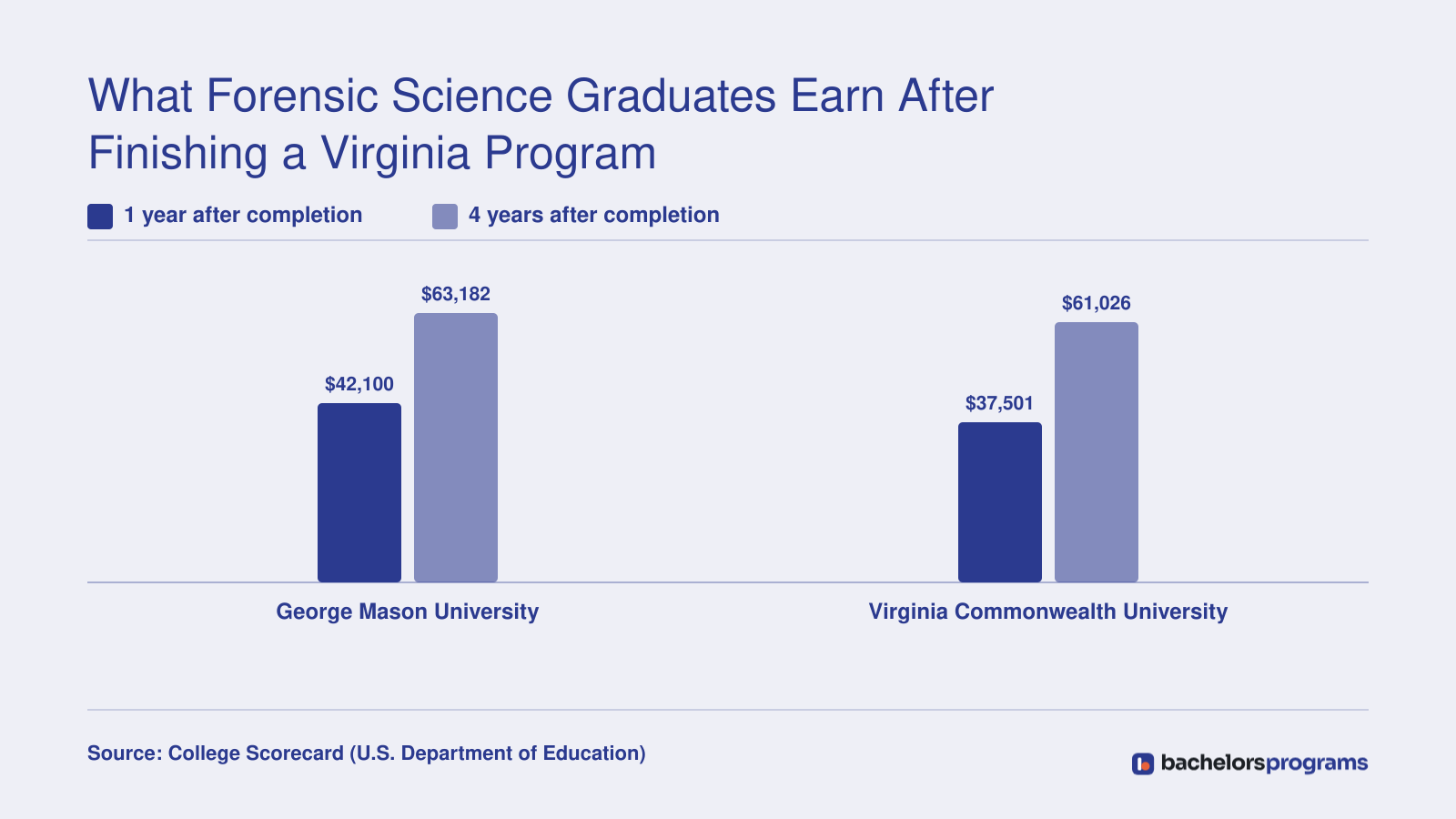
What Forensic Science Graduates Earn After Finishing a Virginia Program
Federal program-level data tracks earnings for forensic science bachelor's graduates of George Mason University and Virginia Commonwealth University. One year after completing the degree, George Mason graduates earn a median of $42,100 and VCU graduates earn $37,501. Four years out, those medians rise to $63,182 at George Mason and $61,026 at VCU. Earnings for forensic science graduates of Hampton, Liberty, Bluefield and Virginia State are not reported at the program level, so those schools are left off the chart rather than represented by campus-wide figures.
How Much Forensic Science Technicians Earn in Virginia
Forensic science technicians in Virginia earn a median of $68,900 a year, or $33.12 an hour, according to the Bureau of Labor Statistics.
Common Questions About Forensic Science Bachelor's Programs in Virginia
These answers cover the questions Virginia students ask most about earning a bachelor's degree in forensic science, from delivery format to accreditation, licensure, and transfer.
Can you earn a bachelor's degree in forensic science online in Virginia?
Which Virginia forensic science programs are FEPAC-accredited?
Do you need a license to work as a forensic scientist in Virginia?
Can I start at a community college and transfer into a forensic science bachelor's program?
Compare Forensic Science programs on the data that matters
Explore more Criminal Justice & Law majors or browse every field of study.
All Criminal Justice & Law programs Browse every field of study