Best Online Forensic Science Degree Programs
Compare 20 accredited online Forensic Science programs, with net price after aid, graduation rates, earnings and debt from IPEDS and the U.S. College Scorecard.

Yes, a forensic science bachelor's degree can be completed online, but only if you choose carefully. Schools award it as a Bachelor of Science (B.S.) or Bachelor of Arts (B.A.) in Forensic Science, and the programs ranked here are fully online, with no hybrid attendance or graduate study in the mix.
The trap is the label. Some online forensic degrees are lab-science programs built on chemistry and biology; others are criminal justice degrees with a forensics concentration. The first can lead to a crime lab bench, the second usually does not.
The science track is the one those wages reward: forensic technicians earned a national median of $72,060 in May 2025.
Key Points
- Online labs use home kits, virtual simulations, or brief in-person sessions.
- Net price: $9,597 at American Public University System, $21,293 at Saint Leo.
- Forensic science technicians earned a $72,060 median salary in May 2025.
Top 10 Fully Online Forensic Science Bachelor's Programs for 2027
Every program on this list can be completed entirely online, with no hybrid or in-person attendance required to enroll. The ten schools are ordered by a mixed composite of student outcomes, affordability and completion rather than by any single metric. Each entry notes the award and concentration a student would actually enroll in, so you can compare like with like.
Florida State University
#1Tallahassee, FL · ~$11,000/yr (est.)
Best for: Crime scene investigation career changers
Florida State University is a large public research university whose forensic offering sits inside its Public Safety and Security program rather than a standalone science department. The crime scene investigation track pairs evidence collection and analysis with 160 hours of certified International Association for Identification training, and students can add a certificate in underwater crime scene investigation. Coursework is available fully online, and graduates move into crime scene investigator, autopsy technician, death investigator and crime laboratory roles.
- 160 hours of IAI certified training built into the curriculum
- Certificate option in underwater crime scene investigation
- Coursework available fully online or in person
- Careers include crime scene investigator and autopsy technician
- Lab courses build familiarity with forensic technology
- Housed in the Public Safety and Security program
American Public University System
#2Charles Town, WV · $5,000 – $10,000/yr (est.)
Best for: Working adults drawn to digital forensics
American Public University System serves a heavily online and military-connected student body, and its forensic option reflects that practical, working-adult orientation. Forensic study here is a digital forensics concentration inside the criminal justice bachelor's, so the focus falls on computers, networks and electronic evidence rather than biology or chemistry benchwork. Instructors include people who hold key positions in government agencies and criminal justice organizations, and a large elective block leaves room for transfer credit.
- 120 semester hours, including 30 hours of open electives
- 27 semester hours in the digital forensics concentration
- Capstone in digital forensics required
- Coursework in computer forensics, cybercrime and wireless investigations
- Covers legal and ethical issues in forensics
- Instructors hold senior posts in government and justice agencies
- Training in handling digital evidence for judicial proceedings
Arizona State University
#3Scottsdale, AZ
Best for: Lab-science learners wanting a research track
Arizona State University offers the closest thing on this list to a full lab-science forensic major, with coursework built on biology and chemistry rather than criminal justice. Students move through general biology, genetics and biochemistry before training in crime scene collection, evidence analysis and mock courtroom testimony. A required culminating experience can be faculty-mentored research in biology, entomology or anthropology, or an internship at a crime laboratory. The program is accredited by the Higher Learning Commission and is designed to lead toward graduate study, medical school or law school as well as lab employment.
- 120 credit hours, including a required culminating experience
- Built on biology and chemistry rather than criminal justice
- Research options in biology, entomology or anthropology
- Internships sponsored by crime labs nationwide
- Training in mock courtroom testimony
- Fingerprint and polygraph background check required
- Accredited by the Higher Learning Commission
Saint Leo University
#4Saint Leo, FL · ~$21,000/yr (est.)
Saint Leo University runs a criminal justice bachelor's whose criminalistics specialization treats forensics as the study of physical evidence. Students learn to recognize, collect, identify and compare evidence and to reconstruct events from a crime scene, with fingerprint work in a forensics lab and a courtroom testimony role-play. Field placement opens doors to internships with agencies such as the U.S. Secret Service and the Florida Department of Law Enforcement, and a Homeland Security specialization sits alongside the forensics track for students who want a second direction.
- 120 credit hours, roughly four years of study
- Criminalistics specialization with a Homeland Security alternative
- Evidence recognition, collection, comparison and scene reconstruction
- Fingerprint examination in the forensics lab
- Courtroom testimony role-play assignment
- Internships with the U.S. Secret Service and Florida Department of Law Enforcement
- Eight-week terms with six start dates a year
Wilmington University
#5New Castle, DE · ~$16,000/yr (est.)
Wilmington University structures its forensic pathway as a completion degree, aimed at students who already hold an associate degree and want a science-heavy finish. The biology major carries a compact forensic science concentration with forensic biology and scientific CSI labs, plus a science co-op and senior seminar. It is the most transfer-friendly science route on this list, well suited to students arriving with two years of college credit who need laboratory credentials rather than a criminal justice degree.
- Completion degree for students who already hold an associate degree
- 120 credits with a 17-credit forensic science concentration
- Forensic biology and scientific CSI labs included
- No ecology course required in the science core
- Science co-op and senior seminar required
- Prerequisite science and criminal justice courses apply
Rosemont College
#6Rosemont, PA · ~$20,000/yr (est.)
Rosemont College delivers its criminal justice bachelor's through an online professional studies format built around accelerated seven-week terms. Students choose a 15-credit forensics concentration from seven course options, or spread coursework across forensics, homeland security, law enforcement and social services. Transfer and prior-learning policies are unusually generous for working adults, who can bring in up to 90 credits and challenge courses they can already demonstrate.
- 120 credits across 40 courses, 30 in the major
- 15-credit forensics concentration drawn from seven courses
- Options in forensics, homeland security, law enforcement and social services
- 3.0 cumulative GPA required to complete a concentration
- Accelerated seven-week semesters
- Transfer up to 90 credits; challenge up to 15 courses
- At least 30 credits must be taken in residence
- Mock crime scene simulations in concentration coursework
Lindenwood University
#7Saint Charles, MO · ~$20,000/yr (est.)
Lindenwood University, founded in 1827, lists its forensic offering as a chemistry bachelor's with a forensics emphasis rather than a criminal justice degree. That makes it the pick here for students who want the science side of evidence analysis, with course topics spanning forensic science, criminal law, criminological theory and the court system. Because credit totals and admission requirements vary across the university's criminal justice lineup, prospective students are directed to enrollment counselors for specifics on the chemistry track.
- Chemistry bachelor's with a forensics emphasis
- Course topics include forensic science, criminal law and criminological theory
- One of four bachelor's options in the criminal justice lineup
- Credit totals and admission requirements vary by track
- University founded in 1827
Columbia College
#8Columbia, SC · ~$18,000/yr (est.)
Columbia College pairs a forensic criminal justice major with a dedicated forensics concentration covering toxicology, DNA and fingerprint comparison. Concentration coursework runs through forensic toxicology, forensic DNA, FBI fingerprint recognition and comparison, and crime scene investigation, supported by labs in forensic DNA and crime scene work. Online terms run seven weeks with six start dates a year and no scheduled login times, and up to 90 transfer credits are accepted, including 24 hours of law enforcement training.
- Concentration covers forensic toxicology, DNA and fingerprint comparison
- Labs in forensic DNA and crime scene investigation
- Seven-week online terms with six start dates a year
- No scheduled online login times
- Transfer up to 90 credits, including 24 training hours
- Free e-books for online students
Colorado Technical University-Colorado Springs
#9Colorado Springs, CO · ~$17,000/yr (est.)
Colorado Technical University's forensic track is a large criminal justice degree with a 60-credit forensic investigation concentration layered on top. Courses run five weeks at a time with frequent start dates, and the concentration covers criminalistics, advanced crime scene forensics, forensic photography, death investigation and recovery of human remains. Lab and practicum exercises in crime scene work and criminal profiling feed into a capstone, and the university is explicit that the degree does not lead to additional licensure or certification.
- 182 credit hours: 66 general education, 56 core, 60 concentration
- Five-week courses with frequent start dates
- Criminalistics, advanced crime scene forensics and forensic photography
- Medicolegal death investigation and human remains recovery
- Lab and practicum exercises plus a criminal justice capstone
- Military benefits and employer tuition reimbursement accepted
- Does not lead to additional licensure or certification
American InterContinental University-Atlanta
#10Atlanta, GA · ~$16,000/yr (est.)
American InterContinental University offers a criminal justice bachelor's with a forensic science specialization in a flexible, career-focused format. The degree runs 180 credits across five-week courses with no SAT or ACT requirement, and students can transfer up to 75% of the credits they already hold, including credit for military service or work experience. Criminalistics I and II, criminal investigation and medicolegal death investigation anchor the specialization, and active-duty undergraduates receive a substantial tuition reduction.
- 180 credit hours structured as a 48-month program
- Five-week courses; next start December 9, 2026
- Criminalistics I and II, criminal investigation and death investigation
- Senior capstone in criminal justice required
- No SAT or ACT score required
- Transfer up to 75% of qualifying credits
- 45% tuition reduction for active-duty undergraduates
- Lab exercises in criminalistics
Cost & outcomes by school
Federal data for the highest-earning Forensic Science programs, independent of the ranking above. Earnings are this field's bachelor's graduates four years after completing where the Scorecard reports them, else the school's undergraduate median.
| School | Net price / yr | Grad rate | Earnings | Debt | Grads/yr | Format |
|---|---|---|---|---|---|---|
| Florida State University FL | $11,297 | 86% | $93,841 | $18,750 | 45 | Online or campus |
| Arizona State University AZ | $14,967 | 68% | $62,668 | $19,500 | — | Hybrid |
| American Public University System WV | $9,597 | 57% | $57,237 | $32,062 | 46 | Online |
Sources: U.S. Department of Education. Net price, graduation rate, earnings and debt: College Scorecard (earnings and debt for this field's bachelor's graduates where reported, else school-wide); graduates: IPEDS. A dash means no figure is reported.
Cost, debt & payoff
Median earnings of this field's bachelor's graduates (4 yrs after completing, else the school's undergraduate median) vs. their median federal loan debt · U.S. College Scorecard
Across these programs the median graduate earns about $51,836 and finishes with roughly $23,750 in debt — a ratio that clears a common rule of thumb (keep debt below first-year salary). Net price and debt vary widely school to school, so check the per-school figures in the table above before you shortlist.
How We Ranked These Online Forensic Science Programs
A fully online forensic science degree lets you keep your job, your schedule, and your address. The tension is that forensic science is a laboratory discipline, so the schools considered here had to show a full bachelor's degree could genuinely be completed at a distance.
The Online-Only Filter
Only bachelor's programs that can be delivered entirely online were eligible. Hybrid programs, which require periodic campus visits for lab work, were set aside. That keeps the list honest about what "online" means for a subject built on bench work and crime scene practice.
The Inputs
Each program was weighed on average net price after aid, institution-wide graduation and retention rates, and, where federal data published it, program-level earnings and debt for graduates.
Where the Data Runs Thin
Graduation rates describe the whole institution, not the forensic major. Net price is an average across students, and small forensic cohorts often have no published earnings figures at all. The ranking also says nothing about how labs are delivered, whether a program holds forensic accreditation, or what the curriculum actually covers. Those questions get separate answers.
What a Bachelor's Degree in Forensic Science Online Involves
How much chemistry and biology should an online forensic science bachelor's degree actually require? The answer depends on the job: the first thing to sort out is the difference between a lab science degree and a criminal justice degree with a forensics label.
The Lab-Science Track
A Bachelor of Science in forensic science is built like a natural science degree. Expect general and organic chemistry, biology, genetics, physics, calculus or statistics, and upper-level lab courses. That coursework is what prepares graduates for laboratory analyst roles in DNA, toxicology, seized-drug analysis, and trace evidence, where the work is instrumental analysis and report writing, not patrol work.
Where Criminal Justice Forensics Fits
A criminal justice degree with a forensics concentration covers crime scene processing, evidence handling, investigation, and legal procedure. It can suit evidence technician, crime scene, or legal-support paths. It usually does not meet the science credit requirements for analyst jobs, because those postings count chemistry and biology hours, not criminal justice hours.
What Crime Labs Ask For
- Chemistry hours: Florida Department of Law Enforcement posts list 25 semester hours of chemistry for seized-drug analysis and 15 for toxicology and trace materials.
- Biology and DNA: DNA posts require a bachelor's in biology, chemistry, or forensic science plus coursework in genetics, molecular biology, biochemistry, and statistics.1 Texas rules implementing the 2025 FBI standards describe 9 semester credit hours of biology- or chemistry-related coursework for DNA foundations.2 One U.S. crime lab qualification lists 12 semester hours in biology or chemistry plus 12 additional science hours.3
- Documentation: Employers may ask for transcripts and course syllabi.1 There is no single nationwide credit-hour rule; requirements vary by discipline and lab.
- Online coursework: No nationwide ban on online degrees, but an entirely online program without documented in-person lab work may fail screening. Supervised lab courses, listed on the transcript, are the safer choice. ABC certification can strengthen an application, but it does not replace the degree, and its exams are in person.4
Check the Credit Requirements First
Before you enroll, compare the program's required chemistry and biology credits with the jobs you want. A degree that requires one survey chemistry course will not meet a 25-credit-hour seized-drug standard. Ask where lab courses meet, whether they appear on the transcript, and whether the program will provide syllabi for employers.
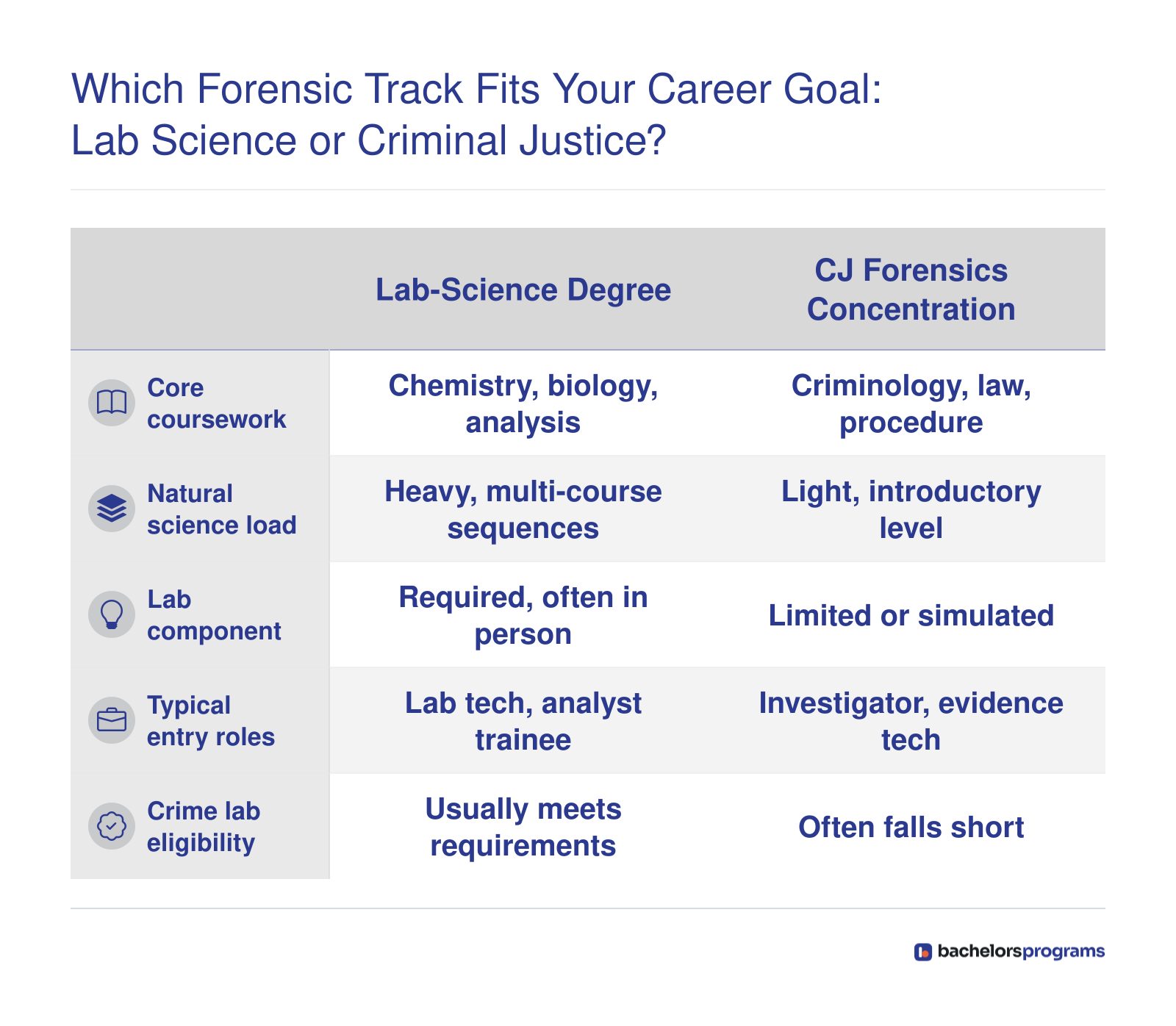
Which Forensic Track Fits Your Career Goal: Lab Science or Criminal Justice?
Online forensic programs usually fall into two tracks: a science-heavy bachelor's degree in forensic science, or a criminal justice degree with a forensics concentration. Choose the lab-science track if you want to analyze evidence in a crime lab, because analyst jobs generally require substantial chemistry and biology coursework with lab work. Choose the criminal justice concentration if you are aiming for investigative, evidence-handling or law enforcement roles.
Lab Requirements and Hands-on Training in Fully Online Programs
Yes, many online forensic science degrees include lab work, but how it is delivered differs from school to school, and no single national practice exists. The common models are at-home lab kits, virtual simulations, transferred lab-science credits, short in-person sessions and optional internships. A 2026 sector overview describes all of these as being in use across online programs, though that does not mean any one school uses every method.
How Real Programs Handle Labs
Arizona State University is a useful example of a lab-heavy online route. Its online Forensic Science (Death Investigations) program requires two in-person sessions in Arizona: practical organic chemistry and biochemistry work at the Tempe campus, and a five-day culminating forensic experience at the West campus. The program page does not say these sessions can be replaced by a home kit or transferred credit. ASU's general online forensic science page does not describe kits or virtual labs at all, so confirm the lab format before assuming it is fully remote.
Some schools lean on facilities rather than remote labs. The University of Findlay's forensic biology program is offered on campus, online or hybrid, and advertises a Crime Scene House and a forensic science laboratory. Its pages do not establish whether online students can use them.
Internships and Practicums
Internships are documented more consistently than kits or virtual labs, and they are usually optional or one of several capstone choices.
- ASU: Faculty-mentored research and internships at crime laboratories and medicolegal offices are options, and the general forensic science major includes a culminating experience.
- Bluefield University: Its internship has placement support, with settings such as NCIS, local police departments and forensic laboratories.
- Lasell University: Its internship requires at least 150 hours of supervised work in settings such as crime labs, biotech companies, hospitals and police departments.
- Findlay: Internships can be local, state, national or private sector.
Online students often have to arrange a placement near home, so start talking to local labs and agencies early.
Set Realistic Expectations
Virtual labs teach concepts, instrument logic and documentation habits. They rarely replace the supervised bench time that crime laboratories look for in chemistry, biology and DNA analysis roles. If you are aiming for a lab-based technician job, plan to add in-person chemistry or biology lab credits, for example at a community college, and ask each program whether transferred lab credits can satisfy its requirements. Digital forensics and crime scene tracks lean less on wet-lab experience, so they carry less of this risk.
Related Articles
Online Forensic Science Degree Cost: Net Price at the Cheapest Ranked Schools
Average annual net price at the schools ranked here runs from $9,597 at American Public University System to $21,293 at Saint Leo University. Net price is an institution-wide average after grants and scholarships, so it can differ sharply from published tuition: Florida State University lists $5,656 in-state versus $18,786 out-of-state, and where program-level debt is reported, median borrowing ranges from $18,750 (about $199 a month over 10 years) at Florida State to $32,062 (about $340 a month) at American Public University System. Net price also leaves out add-on charges such as online technology fees (Norwich University lists $150 part-time and $725 full-time per term for 2026-27), distance learning fees ($22 per credit at University of Cincinnati Online in 2025-26) and science lab course fees of $10 to $40, so check each school's bursar page alongside per-credit rates that typically run $250 to $600.
| School | Average Annual Net Price | Published In-State Tuition and Fees | Published Out-of-State Tuition and Fees | Program Median Debt | Est. Monthly Payment (10 Years) |
|---|---|---|---|---|---|
| American Public University System | $9,597 | $8,400 | $8,400 | $32,062 | $340 |
| Florida State University | $11,297 | $5,656 | $18,786 | $18,750 | $199 |
| Wilmington University | $15,644 | $12,630 | $12,630 | N/A | N/A |
| American InterContinental University-Atlanta | $16,482 | $13,527 | $13,527 | N/A | N/A |
| Colorado Technical University-Colorado Springs | $16,745 | $12,750 | $12,750 | N/A | N/A |
| Columbia College (SC) | $18,408 | $22,214 | $22,214 | N/A | N/A |
| Lindenwood University | $19,638 | $21,600 | $21,600 | N/A | N/A |
| Rosemont College | $20,150 | $23,845 | $23,845 | N/A | N/A |
| American InterContinental University-Houston | $20,249 | $14,829 | $14,829 | N/A | N/A |
| Saint Leo University | $21,293 | $30,000 | $30,000 | N/A | N/A |
Are Online Forensic Science Degrees Accredited? FEPAC and Regional Accreditation Explained
Two separate accreditations decide whether an online forensic science degree is worth your money, and only one of them is non-negotiable.
Institutional Accreditation Comes First
Every legitimate online forensic science degree rests on institutional accreditation: a regional accreditor recognized by the U.S. Department of Education and the Council for Higher Education Accreditation. That status makes federal financial aid available, earns recognition from transfer credit and graduate admissions offices, and is what employers verify when they check a degree. FEPAC's own eligibility rules also require the institution to be regionally accredited before a forensic program can even apply.2
What FEPAC Adds
FEPAC, the Forensic Science Education Programs Accreditation Commission of the American Academy of Forensic Sciences, accredits programs rather than institutions. Its 2026 undergraduate standards begin at Standard 4.0 and set separate expectations for criminalistics, biology, chemistry, digital evidence, and crime scene investigation, covering both the natural science coursework and the laboratory experience behind it.2
Distance learning is an acceptable delivery method, and FEPAC keeps no separate standards for online programs.3 But any program teaching through distance learning must still provide appropriate on-site, in-person, hands-on laboratory work. That requirement is why FEPAC and AAFS materials do not identify a fully online bachelor's forensic science program as accredited.1 A program whose labs are entirely virtual, or merely optional, sits outside the standard.
Why It Matters in Hiring
Public crime laboratories, and many private ones, prefer or require graduates of FEPAC-accredited programs when hiring forensic scientists and examiners. Institutional accreditation alone is enough for adjacent roles: criminal justice, law enforcement, insurance investigation, or cybercrime work that asks for a forensic-related bachelor's without requiring accredited laboratory analysis.
Verify Before You Apply
Two checks, ten minutes each:
- Open the FEPAC accredited programs directory and confirm the exact program name and degree level appear there, not just the university.
- On the institution's site, confirm which accreditor holds it, then look that accreditor up in the Department of Education's database.
Finally, ask admissions in writing where required laboratory sessions are held and whether they are mandatory or optional. A program that requires a campus lab visit can still be marketed as online.
Transfer Credits and State Authorization: What to Verify Before You Enroll
Before you commit to an online forensic science degree, get written answers to these questions from the admissions or transfer office. Policies vary widely from school to school.
- State authorization and SARA participationConfirm the school can legally enroll online students where you live. Most schools do this through SARA, which 49 states have joined. Participation is voluntary for both states and colleges, so check that your state and your school are both members.
- Transfer credit limits and residency rulesAsk how many credits count toward the 120 typically required and how many you must complete at the school. Caps differ. North Carolina Central University accepts up to 64 semester hours from two-year colleges and requires a 30-hour residency. Confirm how community college chemistry and biology credits will apply.
- Prior lab courseworkAsk whether lab science courses you have already completed can satisfy the program's lab requirements or whether you must retake them.
- Accreditation and FEPAC statusVerify institutional accreditation from an accreditor recognized by the U.S. Department of Education. Then ask directly whether the forensic science program itself holds FEPAC accreditation.
- Proctored exams and internship placementFind out whether any exams must be proctored and whether out-of-state students face limits on internship or field placements in their home state.
Median Pay for Forensic Science Technicians
Forensic science technicians earned a national median of $72,060 a year, or $34.65 an hour, in May 2025.
Forensic Science Degree Salary and Career Outcomes
What forensic science technicians earn nationally
The Bureau of Labor Statistics puts the median annual wage for forensic science technicians at $72,060 as of May 2025, or $34.65 an hour, with a mean of $79,2001. The spread matters more than the midpoint: the lowest-paid tenth earned less than $48,250 a year, while the top tenth cleared $117,250. Employer type explains much of that gap. Technicians in state government (excluding education and hospitals) had a median of $74,740, those in local government $70,050, and those in testing laboratories and services $49,600. The occupation is also small, with about 20,100 jobs nationwide, so competition for crime lab openings is real.
What graduates of these programs actually report
Federal earnings data for forensic science graduates is reported by program, and the numbers diverge sharply by school. Florida State University's forensic science bachelor's completers reported median earnings of $93,841 four years after finishing. Graduates of American Public University System's program reported a median of $49,622 one year after finishing, rising to $52,779 five years out. Saint Leo University's criminalistics completers reported $45,724 five years after finishing. Keep these program figures separate from occupational wages and from any institution-wide earnings number, which reflects every major a school offers rather than its forensic science graduates.
Weigh the debt against the payoff
Earnings only mean something next to what you borrowed. Florida State forensic science completers carried a median program debt of $18,750, against those $93,841 four-year earnings. American Public University graduates carried a median of $32,062, a heavier load against lower reported pay. Run that comparison for any program you are considering before you commit.
Plan for an adjacent first job
Because crime lab hiring is limited and often requires a background investigation, polygraph, or state certification, many graduates start somewhere nearby: evidence or property technician, laboratory technician in a private testing facility, quality control analyst, insurance or corporate investigator, or a sworn law enforcement role that feeds into crime scene work. Those positions build the chain-of-custody and instrumentation experience crime labs look for, and several of the schools here build internships or co-op placements into the degree.
Forensic Science programs by state
Compare Forensic Science programs on the data that matters
Explore more Criminal Justice & Law majors or browse every field of study.
All Criminal Justice & Law programs Browse every field of study