Best Early Childhood Education Schools in Arkansas
Compare 6 accredited Early Childhood Education programs in Arkansas, with net price after aid, graduation rates, earnings and debt from IPEDS and the U.S. College Scorecard.

Arkansas's Early Childhood (PK) license runs through a state-approved preparation program and the Praxis 5533 exam. A degree that skips licensure can cost less but narrows where a graduate can teach. That tradeoff, licensure against cost and geography, shapes most decisions here.
Arkansas early childhood degrees come in two shapes: the licensure track, typically a Bachelor of Science (B.S.) in Early Childhood Education, and non-licensure child development programs built for Head Start, private centers and home visiting. The schools ranked here are Arkansas-based, campus and online.
Preschool wages in Arkansas tend to follow whichever route a teacher took.
Key Points
- University of Arkansas-Fort Smith posts the lowest in-state tuition and net price.
- Southern Arkansas University graduates earn $40,746 after borrowing a median $17,122.
- To earn an Arkansas PK license, candidates must pass Praxis test 5533.
Best Early Childhood Education Schools in Arkansas: Ranked Bachelor's Programs
These six Arkansas schools make up every bachelor's program in early childhood education or child development in our data, across campus, hybrid and online formats. Each card gives the school's delivery format, net price, graduation rate, Pell share and admissions profile, with program details and earnings where the data carries them.
University of Arkansas
#1Fayetteville, AR · ~$18,000/yr (est.)
Best for: Aspiring Birth-K public school teachers
The state's flagship campus awards a 120-credit Early Childhood Education Licensure B.S.E. that leads to initial licensure for Birth through Second Grade. Admission is staged and competitive: 61 prerequisite hours, a background check, two faculty recommendations and a target 3.0 GPA, followed by Praxis exams and a teaching audition. Seniors spend the year in Residency I and Advanced Residency II in local public preschools and elementary schools, with field placements at the Jean Tyson Child Development Study Center. The program sits in the College of Education and Health Professions.
- 120-credit bachelor's leading to Birth through Second Grade licensure
- Three-stage admission: 61 prerequisite hours, background check, January 31 deadline
- Target 3.0 GPA and two faculty letters of recommendation
- Praxis licensure exams plus a teaching audition required
- Residency I and Advanced Residency II: two semesters of student teaching
- Field experiences at the Jean Tyson Child Development Study Center
- Coursework in child development, play-based learning, inclusive practices
- Prepares for Birth-Kindergarten and Preschool-Second Grade licensure
Harding University
#2Searcy, AR · ~$22,000/yr (est.)
Best for: Faith-based child development degree seekers
Harding is a private Christian university in Searcy whose Department of Applied Human Sciences awards a Bachelor of Science in Child Development. Coursework covers physical, socio-emotional, cognitive and spiritual growth and applies evidence-based practice to work with children and families. Graduates move into early intervention and advocacy roles, and the degree also feeds graduate study in applied behavior analysis and pediatric occupational therapy. A child development minor is offered alongside the major.
- Bachelor of Science in Child Development, campus based
- Covers physical, socio-emotional, cognitive and spiritual growth
- Applies evidence-based practices with children and families
- Leads to early intervention and advocacy work
- Prepares for graduate study in applied behavior analysis
- Also opens pediatric occupational therapy graduate paths
- Child Development minor also available
Southern Arkansas University
#3Magnolia, AR · $10,000 – $15,000/yr (est.)
Best for: Hybrid learners pursuing early childhood licensure
SAU in Magnolia houses its early childhood preparation in the Teacher Education department within Education and Human Performance. The Elementary Education major with an early childhood concentration is a 120-credit program that leads to a single licensure certification in early childhood, pairing pedagogical and theoretical coursework with observational assessment. It runs in a hybrid format, so students can mix campus and online study rather than commit to one.
- 120-credit major with an early childhood concentration
- Single licensure certification in early childhood
- Hybrid delivery: on campus and fully online
- Combines pedagogical and theoretical content
- Observational assessment built into coursework
- Housed in the Teacher Education department
Arkansas Tech University
#4Russellville, AR · $10,000 – $15,000/yr (est.)
Arkansas Tech in Russellville delivers its child development coursework as an option inside the Bachelor of Arts in Organizational Leadership, a structure built for students who want a bachelor's credential with room for management-oriented study. Students can attend on the Russellville campus or take the option fully online. It suits early childhood staff already working in centers who want a degree that reaches beyond the classroom.
- Child Development option inside the Bachelor of Arts in Organizational Leadership
- Available fully online or at the Russellville campus
- Bachelor's-level credential with a leadership focus
University of Arkansas-Fort Smith
#5Fort Smith, AR · ~$11,000/yr (est.)
UA Fort Smith offers a Bachelor of Science in Early Childhood Education in a non-licensure track, taught online and built for preschool workers and P-4 teaching assistants. The 120-credit degree includes more than 30 hours of early childhood coursework aligned with NAEYC standards, and graduates step into lead teacher roles in Head Start and private centers. A separate route to a first-time Early Childhood Pre-K license runs through the Arkansas Early Childhood PreK Teacher Academy, and the T.E.A.C.H. scholarship can cover courses for working staff.
- 120 credits, more than 30 of them in early childhood coursework
- Non-licensure track delivered fully online
- Curriculum follows NAEYC standards
- Built for preschool workers and P-4 teaching assistants
- Trains lead teachers for Head Start and private centers
- Path to an Arkansas Early Childhood Pre-K license through the PreK Teacher Academy
- T.E.A.C.H. Early Childhood Scholarship can cover courses
- Related 60-credit AAS and 26-hour technical certificate offered
Henderson State University
#6Arkadelphia, AR · $8,000 – $11,000/yr (est.)
Henderson State in Arkadelphia awards the BSE through an integrated Early Childhood/Special Education major covering the Birth through Kindergarten age range. The design prepares one teacher for both general early childhood classrooms and special education settings, which matters in districts that blend the two. The major appears in the university's 2026-2027 degree plan index.
- Integrated early childhood and special education major
- Covers the Birth through Kindergarten age range
- Awards the BSE degree
- Listed in the 2026-2027 degree plan index
- Campus based in Arkadelphia
Cost & outcomes by school
Federal data for the highest-earning Early Childhood Education programs, independent of the ranking above. Earnings are this field's bachelor's graduates four years after completing where the Scorecard reports them, else the school's undergraduate median.
| School | Net price / yr | Grad rate | Earnings | Debt | Grads/yr | Format |
|---|---|---|---|---|---|---|
| University of Arkansas AR | $18,209 | 71% | $51,474 | $24,882 | 131 | Campus |
| University of Arkansas-Fort Smith AR | $10,574 | 38% | $44,197 | $19,652 | 55 | Online |
| Arkansas Tech University AR | $12,970 | 49% | $43,978 | $23,090 | 56 | Online or campus |
| Harding University AR | $22,130 | 69% | $41,228 | $26,687 | 59 | Campus |
| Southern Arkansas University AR | $14,027 | 49% | $40,843 | $17,122 | 86 | Online or campus |
| Henderson State University AR | $23,405 | 37% | $40,226 | $24,978 | 38 | Campus |
Sources: U.S. Department of Education. Net price, graduation rate, earnings and debt: College Scorecard (earnings and debt for this field's bachelor's graduates where reported, else school-wide); graduates: IPEDS. A dash means no figure is reported.
Cost, debt & payoff
Median earnings of this field's bachelor's graduates (4 yrs after completing, else the school's undergraduate median) vs. their median federal loan debt · U.S. College Scorecard
Across these programs the median graduate earns about $42,603 and finishes with roughly $23,986 in debt — a ratio that clears a common rule of thumb (keep debt below first-year salary). Net price and debt vary widely school to school, so check the per-school figures in the table above before you shortlist.
How We Ranked Arkansas Bachelor's Programs in Early Childhood Education
The order of the schools here rests on federal College Scorecard data. Five measures carry the most weight: what students actually pay after grants and scholarships, how many students finish, what graduates earn, how much they borrow, and what share of students receive Pell Grants. Together they show whether a school is affordable, whether students tend to complete, and whether the debt is manageable against pay.
What the Numbers Can and Cannot Tell You
Net price and graduation rate are institution-wide averages. They describe the whole university, not the early childhood education program alone. A school's rate may be higher or lower for students in this major, and a given student's net price depends on aid, residency, and enrollment. Treat these figures as a guide to the school, not a promise about one degree.
Most catalog-style pages skip that caveat. Many lists present school-wide figures as if they described a single major. We would rather mark the limit than blur it.
Where Other Information Comes From
Scorecard does not cover admissions rules or licensure pass rates. GPA expectations, test policies, and transfer credit come from each school's own admissions pages. Licensure requirements and exam results come from the state and the schools themselves. Those sections say so when a school publishes no policy.
What a Bachelor's Degree in Early Childhood Education Covers in Arkansas
Arkansas early childhood licensure covers birth through kindergarten or pre-K through grade 2, depending on the program. That age band is the single biggest thing students get wrong when choosing a major. Elementary education typically runs through grade 4 or grade 6 and prepares you for a different classroom entirely. If you want to teach infants, toddlers, preschoolers, or the earliest primary grades, early childhood is the right track. The University of Arkansas offers an Early Childhood Education Licensure B.S.E., while Henderson State University runs an integrated Early Childhood/Special Education degree for the birth-to-kindergarten range. Southern Arkansas University's teaching degree is housed in elementary education, so read the age band before you apply.
Core Coursework Themes
Four themes recur across Arkansas early childhood programs:
- Child development: cognitive, physical, social, and emotional growth from infancy forward.
- Early literacy and language: phonics, emergent reading, and the science of reading emphasis now standard in Arkansas teacher preparation.
- Family and community engagement: working with parents and caregivers as partners.
- Assessment: observing young children, documenting progress, and using developmentally appropriate screening.
Non-licensure and child development degrees, such as those at Harding University, the University of Arkansas-Fort Smith, and Arkansas Tech University, share much of this content but point toward program administration, Head Start, and community-based roles rather than a public school classroom.
Field Placements and Special Education Pathways
Licensure programs place you in classrooms early, with observation hours building toward a full-semester student-teaching residency in your final year. Requirements vary, so check each school's catalog for placement sequence and timing. Several Arkansas programs pair early childhood with special education, which widens your eligibility for jobs in inclusive and birth-to-three settings.
Online and Hybrid Bachelor's Options at Arkansas Schools
Online delivery has moved the hardest question in Arkansas early childhood programs from coursework to fieldwork: whether a student who lives far from campus can complete the required classroom hours close to home.
Which Schools List an Online Route
Southern Arkansas University and Arkansas Tech University list both campus and online options, and Arkansas Tech's distance route is the Organizational Leadership - Child Development Option. The University of Arkansas-Fort Smith lists its B.S. in Early Childhood Education as fully online, in a 2026-2027 non-licensure version built for preschool teachers, aides and Head Start staff. The University of Arkansas, Harding University and Henderson State University list campus-based programs.
How Placement Works for Distance Students
The University of Arkansas is the most explicit: field experiences run at the Jean Tyson Child Development Study Center and in public Pre-K-2 classrooms, and student teaching is a two-semester residency in a local public preschool or elementary school, with seniors attending full time. Its catalog does not describe an out-of-area placement option. UAFS's 2026-2027 transfer agreement lists an advanced field experience and a practicum among the remaining requirements but leaves open where those take place and who arranges them.1 Southern Arkansas and Arkansas Tech publish no out-of-area arrangement. Ask each program in writing who finds the site and whether a local residency applies.
Best Fit Outside Northwest and Central Arkansas
Students in south Arkansas are closest to Southern Arkansas University in Magnolia; those in the Arkansas River Valley are closest to Arkansas Tech in Russellville and UAFS in Fort Smith. Online coursework at those three cuts down on trips to campus, but you still need a local site for the field hours.
Related Articles
Admission Requirements: GPA, Test Policy, and Transfer Credit
The University of Arkansas closes its early childhood licensure application on January 31, and it reviews candidates in three stages layered on top of general university admission. Meeting the minimums does not guarantee a seat.
Where the admit rates sit
Published acceptance rates give a rough read on selectivity. Arkansas Tech University admits about 96 percent of applicants and the University of Arkansas-Fort Smith about 80 percent. Southern Arkansas University (75 percent) and the University of Arkansas (74 percent) cluster closely, and Harding University is the tightest of the schools ranked here at roughly 71 percent.
A high admit rate describes the university, not the teacher-education program. At most Arkansas schools the early childhood program runs its own gate around the junior year, with separate GPA rules, an application, and a background check.1
The University of Arkansas gate
- GPA: aim for 3.0. The university lists 3.0 as its minimum GPA and also as the recommended GPA, so in a competitive pool treat it as a floor, not a cushion.
- Tests: ACT, SAT, or Praxis Core is accepted, with no separate score cutoff published.
- Application: the teacher-education application plus transcripts, submitted through the college's support page, with two letters of recommendation.
- Background check: required before you enter the program, so start it early.
Transferring an associate degree
The Arkansas Course Transfer System guarantees that listed general-education courses move between the state's public colleges, so composition, math, and social-science credits usually carry over. Applied degrees are the risky part. An Associate of Applied Science in early childhood is built for child-care and instructional-assistant work, and its technical courses often land as electives rather than junior-level early childhood credit. The University of Arkansas-Fort Smith offers a related 60-credit AAS alongside a bachelor's that is itself non-licensure, so ask exactly how those hours apply.
Before you enroll, get three answers in writing:
- Which credits count toward the Arkansas teaching license, not just the degree?
- Does this specific bachelor's track lead to licensure?
- Is there a named 2+2 agreement between my community college and this program?
Cost of an Early Childhood Education Degree in Arkansas
University of Arkansas-Fort Smith has the lowest in-state tuition and the lowest estimated net price among the schools ranked here, and Southern Arkansas University graduates carry the smallest median program debt. Net price is a federal average for students who receive aid, so treat it as an estimate rather than your bill. On aid, the Arkansas Academic Challenge Scholarship generally requires 12 months of state residency, an ACT score of 19 or an equivalent on the traditional route, a 2.5 cumulative GPA, and 27 credit hours in the first year and 30 in each later year. The Arkansas Future Grant funds only associate and certificate programs in STEM and high-demand fields, which matters if you start at that level and transfer into a bachelor's degree later. Education majors should also look at the Minority Teacher Scholars Program, which is open to African-American, Hispanic, Asian-American and Native American students with 60 credits, a 2.5 GPA and admission to a teacher certification program. That award is forgiven at 20 percent for each year of full-time teaching in Arkansas public schools and in full after five years. Award amounts for these programs, and the current role of the Educational Excellence Trust Fund, are best confirmed with the Arkansas Division of Higher Education.
| School | Sector | In-State Tuition and Fees | Estimated Net Price After Aid | Median Program Debt | Est. Monthly Loan Payment (10-Year) |
|---|---|---|---|---|---|
| University of Arkansas-Fort Smith | Public | $7,334 | $10,574 | $19,652 | $208 |
| Arkansas Tech University | Public | $8,674 | $12,970 | $23,090 | $245 |
| Southern Arkansas University | Public | $9,960 | $14,027 | $17,122 | $182 |
| University of Arkansas | Public | $10,104 | $18,209 | $24,882 | $264 |
| Harding University | Private | $26,262 | $22,130 | $26,687 | $283 |
| Henderson State University | Public | $8,244 | $23,405 | $24,978 | $265 |
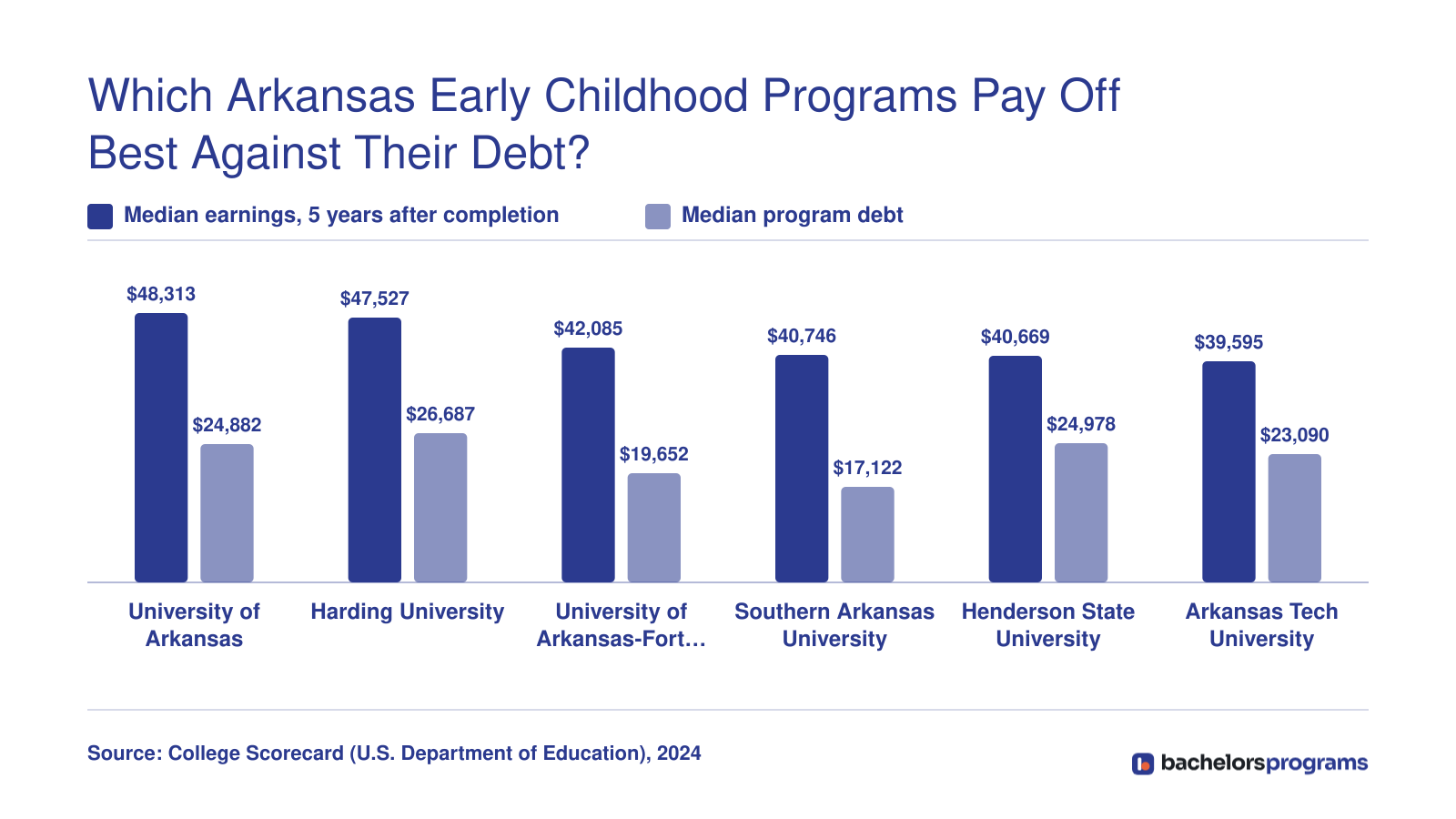
Which Arkansas Early Childhood Programs Pay Off Best Against Their Debt?
The chart compares median earnings five years after completion with median program debt for each school's early childhood or child development bachelor's program. Southern Arkansas University ($40,746 earned, $17,122 borrowed) and University of Arkansas-Fort Smith ($42,085 earned, $19,652 borrowed) show the best earnings-to-debt balance. The University of Arkansas reports the highest earnings, $48,313, against $24,882 in debt. At every school shown, five-year earnings are more than 1.5 times median debt.
Arkansas Early Childhood Licensure at a Glance
What Arkansas Preschool Teachers Earn
Preschool pay sits well below kindergarten pay, so whether your bachelor's program leads to licensure shapes your earning range.
Arkansas Early Childhood Education Degree: Common Questions
These answers draw on the rest of this page and on Arkansas licensure rules. Confirm current requirements, fees, and transfer policies with each school and the Arkansas Department of Education before you apply.
What is the best school for early childhood education in Arkansas?
How much does an early childhood education degree cost in Arkansas?
Can I get a bachelor's degree in early childhood education online in Arkansas?
How do I become a licensed early childhood teacher in Arkansas?
Can I transfer an associate degree in early childhood education to a bachelor's program in Arkansas?
Compare Early Childhood Education programs on the data that matters
Explore more Education & Teaching majors or browse every field of study.
All Education & Teaching programs Browse every field of study