Best Early Childhood Education Schools in New York
Compare 25 accredited Early Childhood Education programs in New York at 24 colleges, with net price after aid, graduation rates, earnings and debt from IPEDS and the U.S. College Scorecard.
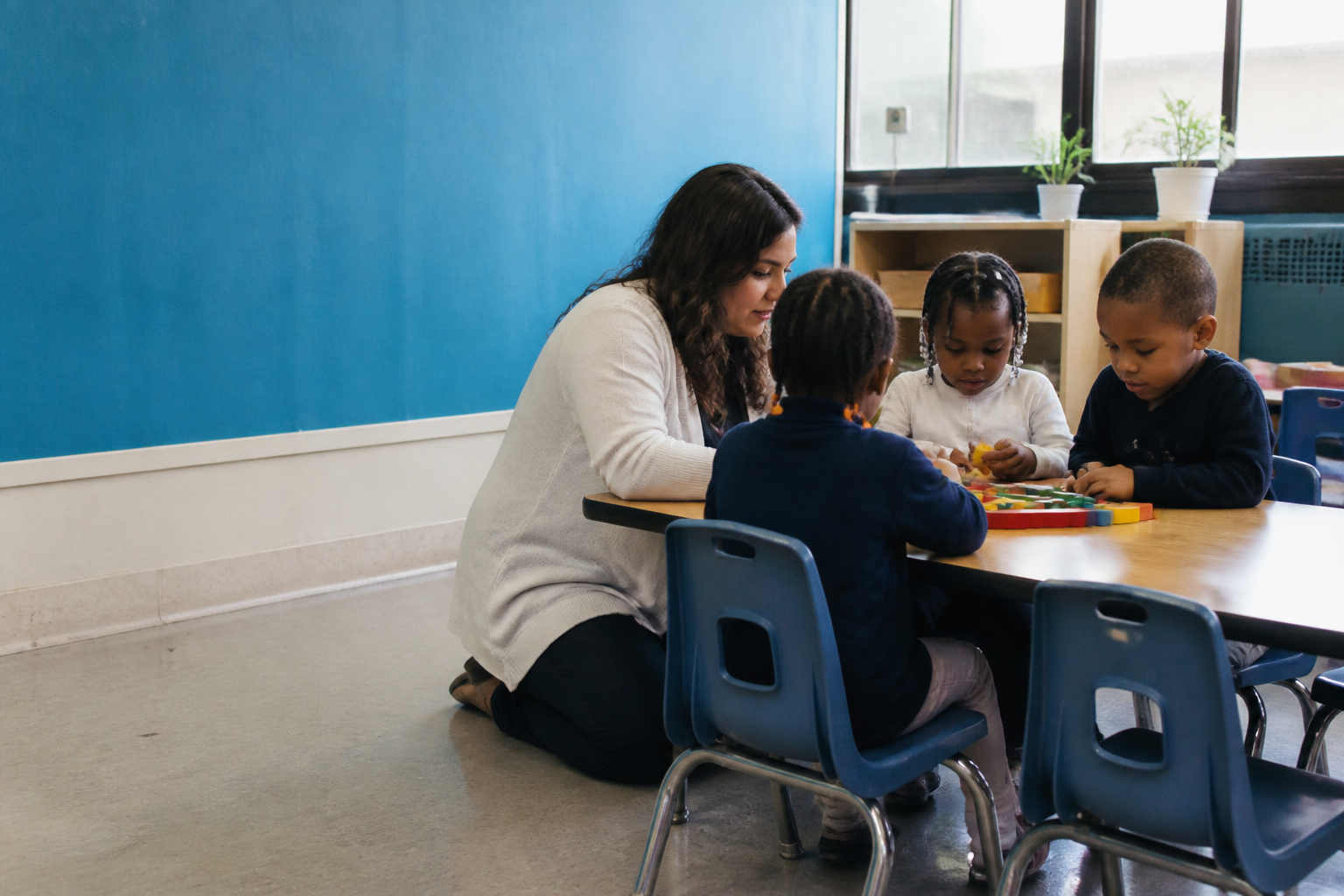
A bachelor's degree in early childhood education in New York leads toward teaching 3-K, pre-K and the early grades, and the state certifies those teachers by grade band, not by major title. The usual credential is the Bachelor of Science (B.S.) in Early Childhood Education, tied in most cases to the Birth to Grade 2 certificate.
Price varies sharply. CUNY Hunter College reports an average net price of $2,984 a year, while New York University's is $37,050. Online formats, GPA floors and state aid shift that math further.
Every route ends at the same gate: state certification exams and supervised student teaching come before an Initial Certificate that is valid for five years.
Key Points
- CUNY's Hunter, Brooklyn and City College report net prices under $4,000.
- New York's initial Birth to Grade 2 certificate lasts five years.
- Kindergarten teachers earn a $62,680 national median versus $38,140 for preschool.
Best Early Childhood Education Schools in New York: Our Top 10
Every school in this top 10 awards a bachelor's degree in early childhood education, and each card lists the delivery format, in-state tuition, average net price and graduation rate so you can compare them side by side. Net price is a sector-based average after aid rather than a quote for one program, and each graduation rate describes the whole institution, so schools offering this program graduate that share of their students overall, not just in education. The CUNY campuses set the low end on price, while the SUNY, private and independent options that follow compete on fieldwork, dual certification and licensure support.
CUNY Brooklyn College
#1Brooklyn, NY · under $5,000/yr (est.)
Best for: Brooklyn residents seeking local public-university value
Brooklyn College pairs a public-university price with one of the more structured early childhood pathways in the City University system. Its Bachelor of Arts in Early Childhood Education Teacher (Birth to Grade 2) combines a 30-credit liberal arts concentration, 20 concentration options and a 14-week full-time student teaching placement, and adds literacy work through Jumpstart and Reading Rescue in neighborhood preschools and schools. Admission to the major requires 40 liberal arts credits and a 2.80 GPA, and candidates must pass the Educating All Students exam and the Content Specialty Test before student teaching. Graduates leave with New York State initial certification for birth through grade 2.
- 20 concentration options within the liberal arts core
- 30-credit liberal arts and sciences concentration
- 2.80 GPA and 40 liberal arts credits required for major admission
- 14-week full-time supervised student teaching
- 3.00 GPA required to enter student teaching
- Educating All Students and CST Multi-Subject Early Childhood exams required
- Fingerprint clearance through the New York City Department of Education
- Leads to New York State initial certification, birth through grade 2
CUNY Hunter College
#2New York, NY · ~$3,000/yr (est.)
Best for: NYC public school aspirants wanting city fieldwork
Hunter College runs a 39-credit early childhood major that students complete in four to six semesters, with fieldwork threaded through New York City public schools. Field experiences cover three age bands (birth to four, kindergarten, and first or second grade), and student teaching runs five full days a week for a full semester at a partner school. The degree leads to New York State initial certification in Early Childhood Education, Birth through Grade 2, and the initial certificate is valid for five years. Education students also take part in a Youth Educator Program that brings city high schoolers into early college teaching coursework.
- 39 credit hours, completed over four to six semesters
- Fieldwork covers birth to four, kindergarten, and grades 1 or 2
- Student teaching five full days a week for one semester
- Educating All Students and CST Multi-Subject Birth-Grade 2 exams before student teaching
- Leads to New York State initial certification, Birth-Grade 2
- Initial certificate is valid for five years
- Student teaching applications due April 1 for fall, November 1 for spring
CUNY City College
#3New York, NY · ~$3,800/yr (est.)
Best for: Community college graduates with a mapped transfer path
City College offers a Bachelor of Science in Early Childhood Education that leads to New York State initial certification for birth through grade 2 and holds CAEP accreditation. Classes run through the Center for Worker Education at 25 Broadway, and the curriculum is built around the needs of children from diverse socio-cultural backgrounds in urban schools. BMCC's published articulation agreements give its Childcare and Early Childhood Education associate degree holders a defined transfer route into the bachelor's program. Graduates move into childcare, Head Start, 3K and PreK, and kindergarten through second grade classrooms.
- CAEP accredited through the School of Education
- Leads to New York State Initial Teacher Certification, birth through grade 2
- Classes held at the Center for Worker Education, 25 Broadway
- Coursework focuses on diversity in urban school settings
- Structured transfer route from BMCC's early childhood associate degree
- Admissions workshops open to prospective students
- Prepares graduates for childcare, Head Start, 3K and PreK, and K-2 roles
St. Joseph's University-New York
#4Brooklyn, NY · ~$19,000/yr (est.)
St. Joseph's University in Brooklyn awards a Bachelor of Arts in Child Study with four certification tracks: early childhood, childhood, and students with disabilities at either level. Every student pairs the major with a 30-credit concentration outside Child Study, and the Dillon Child Study Center on campus serves as a laboratory school for supervised work with young children. The program is CAEP accredited, requires a 2.8 average in the major, and asks transfer students to complete at least 15 Child Study credits at St. Joseph's. Certification candidates also complete the mandated reporter, DASA and school violence workshops alongside the state exams.
- 30-credit concentration required in a field outside Child Study
- Four certification tracks, including students with disabilities
- 2.8 average in the major required
- Dillon Child Study Center serves as the campus laboratory school
- CAEP accredited
- Transfer students complete at least 15 Child Study credits at St. Joseph's
- Mandated Reporter, DASA and school violence workshops required
- e-portfolio required for completion
State University of New York at New Paltz
#5New Paltz, NY · ~$19,000/yr (est.)
New Paltz offers a four-year Bachelor of Science in Early Childhood and Childhood Education that leads to dual certification, birth through grade 2 and grades 1 through 6, so graduates are eligible for both preschool and elementary classrooms. Students choose a 29- to 36-credit liberal arts concentration from 11 options, complete three fieldwork placements and finish with a capstone student teaching semester split across two settings. Entry to the major requires a 3.0 overall GPA and a B- or better in the required education courses, and placements are arranged within an hour of campus. The department also runs the program on a part-time basis for students balancing work and study.
- Dual certification, birth through grade 2 and grades 1 through 6
- 29-36 credit liberal arts concentration with 11 options
- 3.0 overall GPA and 2.5 in the concentration
- B- or better in required education courses
- Three fieldwork placements before student teaching
- Capstone student teaching semester split across two settings
- Field sites arranged within one hour of campus
- Full-time and part-time study available
New York University
#6New York, NY · ~$37,000/yr (est.)
NYU's Bachelor of Science in Early Childhood Education and Early Childhood Special Education prepares students for dual New York State initial certification in early childhood and early childhood special education, birth through grade 2. The program is full-time and field-based across 128 to 134 credits, with placements in both general and special education settings and a liberal arts core in history, literature, science and mathematics. Qualified seniors can pursue guided research, and students may spend time in London or Accra with weekly school observations. Admission is selective and the program begins in the fall, with Early Decision 1 in November and Regular Decision in January.
- Dual certification in early childhood and early childhood special education
- 128-134 credits, full-time and field-based
- Fieldwork in general and special education early childhood settings
- Study abroad in London or Accra with weekly school observations
- Guided research available to qualified seniors
- Fall start; Early Decision 1 November 1, Regular Decision January 5
- Liberal arts core in history, literature, science and mathematics
State University of New York at Cortland
#7Cortland, NY · $20,000 – $25,000/yr (est.)
Cortland's teacher education program is among the largest in New York, and its early childhood offerings split into a birth through grade 6 dual certification track and an inclusive birth through grade 2 track that pairs early childhood with special education. Both require 100 or more hours of clinical work before a full student teaching semester, with placements in urban, suburban and rural districts and an option to student teach in Australia. Concentration choices include English language arts, mathematics, environmental studies, urban studies and interdisciplinary studies, and the programs are CAEP accredited. Department scholarships support students through the senior year and the student teaching semester.
- 124 credit hours with dual certification, birth through grade 6
- 7 concentration options, including English language arts and mathematics
- 100 or more clinical hours before student teaching
- Student teaching in urban, suburban and rural districts
- Option to student teach at the University of the Sunshine Coast in Australia
- CAEP accredited
- Department scholarships, including one for excellence in student teaching
- 126 credit hours with dual certification in special education
- Placements with families of children with disabilities
- Student teaching in urban, suburban or rural settings, plus Australia and New York City
- C.U.R.E. urban recruitment program for city placements
- Kappa Delta Pi honor society chapter
- Inclusive Special Education Award available
Monroe University
#8Bronx, NY · $15,000/yr (est. net price)
Monroe University, based in the Bronx, offers a Bachelor of Science in Early Childhood Education for children from birth to grade 2, with guided fieldwork in local classrooms every semester rather than one block at the end. The initial degree is CAEP accredited and graduates earn New York State initial certification, and faculty work one on one with students on the cognitive, cultural, developmental and linguistic needs of young learners. Qualified students can apply for institutional scholarships, and the School of Education belongs to AACTE, NYACTE and ASCD.
- CAEP accredited initial certification program
- Prepares for New York State initial certification, birth through grade 2
- Guided fieldwork in local classrooms every semester
- Faculty serve as one-on-one teacher coaches
- Scholarships available to qualified students
- School of Education holds AACTE, NYACTE and ASCD membership
Mercy University
#9Dobbs Ferry, NY · ~$14,000/yr (est.)
Mercy University's Bachelor of Science in Early Childhood and Childhood Education adds a STEM concentration, building content and pedagogy in computer science, engineering and educational technology with microteaching across those fields. The 120-credit degree leads to initial certification in both early childhood (birth through grade 2) and childhood (grades 1 through 6), and it is taught at the Bronx, Manhattan and Westchester campuses as well as fully online. Applications are reviewed on a rolling basis, and the online route makes this one of the more flexible certification paths on the list. Students can also pair the major with a psychology minor.
- 120 credit hours
- Initial certification in early childhood (B-2) and childhood (1-6)
- STEM concentration in computer science, engineering and educational technology
- Microteaching across the STEM fields
- Aligned to New York State science, math and digital literacy standards
- Taught in the Bronx, Manhattan, Westchester and fully online
- Rolling admissions
- Can be paired with a psychology minor
Daemen University
#10Amherst, NY · ~$19,000/yr (est.)
Daemen University, outside Buffalo in Amherst, offers a bachelor's degree in Early Childhood and Special Education for birth through grade 2, with field experience starting early through partnerships with local public, private and charter schools. Classes are small, students work with SMART Boards, iPads and the Center for Interprofessional Learning and Simulation, and the education department reports a combined pass rate consistently above 90 percent on the New York State Teacher Certification Examinations. Graduates are hired by districts including Buffalo Public Schools, Williamsville and Clarence, and the educator preparation programs hold continuous accreditation for state requirements while pursuing AAQEP.
- Field experience begins early through local partner schools
- Small class sizes
- Instructional technology including SMART Boards and iPads
- Center for Interprofessional Learning and Simulation on campus
- Department reports a combined NYSTCE pass rate consistently above 90 percent
- Graduates hired by Buffalo Public Schools and suburban districts
- Continuously accredited for New York State requirements; pursuing AAQEP
Cost & outcomes by school
Federal data for the highest-earning Early Childhood Education programs, independent of the ranking above. Earnings are this field's bachelor's graduates four years after completing where the Scorecard reports them, else the school's undergraduate median.
| School | Net price / yr | Grad rate | Earnings | Debt | Grads/yr | Format |
|---|---|---|---|---|---|---|
| Siena University NY | $33,733 | 75% | $76,079 | $26,561 | 7 | Campus |
| CUNY Hunter College NY | $2,984 | 57% | $73,857 | $13,920 | 41 | Campus |
| Monroe University NY | $14,522 | 57% | $73,537 | $24,250 | 13 | Campus |
| Yeshiva University NY | $49,965 | 83% | $71,353 | $18,250 | 7 | Campus |
| Pace University NY | $30,892 | 60% | $70,378 | $23,250 | 48 | Campus |
| Hofstra University NY | $34,176 | 69% | $67,847 | $23,250 | 34 | Campus |
| New York University NY | $37,050 | 88% | $64,640 | $18,000 | 34 | Campus |
| St. Joseph's University-New York NY | $19,035 | 69% | $63,905 | $22,000 | 7 | Campus |
| Utica University NY | $19,108 | 56% | $63,277 | $23,250 | 16 | Campus |
| State University of New York at Cortland NY | $22,345 | 68% | $62,275 | $21,794 | 172 | Campus |
| Daemen University NY | $18,693 | 59% | $61,808 | $22,091 | 7 | Campus |
| CUNY Brooklyn College NY | $3,103 | 54% | $58,828 | $10,315 | 142 | Campus |
Sources: U.S. Department of Education. Net price, graduation rate, earnings and debt: College Scorecard (earnings and debt for this field's bachelor's graduates where reported, else school-wide); graduates: IPEDS. A dash means no figure is reported.
Cost, debt & payoff
Median earnings of this field's bachelor's graduates (4 yrs after completing, else the school's undergraduate median) vs. their median federal loan debt · U.S. College Scorecard
Across these programs the median graduate earns about $58,828 and finishes with roughly $21,794 in debt — a ratio that clears a common rule of thumb (keep debt below first-year salary). Net price and debt vary widely school to school, so check the per-school figures in the table above before you shortlist.
Most Affordable Bachelor's in Early Childhood Education Schools in New York
The lowest-cost options are the three CUNY colleges: Hunter, Brooklyn and City College each report an average annual net price under $4,000 and median graduate debt near $11,000 to $12,000, while SUNY Buffalo State University and the online program at Empire State University (both in our directory) land above $11,000 in net price with higher typical debt. Figures come from the U.S. Department of Education's IPEDS and College Scorecard 2024 data, and the debt figure covers all of a school's graduates rather than early childhood education majors alone. Net price is an average after grants and scholarships, so your own cost will move up or down depending on your family income, state aid such as New York's Tuition Assistance Program, and any institutional awards.
| School | City | Format | In-State Tuition and Fees | Average Net Price (per year) | Median Debt at Graduation |
|---|---|---|---|---|---|
| CUNY Hunter College | New York | Campus | $7,382 | $2,984 | $11,000 |
| CUNY Brooklyn College | Brooklyn | Campus | $7,452 | $3,103 | $11,000 |
| CUNY City College | New York | Campus | $7,340 | $3,776 | $11,990 |
| SUNY Buffalo State University | Buffalo | Campus | $8,533 | $11,346 | $21,028 |
| Empire State University | Saratoga Springs | Online | $7,648 | $11,676 | $18,730 |
Online and Hybrid Bachelor's in Early Childhood Education at New York Schools
In an online bachelor's degree in early childhood education at a New York school, coursework, readings, and assignments happen remotely. The supervised classroom work that New York certification depends on still happens in a real New York classroom, on a school calendar. Understanding that split before you enroll matters more than the percentage of courses listed as online.
Which New York schools offer remote formats
- Mercy University: the early childhood and childhood education program carries an initial certification path for birth through grade 2 and grades 1 through 6, with a fully online option alongside its Bronx, Manhattan, and Westchester sections.
- SUNY Empire State University: the B.S. in Early Childhood Education, Birth through Grade 2 is listed as 100% online and leads to New York State B-2 Initial Certification.
- SUNY Fredonia: its childhood and early childhood/childhood B.S. programs are listed as 50% online for 2026-2027, at 120 credits each.
- Campus-based options: the CUNY campuses on this list (Brooklyn, Hunter, City College), the SUNY campuses (Cortland, New Paltz), and most of the private universities here, including NYU, St. Joseph's, Monroe, and Daemen, list their early childhood programs as campus-based.
What the online format does not skip
Empire's certification track shows how the clinical side works. Observation courses each require 50 hours during regular school hours in a New York State public school district, when you are not on work duty. After admission, you locate a nearby classroom yourself, then coordinate with faculty and the university's clinical and licensure office; a workplace site is sometimes accepted if it meets state expectations. The clinical sequence runs at least four semesters regardless of how many credits you transfer, starts in fall or spring only, and ends with student teaching split between prekindergarten or kindergarten and grades 1 and 2.
Confirm the track, not just the format
Empire also offers an online early childhood studies degree that is explicitly not teacher certification: no observation or student teaching, and no alternate route to a license. Check that the program you apply to is the certification track before you commit.
Admission Requirements for New York Early Childhood Education Bachelor's Programs
Admissions trade selectivity against access: some schools set a firm GPA floor, while others publish almost nothing. Check each school's own admissions page before you apply.
GPA and Test Policies
Published minimums vary. Monroe University lists a 2.75 GPA and an 80 high school average, then asks for a 3.0 to progress in the program. State University of New York at New Paltz lists a 3.0 minimum, and St. Joseph's University-New York lists 2.8. City College's published figures conflict. Its sources show both 2.8 and 3.0, and it also requires the SEAT exam (passing score 57, three attempts), so confirm the current figure with the school.2
On testing, SUNY has suspended SAT and ACT requirements for its bachelor's-degree campuses.1 Scores are considered only if you choose to send them and the college agrees. Monroe, City College, and New York University publish no test policy on the pages we reviewed. Empire State University publishes neither an admission GPA nor a test policy. NYU also states no minimum GPA for admission.3
Which Schools Are More Selective
NYU is the clear outlier, admitting about 9 percent of applicants. The rest are far more open: CUNY Hunter College admits roughly 54 percent, CUNY City College 60 percent, New Paltz 62 percent, Monroe 68 percent, Daemen University 68 percent, St. Joseph's 72 percent, and Mercy University 86 percent.
Transfer Credit
SUNY campuses accept coursework from other SUNY campuses, and the SUNY early childhood transfer path is built for that move.4 Empire State's total degree credits (60 to 120) shift with the credit you bring. Monroe publishes no maximum for transferable credits. St. Joseph's asks transfer students for 15 Child Study credits.
The transfer route rewards planning. If you start at a community college, finish the early childhood transfer path and keep every grade at C or better.4 Then ask the receiving campus for a course-by-course credit evaluation before you commit. Guaranteed CUNY admission for community college students does not guarantee a spot at a particular college or in a particular major. Teacher education programs often have their own entry rules on top of general admission.
Cost of a Bachelor's Degree in Early Childhood Education in New York
What will a bachelor's degree in early childhood education in New York actually cost after aid? At the public CUNY schools, the answer is far less than the sticker price suggests.
Tuition vs. Net Price
In-state tuition and fees run about $7,382 at CUNY Hunter College, $7,452 at CUNY Brooklyn College and $7,340 at CUNY City College. Average net price after aid is lower still: $2,984 at Hunter, $3,103 at Brooklyn and $3,776 at City College. Private options sit higher. Mercy University lists $22,880 in tuition and an average net price of $14,072, while Monroe University lists $18,464 against a $14,522 net price. Net price is an average, so your own figure depends on income and aid.
New York State Aid
The Tuition Assistance Program (TAP) is a grant, not a loan, worth up to $5,665 a year for 2026-27.1 You need 12 months of New York residency, enrollment of at least 12 credits per semester, and income within the limits: $125,000 for dependent students, $60,000 for independent married students without dependents, and $30,000 for independent single students.2
The Excelsior Scholarship covers remaining SUNY and CUNY tuition after TAP and other grants. The household cap is $125,000.3 You must study full-time, complete 30 credits a year, and stay on track for a four-year degree. After graduating, you must live in New York for as many years as you received the award, and employment must be in-state. Leaving early can turn the award into a no-interest loan. Private schools such as Mercy and Monroe are not covered.
Teacher-Specific Help
None of these benefits is limited to early childhood majors. Federal Teacher Loan Forgiveness can cancel up to $17,500 after five years in a qualifying low-income school.4 The TEACH Grant requires four years of teaching within eight years of finishing.5 The state Teacher Loan Forgiveness Program ($5,000 a year, $20,000 lifetime) is currently not accepting applications.6 The Educational Incentive Program lists awards of $2,500 for eligible child care professionals.7
A Stacking Tip
File the FAFSA and TAP application together. Excelsior pays what is left after TAP, so one filing can close most of a CUNY tuition gap. Then keep 30 credits a year, including summer or winter terms, to protect the award.
Questions to Ask Yourself
Are you willing to live and work in New York after graduation?
Does your family income fall within the TAP or Excelsior limits, and have you filed on time?
Would a SUNY or CUNY route leave you with less debt than a private school's aid package?
Related Articles
Birth–Grade 2 vs. Grades 1–6: New York Certification Pathways and NYSTCE Exams
The grade band on your certificate matters more than the major title on your diploma, because New York licenses teachers by the grades they are prepared to teach.
Early Childhood vs. Childhood
The Early Childhood certificate covers Birth through Grade 2: pre-K, kindergarten, and the first two grades.1 It suits students who want to work with the youngest learners. The Childhood certificate covers Grades 1 through 6 and fits those drawn to the upper elementary years. Several schools here bundle the two, including Hofstra University, SUNY Cortland, and Siena University; a dual grade band can widen your job options.
Required Exams
For the Early Childhood initial certificate, candidates take two NYSTCE exams:2
- Educating All Students (EAS): The state's exam on teaching diverse learners.
- Multi-Subject: Early Childhood B, Grade 2 CST: Three parts (Arts and Sciences, Literacy, Mathematics), each with a passing score of 520.
A separate Students with Disabilities CST is not required unless you also pursue that certificate or a combined special education program.3 The edTPA is no longer required, since the Regents voted to drop it in 2022. Registered programs now build their own performance assessment into clinical work, so the format varies by school.
Fingerprinting, Workshops, and Progression
Fingerprint clearance is mandatory.4 Procedures and fees are not set out in the state's certification materials, and school placements may add local checks, so confirm the steps with your program. You also need four workshops from a New York State-approved provider: Child Abuse Identification and Reporting, School Violence Prevention and Intervention (SAVE), the Dignity for All Students Act (DASA), and the Needs of Children with Autism.5
The initial certificate is your entry-level license. A professional certificate comes later, after you have teaching experience and meet further state requirements, so check current NYSED rules before planning that step.
What Your Bachelor's Program Must Include
Your bachelor's program must be NYSED-registered.1 Expect at least 100 clock hours of fieldwork, 15 of them focused on students with disabilities, plus 50 clinical hours.6 Student teaching means either two placements of at least 20 school days each or one placement of at least 40 days, in pre-K through Grade 2 settings.6 The state also expects six semester hours of early childhood coursework.1
New York Early Childhood Teacher Certification at a Glance
Early Childhood Teacher Salary and Job Outlook in New York
The most recent federal figures put the national median at $38,140 for preschool teachers and $62,680 for kindergarten teachers. New York State employs about 23,870 preschool teachers, but state and metro medians for these roles have not been published. Read these occupation wages separately from the program-level graduate earnings shown earlier, which come from a different dataset. Pay in New York generally depends on setting: certified teachers in public school kindergarten and district Universal Pre-K classrooms tend to earn more than staff in private centers or Head Start, and since 2019, New York City's limited pay parity has raised starting wages for licensed 3-K and Pre-K teachers in DOE-contracted programs toward DOE classroom levels. Nationally, BLS projects preschool teacher jobs to grow 4% from 2025 to 2035, with about 66,700 openings a year, while kindergarten and elementary roles show little or no growth but still about 99,400 openings a year from retirements and turnover.
| Area | Occupation | Median Annual Wage | Employment |
|---|---|---|---|
| United States | Preschool Teachers (except special education) | $38,140 | N/A |
| United States | Kindergarten Teachers (except special education) | $62,680 | N/A |
| New York State | Preschool Teachers (except special education) | N/A | 23,870 |
| New York-Newark-Jersey City metro (includes parts of NJ) | Preschool Teachers (except special education) | N/A | 28,140 |
Compare Early Childhood Education programs on the data that matters
Explore more Education & Teaching majors or browse every field of study.
All Education & Teaching programs Browse every field of study