Best Early Childhood Education Schools in Wisconsin
Compare 11 accredited Early Childhood Education programs in Wisconsin at 9 colleges, with net price after aid, graduation rates, earnings and debt from IPEDS and the U.S. College Scorecard.

In Wisconsin, the teaching license, not the degree title, determines which early childhood jobs a graduate can take. A bachelor's degree in early childhood education, most often a Bachelor of Science (B.S.) in Early Childhood Education, only leads to a Department of Public Instruction birth-to-grade-three license if the program is approved for it.
Every program here is a campus or online bachelor's program. In-state tuition runs from $8,270 at UW-Parkside to $35,470 at Concordia University-Wisconsin.
That gap matters because preschool teachers earned a median of $38,140 in May 2025, while elementary teachers earned $61,210.
Key Points
- UW-Parkside has the lowest in-state tuition and net price here.
- UW-River Falls, UW-Stout and Concordia University-Wisconsin offer online early childhood formats.
- Wisconsin preschool teachers earned $38,140 median; elementary teachers, $61,210 (May 2025).
Best Early Childhood Education Schools in Wisconsin at a Glance
Nine Wisconsin institutions appear here, and they fall into three rough groups: campus programs that lead to a Wisconsin teaching license, online completion degrees built for people who already hold an associate degree or a child care credential, and private university options. Each card lists the program name, city, delivery format, in-state tuition, net price after aid, and the university's overall graduation rate. Net price is a sector average after grant and scholarship aid, so treat it as an approximate guide rather than a quote.
University of Wisconsin-Madison
#1Madison, WI · ~$17,000/yr (est.)
Best for: Future child life specialists
Wisconsin's flagship campus runs its early childhood path through the School of Human Ecology rather than a stand-alone teaching major: a Bachelor of Science in Human Development and Family Studies with a Child Development named option. The 120-credit degree requires a semester-long internship (150 hours for 3 credits) and a capstone, and students can add credentials in family life education, infant and early childhood mental health, or child life. Entry to the major needs a 2.750 cumulative GPA for students within their first 60 credits, and the program starts in fall and spring but not summer. The university as a whole graduates about 90 percent of its students.
- 120 credits over four years with a child development named option
- Semester-long internship: 150 hours earns 3 credits
- 2.750 cumulative GPA required within the first 60 credits
- Capstone required; fall and spring starts only
- Credentials in family life education and infant/early childhood mental health
- Certified Child Life Specialist credential pathway
University of Wisconsin-Whitewater
#2Whitewater, WI · $10,000 – $15,000/yr (est.)
Best for: Dual-licensure seekers in general and special education
UW-Whitewater runs one of the clearer licensure tracks in the state: a cohort-based Bachelor of Science in Education in Early Childhood/Early Childhood Special Education that awards dual licensure for children from birth through age 8. Admission to professional education is selective, requiring 30 completed credits, a 2.75 GPA, and standing among the top 30 applicants by GPA. The same university also runs a fully online Early Child Care and Education bachelor's for people who already hold an associate degree or a Wisconsin Registry credential, which leads to Registry credentials rather than a teaching license. About 59 percent of students at the university graduate.
- Dual licensure in early childhood and early childhood special education
- NAEYC-accredited program with a cohort-based four-year plan
- Birth through age 8 focus; leads to a Wisconsin DPI license
- Professional education admission: 30 credits, 2.75 GPA, top 30 by GPA
- Three pre-professional skills tests required for admission
- Clinical placements span the first five semesters
- Student teaching abroad options available
- Fully online, 120 credits, $424 per credit for residents
- Non-license degree; requires an AAS in early childhood education
- Stack credential-based credits, including one Wisconsin Registry credential
- Textbook rental included in tuition; part-time option available
- Leadership concentration within a five-concentration online degree
- No campus visits required; 120 total credit hours
- Nonresident tuition $845.68 per credit
- Leads to Wisconsin Registry Credentials
- Textbook rental included; financial aid and scholarships available
Maranatha Baptist University
#3Watertown, WI · ~$26,000/yr (est.)
Best for: Christian educators seeking biblical worldview training
Maranatha Baptist University is a small private Baptist school in Watertown where the early childhood major sits alongside Bible and doctrine coursework, and teaching content is delivered from a biblical worldview. The four-year plan opens with freshman fieldwork and builds through curriculum and methods courses in reading, math, art, and music, plus administration of early childhood programs, ending with 12 credits of student teaching. Listed career paths include preschool teacher, early childhood program supervisor, elementary teacher, and mission field teacher. The university graduates about 64 percent of its students.
- Four-year suggested schedule that opens with freshman fieldwork
- Methods coursework in reading, math, art, and music
- Course in administration of early childhood programs
- Diagnosis and treatment of reading disabilities
- 12 credits of student teaching in the final semester
- Bible and doctrine courses run alongside education coursework
- Dual degree options available
University of Wisconsin-River Falls
#4River Falls, WI · $10,000 – $15,000/yr (est.)
UW-River Falls delivers its early childhood bachelor's as a fully online degree completion program, designed for people who already hold an associate degree in early childhood education or child development. Students need a 2.5 GPA for the degree and 2.75 for the optional birth-to-age-8 teaching certification, and field experience hours can be completed near home or work. There are three start dates a year, part-time enrollment is allowed, and the program is approved by the Wisconsin Department of Public Instruction. The university graduates about 57 percent of its students.
- Fully online degree completion, full-time or part-time
- Requires an associate degree in early childhood education or equivalent
- 2.5 GPA to enter; 2.75 for the teaching certification track
- Optional Wisconsin certification covering birth through age 8
- Three start dates a year with July, December, and April deadlines
- Field experience hours completed near home or work
- T.E.A.C.H. Wisconsin scholarship for child care staff
University of Wisconsin-Stout
#5Menomonie, WI · $17,000/yr (est. net price)
UW-Stout's early childhood education bachelor's is completed entirely online and leads to Wisconsin licensure for birth through third grade, with eligibility for dual licensure in regular and special education. Entry requires an associate degree, a bachelor's degree, or substantial transfer credit plus a 2.75 GPA from the last institution attended, and lower GPAs are reviewed case by case. Tuition is a flat customized-instruction rate that includes the textbook rental fee, carries no added semester or technology fees, and costs the same regardless of state of residence. The university graduates about 55 percent of its students.
- Fully online; leads to a Wisconsin license for birth through grade 3
- Dual licensure eligible: DPI #1777 and DPI #1809
- Requires an associate degree, a bachelor's, or significant transfer credit
- 2.75 GPA from the last institution; lower GPAs reviewed case by case
- Flat customized-instruction tuition includes textbook rental
- Credit for prior learning by testing, portfolio, or competency demonstration
- Student teaching in child care facilities and districts near you
University of Wisconsin-Stevens Point
#6Stevens Point, WI · $15,000/yr (est. net price)
UW-Stevens Point offers its early childhood education major in person with mixed-modality coursework, and the School of Education publishes a program coordinator and undergraduate advising contacts for students in the major. Program requirements are documented in the university catalog rather than on a dedicated program page, so applicants should plan to review the catalog entry and speak with an advisor early. The university graduates about 51 percent of its students.
- Bachelor of Science with program code ECE-BS
- In-person and mixed-modality delivery
- Program coordinator and undergraduate advising contacts listed
- Requirements published through the university catalog
University of Wisconsin-Parkside
#7Kenosha, WI · ~$12,000/yr (est.)
UW-Parkside admits students to its early childhood education bachelor's through an articulation agreement with the Wisconsin Technical College System, so students first finish an Associate of Applied Sciences in early childhood education and then complete the bachelor's in Kenosha. The program ends with a semester-long, full-time, school-based residency in a co-teaching model with a mentor teacher and a university supervisor. Delivery is in person, a background check is required, and graduates qualify as classroom teachers for children from birth to grade 3. The university graduates about 40 percent of its students.
- Bachelor of Science leading to a Wisconsin birth through grade 3 license
- Articulation agreement with the Wisconsin Technical College System
- Requires an AAS in early childhood education before entry
- Semester-long, full-time, school-based residency
- Co-teaching model with a mentor teacher and university supervisor
- Background check required for admission
- Methods coursework in literacy, math, science, and social studies
Concordia University-Wisconsin
#8Mequon, WI · ~$36,000/yr (est.)
Concordia University Wisconsin is a Lutheran-affiliated private university in Mequon that offers a Bachelor of Arts in Early Childhood Education leading to a Wisconsin license for birth through grade three, completed fully online. Courses run in 8-week sessions, some classes meet live over Zoom on a set weeknight with the professor, and student teaching happens in the final semester in a school or licensed early childhood facility. Up to 84 credits transfer with program director approval, ACT and SAT scores are not required, and there are start dates in all three trimesters. The university graduates about 68 percent of its students.
- Fully online; leads to a Wisconsin birth through grade 3 license
- $450 per credit; 120 total credit hours
- 8-week sessions; select classes meet live over Zoom
- Pre-student teaching is a 30-hour field experience
- Up to 84 transfer credits with program director approval
- ACT and SAT not required; essay needed if GPA is under 3.0
- Optional Lutheran Teacher Diploma
Marian University
#9Fond Du Lac, WI · $20,000 – $25,000/yr (est.)
Marian University is a private university in Fond du Lac whose Bachelor of Science in Early Childhood-Elementary Education prepares students for Wisconsin licensure to teach in birth through grade three classrooms. Classroom placements start as early as freshman year with mentor teachers in area schools, and coursework covers literacy instruction, math methods, children's literature, educational psychology, assessment, and inclusive teaching for diverse learners. The program is built around a Whole Child Education philosophy that spans academic growth, emotional development, creativity, communication, and social responsibility. The university graduates about 44 percent of its students.
- Prepares for Wisconsin DPI licensure, birth through grade 3
- Classroom placements begin as early as freshman year
- Mentor teachers in area schools
- Coursework in literacy and math methods, children's literature, assessment
- Inclusive teaching practices for diverse learners
- Built around a Whole Child Education philosophy
Cost & outcomes by school
Federal data for the highest-earning Early Childhood Education programs, independent of the ranking above. Earnings are this field's bachelor's graduates four years after completing where the Scorecard reports them, else the school's undergraduate median.
| School | Net price / yr | Grad rate | Earnings | Debt | Grads/yr | Format |
|---|---|---|---|---|---|---|
| Marian University WI | $21,937 | 44% | $53,501 | $25,000 | 10 | Campus |
| University of Wisconsin-Parkside WI | $11,772 | 40% | $51,129 | $20,492 | 25 | Campus |
| University of Wisconsin-Madison WI | $17,354 | 90% | $49,640 | $21,500 | 110 | Campus |
| University of Wisconsin-Stout WI | $17,490 | 55% | $47,256 | $24,260 | 28 | Online |
| University of Wisconsin-Whitewater WI | $14,158 | 59% | $46,637 | $26,613 | 152 | Campus |
| University of Wisconsin-River Falls WI | $14,054 | 57% | $46,004 | $22,828 | 47 | Online |
| Concordia University-Wisconsin WI | $36,201 | 68% | $45,665 | $26,000 | 55 | Online |
| Maranatha Baptist University WI | $26,005 | 64% | $45,593 | $14,143 | 14 | Campus |
| University of Wisconsin-Stevens Point WI | $14,559 | 51% | $45,181 | $22,500 | 143 | Hybrid |
Sources: U.S. Department of Education. Net price, graduation rate, earnings and debt: College Scorecard (earnings and debt for this field's bachelor's graduates where reported, else school-wide); graduates: IPEDS. A dash means no figure is reported.
Cost, debt & payoff
Median earnings of this field's bachelor's graduates (4 yrs after completing, else the school's undergraduate median) vs. their median federal loan debt · U.S. College Scorecard
Across these programs the median graduate earns about $46,637 and finishes with roughly $24,260 in debt — a ratio that clears a common rule of thumb (keep debt below first-year salary). Net price and debt vary widely school to school, so check the per-school figures in the table above before you shortlist.
How We Ranked Wisconsin Bachelor's Programs in Early Childhood Education
Some rankings reward reputation. This one weighs cost and outcomes: what the degree is likely to cost you, whether students finish, and what graduates tend to earn and owe afterward.
What the Ranking Considers
- Net price: The average yearly cost after grants and scholarships, which often differs sharply from a school's listed tuition.
- Graduation rate: How many students complete a bachelor's degree, a practical signal of student support and program stability.
- Format: Campus, online or hybrid delivery, so working adults and career changers can find a schedule that fits.
- Program-level earnings and debt: Where federal data report results for early childhood graduates specifically, those figures carry more weight than school-wide averages.
Licensure Tracks vs. Non-Licensure Tracks
Not every program here prepares you for a Wisconsin teaching license. Some are licensure tracks built toward the birth-to-grade-three credential, with student teaching and state testing requirements. Others focus on child development, family studies or child care leadership without leading to a classroom license. We note which path a program follows separately from its rank, because the right choice depends on whether you plan to teach in a public school.
Limits of the Data
Institution-wide figures, such as overall graduation rates, offer context but do not describe the early childhood program alone. Net price is an average, and your own cost will depend on income, residency and the aid you receive. Program-level earnings are not reported for every school. Treat the rank as a starting point, then confirm licensure status, costs and transfer policies directly with each school.
Cheapest Wisconsin Schools for an Early Childhood Education Bachelor's
The schools below are ordered by average net price, which is what students pay per year after grants and scholarships, according to 2024 federal IPEDS and College Scorecard data. UW-Parkside has the lowest in-state tuition and the lowest net price of the schools ranked here. Graduation rates vary widely, so weigh what a degree costs against how many students actually finish it.
| School | City | Program | Format | In-State Tuition and Fees | Average Net Price | Graduation Rate |
|---|---|---|---|---|---|---|
| University of Wisconsin-Parkside | Kenosha | Early Childhood Education Major (Birth-Grade 3) | Campus | $8,270 | $11,772 | 40% |
| University of Wisconsin-River Falls | River Falls | Early Childhood Degree Completion | Online | $9,008 | $14,054 | 57% |
| University of Wisconsin-Whitewater | Whitewater | Early Childhood/Early Childhood Special Education | Campus | $8,616 | $14,158 | 59% |
| University of Wisconsin-Stevens Point | Stevens Point | Early Childhood Education Major (BS) | Hybrid | $9,488 | $14,559 | 51% |
| University of Wisconsin-Madison | Madison | Human Development and Family Studies, BS (Child Development) | Campus | $11,603 | $17,354 | 90% |
Related Articles
Online and Hybrid Bachelor's Degree Options at Wisconsin Schools
Yes. Several Wisconsin schools offer their bachelor's degree in early childhood education online. University of Wisconsin-River Falls, University of Wisconsin-Stout and Concordia University-Wisconsin offer online formats. University of Wisconsin-Stevens Point lists in-person and mixed-modality delivery. The remaining schools, University of Wisconsin-Madison, University of Wisconsin-Whitewater, Maranatha Baptist University, University of Wisconsin-Parkside and Marian University, run on campus, so plan to attend in person.
Who Online Formats Suit
Online and degree-completion routes fit working adults, child care staff and students arriving with an associate degree or technical college credits. Each school handles that differently:
- River Falls: A degree-completion program with three start dates a year, full-time or part-time pacing, and prerequisite courses. Child care staff may qualify for the T.E.A.C.H. Wisconsin scholarship.
- Stout: A fully online B.S. that accepts credit for prior learning and lists dual licensure tracks.
- Concordia: Eight-week course sessions, rolling starts in fall, spring and summer, and up to 84 transfer credits plus up to 6 credits for prior learning.
- Stevens Point: A mixed-modality option, useful if you can attend some in-person components.
Placements Still Happen in Person
Online coursework does not remove the classroom requirement. If you are pursuing a Wisconsin teaching license, expect supervised field experience and student teaching in real schools. River Falls says field experiences can be arranged near your home or work, and Stout places student teachers in local districts. Concordia lists 30 clinical hours and student teaching in the final semester. Before you enroll, ask each program how placements are arranged where you live and whether your current job can count toward any hours. Then confirm that the track you choose leads to the license you want.
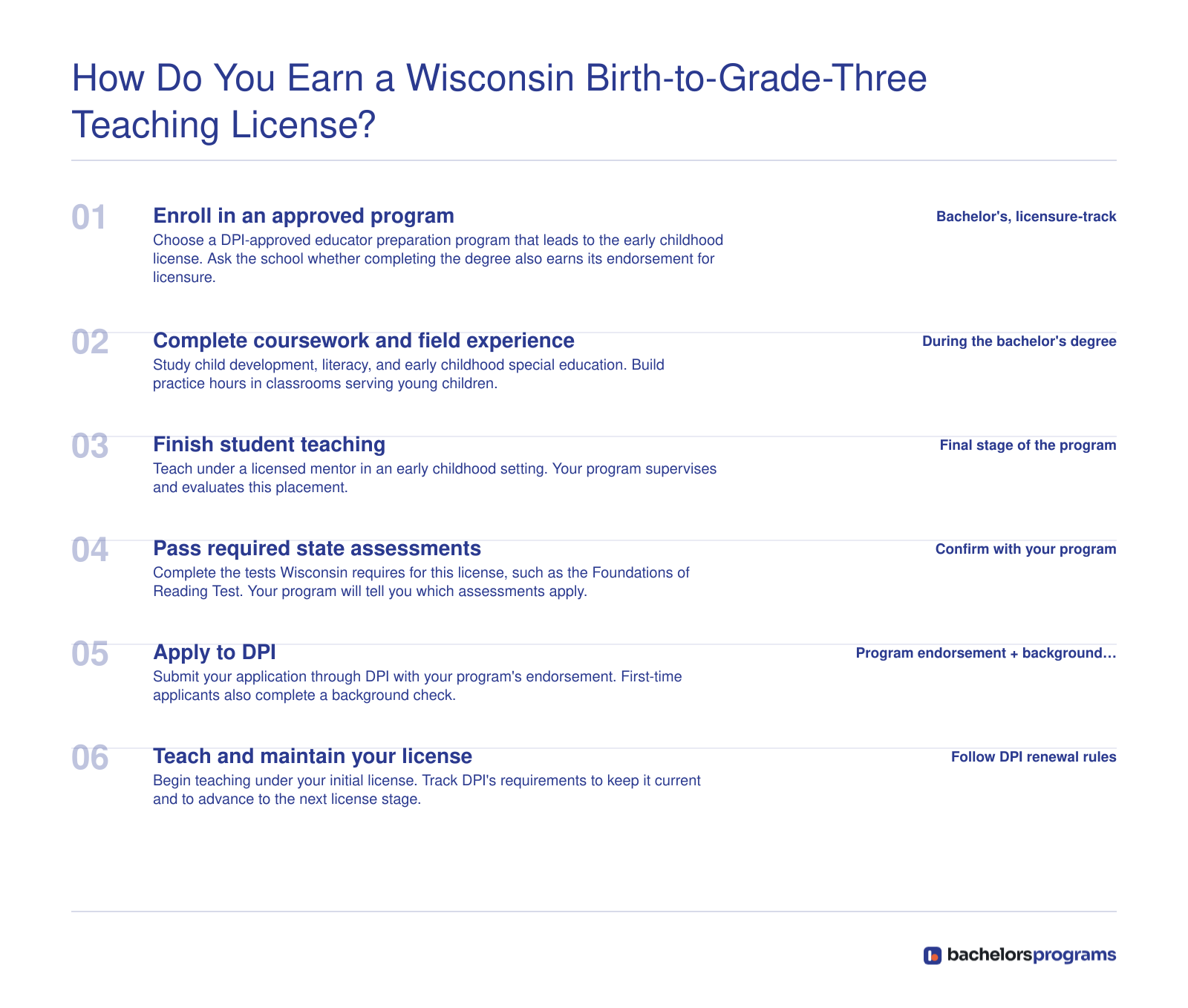
How Do You Earn a Wisconsin Birth-to-Grade-Three Teaching License?
Wisconsin licenses early childhood teachers through the Department of Public Instruction (DPI), and the route runs through an approved bachelor's program. Some early childhood bachelor's programs prepare graduates for classroom licensure and some do not, so confirm that yours is licensure-track before you enroll.
Early Childhood Careers and Salaries in Wisconsin
In Wisconsin, a bachelor's degree in early childhood education paired with a state teaching license opens the higher-paying classroom roles. Elementary teachers earned a median of $61,210 in May 2025, about $23,000 more than the $38,140 median for preschool teachers, according to the U.S. Bureau of Labor Statistics. Many child care and preschool jobs do not require a teaching license, which helps explain the gap. Program-level earnings from the federal College Scorecard, which follow a specific program's graduates for a set period after they finish, were not available for these programs at the time of writing, so the state wage figures below are the clearer guide.
| Occupation | Wisconsin Median Annual Wage | Employment | Job Outlook |
|---|---|---|---|
| Preschool Teachers | $38,140 (May 2025) | N/A | Steady openings expected across child care centers and school-based programs |
| Elementary School Teachers, Except Special Education | $61,210 (May 2025) | 24,920 jobs (May 2025) | Steady openings expected; requires a bachelor's degree and a Wisconsin teaching license |
Frequently Asked Questions About Early Childhood Education Degrees in Wisconsin
Transfer rules, licensure details and job eligibility change, so confirm them in writing before you commit. Use these steps to get answers directly from the schools and agencies that decide.
How do I find out which associate degree credits will transfer to a bachelor's program?
Which sources should I check to verify details myself?
What can I do with an early childhood degree that does not lead to a teaching license?
What exact search terms and questions should I use?
Compare Early Childhood Education programs on the data that matters
Explore more Education & Teaching majors or browse every field of study.
All Education & Teaching programs Browse every field of study